Proxy for Web Scraping: Why Residential IPs Matter

Proxy for web scraping is a practical topic, not a magic bypass trick. A proxy only helps when it matches the target website, request rhythm, data goal, and risk level. For business teams, residential IPs matter because many public websites evaluate more than the request itself. They look at network source, location consistency, session behavior, repetition, and whether the traffic looks like a normal user workflow.
For a general definition, see Wikipedia's web scraping overview. In IPIPD's product context, the useful question is narrower: when does a scraping workflow need dynamic residential proxies, when does it need static residential IPs, and when should a team avoid overcomplicating the setup?
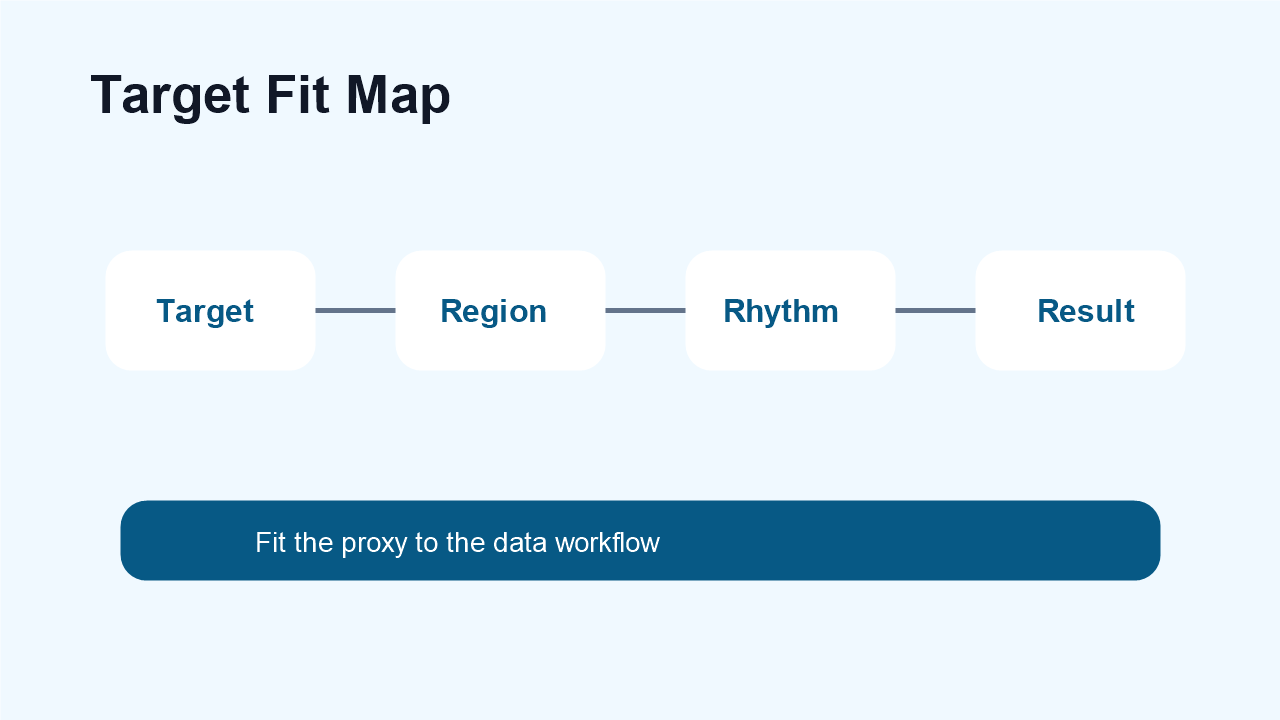
Public-page collection should consider target difficulty, region, and request rhythm together.Why residential IPs matter for scraping
Web scraping often fails because the traffic pattern does not match the target. A fast script from a data center range can be fine for low-risk public pages, but it may struggle when the target checks network origin, region, repeated access, or session continuity. Residential IPs are closer to ordinary access patterns because they come from residential networks, which can reduce obvious network-level mismatch.
That does not mean every scraper needs residential proxies. The right choice depends on target sensitivity, data value, request volume, and how much failure the team can tolerate. A small one-time check may not need much infrastructure. A recurring SEO, ecommerce, ad verification, or market research workflow usually needs a cleaner proxy plan.
Dynamic residential proxy or static residential IP?
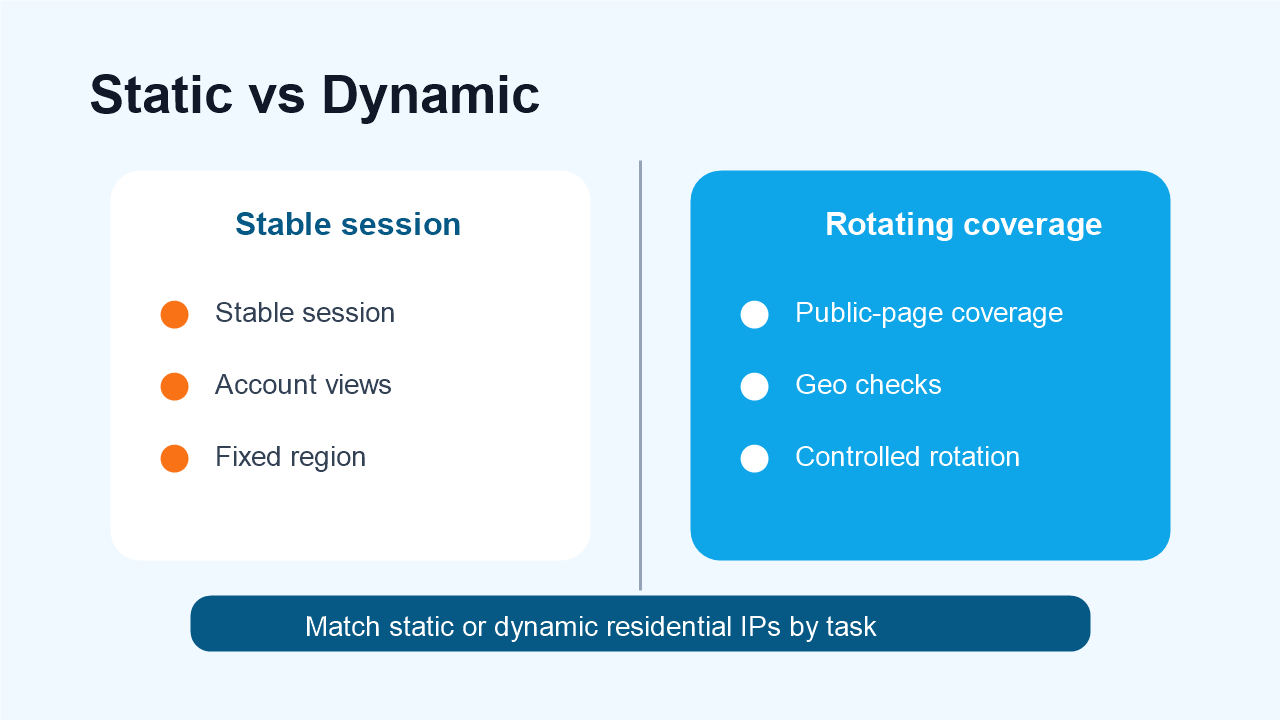
Static and dynamic residential proxies fit different scraping workflows.Dynamic residential proxies are usually better for public-page collection, regional checks, search result monitoring, competitor pages, and market research where the workflow benefits from controlled rotation. Static residential IPs are better when continuity matters, such as account-backed dashboards, logged-in views, browser profiles, or workflows where sudden IP changes can trigger verification.
A good scraping strategy often separates these jobs. Use dynamic residential proxies for broad public-page coverage. Use static residential IPs only where a stable identity is part of the workflow. This prevents a common mistake: forcing one proxy behavior to solve every task.
What to evaluate before choosing a scraping proxy
When choosing scraping proxies, success rate matters more than raw IP count.- Target difficulty: Is the target a simple public page or a site with heavy anti-bot checks?
- Location need: Does the data change by country, city, or language?
- Session behavior: Does the workflow need continuity or safe rotation?
- Request rhythm: Can the scraper slow down, retry, and avoid repetitive spikes?
- Data quality: Is a successful response actually complete and usable?
If these questions are not answered, proxy spending becomes guesswork. Before buying, define the target list, geography, acceptable failure rate, retry policy, and success metric. Then test on a small sample before scaling. IPIPD's pricing page is useful only after the workflow has been defined clearly.
How this topic should connect to IPIPD products
IPIPD currently should position scraping content around static residential addresses and dynamic residential addresses. It should not imply that every scraping API or browser automation product is available. The article should explain adjacent concepts, then guide readers back to the real product choices: stable identity when sessions matter, dynamic residential coverage when public-page checks matter.
For related reading, connect this article with residential proxy service evaluation, static vs dynamic residential proxy comparison, and the next article in this cluster on web scraping proxy setup.
A simple pilot test before scaling
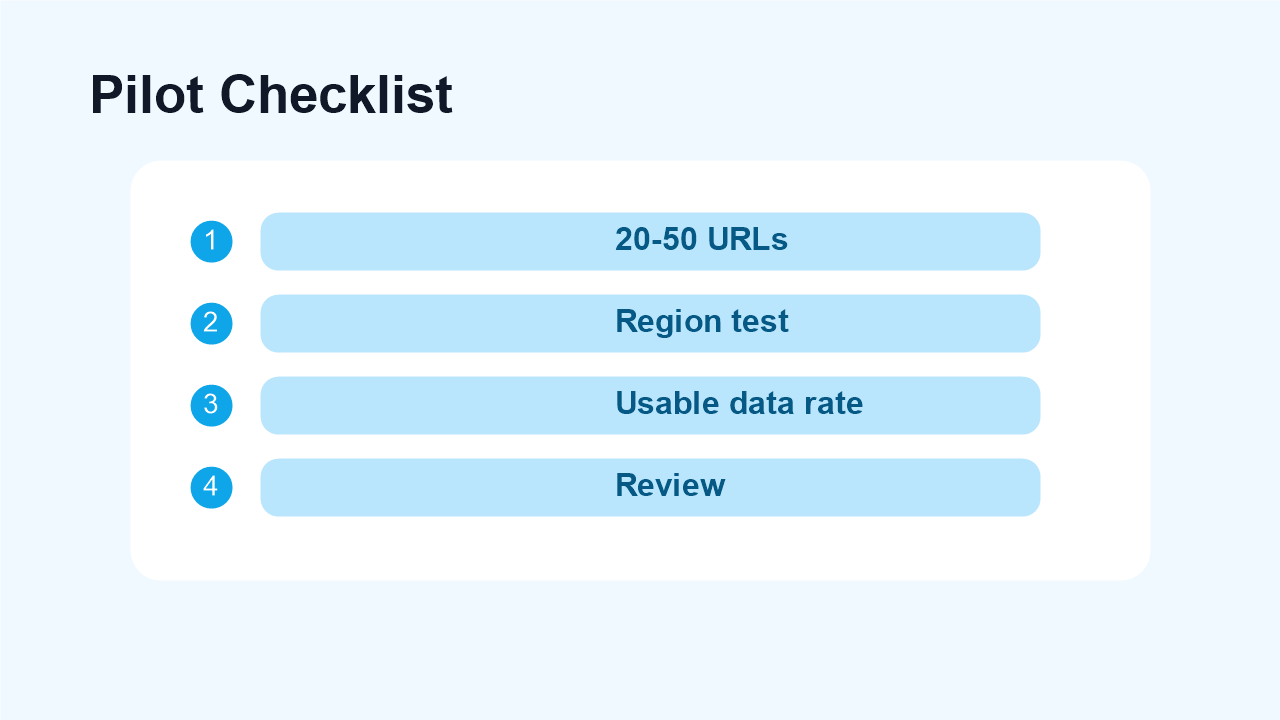
A practical scraping proxy pilot can be small. Choose 20 to 50 representative URLs, one or two target regions, and a clear request rhythm. Run the same target set with the planned proxy type, record every response, and classify the result into usable data, soft block, hard block, timeout, wrong region, or incomplete page. This creates a baseline that is more useful than a broad claim such as "the proxy works".
The pilot should also include a stop rule. If failure rate rises after concurrency increases, slow down before changing providers. If wrong-region pages appear, adjust region selection before changing rotation. If logged-in sessions break, test static residential IPs instead of adding more dynamic rotation. This is how proxy choice becomes an operating decision rather than a guessing game, and it gives teams a repeatable benchmark for future optimization.
Summary
Residential IPs matter in web scraping because many failures are not about code alone. They come from mismatched network identity, wrong geography, unstable sessions, or overly aggressive request behavior. Use dynamic residential proxies for public-page coverage, static residential IPs for continuity, and always measure cost by usable results rather than raw IP count.