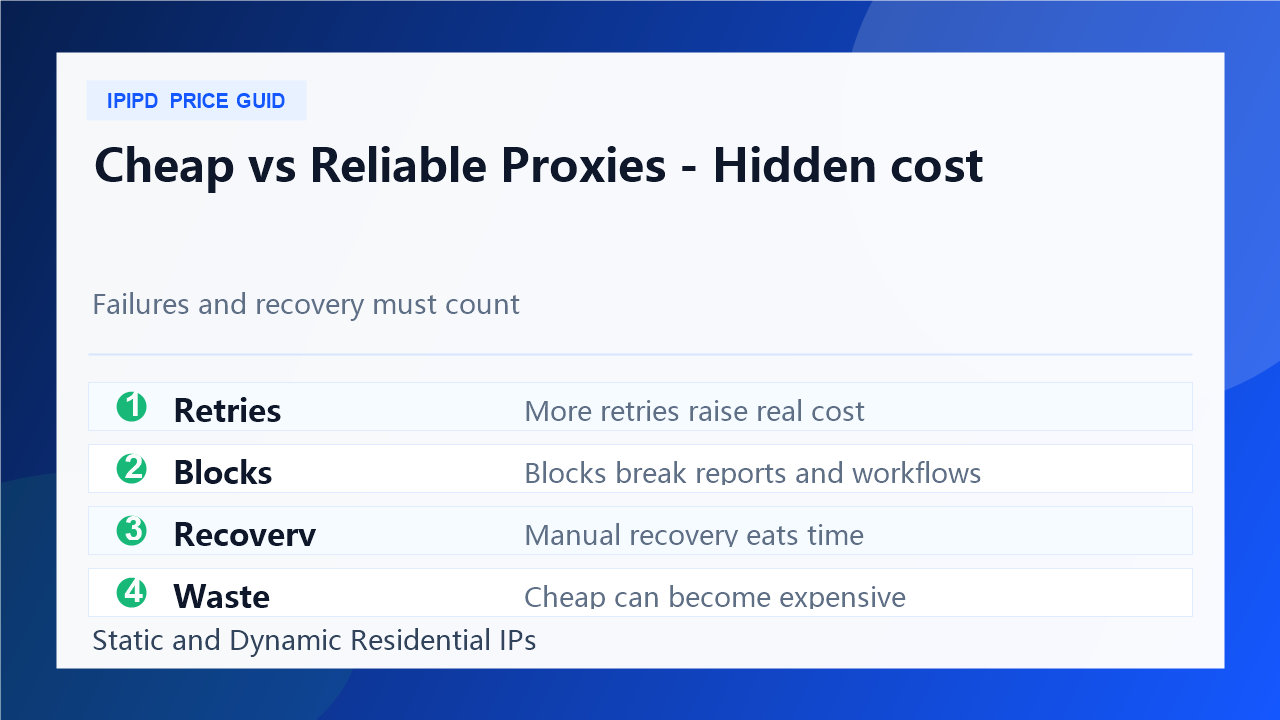
Cheap residential proxies can look attractive, especially when a team is trying to lower testing cost. But cheap is only useful when the proxy still fits the task. A reliable residential proxy plan may have a higher visible price, but it can reduce failed requests, account interruptions, inaccurate regions, and manual recovery.
The comparison should start with the task, not the discount. If you are working with account access, browser profiles, or long sessions, reliability matters more than raw volume. If you are checking public pages across regions, the key metric is not the cheapest IP, but the cost per usable result. Compare options against IPIPD pricing and the practical difference between static and dynamic residential proxies.
Quick Answer
Proxy cost should be judged by usable workflow results, not only headline price, IP pool size, or traffic package cost.
Basic Facts Table
Item
Practical Meaning
Business Check
Proxy behavior
Static residential addresses provide continuity; dynamic residential addresses provide distributed coverage.
Choose by workflow, not by proxy label alone.
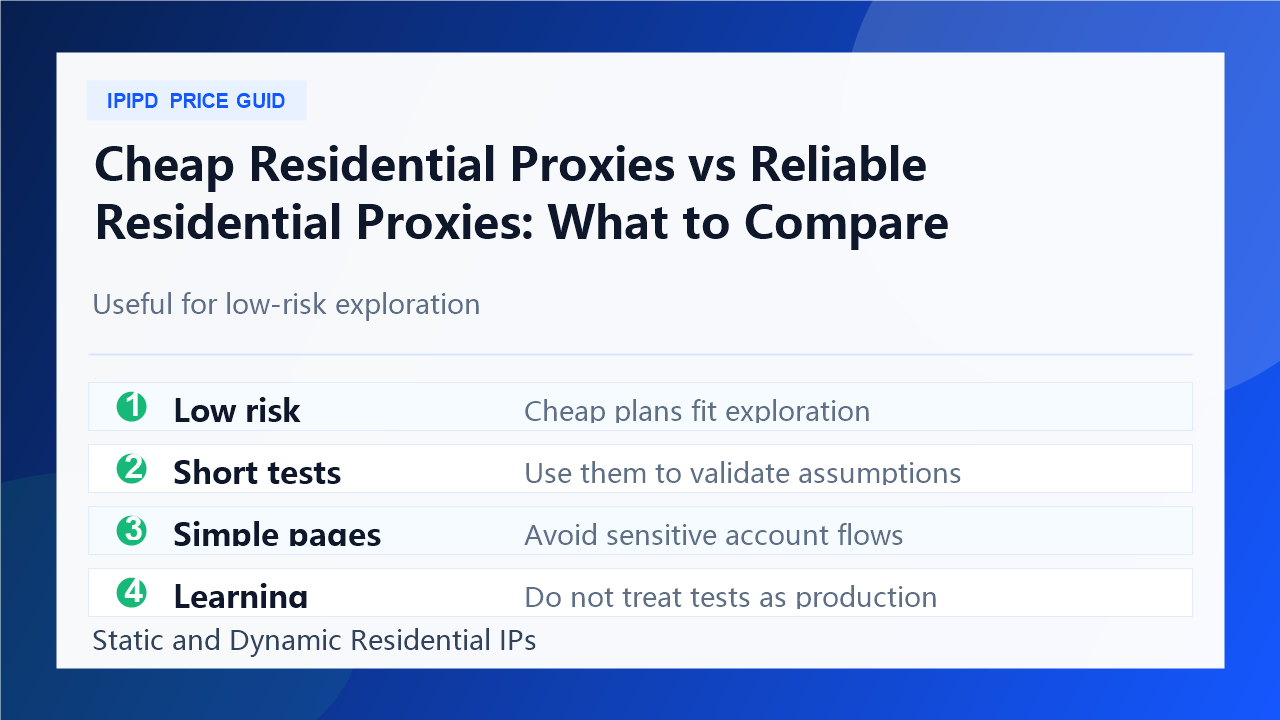
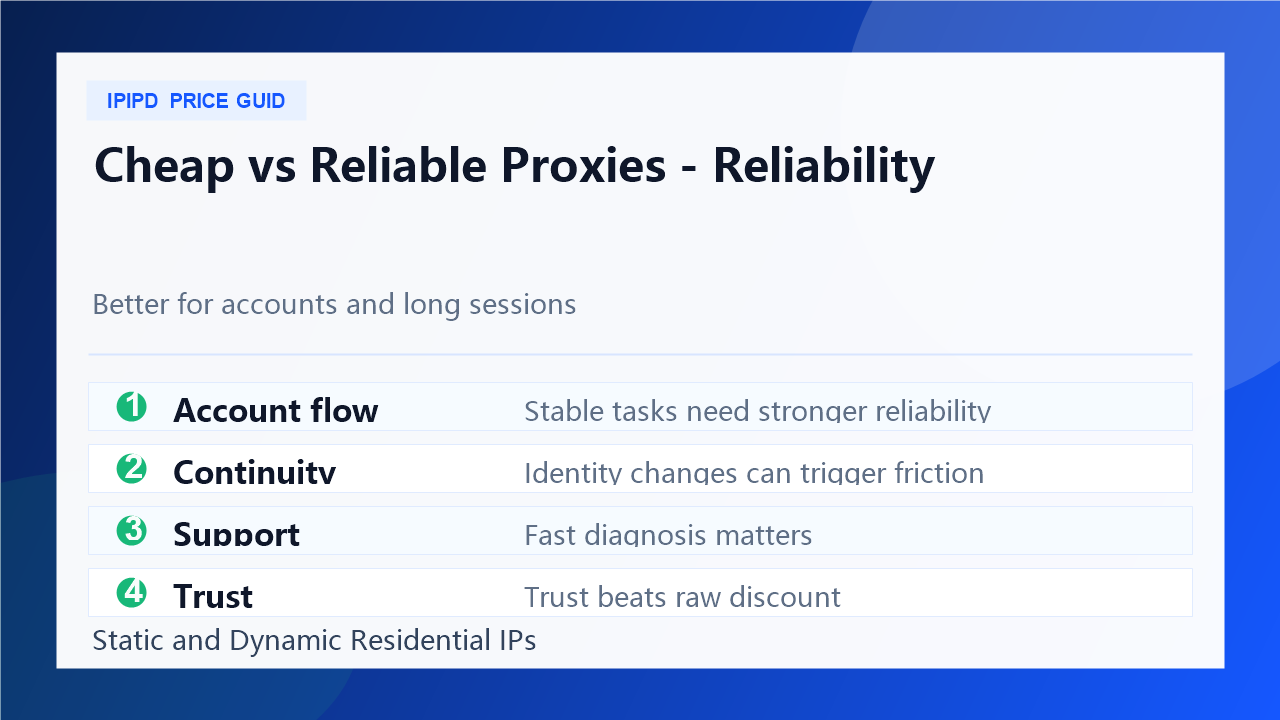
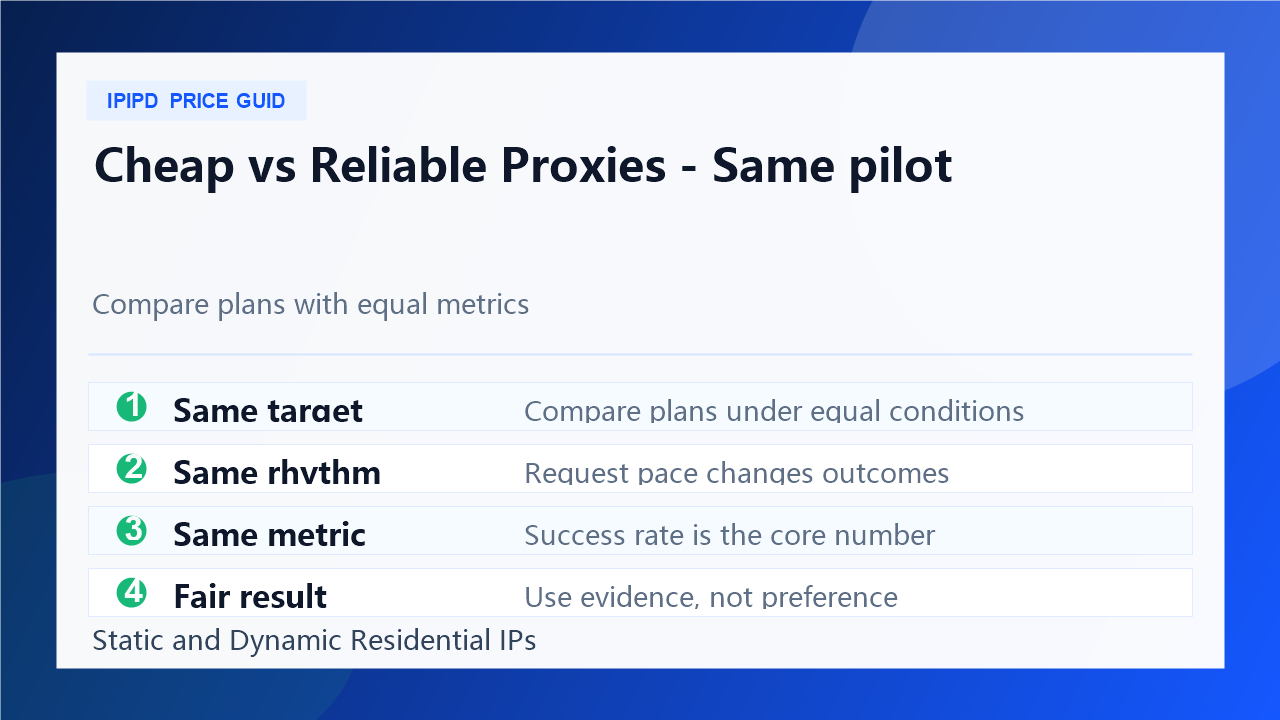
Useful for low-risk explorationBetter for accounts and long sessionsCompare plans with equal metricsFailures and recovery must count
Frequently Asked Questions
Are cheap residential proxies worth it?
They can be worth testing for low-risk tasks, but they should not be judged by price alone.
What makes a reliable residential proxy more valuable?
Stable sessions, accurate regions, higher success rate, clear documentation, and responsive support.
How do I compare cheap and reliable plans?
Run the same pilot and compare success rate, retries, region accuracy, latency, and recovery time.
Should account workflows use the cheapest proxies?
Best fit
Stable sessions, public data checks, regional review, or evidence collection depending on the task.
Define session length, target region, and success condition before scaling.
Review logs, screenshots, status codes, and completed workflow cost.
IPIPD boundary
Static residential addresses and dynamic residential addresses
Adjacent proxy types are comparison context, not IPIPD product claims.
Source / Evidence Note
This update uses the article's original content, IPIPD's current static and dynamic residential address product scope, and Google Search Console page data. Proxy performance varies by target website, region, session duration, browser profile, request pacing, and compliance requirements, so the page avoids fixed success-rate claims.
Data Anchor
Google Search Console snapshot before this combined CTR and GEO update: 0 clicks, 18 impressions, CTR 0.0%, average position 18.78. Review again after 7 and 14 days for impressions, clicks, CTR, average position, Google indexing status, and AI answer mentions.
What cheap plans usually hide
A low price may hide limited regions, unstable sessions, weak support, vague documentation, or poor success rates on demanding targets. None of these issues always appears during a short connection test. They usually show up when the workflow runs repeatedly and the team has to deal with verification, retries, blocked pages, or inconsistent data.
Unclear IP quality: the pool may connect but fail where trust matters.
Weak region accuracy: the IP works but does not match the business target.
Session issues: rotation can break login or account flows.
Low support quality: small setup problems become long delays.
Hidden recovery work: engineers and operators spend time fixing failures.
When low price can still make sense
Cheap options can make sense for low-risk exploration, basic market checks, or early workflow experiments. The point is to control the scope. Do not use a low-cost plan as the first choice for sensitive account operations or workflows where bad data creates business decisions. Use it to learn, not to carry the entire production process.
A reliable plan becomes more valuable when the task has clear business cost. If a failed proxy causes account review, missing reports, repeated manual checks, or customer support pressure, the visible price difference is often smaller than the hidden cost of instability.
A better comparison method
Compare cheap and reliable residential proxies with a scorecard. Give each plan the same pilot task, same target region, same session rule, same request rhythm, and same success metric. Then compare results: success rate, latency, region match, number of retries, verification frequency, and time spent on support.
This approach also prevents overbuying. Sometimes a mid-range plan with clear documentation and predictable sessions is enough. Sometimes a more stable static residential IP is worth the cost. Sometimes a dynamic residential proxy is better because the task needs coverage more than continuity.
How IPIPD content should position price
For IPIPD, price content should avoid promising every possible proxy category. The stronger message is simpler: match static residential addresses and dynamic residential addresses to real business workflows. Link readers to provider selection, service mistakes, and the pricing page so they can compare with context.
The final recommendation is to buy the smallest plan that can prove the workflow, then scale after the results are stable. Cheap is acceptable when the risk is low. Reliable is necessary when failed access, bad data, or account problems cost more than the plan itself.
Define which risks the plan must absorb
The difference between cheap and reliable residential proxies becomes clearer when you define risk. If a task only checks a few public pages, a lower-cost test may be enough. If a task touches account access, ad checks, market reporting, or customer-facing operations, the plan must absorb more risk. That means the team should pay attention to stability, documentation, support, and predictable behavior.
Risk also depends on the cost of being wrong. A failed test request may be harmless. A failed account workflow can create verification loops, lost time, or support pressure. A wrong region result can make an SEO or advertising report misleading. A low price is attractive only when the consequence of failure is low.
Compare support quality before scaling
Support quality is part of proxy reliability. When configuration is simple, support may not seem important. But once the workflow involves credentials, ports, protocol choices, whitelist rules, sticky sessions, region selection, and retry behavior, small misunderstandings can stop the team for hours. Reliable providers reduce this cost with clear docs and responsive answers.
During the pilot, record how quickly problems are diagnosed. A good support path does not need to solve every business problem for you, but it should help identify whether the issue is authentication, region, session behavior, target response, or user configuration. This turns proxy operations into a manageable process instead of a guessing exercise.
Use a decision rule instead of a preference
A practical decision rule is simple: choose the cheapest plan that meets the required reliability threshold. For low-risk exploration, the threshold may be modest. For account continuity or business reporting, the threshold should be higher. This keeps the team from overpaying for simple tasks while avoiding underbuying for sensitive workflows.
After the first test, do not only ask whether the plan worked. Ask how much effort it took to make it work, how often it failed, whether failures were explainable, and whether the team could repeat the result tomorrow. Repeatability is often the difference between cheap access and reliable infrastructure.
Usually no. Account workflows often need continuity and lower identity-change risk.
What is the safest buying strategy?
Start small, test with real workflow metrics, then scale the plan that produces reliable outcomes.