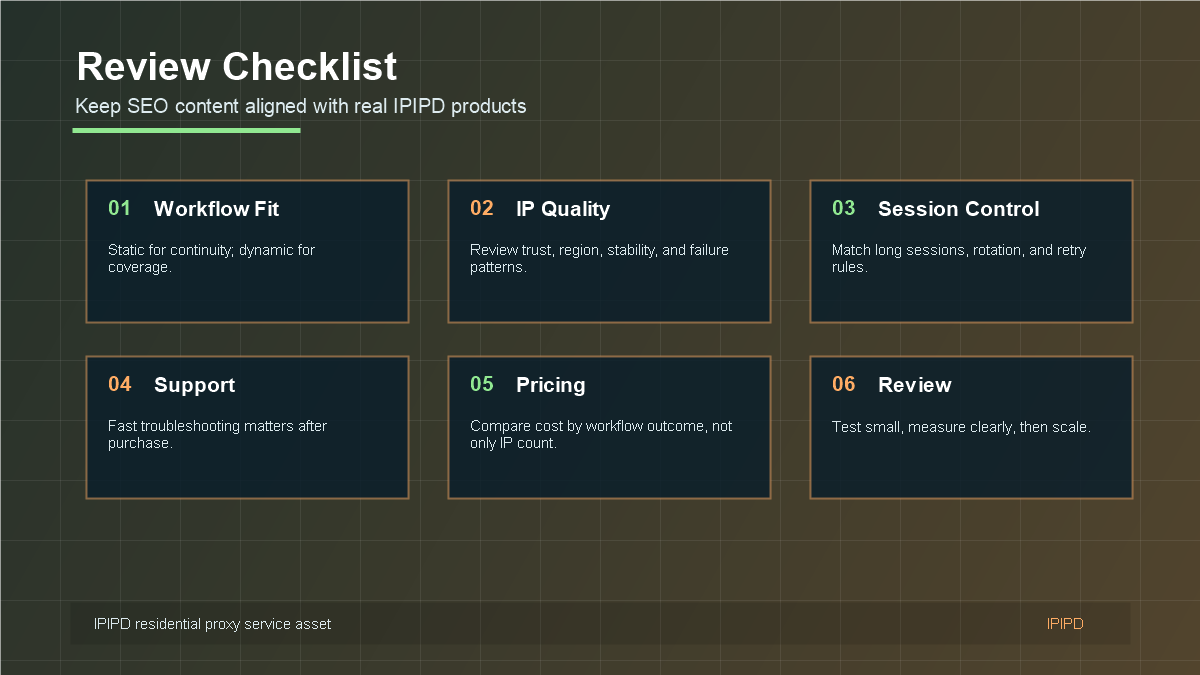
Residential proxy service mistakes usually happen before the first request is sent. The team buys a plan without defining the workflow, compares providers by the wrong metric, tests with unrealistic tasks, or expects one proxy type to solve every problem. The result is wasted budget, more manual recovery, and unclear performance data.
This article explains common buying and setup mistakes so teams can avoid them before scaling. It also keeps the message aligned with IPIPD's real product focus: static residential addresses and dynamic residential addresses.
Quick Answer
Residential proxy selection should start from the workflow: stable identity, dynamic coverage, regional accuracy, or evidence review.
Basic Facts Table
Item
Practical Meaning
Business Check
Proxy behavior
Static residential addresses provide continuity; dynamic residential addresses provide distributed coverage.
Choose by workflow, not by proxy label alone.
Best fit
Stable sessions, public data checks, regional review, or evidence collection depending on the task.
Define session length, target region, and success condition before scaling.
Main risk
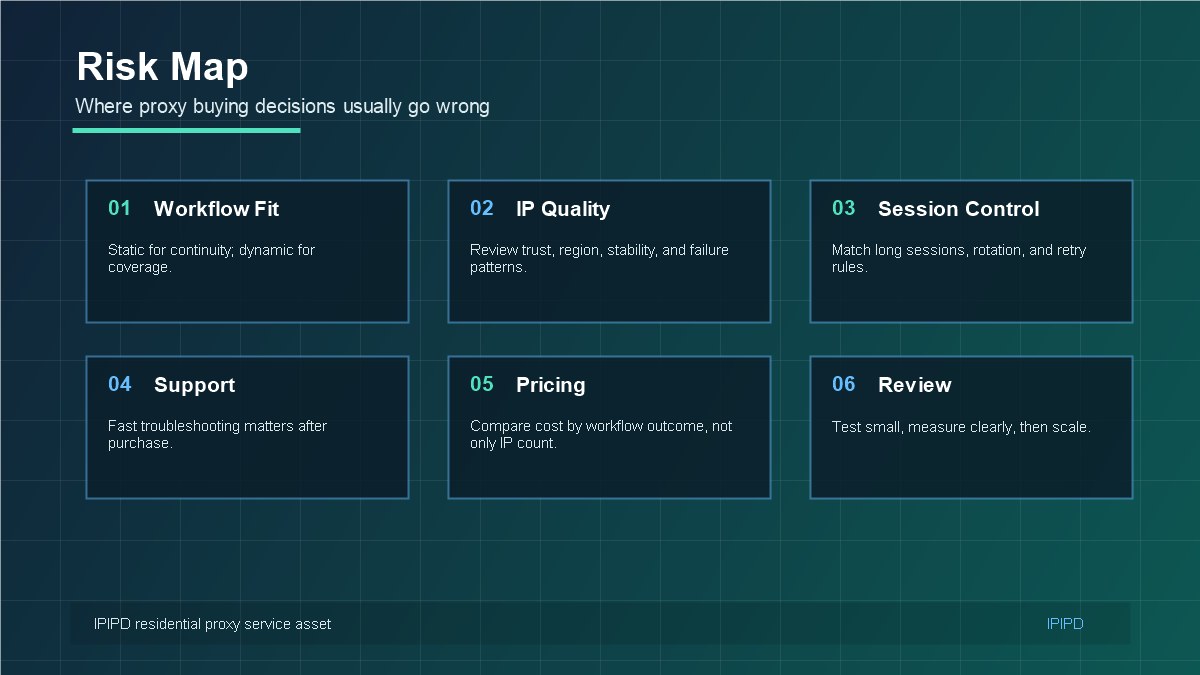
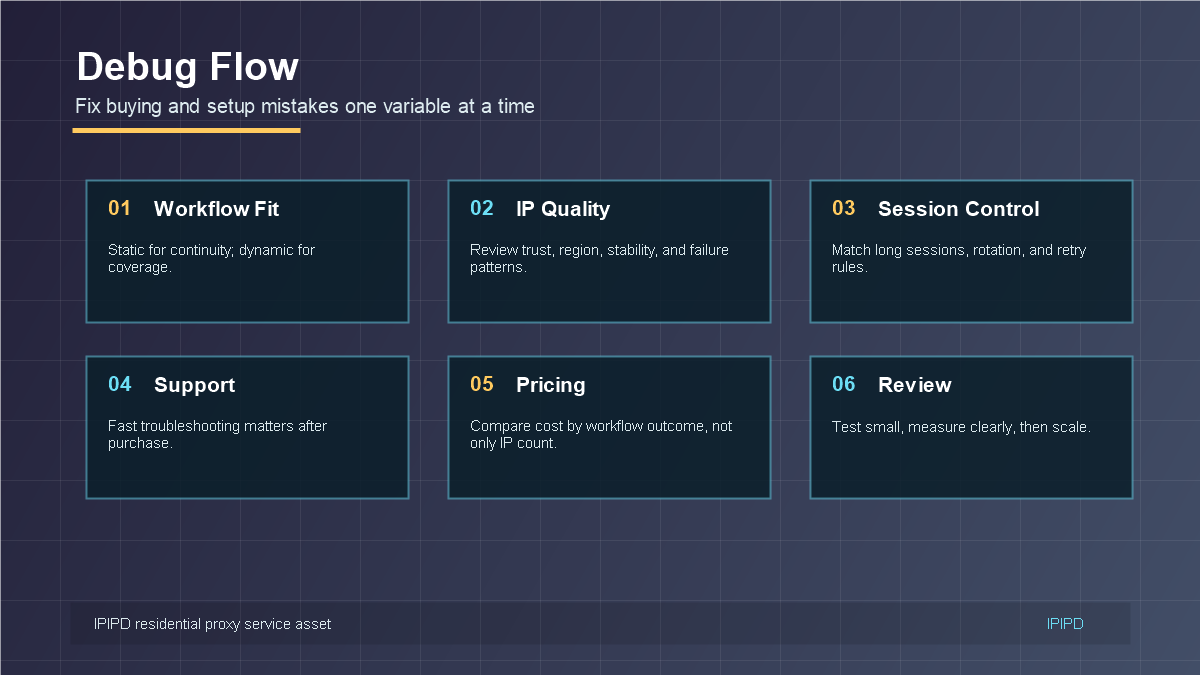
Most service mistakes start with unclear workflow requirements.Map buying risks before they become failed workflows.Fix proxy service issues one variable at a time.Keep content aligned with IPIPD static and dynamic residential products.
Frequently Asked Questions
What is the most common residential proxy service mistake?
Buying before defining the workflow. Teams should know whether they need stable identity, dynamic coverage, or both.
Should I compare residential proxy services by price?
Price matters, but it should be measured by successful workflow outcome, not only by headline cost.
Why do residential proxy tests fail?
Tests often fail because the KPI does not match the workflow, or because region, browser, session, and request behavior are not controlled.
Review logs, screenshots, status codes, and completed workflow cost.
IPIPD boundary
Static residential addresses and dynamic residential addresses
Adjacent proxy types are comparison context, not IPIPD product claims.
Source / Evidence Note
This update uses the article's original content, IPIPD's current static and dynamic residential address product scope, and Google Search Console page data. Proxy performance varies by target website, region, session duration, browser profile, request pacing, and compliance requirements, so the page avoids fixed success-rate claims.
Data Anchor
Google Search Console snapshot before this combined CTR and GEO update: 0 clicks, 13 impressions, CTR 0.0%, average position 27.69. Review again after 7 and 14 days for impressions, clicks, CTR, average position, Google indexing status, and AI answer mentions.
Mistake 1: Buying Before Defining the Workflow
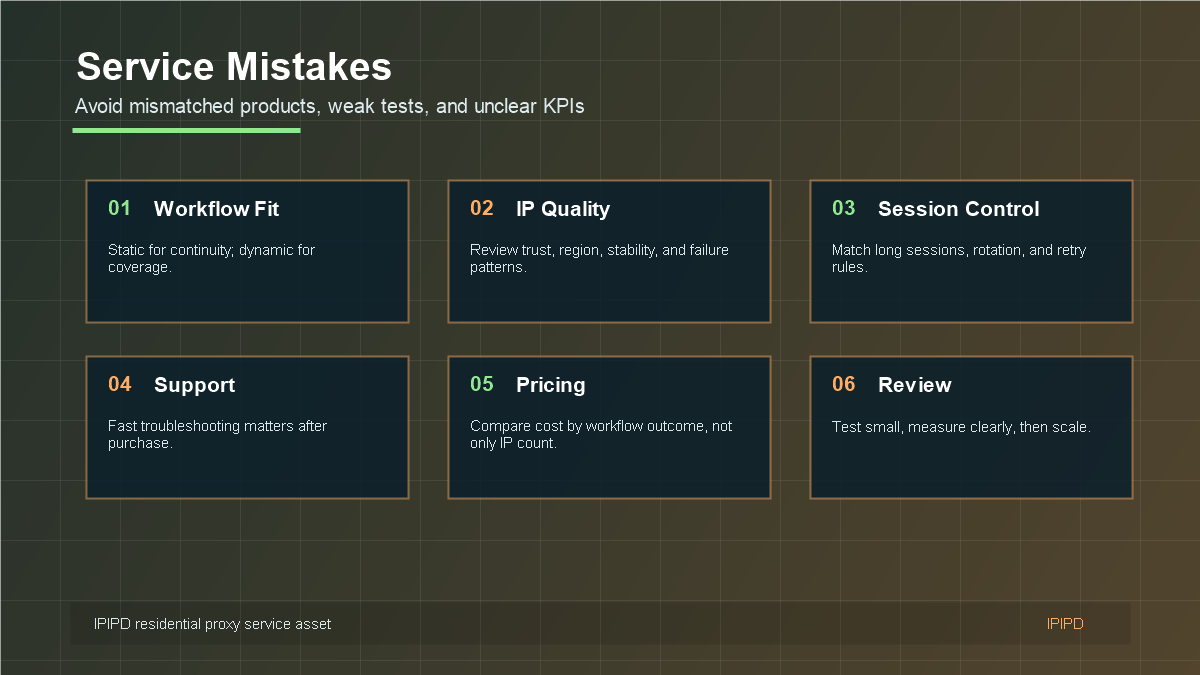
The first mistake is buying a residential proxy service before defining the workflow. "We need proxies" is not a requirement. A useful requirement sounds like: "We need stable residential IPs for account profiles in one region" or "We need dynamic residential coverage for daily SEO checks across several markets." The more specific the workflow, the easier the provider decision becomes.
Fix this by writing the workflow owner, target platform, region, login requirement, session length, request volume, and success metric. This short note prevents the team from comparing features that do not matter.
Mistake 2: Comparing Only Price or IP Count
Low price and large IP count can look attractive, but they are not enough. A low-cost plan becomes expensive if it creates failed logins, blocked checks, inaccurate regions, slow responses, or manual cleanup. A large pool is not valuable if the workflow needs a small number of stable account identities.
Fix this by comparing cost per successful workflow. For static residential IPs, that may mean cost per stable account or dashboard. For dynamic residential proxies, that may mean cost per successful public check, market report, or monitoring cycle.
Mistake 3: Testing With the Wrong KPI
Static and dynamic residential workflows need different KPIs. Static workflows should be measured by identity stability, verification frequency, session length, and recovery effort. Dynamic workflows should be measured by successful retrieval, block rate, region accuracy, latency, and retry cost. Mixing these KPIs can make the wrong product look right.
Fix this by testing each workflow separately. Do not judge a static account workflow by public scraping volume. Do not judge a dynamic public-check workflow by account login stability.
Mistake 4: Ignoring Support and Documentation
Support and documentation are often ignored until something breaks. But residential proxy workflows can fail for many reasons: credentials, ports, whitelists, region mismatch, browser profiles, target-site changes, and request behavior. Good documentation reduces setup mistakes. Good support reduces downtime when troubleshooting becomes difficult.
Mistake 5: Writing Content That Overclaims the Product
For SEO content, another mistake is writing about products the company does not actually sell. Large competitors may rank for SERP APIs, browser APIs, unlocker APIs, scraper APIs, datasets, and many proxy types. IPIPD can mention adjacent concepts for education, but the article should bring readers back to static and dynamic residential addresses. Otherwise traffic may grow while conversion stays weak.
Residential proxy service mistakes are avoidable when the workflow is clear. Define the job, choose static or dynamic behavior deliberately, test with the right KPI, and keep content aligned with real product capability. That is better for operations, SEO, and conversion.
Mistake 6: Scaling Without Ownership
A residential proxy service becomes harder to manage when nobody owns the mapping between workflow, proxy type, region, and success metric. One person may change the browser profile, another may change the IP, and another may change the target list. When the result breaks, the team cannot identify the cause. This is especially common when static and dynamic workflows are mixed together.
Fix this by assigning an owner for each workflow. The owner should document which accounts use static residential IPs, which public checks use dynamic residential proxies, which regions are required, and which metrics define success. Ownership does not need to be bureaucratic. It simply makes changes visible.
Mistake 7: Ignoring Content-to-Product Alignment
SEO content can attract the wrong audience if it chases broad proxy terms without connecting them to real products. For IPIPD, the content should educate readers about adjacent concepts but guide them back to static and dynamic residential address choices. If an article ranks for a term but the product page cannot satisfy the intent, traffic may rise while conversion remains weak.
A better approach is to build clusters around real decision points: service selection, provider comparison, price, static versus dynamic, account workflows, web scraping, SEO monitoring, ecommerce checks, and common mistakes. These topics can capture search demand while staying close to IPIPD's current business.
Mistake 8: Treating the First Test as the Final Answer
A pilot is a starting point, not a permanent conclusion. Target sites change, account behavior changes, regions change, and volume grows. Review the proxy service after each scaling step. If account verification rises, revisit static identity mapping. If public checks fail more often, revisit dynamic rotation, pacing, and region selection.
The service should improve with feedback. Teams that keep measurement and review habits usually get more value from the same proxy budget than teams that only change providers when something breaks.
Implementation Table for Internal Review
Before the article is published or the service is purchased, the team should translate the recommendation into an internal review table. The table should include the workflow name, proxy type, target region, user or system owner, login requirement, session policy, test period, success metric, expected risk, and next action. This simple table makes the decision operational instead of theoretical.
For example, an account dashboard workflow may use static residential IPs, one browser profile, one region, and a success metric based on verification frequency and session stability. A public SEO monitoring workflow may use dynamic residential proxies, controlled rotation, multiple regions, and a success metric based on successful checks, latency, block rate, and region accuracy. Both are residential proxy workflows, but they should never be judged by the same measurement.
Practical Test Sample
A practical test can run for three to seven days. For static residential IPs, choose a small number of accounts or dashboards and keep the browser profile, region, and IP assignment consistent. Record every login prompt, unusual redirect, region warning, slow page, and manual recovery. For dynamic residential proxies, choose a small set of public pages or search queries, define the region list, set a rotation rule, and record status codes, latency, retries, and blocked responses.
The goal of the pilot is not to prove that every request succeeds. The goal is to discover whether the service gives the team a predictable operating model. Predictability is what makes the service scalable. If the team knows why a failure happened and which variable changed, the proxy workflow can be improved. If every failure is a mystery, scaling will only make the problem more expensive.
Review Rule for SEO and Conversion
For IPIPD content, the final review should ask whether the reader can connect the article to a real next step: compare static and dynamic residential addresses, visit the pricing page, read a related tutorial, or choose the correct workflow. A good SEO article should not only collect traffic; it should reduce confusion before the reader talks to sales or support.
Final Publishing Check
Before publishing, confirm that the article gives the reader a clear next action. The next action may be comparing static and dynamic residential proxy plans, testing a small workflow, reading a related guide, or reviewing the pricing page. If the article only explains concepts but does not help the reader decide, it should be revised before going live.
The final check should also verify that the keyword is used naturally, internal links are useful, external references are not excessive, images have accurate alt text, and the FAQ answers buyer questions directly.
For content review, one more rule helps: if a paragraph does not help the reader avoid a buying mistake, choose the right IP behavior, or understand an IPIPD product path, it should be shortened or removed. Clear content reduces confusion and usually converts better than broad generic proxy writing.
Very important. Support helps resolve credential, region, session, block, and setup issues after purchase.
What should IPIPD content avoid?
It should avoid overclaiming unrelated products and should stay focused on static and dynamic residential address use cases.