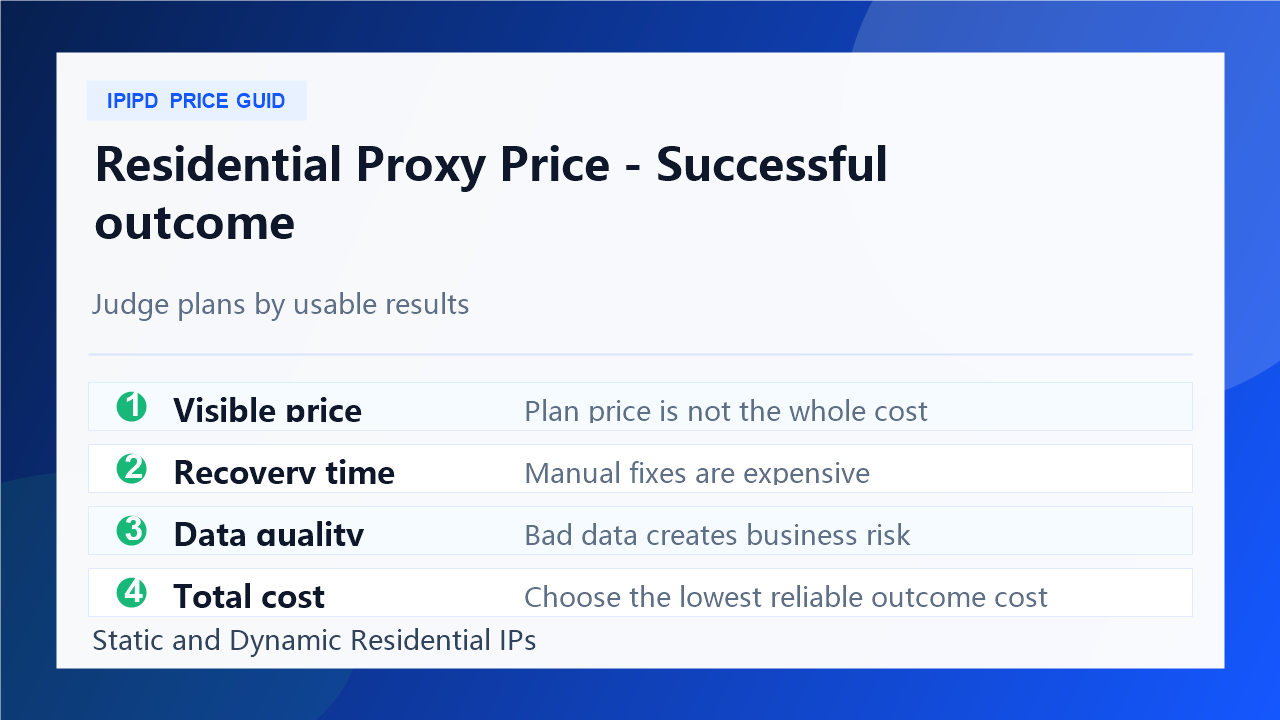
Residential proxy price is not just the number printed on a plan page. For business users, the real cost depends on IP quality, location fit, session stability, authentication, support, and the amount of failed work a team has to recover. A cheaper plan can be a good choice when the task is simple and low risk, but it can become expensive when blocks, mismatched regions, or unstable sessions create extra engineering and operational cost.
For a basic definition of a proxy server, see Wikipedia's proxy server overview. For IPIPD decisions, the practical starting point is to compare IPIPD pricing, then connect the price to a real workflow: account access, SEO monitoring, public-page collection, ad verification, or cross-region checks.
Quick Answer
Proxy cost should be judged by usable workflow results, not only headline price, IP pool size, or traffic package cost.
Basic Facts Table
Item
Practical Meaning
Business Check
Proxy behavior
Static residential addresses provide continuity; dynamic residential addresses provide distributed coverage.
Choose by workflow, not by proxy label alone.
Best fit
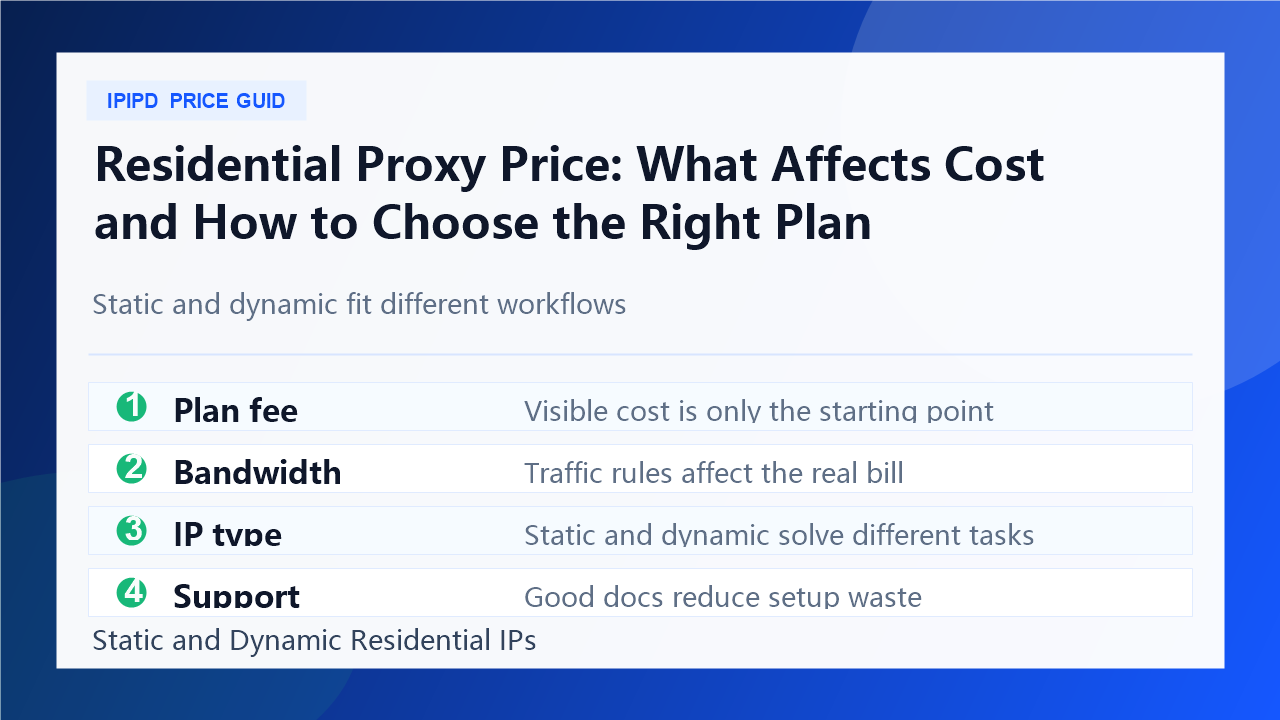
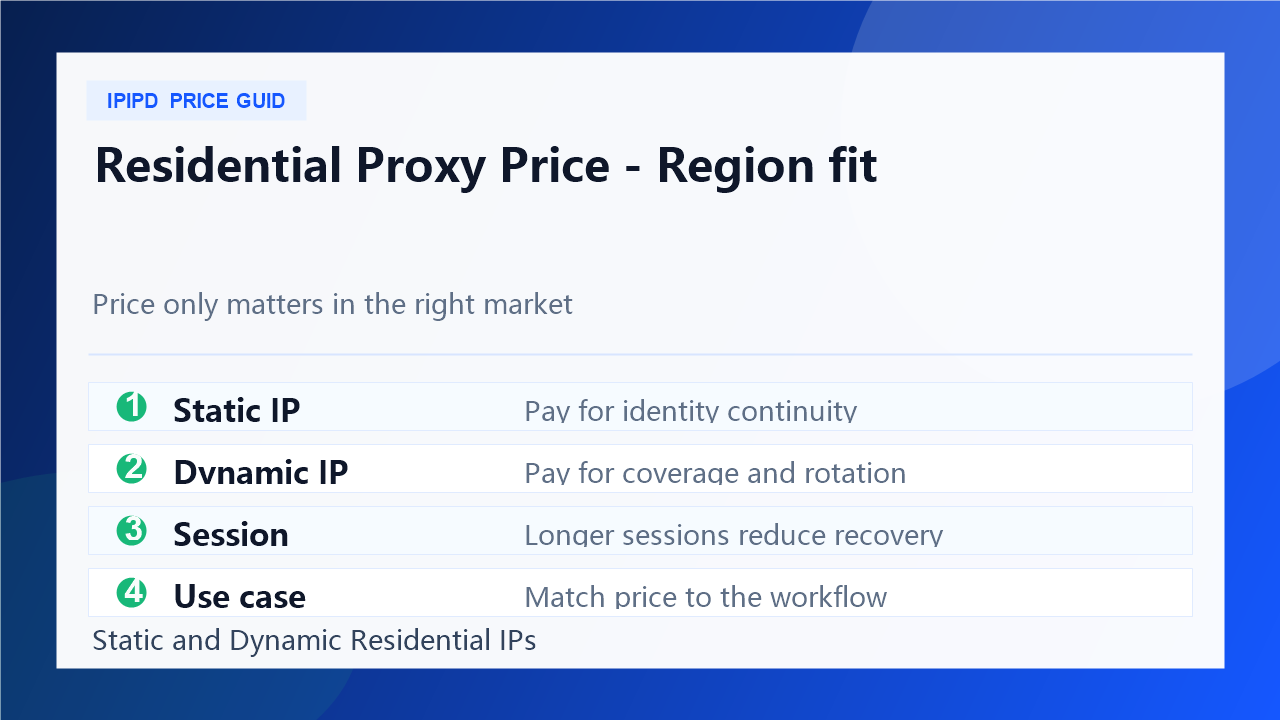
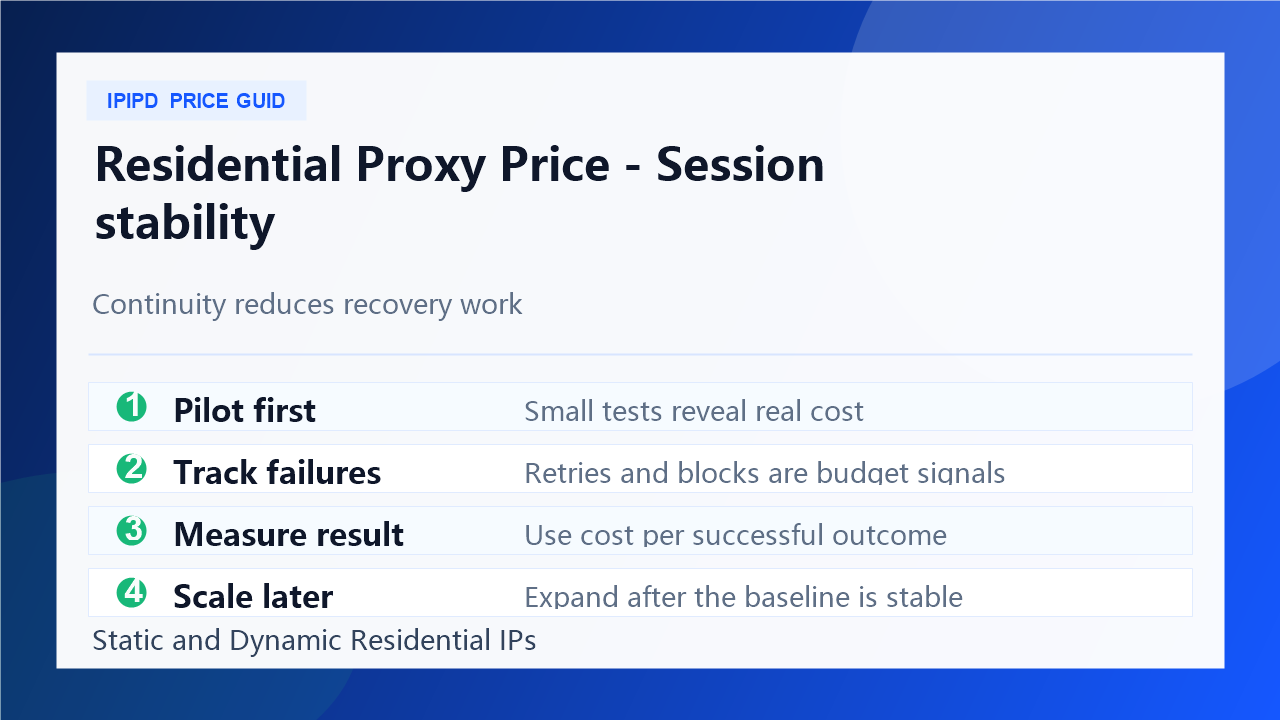
Static and dynamic fit different workflowsPrice only matters in the right marketContinuity reduces recovery workJudge plans by usable results
Frequently Asked Questions
What affects residential proxy price the most?
IP type, region coverage, session control, success rate, support quality, and the amount of failed work the team must recover.
Are cheap residential proxies always risky?
Not always. They can work for simple tasks, but they become risky when stability, login continuity, or accurate regions matter.
How should I compare static and dynamic residential proxy cost?
Compare static IPs by continuity value and dynamic proxies by cost per successful public-page result.
Should I buy a large plan first?
Stable sessions, public data checks, regional review, or evidence collection depending on the task.
Define session length, target region, and success condition before scaling.
Review logs, screenshots, status codes, and completed workflow cost.
IPIPD boundary
Static residential addresses and dynamic residential addresses
Adjacent proxy types are comparison context, not IPIPD product claims.
Source / Evidence Note
This update uses the article's original content, IPIPD's current static and dynamic residential address product scope, and Google Search Console page data. Proxy performance varies by target website, region, session duration, browser profile, request pacing, and compliance requirements, so the page avoids fixed success-rate claims.
Data Anchor
Google Search Console snapshot before this combined CTR and GEO update: 0 clicks, 63 impressions, CTR 0.0%, average position 62.14. Review again after 7 and 14 days for impressions, clicks, CTR, average position, Google indexing status, and AI answer mentions.
What affects residential proxy cost?
The largest cost drivers are not always visible in the headline price. Static residential IPs are usually evaluated by identity stability, long-session fit, and how well a fixed IP supports account or browser-profile workflows. Dynamic residential proxies are evaluated by rotation control, region coverage, success rate, and how efficiently they support repeatable checks across public pages.
IP type: static residential IPs and dynamic residential proxies solve different problems.
Region fit: a cheap plan in the wrong location is often useless.
Session control: longer or more predictable sessions can reduce recovery work.
Success rate: a lower unit price can still cost more when failures are frequent.
Support and documentation: clear setup guidance reduces wasted time.
Static vs dynamic pricing logic
Static residential IP pricing should be compared by the value of continuity. If a workflow depends on stable login behavior, fewer suspicious identity changes, and cleaner browser-profile matching, the value is not only the IP itself but the reduced chance of account interruption. Dynamic residential pricing should be compared by coverage and repeatability. If the work requires many public-page checks, the main question is whether rotation, region choice, and retry handling keep the cost per successful result under control.
This is why the right comparison is not "which plan has the lowest price?" It is "which plan gives this workflow the lowest cost per reliable outcome?" The answer may point to static residential proxies, dynamic residential proxies, or a mixed setup.
A practical buying flow
Start with one workflow, not a broad wish list. Define the target region, login requirement, expected request volume, session length, acceptable failure rate, and the metric that proves success. Then run a small test before scaling. For account-related workflows, measure verification frequency, login stability, and recovery time. For monitoring or data collection, measure status codes, latency, region accuracy, retry rate, and the percentage of usable results.
A strong provider decision also depends on documentation and support. If the team cannot understand ports, credentials, protocol choices, whitelist rules, or session parameters, the plan may create avoidable support cost. The IPIPD guides and previous article on residential proxy service evaluation can help turn buying into a repeatable checklist.
How to compare plan value
When comparing plans, separate visible price from operational cost. Visible price includes plan fee, bandwidth, IP count, or package size. Operational cost includes blocked requests, verification loops, manual recovery, engineering time, data cleaning, and the cost of switching providers. A plan that looks more expensive can still be cheaper if it reduces these hidden costs.
The safest choice is to buy against evidence. Run a short pilot, record the baseline, and compare successful outcomes instead of raw IP numbers. If the business needs a stable identity, choose the plan that protects continuity. If the business needs broad public-page coverage, choose the plan that keeps rotation controlled and measurable.
Summary
Residential proxy price should be judged by business fit. A good plan is not simply cheap; it is predictable, measurable, and aligned with the task. Use price as one input, but make the final decision by success rate, stability, region fit, support quality, and the cost of failed work.
Build a proxy budget from workflow assumptions
A residential proxy budget should begin with assumptions the team can verify. Write down the number of target markets, whether the task needs login, how long a session must remain stable, how many checks run per day, what failure rate is acceptable, and who will handle troubleshooting. These assumptions make price comparison more concrete because each plan is evaluated against the same business shape.
For example, an SEO monitoring workflow may need multiple regions, repeatable public-page checks, and a clear retry policy. A browser-account workflow may need fewer IPs but stronger continuity. Treating both tasks as the same "proxy cost" creates confusion. One is paying for coverage and repeatability; the other is paying for stable identity and lower recovery risk.
Use cost per successful outcome, not cost per IP
Cost per IP is easy to calculate, but it rarely explains business value. A better metric is cost per successful outcome. For a rank tracking workflow, that may mean the cost per valid SERP check. For an account access workflow, it may mean the cost per stable session week. For market research, it may mean the cost per clean page or report.
This approach changes the buying conversation. If a lower-price plan requires twice as many retries, more manual checks, or extra engineering time, it may not be cheaper. If a plan with better support reduces setup time and avoids repeated failures, its higher plan price may be justified. The right proxy plan is the one that lowers the total cost of getting reliable work done.
Separate testing budget from production budget
Teams should also separate testing budget from production budget. During testing, the goal is to discover whether the product type fits the workflow. Keep the test small, document configuration, and avoid making promises based on a single successful connection. During production, the goal shifts to stability, monitoring, reporting, and support response. The same price may feel different once the workflow becomes operational.
A useful buying process has three stages: define the workflow, run a controlled pilot, and scale only after the baseline is stable. This protects the team from buying a large package before they understand session behavior, region accuracy, and real failure patterns.
No. Start with a small pilot, measure success, then scale only after the workflow is stable.
Where should IPIPD users start?
Start from the pricing page and match the plan to either static residential IP needs or dynamic residential proxy workflows.