IP Rotation Strategy for Scraping, SEO, and Monitoring
IP Rotation Strategy for Scraping, SEO, and Monitoring is not only a question of how often to change an IP. The real question is whether the workflow needs coverage or continuity. Rotation, sticky sessions, and static residential IPs each have a different role.
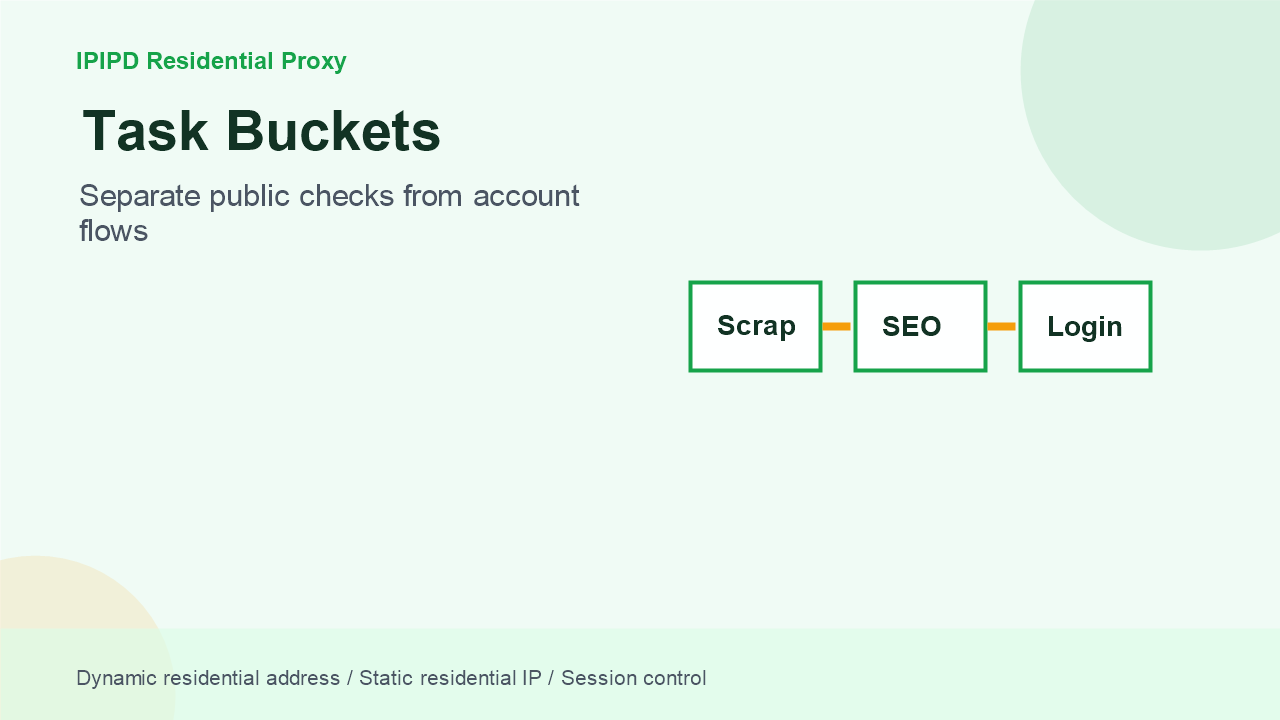
Separate public checks from account flowsStart With Task Buckets
A practical IP rotation strategy starts by separating tasks. Public data collection, SEO monitoring, ad checks, account login, and manual review should not share the same rule. If every workflow uses the same aggressive rotation pattern, the team cannot tell whether a failure came from the proxy, the target platform, the account, or the request strategy.
Create task buckets before buying or scaling. Public page checks can use dynamic residential addresses with controlled rotation. Account workflows should use static residential IPs or a stable sticky session. Monitoring tasks sit in the middle: they may need rotation for location coverage, but they also need repeatable rules so trend data is comparable.
Choose the Rotation Unit
The rotation unit is the event that triggers a new IP. It can be one request, one keyword, one page group, one city, one time window, or one failed attempt. Per-request rotation is useful for large public crawls, but it can create noise when a task needs consistent context. Time-based rotation is easier to reason about and often works better for scheduled monitoring.
For SEO monitoring, a common approach is to keep the same IP for a small group of related checks, then rotate before moving to another city or keyword batch. For scraping, rotate by page group or failure threshold rather than blindly rotating every second. For account work, avoid rotation inside the sensitive login path.
| Task | Better IP behavior | Reason |
|---|---|---|
| Public page scraping | Dynamic residential rotation | Requests are independent and need coverage |
| SEO location monitoring | Rotate by region or keyword batch | Local views matter, but trends need comparable rules |
| Account dashboard review | Static residential IP | Login state, cookies, and review context need continuity |
| Short pagination checks | Sticky session | A few related requests need the same identity |
Use Sticky Sessions Where Context Matters
Sticky sessions are the bridge between dynamic coverage and stable context. A sticky session keeps the same IP for a defined period, such as several minutes, so a multi-step task can finish without identity changes. This is useful for pagination, short search journeys, and public workflows that need several related requests.
Sticky sessions are not a replacement for static residential IPs. If the task needs the same identity for days or weeks, a static residential IP is the clearer choice. Use sticky sessions for short continuity, and use static residential IPs for long-running continuity.
Match interval, sticky time, and failoverAdd Delays, Retry Rules, and Failure Labels
Rotation alone does not make a workflow reliable. Add random delays, request limits, retry caps, and failure labels. A useful log should distinguish timeout, blocked page, captcha, wrong region, session reset, unexpected redirect, and content mismatch. Without these labels, the team will only see a generic failure count.
Retry logic should also be conservative. If a page returns a clear block, immediately retrying ten times through ten different IPs can make the pattern worse. A better rule is to pause, switch region or session only when needed, and record the condition that caused the retry.
Build a Small Pilot Before Scaling
Run a pilot with a small keyword set, a small page list, or a limited region group. Keep the rules stable for several days. Measure success rate, block rate, region accuracy, session breakage, response time, data completeness, and manual review time. The goal is not only to prove that the proxy connects, but to prove that the workflow produces reliable business data.
After the pilot, change one variable at a time. Increase concurrency, adjust delay, change sticky session length, or widen the region set, but do not change everything in one round. A disciplined pilot creates evidence that can be reused in SEO reports, GEO visibility work, and internal buying decisions.
Measure success, blocks, and costConnect the Strategy to IPIPD Products
For IPIPD positioning, the clean explanation is that dynamic residential addresses support controlled rotation and regional coverage, while static residential IPs support stable identity and long sessions. This avoids overpromising and keeps the article aligned with real product capability.
A good article should also guide the reader to the next decision. If they need broad public observation, they should compare dynamic residential address options. If they need account continuity, they should evaluate static residential IPs. If they need both, they should separate workflows and measure each part with different indicators.
Related Reading and Internal Links
If you are still choosing the proxy type, start with static vs dynamic residential proxy. For long-running identity, review the static residential proxy guide. For public coverage, review the dynamic residential proxy guide. For adjacent workflows, see web scraping proxy setup and SEO monitoring with residential proxies.
This cluster should link together after publishing: IP rotation basics, IP rotation strategy, and IP rotation mistakes.
Pre-Publish Review Checklist
- Confirm the title and meta description stay within SEO limits.
- Confirm the cover image is not reused inside the body.
- Confirm the three body images are different and relevant to the sections.
- Confirm internal links point to the same language path.
- After publishing, monitor search indexing first, then separate GEO citation checks.
In short, IP rotation is not a magic action. It is a rule tied to the task type. Use dynamic residential addresses for public coverage, static residential IPs for long sessions, and sticky sessions for short continuity. The scalable strategy is the one with clear rules, logs, and review metrics.
Frequently Asked Questions
What is an IP rotation strategy?
It is a written rule for when to change IPs, how long to keep sessions, how to retry failures, and how to measure results.
Should scraping rotate every request?
Sometimes, but not always. Rotate by page group, time window, region, or failure threshold when that creates cleaner evidence.
How should SEO monitoring rotate IPs?
Rotate by location or keyword batch while keeping rules consistent enough that ranking trends remain comparable.