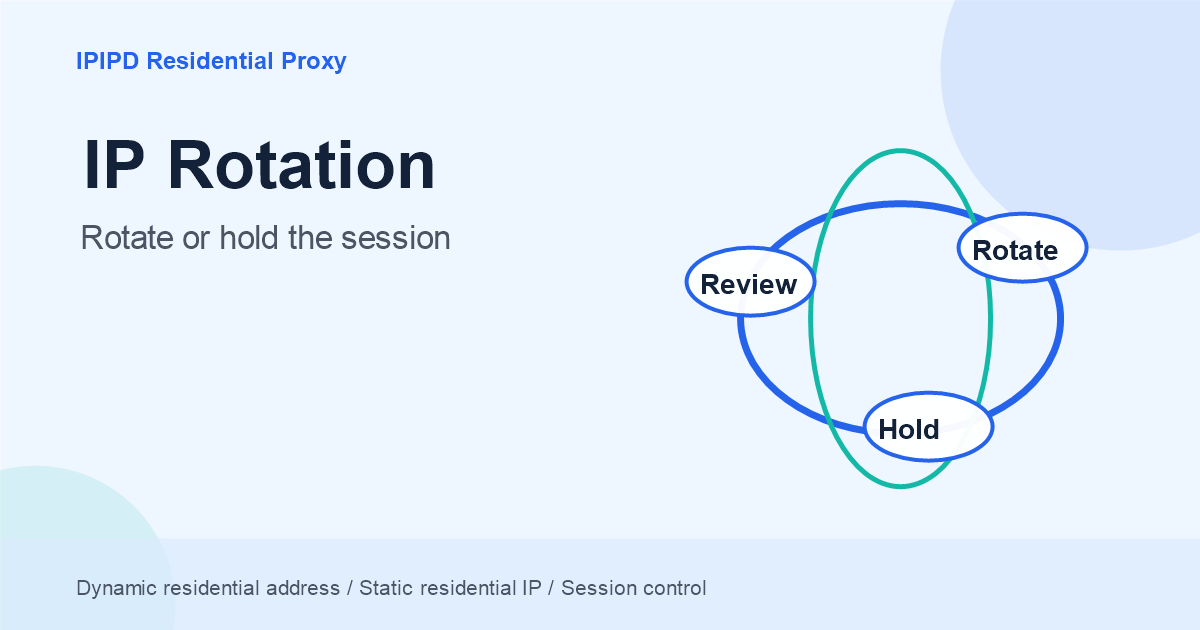
IP Rotation for Residential Proxies: Rotate or Hold Sessions is not only a question of how often to change an IP. The real question is whether the workflow needs coverage or continuity. Rotation, sticky sessions, and static residential IPs each have a different role.
Request, time, region, and session rules
Quick Answer
IP rotation means changing the outbound IP address according to a rule. The rule may be per request, per time window, per region, or per session. In residential proxy work, rotation is useful when a task needs broad coverage, low per-IP pressure, or different local views. It is not automatically useful when the task depends on a stable login, a cookie trail, or a long review session.
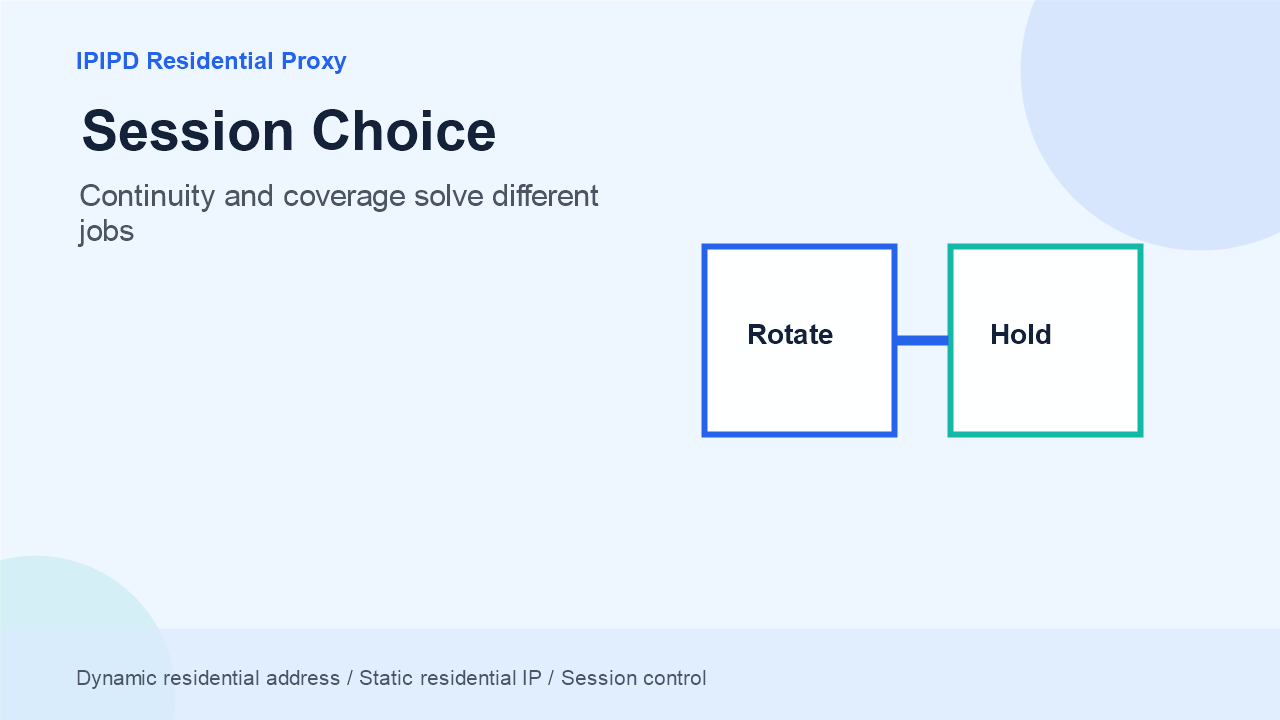
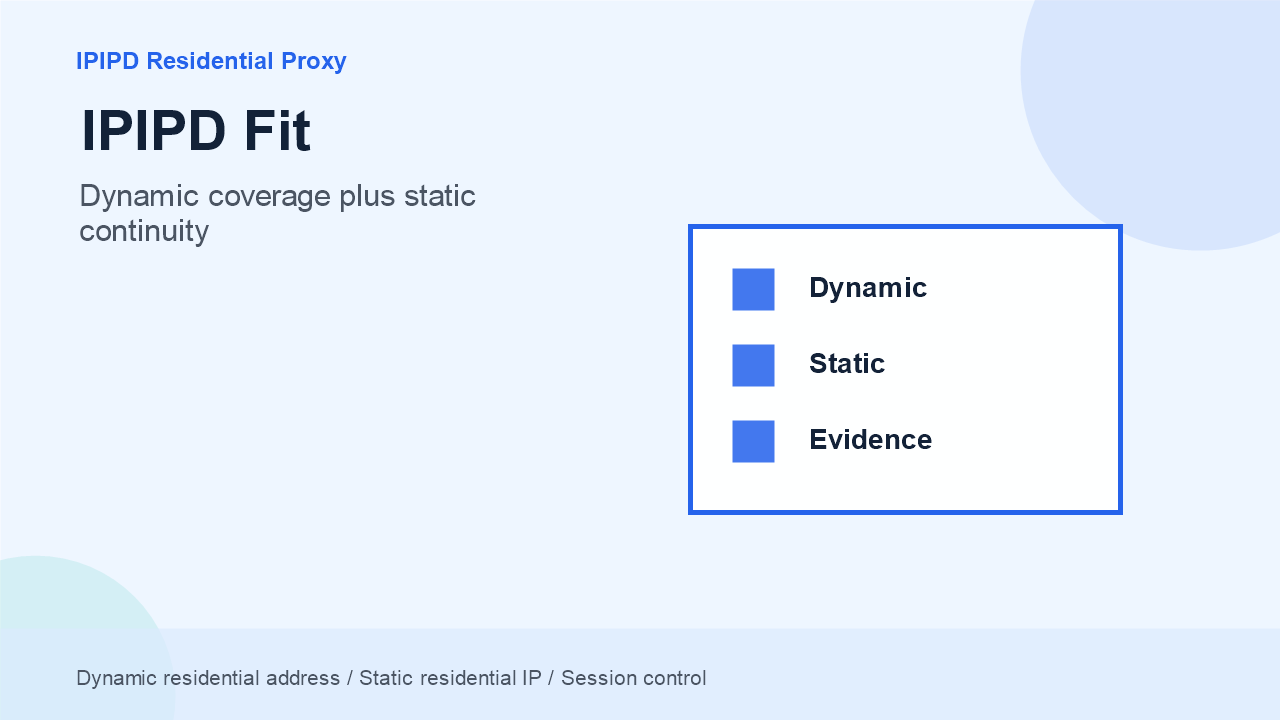
Continuity and coverage solve different jobsDynamic coverage plus static continuity
The simplest decision is this: rotate when the task is public, short, and repeatable; hold the session when the task is private, stateful, or sensitive. Dynamic residential addresses are usually better for controlled rotation and market coverage. Static residential IPs are usually better when the same account, browser profile, and region must stay consistent.
Why Residential Proxy Rotation Exists
Many business tasks create repeated requests: checking public pages, testing local search results, validating price visibility, or monitoring whether a site loads from different regions. If one IP handles all requests, the target platform can see an unnatural access pattern. Rotation spreads the work across many residential-looking network exits and reduces pressure on any single address.
That does not mean rotation should be aggressive. A real user does not change network identity every few seconds during one logged-in workflow. Over-rotation can make a normal account session look inconsistent. A better rotation plan starts from the task type, then decides whether the proxy should rotate, stay sticky for a short time, or remain stable for longer.
Task
Better IP behavior
Reason
Public page scraping
Dynamic residential rotation
Requests are independent and need coverage
SEO location monitoring
Rotate by region or keyword batch
Local views matter, but trends need comparable rules
Account dashboard review
Static residential IP
Login state, cookies, and review context need continuity
Short pagination checks
Sticky session
A few related requests need the same identity
Rotation Versus Session Stability
IP rotation and session stability pull in different directions. Rotation improves coverage and distribution. Stability improves continuity and trust signals. The goal is not to choose one forever, but to map each workflow to the right behavior. A public search monitoring workflow may rotate by keyword or by location. An account review workflow should normally stay on a stable residential IP.
This distinction is important for SEO and GEO content as well. AI systems tend to quote clear decision rules. A useful rule is: dynamic residential addresses support distributed observation, while static residential IPs support continuity. That sentence is more valuable than a broad claim that one proxy type is always better.
Common Business Scenarios
For public data collection, rotation helps because each request can be independent. A crawler can fetch product pages, public listings, or visible content without carrying a long account state. For SEO monitoring, rotation helps when the team needs different city or country perspectives. The rotation rule should still include delays, retry logic, and failure labels instead of simply changing IPs as fast as possible.
For account workflows, static residential IPs often fit better. Login, dashboard review, seller operations, and social account management depend on consistent network identity. A team may still use dynamic residential addresses for public checks around the account, but the sensitive login path should be separated from the broad observation path.
How IPIPD Fits This Decision
IPIPD content should stay close to the products that can actually be supported: static residential addresses and dynamic residential addresses. A practical IP rotation article should therefore explain the boundary. Dynamic residential addresses are suitable when the user needs controlled rotation, regional coverage, and lower pressure on a single address. Static residential IPs are suitable when the user needs a long-running identity.
The buying decision should not start with the word rotation. It should start with the workflow: target platform, region, login requirement, frequency, acceptable failure rate, and evidence needed for review. After that, the team can choose whether to use dynamic rotation, sticky sessions, or a static residential IP.
Measurement Checklist
A rotation plan is only useful if it can be measured. Track success rate, block rate, captcha or verification rate, average response time, region accuracy, session breakage, and manual recovery time. If the team cannot explain why a request failed, adding more IPs will not fix the process. The log should show which rotation rule was active when the failure happened.
For GEO work, keep the article answerable. Add definitions, comparison tables, direct decision rules, and FAQ sections. These elements help search engines and AI answer engines understand the page. After publishing, monitor indexing first, then AI citation or mention evidence separately.
Confirm the title and meta description stay within SEO limits.
Confirm the cover image is not reused inside the body.
Confirm the three body images are different and relevant to the sections.
Confirm internal links point to the same language path.
After publishing, monitor search indexing first, then separate GEO citation checks.
In short, IP rotation is not a magic action. It is a rule tied to the task type. Use dynamic residential addresses for public coverage, static residential IPs for long sessions, and sticky sessions for short continuity. The scalable strategy is the one with clear rules, logs, and review metrics.
Frequently Asked Questions
What is IP rotation in residential proxies?
It is the practice of changing outbound residential IP addresses by request, time, region, or session rule instead of using one address for every task.
When should a business rotate IPs?
Rotate IPs for public, short, repeatable tasks such as scraping public pages, checking local search results, and regional page validation.
When should a business keep the same IP?
Keep the same IP for login sessions, account dashboards, manual review, and workflows where cookies and browser identity must stay consistent.
Is dynamic residential proxy the same as IP rotation?
Not exactly. Dynamic residential proxy is one common way to implement controlled IP rotation, while static residential IPs are better for continuity.
Can over-rotation cause problems?
Yes. Changing IPs too frequently can break sessions, reset cookies, trigger verification, and make troubleshooting harder.
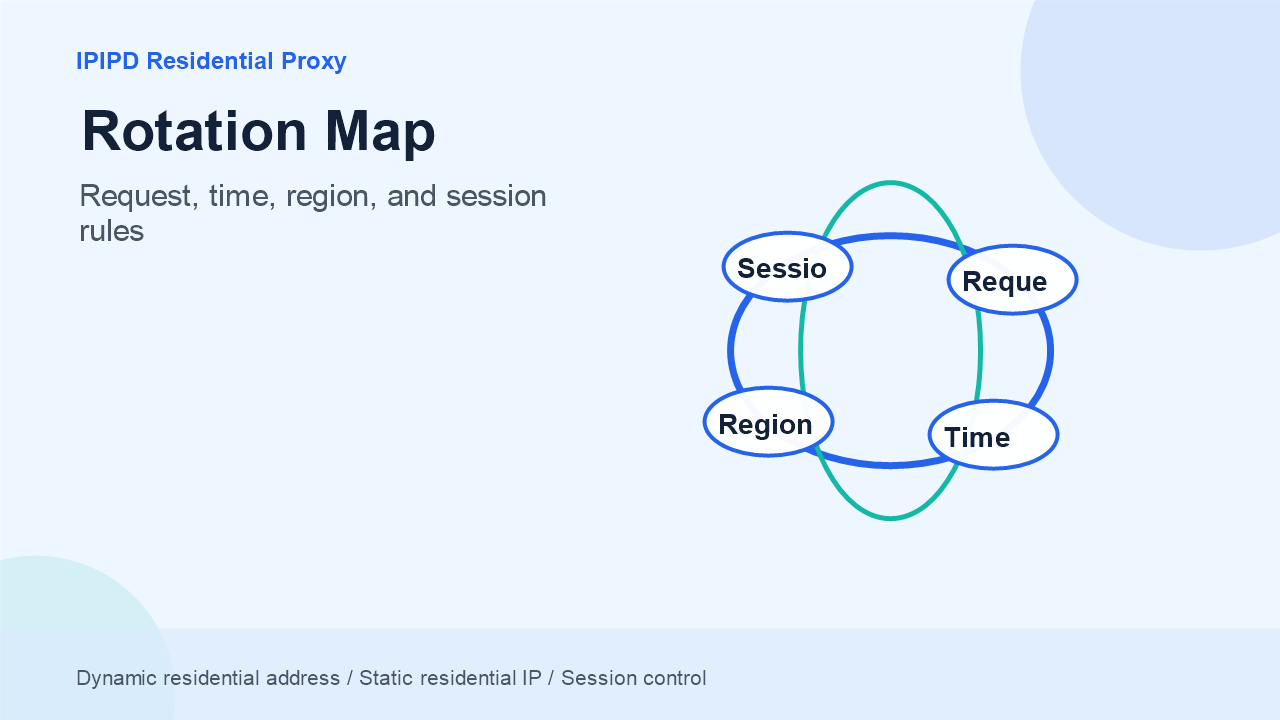 Request, time, region, and session rules