AI has made media production faster. A small team can now create headlines, scripts, captions, thumbnails, ad copy, landing page variants, and multilingual drafts in hours instead of weeks.
But faster production creates a new problem: generated content still has to be checked in the real markets where it will be seen.
A video script may sound natural in one country and awkward in another. A landing page may show a different language, currency, promotion, or redirect path depending on location. A search result page may expose different competitors in different markets. A platform feed may display different comments, topics, and recommendations by region.
That is where a residential proxy purchase becomes more than a technical purchase. For AI media teams, it can become part of a market validation workflow.
For technical background, Wikipedia describes a proxy server as an intermediary that forwards requests between a client and another server. This article focuses on the business workflow after that concept: how to use residential proxies responsibly to see region-specific platform behavior and make better growth decisions.
Quick Answer
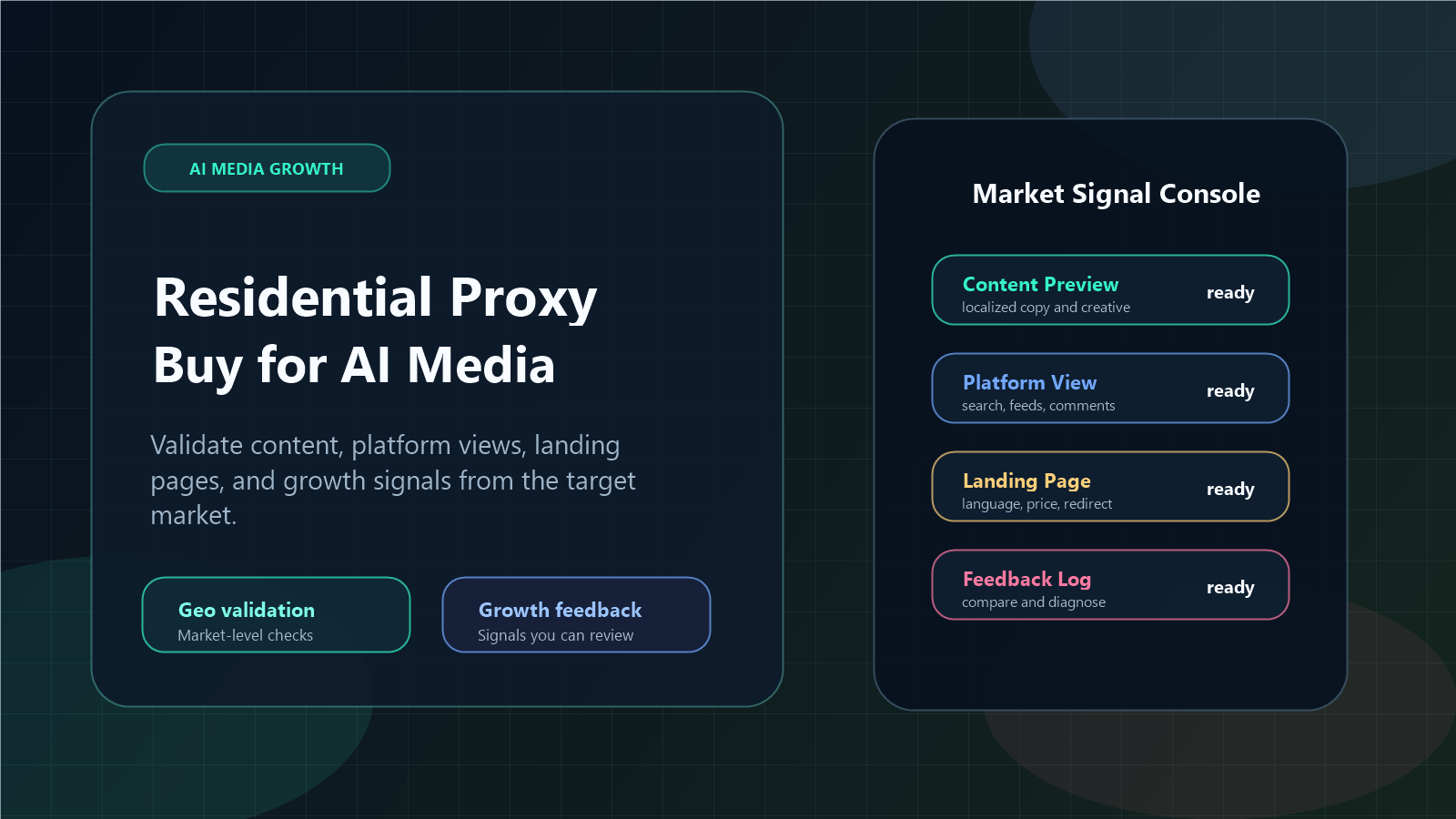
For AI media expansion, a residential proxy buy is useful because it helps teams check content, ads, landing pages, ecommerce pages, comments, and search results from a target-market perspective. The goal is not just to connect. The goal is to validate what users in a specific region actually see.
A practical workflow looks like this:
Generate AI content
Choose target markets
Check pages through regional residential proxies
Record platform display and landing page differences
Compare growth feedback
Revise content, accounts, and campaigns
This is different from treating proxy access as a generic connection tool. In AI media work, the setup should serve content validation, geo consistency, session persistence, and reviewable growth signals.
Why AI Media Teams Need a Target-Market View
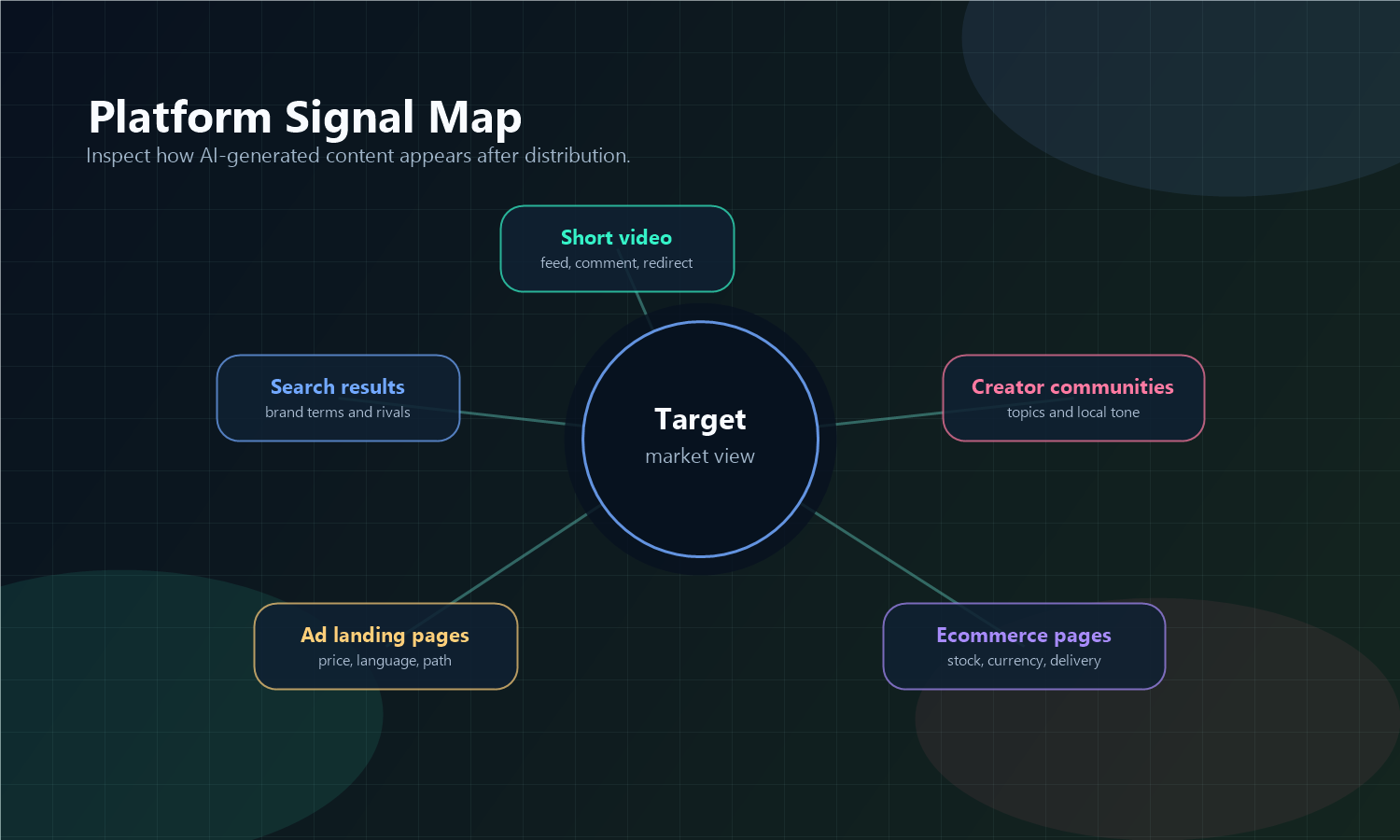
AI media teams often work across several channels at once: short-form video, creator communities, search pages, ad platforms, ecommerce pages, and brand monitoring workflows. Each channel may respond differently by region.
For example, a team may generate ten short-form video hooks for the United States, Japan, and the United Kingdom. The words may be translated correctly, but the local tone may still be wrong. A landing page may load in English from one market but show a different promotion from another. A product page may display another currency or shipping rule. A brand query may surface different competitors by country.
Without a target-market view, the team may misread the result. A campaign can look weak when the actual issue is a wrong landing page version. A script can look ineffective when the real issue is regional wording. A platform test can look inconsistent when the team is mixing different access environments.
This is why proxy planning should be connected to validation questions:
Validation Object
Weak Question
Better Question
AI content
Was the content generated?
Does it read naturally in the target market?
Overseas platform page
Can the page open?
Does the region, language, price, and recommendation match the campaign?
Landing page
Does the link load?
Does the target user see the expected version and redirect path?
Growth feedback
Did the metric move?
Did the movement come from creative quality, region display, or platform behavior?
If a team only asks whether the page opens, it misses the business signal. A better validation workflow asks whether the page opens as the right market, at the right time, with the right version.
Start With the Platform Task, Not the Package
Many buyers compare traffic volume, IP count, package price, and region coverage first. Those details matter, but they are not the best starting point.
For AI media teams, the better starting point is the platform task.
Currency, stock, shipping rule, promotion, product page version
Brand monitoring
Regional search exposure, reviews, mentions, and competitor pages
If the job is to see what a user in a target country sees, geo accuracy is more important than raw speed. If the job is to maintain a long-term account environment, session persistence is more important than frequent rotation. If the job is to check many public pages, request rhythm and usable-result cost matter more than a large headline traffic number.
This is why proxy access should be planned by workflow. The same setup should not be used casually for content research, account access, ad verification, and bulk page checks. Each task has a different risk and a different signal value.
For teams that include public web data collection in their process, the related guide Web Scraping Proxy Complete Guide is a useful next read. It focuses on access rhythm, retry logic, and data collection structure. This article stays focused on residential proxy decisions for AI media validation and growth feedback.
The biggest mistake in AI media operations is stopping at content generation.
Generating 30 headlines, 20 scripts, or 10 landing page variants is only the first step. The real question is whether those assets survive contact with overseas platforms and local market display rules.
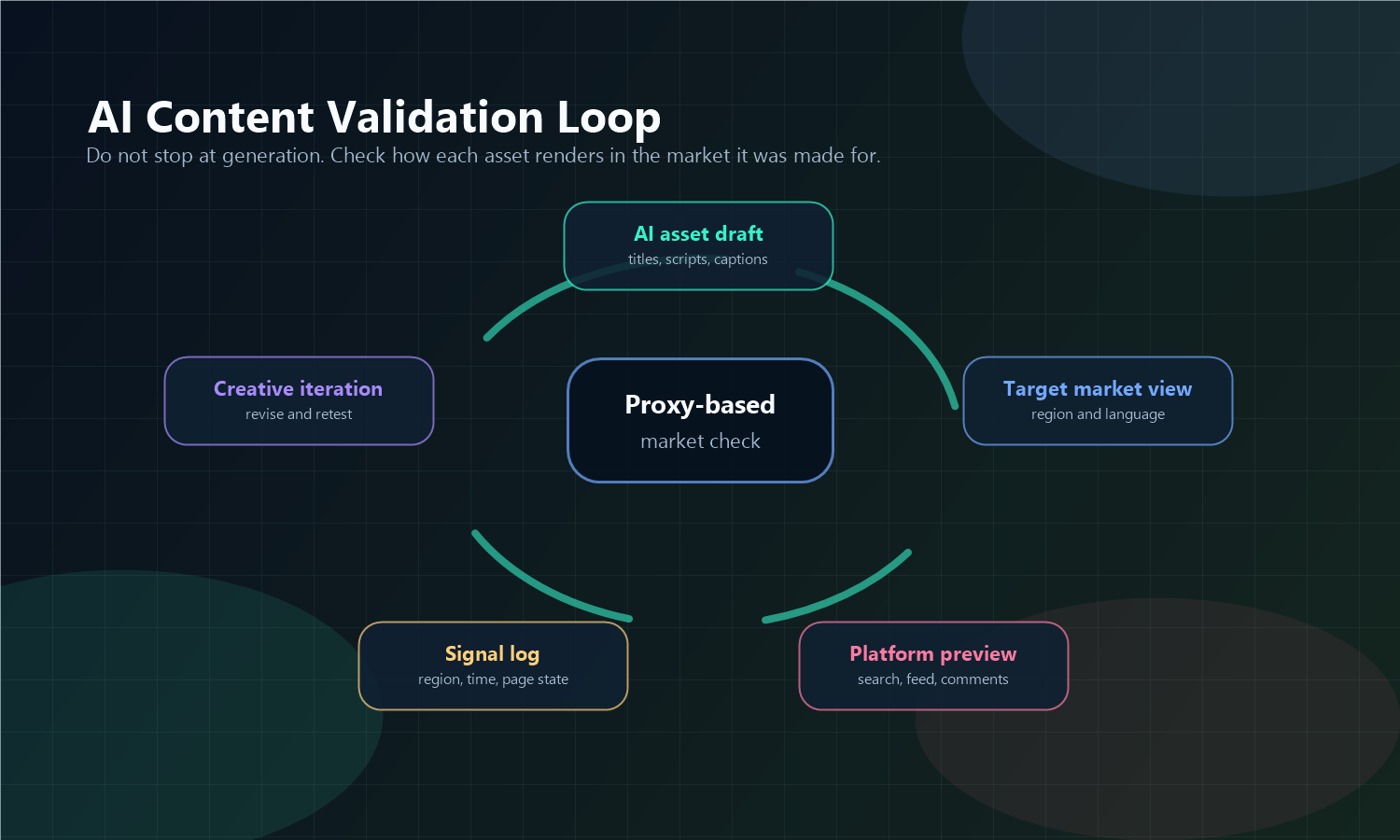
A stronger loop looks like this:
Step
What to Check
Content generation
Headline, script, caption, visual text, and landing page copy
Market selection
Country, language, currency, platform, and audience segment
Regional preview
Whether the target-market version appears correctly
Platform check
Search result, feed display, comment context, ad redirect, landing page version
Signal logging
Region, time, asset version, page state, error type, and reviewer note
Iteration
Adjust copy, creative, targeting, account setup, or landing page flow
In this loop, the proxy setup is not only an IT resource. It supports content, marketing, operations, and analytics teams at the same time.
For example, imagine a team testing three landing page variants for a product launch. If the team only checks from its local network, it may not notice that the target country sees a different currency or promotion. If the team checks through unstable regions without logs, it may not know whether a conversion change came from the creative or from page display drift.
The better approach is to record each validation round:
US market: creative version A/B/C, page language, offer display, comment context
Japan market: creative version A/B/C, landing page redirect, campaign copy, search result
EU market: creative version A/B/C, currency display, privacy notice, regional offer
Once the team records these checks, residential proxy access becomes part of a repeatable growth process. It helps reduce guesswork, not just change the access route.
Separate Account Environments From Research Tasks
AI media expansion often mixes several activities: content research, creator discovery, creative testing, ad verification, social account management, ecommerce checks, and review monitoring. These activities may all involve overseas platforms, but they should not always share the same proxy setup.
Content research needs breadth. A team may want to inspect topics, search results, trending posts, competitor pages, or local comments across several countries. This usually requires region coverage and controlled switching.
Account operations need stability. A long-term dashboard, creator account, store account, or ad account should not jump between unrelated environments. For this layer, session persistence, fixed region discipline, and lower change frequency matter more.
Ad verification needs accuracy. The team must confirm whether a campaign shows the right offer, language, landing page, and redirect path in the target market. For this layer, the most important question is whether the observed page matches the campaign expectation.
Growth review needs traceability. When a result changes, the team should know whether the change came from the creative, the market, the platform page, the account environment, or the validation method.
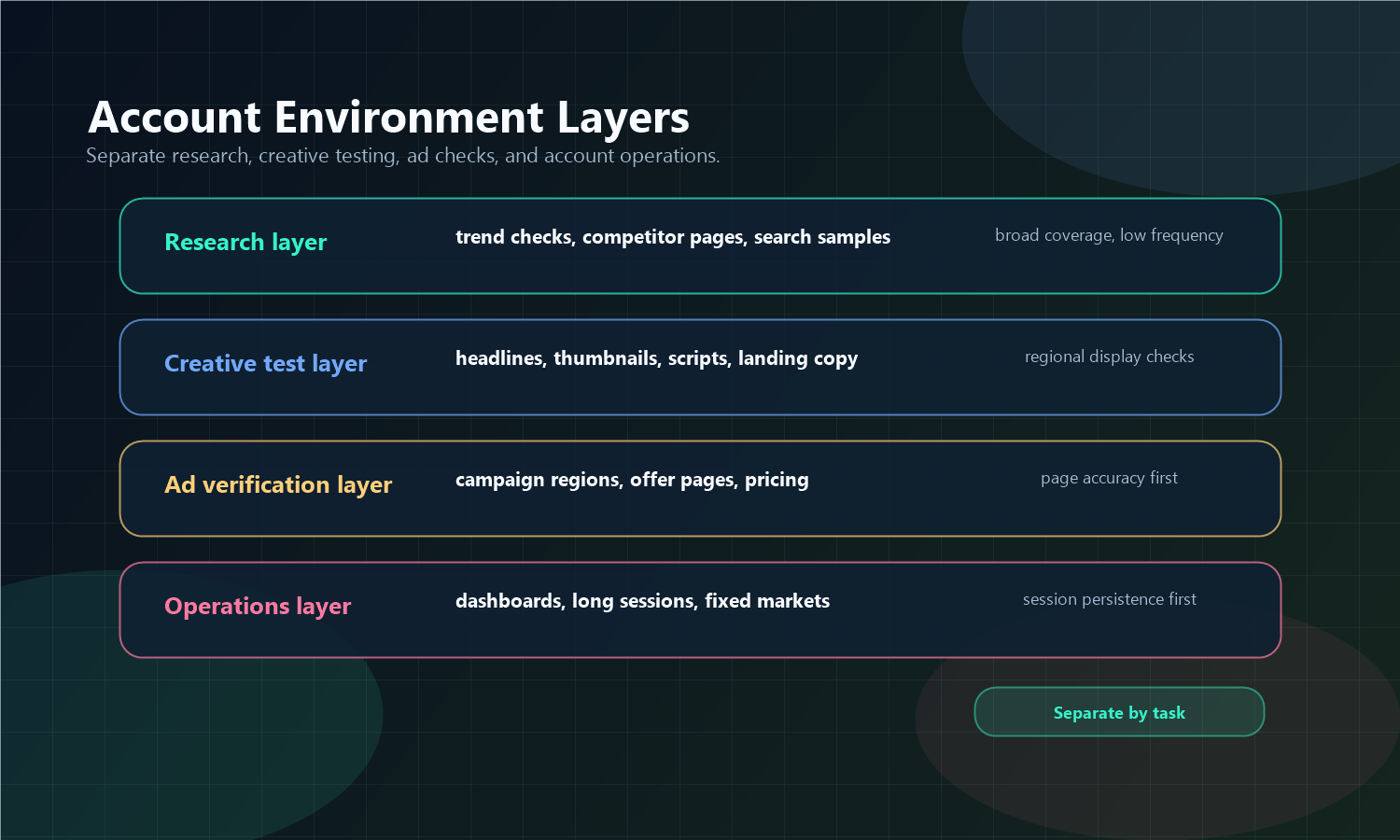
A simple layer model helps:
Layer
Best-Fit Tasks
Proxy Planning Focus
Research layer
Trends, competitor pages, local topics, search samples
When all these tasks share one uncontrolled setup, diagnosis becomes difficult. A drop in ad performance may actually be a landing page display issue. An account prompt may come from environment changes caused by research activity. A content test may look weak because the page version was wrong.
The cleaner rule is this: separate proxy usage by task, not by whoever happens to need access that day.
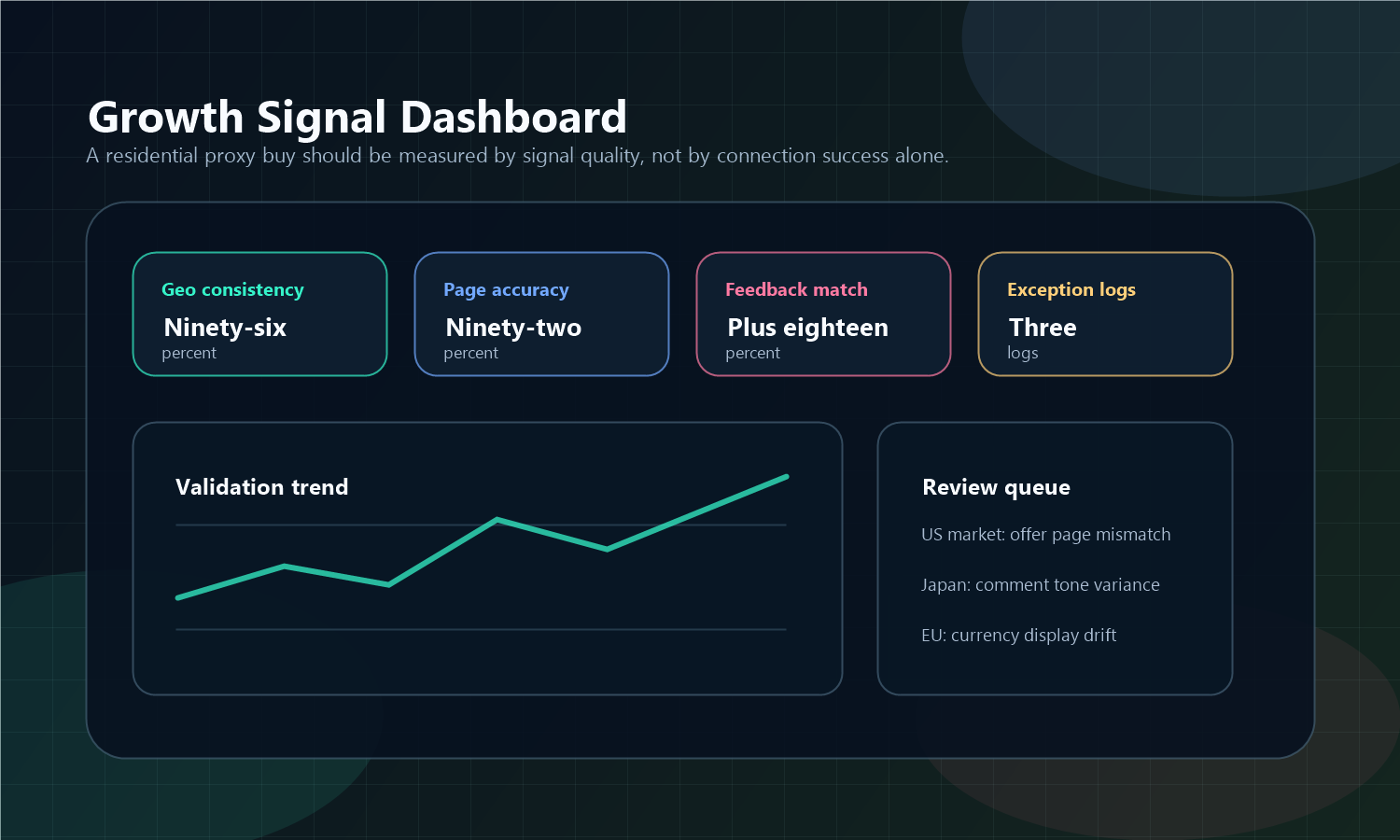
Measure Signal Quality, Not Only Connection Success
Traditional proxy testing often checks three things: connection, speed, and success rate. Those are useful, but they are not enough for AI media expansion.
The better metric is growth signal quality.
Signal
Why It Matters
Geo consistency
Confirms whether the target market displays reliably
Page accuracy
Confirms language, price, promotion, and redirect behavior
Content readability
Shows whether AI content feels natural in the local context
Feedback comparability
Makes asset versions easier to compare
Exception traceability
Helps explain failures, redirects, and display differences
If a proxy plan is fast but often shows the wrong region, it has limited value for platform validation. If a plan is cheap but creates many failed checks and unclear logs, the real cost may be higher than it looks.
For AI media work, the budget should be connected to useful outcomes:
Cost per verified target-market landing page.
Cost per checked AI creative variant.
Cost per reliable regional platform observation.
Cost per stable account environment.
Cost per reviewable growth signal.
This helps the team decide which markets deserve more testing, which tasks should run less often, and which workflows need a more stable setup.
Before buying residential proxies, write the requirement as a validation checklist. This keeps the team from buying only by package size.
Question
What to Define
What is the main platform task?
Research, creative testing, ad verification, account operation, ecommerce check, or brand monitoring
Which markets matter?
Country, city, language, currency, platform, and campaign region
Does the task need session persistence?
Usually important for account operations and long-term dashboards
Does the task need regional switching?
Usually important for research and multi-market checks
How often will validation run?
Daily, weekly, before launch, during campaign, or after anomaly
Who records the result?
Content, ads, operations, analytics, or proxy owner
What counts as success?
Correct region, correct page, comparable feedback, and traceable exceptions
After this table is filled, the purchase discussion becomes clearer.
Instead of asking only "how much traffic do we get?", the team can ask:
Can this region reliably show the target platform view?
Does this workflow require static access or rotating access?
Can AI content variants be checked from the right market?
Can landing page differences be recorded by region and time?
Can failures be diagnosed without restarting the whole test?
Those questions are closer to business results than traffic volume alone.
Conclusion
AI makes content production faster, but faster production is not the same as better overseas growth.
Teams still need to know whether an AI-generated headline, script, caption, offer page, or ad creative works in the market where it will be seen. They also need to separate content quality problems from region display problems, landing page problems, platform behavior, and account environment issues.
That is the real role of residential proxies in AI media expansion. They are not just an access route. They are a validation layer that helps teams check market-specific pages, preserve stable workflows, compare signals, and make better growth decisions.
When planned this way, proxy access becomes part of the growth stack: content generation, target-market preview, platform validation, account environment management, and reviewable data feedback.
Why does AI media expansion need a residential proxy buy?
AI media teams need to validate how content, ads, landing pages, comments, search results, and ecommerce pages appear in target markets. The right proxy setup helps the team inspect region-specific platform behavior instead of judging content only from a local network view.
Does a residential proxy buy generate AI content?
No. Residential proxies do not generate content. They help validate how AI-generated content appears across regions, languages, platforms, and landing pages. The value is in market checking, not content creation.
Should AI media teams use static or rotating residential proxies?
Use stable access when the task needs session persistence, long-term account access, or fixed-region comparison. Use rotating residential proxies when the task needs multi-market research, regional sampling, or broader page checks. The right choice depends on the workflow.
What is geo-targeted validation?
Geo-targeted validation means checking a page, platform result, ad, or content asset from the perspective of a specific region. In practice, it helps teams confirm whether language, price, offer, redirect path, and platform display match the target market.
Is connection success enough for overseas platform validation?
No. A successful connection only proves that the page opened. AI media teams also need geo consistency, page accuracy, content readability, comparable feedback, and traceable exceptions.
How is this article different from the first two residential proxy buy guides?
The first guide explains how to buy by scenario. The second guide explains how teams should deploy and manage proxy access after purchase. This article explains how residential proxies support AI media expansion, overseas platform validation, and growth signal review.