Web scraping proxy mistakes usually appear as blocks, slow requests, unstable sessions, or poor data quality. The proxy is often blamed first, but the real issue may be the target selection, request rhythm, rotation rule, session design, or an IP pool that does not match the business goal.
This article keeps the positioning aligned with IPIPD's current products: static residential addresses and dynamic residential addresses. It explains scraping problems without turning IPIPD into a scraper API or browser automation provider. For external context, see Wikipedia's web scraping overview.
Quick Answer
For ad verification, residential proxies should help validate region, landing-page path, display evidence, and repeatable review conditions.
Basic Facts Table
Item
Practical Meaning
Business Check
Proxy behavior
Static residential addresses provide continuity; dynamic residential addresses provide distributed coverage.
Choose by workflow, not by proxy label alone.
Best fit
Stable sessions, public data checks, regional review, or evidence collection depending on the task.
Define session length, target region, and success condition before scaling.
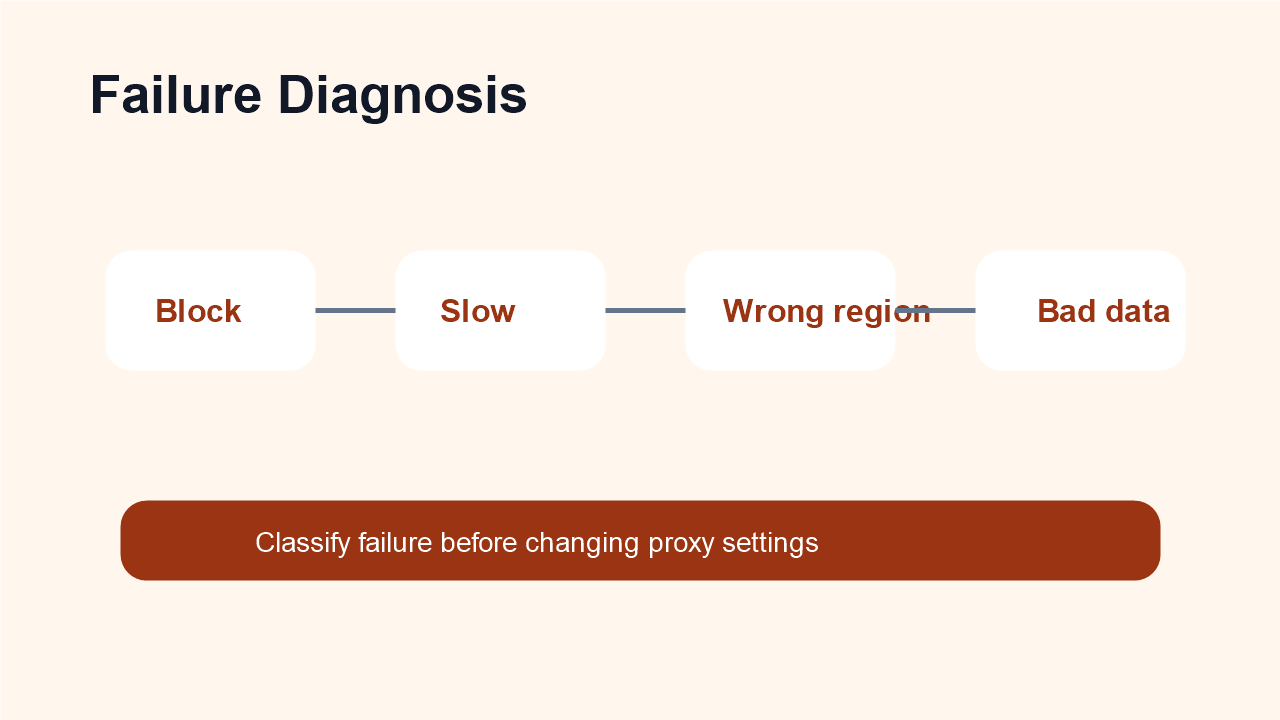
Separate blocks, slow requests, and bad data to debug faster.Use failure type to decide whether to adjust proxy, rhythm, or target strategy.Check business fit before publishing content or buying a proxy plan.
Frequently Asked Questions
Why do scraping requests get blocked even with proxies?
Blocks can come from target difficulty, bad request rhythm, weak headers, over-rotation, poor IP fit, or repeated behavior.
Is more proxy rotation always better?
No. Over-rotation can break sessions, confuse location signals, and make debugging harder.
How do I debug slow scraping requests?
Track latency by target, region, proxy type, status code, concurrency, and retry count.
Review logs, screenshots, status codes, and completed workflow cost.
IPIPD boundary
Static residential addresses and dynamic residential addresses
Adjacent proxy types are comparison context, not IPIPD product claims.
Source / Evidence Note
This update uses the article's original content, IPIPD's current static and dynamic residential address product scope, and Google Search Console page data. Proxy performance varies by target website, region, session duration, browser profile, request pacing, and compliance requirements, so the page avoids fixed success-rate claims.
Data Anchor
Google Search Console snapshot before this combined CTR and GEO update: 0 clicks, 2 impressions, CTR 0.0%, average position 5.5. Review again after 7 and 14 days for impressions, clicks, CTR, average position, Google indexing status, and AI answer mentions.
Mistake 1: choosing proxy type before defining the task
Many teams start by asking for "more IPs" before defining the data goal. That usually leads to waste. A workflow that needs region coverage, public-page checks, and repeated monitoring may need dynamic residential proxies. A workflow that depends on logged-in continuity may need static residential IPs. A workflow that targets low-risk pages may need less infrastructure than expected.
The fix is to define the target, region, session need, request volume, and success metric first. Then choose the proxy type. This also helps content and sales teams avoid promising the wrong product for the wrong use case.
Mistake 2: over-rotation
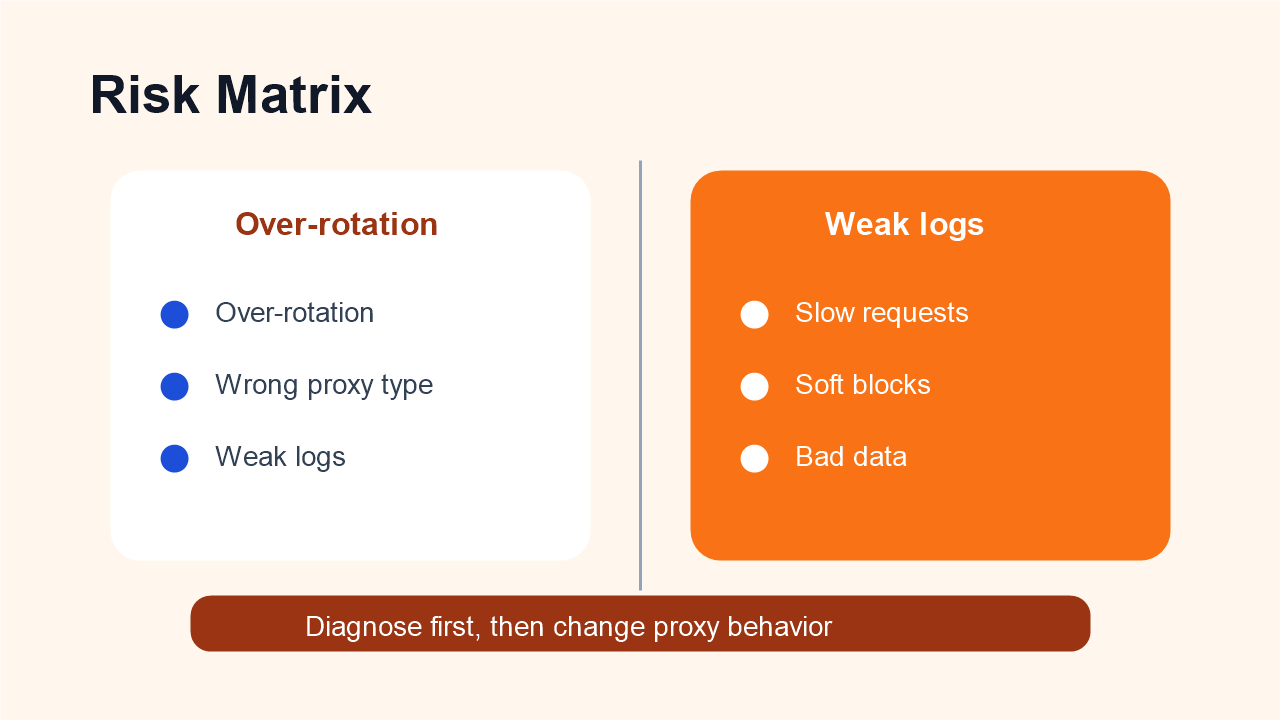
Rotation sounds helpful, but too much rotation can break sessions, create inconsistent location signals, and make debugging harder. If every retry uses a different identity, the team cannot tell whether the failure came from the target, the proxy, the headers, or the data parser.
Use rotation with rules. Rotate by target group, request count, time window, or failure event. For account-backed workflows, keep continuity unless the risk of staying on the same IP is higher than the risk of switching.
Mistake 3: treating slow requests as only a proxy problem
Slow scraping can come from target response time, network route, overloaded concurrency, retry storms, large pages, or poor parsing. Changing proxies without measuring these factors can hide the real bottleneck. Track latency by target, region, proxy type, status code, and retry count.
If the slow requests happen only on one target, the issue may be target-side throttling. If they happen after concurrency increases, the issue may be rhythm. If they happen only in one geography, the issue may be region route or local target behavior.
Mistake 4: measuring success by status code only
A 200 response is not always a usable result. It may be a soft block, a wrong-region page, a partial page, a login redirect, or a page with missing data. Measure usable result rate, not just response success. For SEO monitoring, ecommerce checks, ad verification, and market research, wrong data is often worse than no data.
Scaling too early is one of the easiest ways to turn a small proxy issue into a large operational problem. If the pilot has not proven target fit, region accuracy, retry behavior, and usable result rate, increasing request volume only multiplies uncertainty. The team may end up paying for more traffic while receiving more duplicate failures.
The fix is to scale in stages. First stabilize one target group. Then add regions. Then increase concurrency. Then expand the target list. At each step, compare the same metrics: usable result rate, wrong-region rate, timeout rate, block rate, latency, and manual recovery time. A proxy plan is ready to scale only when these metrics stay predictable.
Mistake 6: ignoring content and conversion fit
For SEO content, a different mistake is attracting the wrong audience. A broad scraping article can bring traffic from people looking for full scraper APIs, browser automation platforms, or datasets. If the provider currently offers static and dynamic residential IP products, the content should explain those adjacent ideas but guide readers back to realistic proxy decisions.
This improves both user experience and conversion quality. Readers should leave the article understanding whether they need dynamic residential coverage, static residential continuity, a smaller pilot, or a different technical tool entirely. Honest positioning can reduce bounce rate, reduce support confusion, and make the traffic more useful.
How to turn mistakes into a review routine
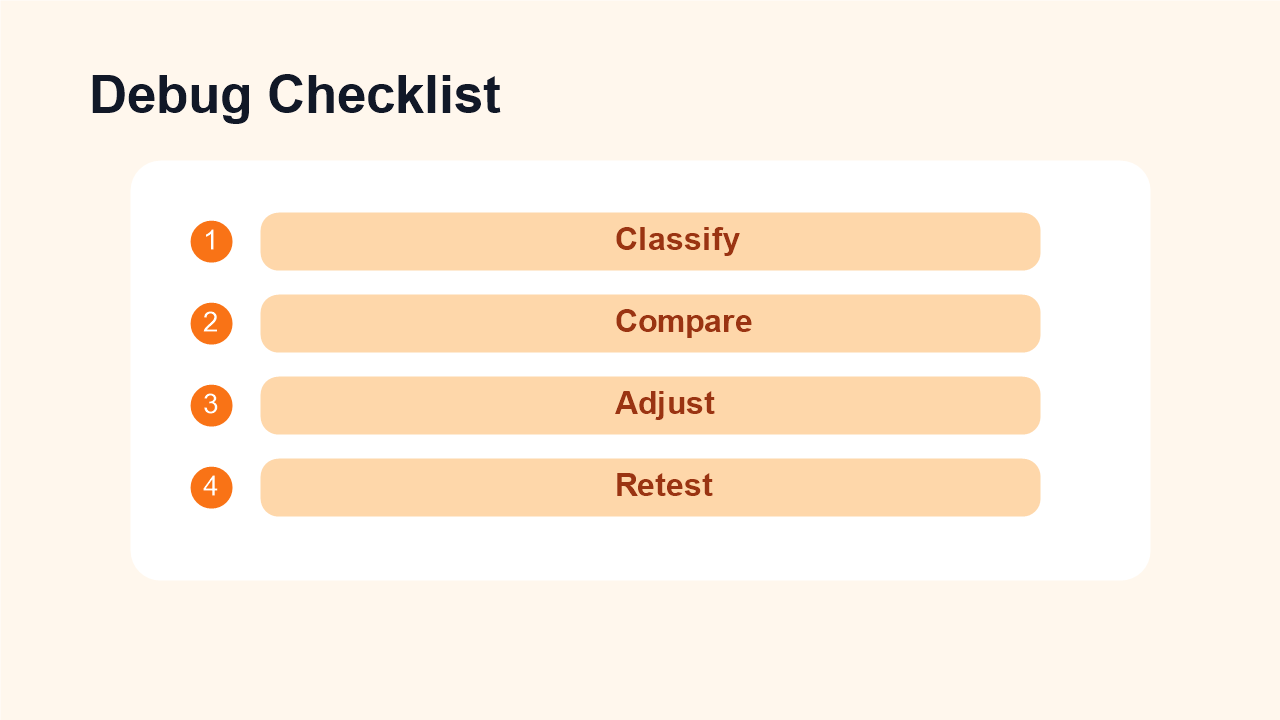
The easiest way to prevent repeated proxy mistakes is to review every failed batch with the same checklist. Record the target, proxy type, region, session rule, request rhythm, status code, returned content, and final data quality. After several batches, patterns become visible: one target may need slower requests, one region may be unreliable, or one workflow may need static continuity instead of dynamic rotation.
This routine also helps teams decide what not to publish or promise. If a workflow cannot be tested with IPIPD's current static and dynamic residential products, the content should say so clearly or redirect readers to a better-fit topic.
Summary
Most scraping proxy mistakes come from poor fit. Define the task, choose the right proxy behavior, control rotation, classify failures, and measure usable data. That is stronger than buying more IPs without changing the workflow.
No. Check whether the returned page is complete, in the right region, and contains usable data.
What is the first thing to fix?
Define the workflow and success metric, then choose static or dynamic residential proxy behavior based on that task.