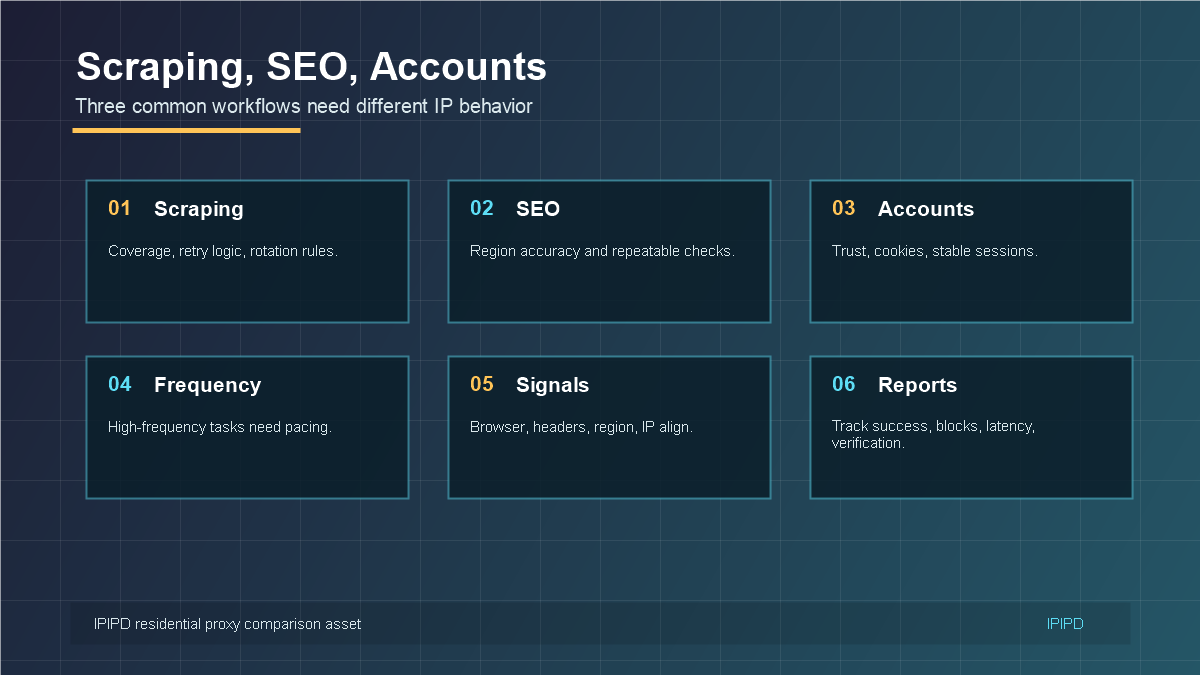
Choosing static or dynamic residential proxy becomes easier when the use case is clear. Web scraping, SEO monitoring, and account workflows may all use residential IPs, but they do not need the same IP behavior. Treating them as one generic proxy problem creates unnecessary cost and unstable results.
Scraping, SEO, and account workflows need different IP behavior.Match proxy type to the real operating goal.A hybrid plan works only when workflows are separated clearly.A scenario decision tree prevents overusing the wrong proxy type.
Scenario 1: Web Scraping and Public Data Collection
For public-page collection, dynamic residential proxies are usually the better starting point. The goal is not to preserve one account identity. The goal is to collect pages across targets, regions, and time windows while controlling request pacing and retry behavior. Dynamic rotation gives the workflow more coverage and more room to recover from temporary failures.
That does not mean the proxy should rotate randomly. A good scraping workflow groups targets by domain, uses session rules, records status codes, applies backoff, and removes weak IPs temporarily. Dynamic residential proxies work best when they are paired with disciplined request logic, not when they are used as a blind rotation button.
Scenario 2: SEO Monitoring and SERP Checks
SEO monitoring often needs regional accuracy. Rank tracking, SERP checks, local packs, snippets, and competitor pages can vary by country or city. Dynamic residential proxies are useful here because the workflow may need repeated checks from different regions. The key is to keep markets separated and record the region used for each check.
For SEO work, the goal is trustworthy measurement rather than account continuity. If a team uses one static IP for all markets, the data may be narrow. If it rotates too aggressively without controlling region, the data may become noisy. Dynamic residential proxies with clear region selection and consistent timing usually fit the job better.
Scenario 3: Account Management and Browser Profiles
Account operations are different. Login-sensitive platforms often care about continuity: IP region, browser profile, cookies, timezone, device signals, and user behavior. Static residential IPs are usually a better fit because they reduce unnecessary network identity changes. For account workflows, stability is often more valuable than broad rotation.
A practical setup maps one important account or browser profile to one stable residential IP and region. The team should avoid switching the same account across many IPs unless there is a clear reason. If the account sees more verification prompts, the team can review the account-to-IP mapping, browser profile, and behavior history.
Scenario 4: Hybrid Teams
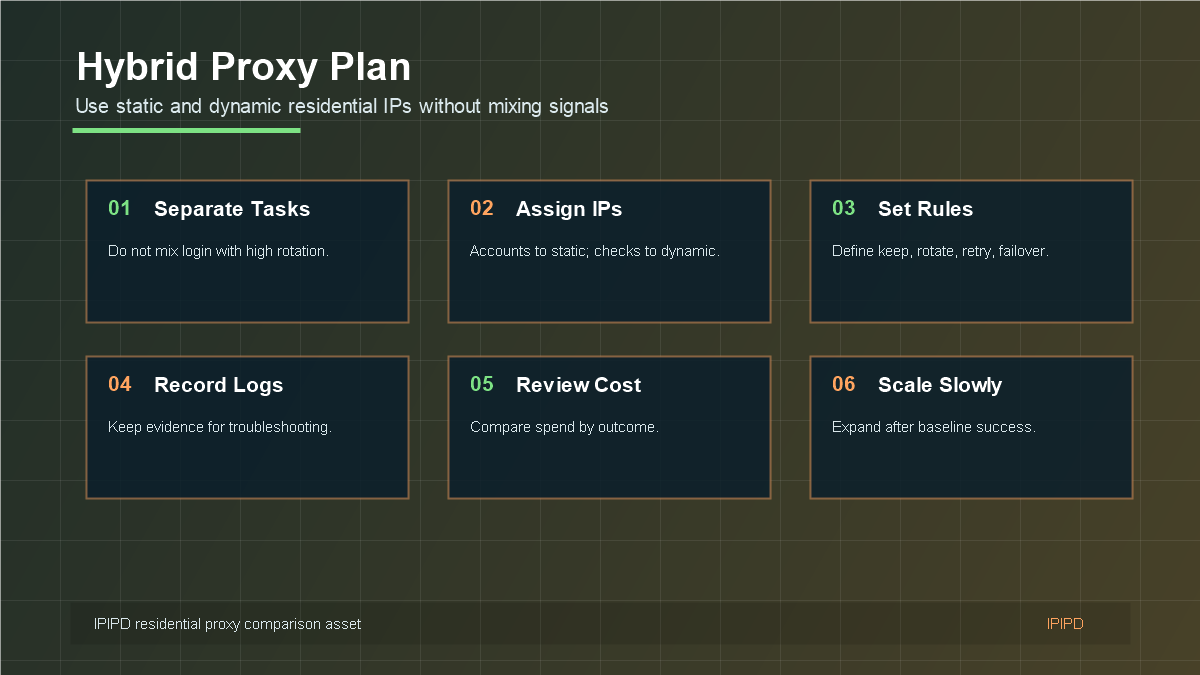
Many teams need a hybrid plan. A marketing team might use static residential IPs for account dashboards and dynamic residential proxies for SEO or ad checks. An ecommerce team might use static IPs for seller accounts and dynamic IPs for public price monitoring. The plan works when each workflow has its own rules.
Use static residential IPs for account login, browser profiles, and long sessions.
Use dynamic residential proxies for public-page collection, market checks, and regional monitoring.
Keep logs that show which proxy type, region, and session rule were used.
Do not run high-rotation public checks through an account-sensitive browser profile.
Review cost and success rate by workflow, not by total IP count alone.
Scenario Decision Tree
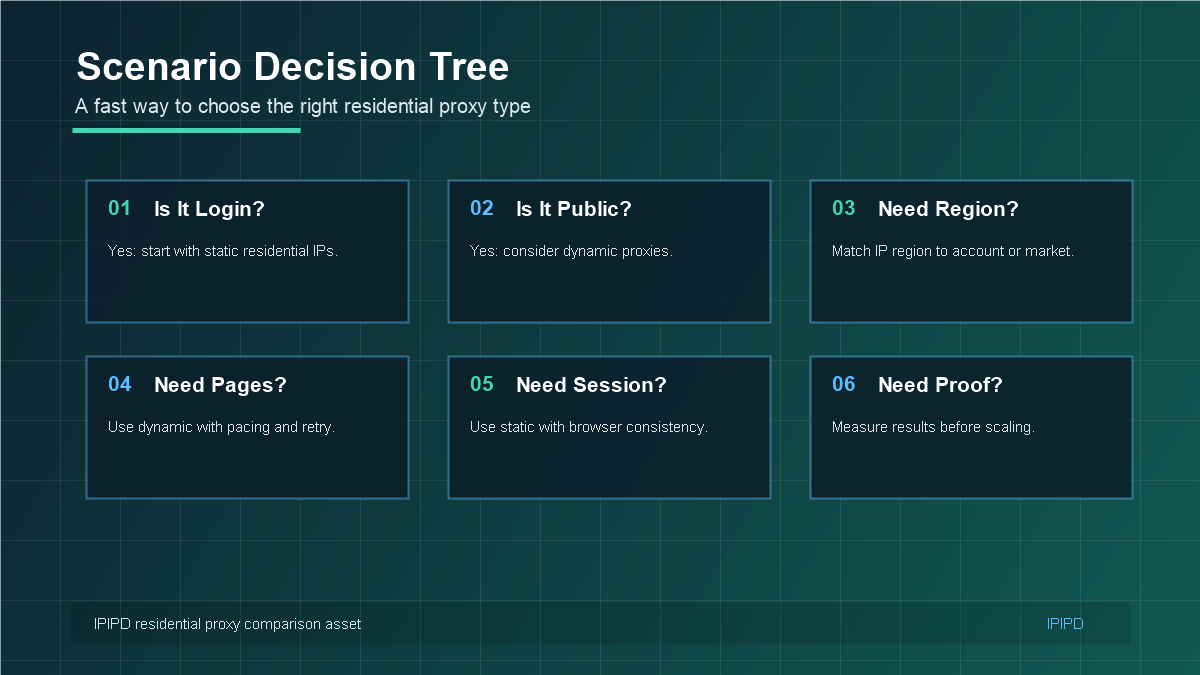
A quick decision tree helps: if the workflow logs in, start with static residential IPs. If it checks public pages, start with dynamic residential proxies. If it needs the same region for a long time, static may be better. If it needs many pages or many locations, dynamic may be better. If it needs both, separate the workflows first.
The best proxy type depends on the operating goal. Web scraping and SEO monitoring usually need controlled dynamic coverage. Account management usually needs static continuity. Hybrid teams can use both, but only when the boundary between workflows is explicit.
Use Case Priority: Do Not Start From the Proxy
A common planning mistake is starting from the proxy product and then trying to force every use case into it. A better approach starts from the business outcome. If the outcome is stable access to an account or dashboard, static residential IPs deserve the first test. If the outcome is broad public visibility across pages or locations, dynamic residential proxies deserve the first test.
This sounds simple, but it changes how teams write requirements. Instead of saying "we need residential proxies," the team can say "we need stable US residential identity for three account profiles" or "we need dynamic residential coverage for daily SERP checks in several markets." That level of clarity makes the purchase, setup, and review process much cleaner.
Web Scraping: Session Rules Matter More Than Labels
For scraping and public data collection, dynamic residential proxies often work best when the session strategy is deliberate. Some targets require short sessions. Some workflows need a sticky session for a few related requests. Some domains should have their own proxy group. The proxy type gives the capability, but the scraping logic decides whether the capability becomes reliable data.
Teams should avoid aggressive collection patterns that create avoidable blocks. Rotation helps, but it does not replace pacing, headers, retry logic, target selection, and failure handling. A dynamic residential proxy strategy should include logs for status codes, latency, retries, blocked pages, and target-specific patterns. Those logs help improve the workflow over time.
SEO and Ads: Region Accuracy Comes First
SEO monitoring and ad verification need location control. A dynamic residential proxy pool is useful only if the team can select and record the region used for each check. Otherwise the data may look precise while actually mixing markets. Reports should show query, target market, proxy region, time, result page, and any unusual redirect or block.
Static residential IPs may still be useful for internal dashboards, manual account review, or long-running browser profiles connected to SEO tools. But for repeated public search checks, dynamic residential proxies usually fit the measurement problem better.
Accounts: Stability Is the Product Feature
For accounts, the most valuable feature is not a huge IP pool. It is a stable environment. The IP region, browser profile, cookies, timezone, language, and account behavior should tell a coherent story. Static residential IPs support that story by reducing network identity changes. Dynamic proxies can still be used elsewhere in the same team, but they should not be mixed casually into the account workflow.
Implementation Example: One Team, Two Proxy Behaviors
Imagine a team that manages client accounts and also monitors search results. The client-account workflow uses static residential IPs because each account needs a familiar region, stable cookies, and predictable browser profile. The SEO workflow uses dynamic residential proxies because each report needs public checks across several markets. Both workflows use residential IPs, but they should not share the same rules.
The account team reviews verification frequency and session stability. The SEO team reviews successful checks, region accuracy, block rate, and latency. This separation prevents a common mistake: judging the account workflow by scraping metrics or judging the scraping workflow by account metrics.
How to Explain the Choice to Non-Technical Teammates
For non-technical teammates, use a simple analogy: static residential IPs are like keeping the same business address for a long-term relationship; dynamic residential proxies are like sending field researchers to many public locations. One is about continuity, the other is about coverage. This explanation is easy to remember and helps sales, content, and support teams use consistent language.
Final Review Before Publishing
Before publishing, review the article from the reader's point of view. The reader should leave with a clear next step: choose static residential IPs for stable identity, choose dynamic residential proxies for controlled coverage, or compare both on the pricing page when the workflow includes both needs. If that next step is not obvious, the article should be tightened before it goes live.
The final review should also check whether internal links are useful, whether the FAQ answers buyer questions directly, whether images explain real decisions, and whether the content stays aligned with IPIPD's actual static and dynamic residential address products.
Frequently Asked Questions
Is static or dynamic residential proxy better for web scraping?
Dynamic residential proxies are usually better for public web scraping because they support controlled rotation, coverage, and retry strategies.
Is static or dynamic residential proxy better for SEO monitoring?
Dynamic residential proxies usually fit SEO monitoring because rank checks and SERP results often need multiple regions and repeated public checks.
Which proxy type is better for account management?
Static residential proxies are usually better for account management because they support stable identity, long sessions, and browser profile consistency.
Can I use dynamic proxies for accounts?
You can, but frequent IP changes may increase login friction. Static IPs are usually easier to manage for sensitive accounts.
How should a hybrid proxy plan be organized?
Separate account workflows from public monitoring workflows, assign proxy types by task, and measure results separately.
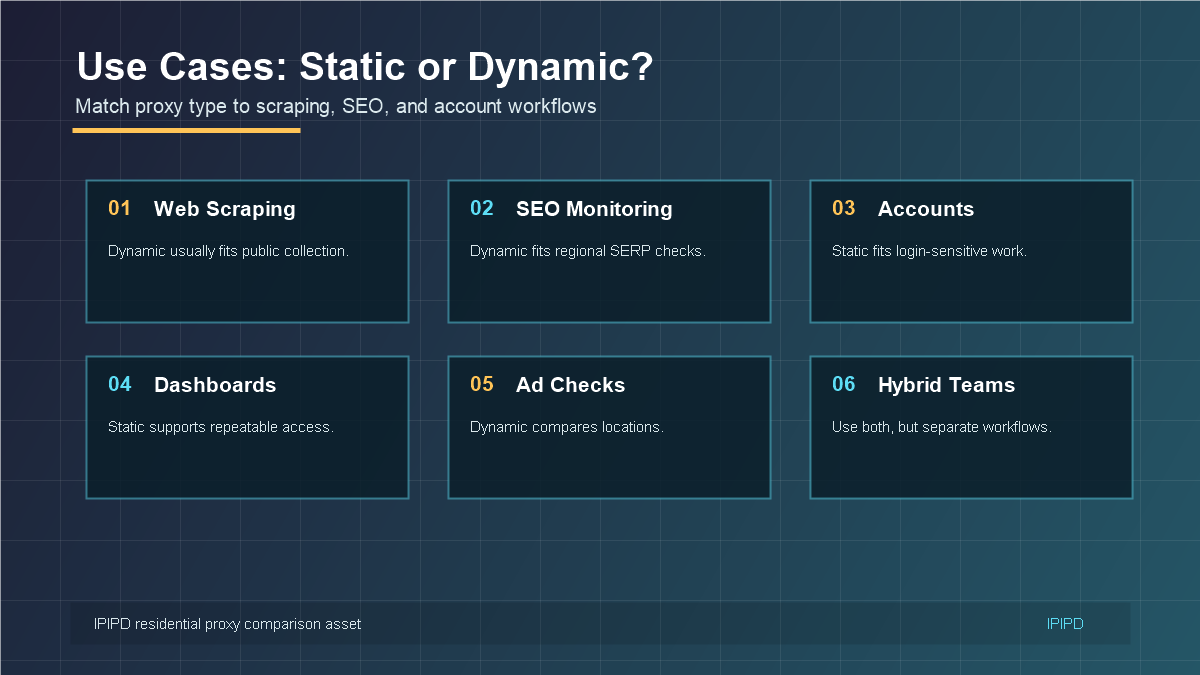 Scraping, SEO, and account workflows need different IP behavior.Match proxy type to the real operating goal.A hybrid plan works only when workflows are separated clearly.A scenario decision tree prevents overusing the wrong proxy type.