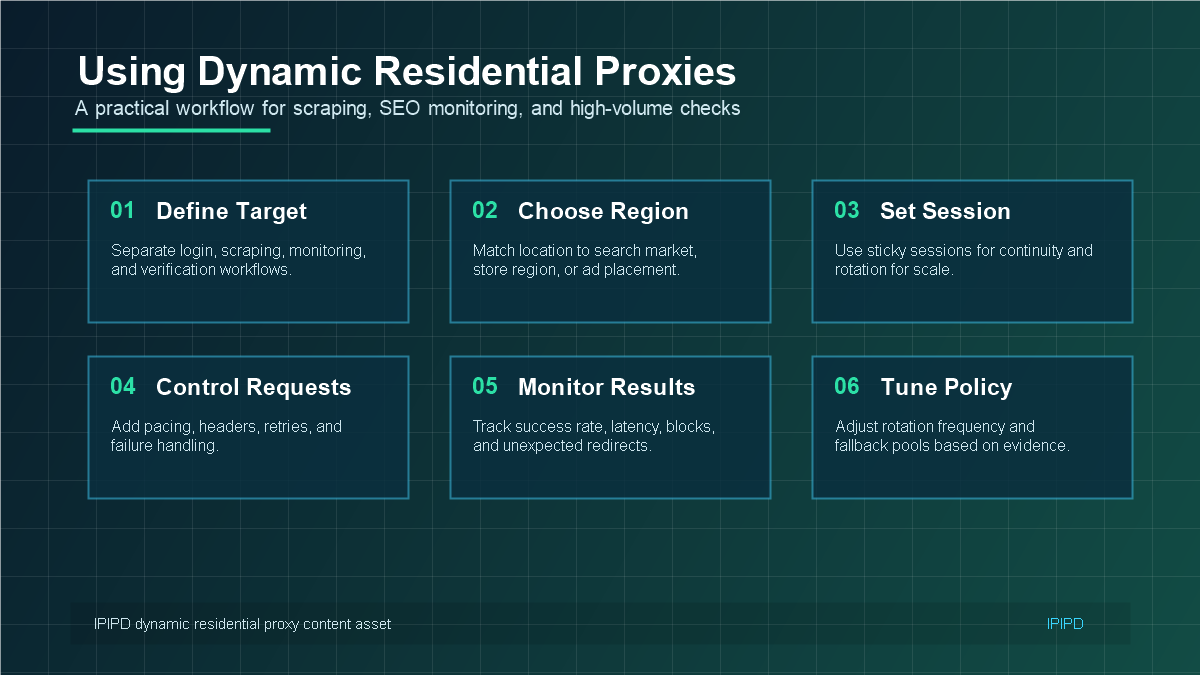
Dynamic residential proxies work best when they are used as part of a complete workflow, not as a simple IP switch. For web scraping and SEO monitoring, the important choices are target grouping, region, session duration, pacing, retry logic, and failure handling.
Use dynamic residential addresses when the workflow needs distributed residential access, controlled IP rotation, regional sampling, and scalable public-page observation.
Basic Facts Table
A practical dynamic residential proxy workflow starts with target, region, session, pacing, and monitoring rules.Web scraping proxy performance depends on pacing, retry logic, session policy, and failure tracking.Residential proxies help SEO teams reduce location bias in rank tracking and SERP checks.Session strategy decides whether a dynamic residential proxy workflow stays stable under real traffic. expanded-2026-06-12-use-cases-en expanded-2026-06-12-use-cases-en-pass2
Item
Practical Meaning
Business Check
Proxy behavior
Static residential addresses provide continuity; dynamic residential addresses provide distributed coverage.
Choose by workflow, not by proxy label alone.
Best fit
Stable sessions, public data checks, regional review, or evidence collection depending on the task.
Define session length, target region, and success condition before scaling.
Review logs, screenshots, status codes, and completed workflow cost.
IPIPD boundary
Static residential addresses and dynamic residential addresses
Adjacent proxy types are comparison context, not IPIPD product claims.
Source / Evidence Note
This update uses the article's original content, IPIPD's current static and dynamic residential address product scope, and Google Search Console page data. Proxy performance varies by target website, region, session duration, browser profile, request pacing, and compliance requirements, so the page avoids fixed success-rate claims.
Data Anchor
Google Search Console snapshot before this combined CTR and GEO update: 0 clicks, 3 impressions, CTR 0.0%, average position 2.67. Review again after 7 and 14 days for impressions, clicks, CTR, average position, Google indexing status, and AI answer mentions.
Step 1: Separate Workflows by Goal
Do not use the same proxy rules for every task. A scraping workflow, an SEO rank tracker, an ecommerce monitor, and a login-sensitive account workflow have different risk profiles.
Public scraping: needs pacing, retries, domain grouping, and controlled rotation.
SEO monitoring: needs location accuracy, clean sessions, and repeatable checks.
Ad verification: needs regional targeting and landing-page validation.
Account workflows: often need static residential IPs or sticky sessions instead of frequent rotation.
Step 2: Build a Web Scraping Proxy Flow
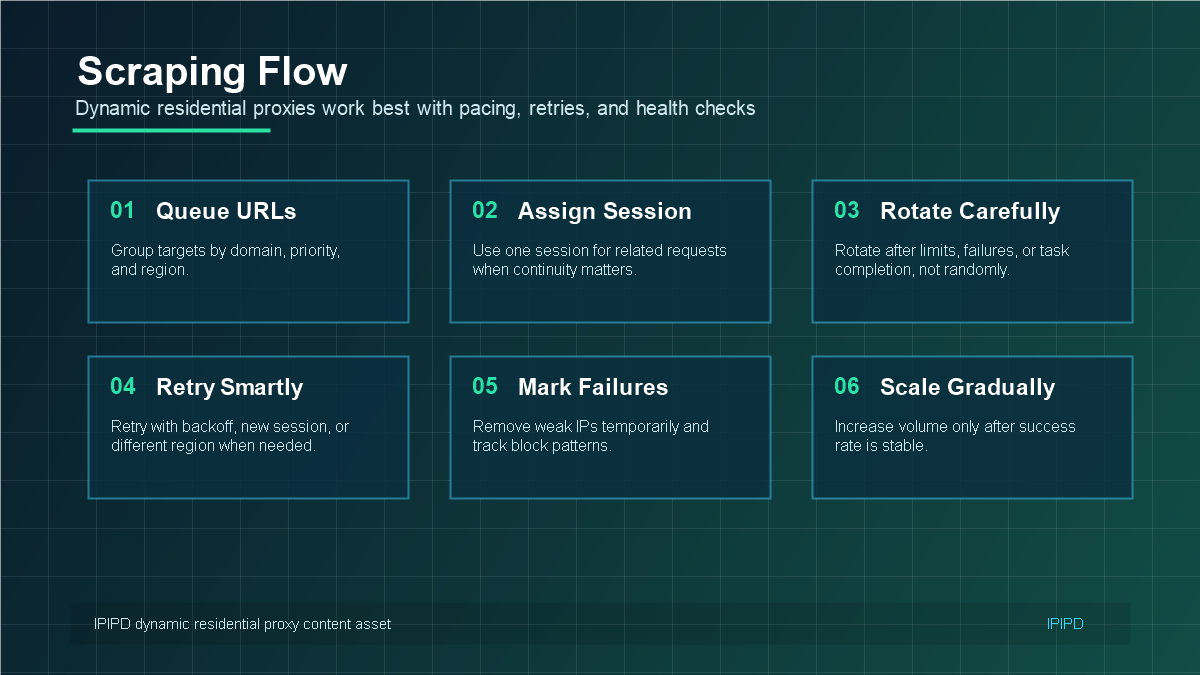
For scraping, organize targets before increasing volume. Group URLs by domain and priority, assign session rules, rotate only when needed, and monitor block signals. Randomly switching IPs without request discipline often creates more problems than it solves.
A good scraping setup also includes request pacing, realistic headers, backoff on failures, and a health check process. IP rotation helps, but it does not replace workflow design. For more detail, compare this with the existing web scraping proxy setup guide.
Step 3: Use Residential Proxies for SEO Monitoring
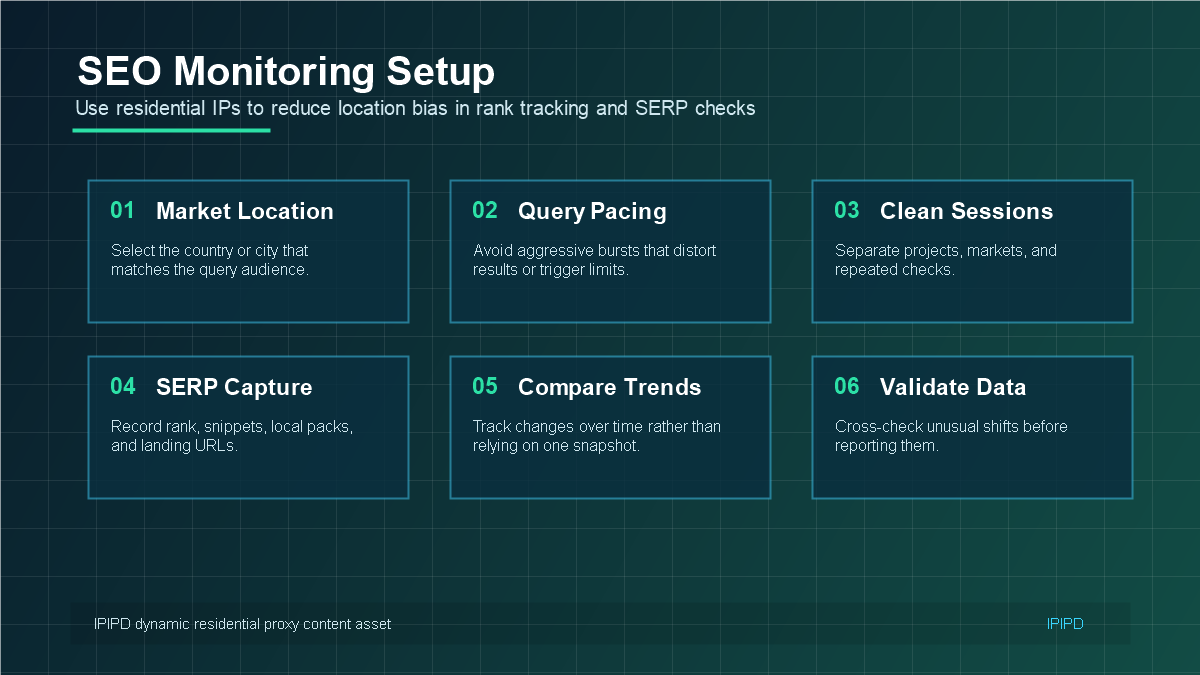
SEO monitoring needs stable methodology. Choose the market location, separate projects or query groups, control query frequency, and record more than rank position. Search result features, local packs, snippets, and landing URLs can all change by location.
Match the proxy region to the audience market.
Use repeatable sessions for consistent comparison.
Avoid aggressive query bursts that can distort results.
Track trends over time rather than relying on one snapshot.
Validate unusual rank changes before reporting them.
Step 4: Choose Session and Rotation Rules
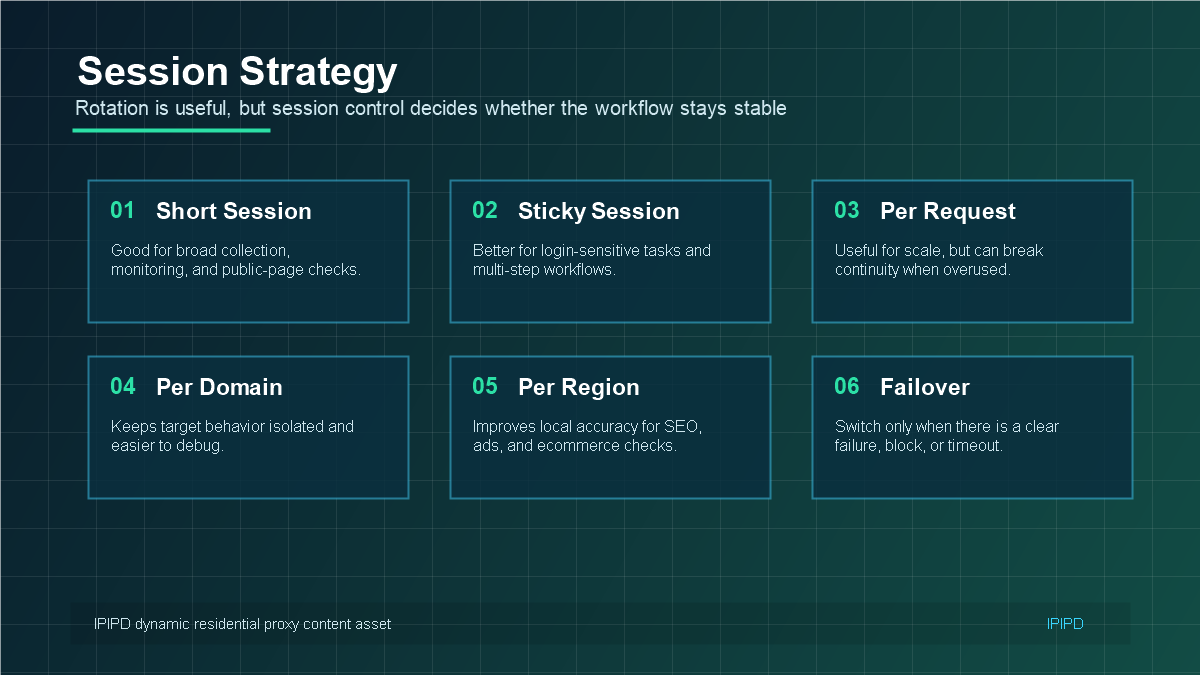
The most common mistake is rotating too often. Per-request rotation can be useful for broad public checks, but it can break multi-step flows. Sticky sessions are better when the target expects continuity, such as pagination, cart checks, login-adjacent workflows, or multi-page research.
A practical rule: use shorter sessions for broad collection, domain-level sessions for scraping, region-level sessions for SEO and ecommerce monitoring, and static residential IPs when login identity matters.
Step 5: Connect the Workflow to the Right Product Option
On the IPIPD pricing page, users can compare static and dynamic residential proxy options. Dynamic residential proxies are usually the better fit for scraping and monitoring, while static residential IPs are better when a stable identity is required.
A Practical Setup Pattern for Scraping Teams
For scraping teams, the best starting point is not maximum rotation. It is clean workflow design. Build a small test queue, group URLs by domain, choose one or two target regions, and run the workflow with conservative request pacing. Only after the success rate is stable should you increase volume.
Each domain should have its own policy. A product listing site, a search results page, and a public directory may react differently to request speed, headers, cookies, and session changes. If every domain shares the same aggressive rotation rule, it becomes harder to know what caused a failure.
Start with a sample: test 50 to 200 URLs before scaling thousands of requests.
Group by domain: keep different targets isolated for easier debugging.
Use controlled rotation: rotate after a task, a failure threshold, or a defined time window.
Add backoff: slow down after 403, 429, timeouts, or repeated redirects.
Log everything: region, session ID, status code, latency, retry count, and response type.
This approach turns dynamic residential proxies into part of a system. The proxy supplies residential IP coverage, but the workflow decides whether the traffic pattern looks stable and whether the final data is reliable.
How SEO Teams Should Structure Rank Tracking
SEO monitoring has a different goal from scraping. The purpose is not simply to collect many pages. The purpose is to collect comparable results over time. That means the proxy region, query timing, language, device type, and session behavior should be consistent enough to make trend analysis meaningful.
For rank tracking, create a separate configuration for each market. A US keyword set, a UK keyword set, and a Japan keyword set should not share the same assumptions. SERP features, local packs, shopping units, maps, and snippets can change by region. If the proxy location is wrong, the SEO report may look precise while being strategically misleading.
Use market-level groups: organize keywords by country, language, and search intent.
Control timing: run checks at consistent intervals instead of random bursts.
Capture SERP context: record featured snippets, ads, local packs, and landing pages.
Compare trends: focus on movement across time, not one isolated snapshot.
Validate anomalies: recheck unusual changes before reporting them to clients or teams.
Session Rules for Different Workflow Types
Session rules are where many proxy workflows either become stable or fall apart. A public data collection task may work well with shorter sessions. A multi-page flow may require a sticky session. A login-sensitive workflow may need a static residential IP rather than dynamic rotation.
Use per-request rotation only when each request is independent. Use domain-level sessions when requests belong to the same target. Use region-level sessions when the goal is local accuracy. Use static residential IPs when the workflow needs a consistent identity over time.
How to Avoid Waste When Scaling
Scaling too early is expensive. If the workflow has a 60 percent success rate at low volume, increasing volume usually multiplies waste. Fix the failure pattern first. Look at status codes, content quality, latency, redirects, and retry behavior. Then adjust request pacing, session length, region choice, and fallback rules.
A strong dynamic residential proxy setup should improve both reach and efficiency. The goal is not to send more requests. The goal is to get more correct results with fewer wasted retries.
Where Dynamic Residential Proxies Fit in an IPIPD Workflow
In an IPIPD workflow, dynamic residential proxies are best positioned for scalable public-page tasks. Static residential IPs are best positioned for stable identity tasks. A complete business setup may use dynamic residential proxies for scraping, SEO checks, ad verification, and ecommerce monitoring, while using static residential IPs for account operations and long sessions.
That separation keeps the workflow cleaner. It also helps teams troubleshoot faster because the IP type is chosen according to task design rather than habit.
Example Workflow: From Small Test to Daily Monitoring
A practical team can use a simple staged rollout. In the first stage, test a small URL group with one region and low concurrency. In the second stage, add a second region and compare whether content changes as expected. In the third stage, increase volume only for targets with stable success rates. This prevents the team from scaling a broken pattern.
For SEO monitoring, the same staged idea works well. Start with a small keyword set, one market, and a consistent checking schedule. Once the results look stable, add more keywords, then add more regions. If results become inconsistent after adding a region, troubleshoot location accuracy before increasing request volume.
Operational Checklist Before Publishing Results
Before a scraping or SEO monitoring result is used in a report, check whether the workflow produced data that is complete, local, and repeatable. A page that loads successfully is not always a correct result. The content may come from the wrong region, an unexpected redirect, a consent page, a bot challenge, or a cached version that does not represent the real target view.
Confirm that the final page is the expected target page, not an error or challenge page.
Confirm that the location matches the business question.
Check whether retries changed the result or only repeated the same failure.
Compare a small manual sample against automated output.
Keep a short change log when rotation rules or regions are adjusted.
This checklist is especially useful when a team turns proxy output into client-facing reports. It improves confidence and reduces the chance that proxy configuration mistakes become business decisions.
Dynamic residential proxies are most effective when paired with good workflow design. Define the target, region, session rule, pacing, retry logic, and monitoring metrics before scaling traffic.
Frequently Asked Questions
How do I use dynamic residential proxies for web scraping?
Group URLs by domain, choose target regions, set session rules, add pacing and retry logic, and monitor blocks, latency, and success rate before scaling.
Are dynamic residential proxies good for SEO monitoring?
Yes, they can help SEO teams check search results from specific regions and reduce location bias, as long as query frequency and sessions are controlled.
Should I rotate IPs on every request?
Not always. Per-request rotation can help broad public checks, but sticky or domain-level sessions are better for workflows that need continuity.
What should I monitor in a proxy workflow?
Track status codes, latency, retries, block rate, region accuracy, redirects, and final data quality.
When should I use static residential IPs instead?
Use static residential IPs when the workflow depends on stable identity, long login sessions, account trust, or consistent access patterns.