How many "5-minute proxy setup for web scraping" tutorials have you watched?
Most of them say: buy a proxy, change a config, run it.
Quick Answer
For web scraping workflows, residential proxy selection should be based on request pacing, rotation control, session needs, validation logs, and usable result cost.
Basic Facts Table
Item
Practical Meaning
Business Check
Proxy behavior
Static residential addresses provide continuity; dynamic residential addresses provide distributed coverage.
Choose by workflow, not by proxy label alone.
Best fit
Stable sessions, public data checks, regional review, or evidence collection depending on the task.
Define session length, target region, and success condition before scaling.
Review logs, screenshots, status codes, and completed workflow cost.
IPIPD boundary
Static residential addresses and dynamic residential addresses
Adjacent proxy types are comparison context, not IPIPD product claims.
Source / Evidence Note
This update uses the article's original content, IPIPD's current static and dynamic residential address product scope, and Google Search Console page data. Proxy performance varies by target website, region, session duration, browser profile, request pacing, and compliance requirements, so the page avoids fixed success-rate claims.
Data Anchor
Google Search Console snapshot before this combined CTR and GEO update: 0 clicks, 3 impressions, CTR 0.0%, average position 9.0. Review again after 7 and 14 days for impressions, clicks, CTR, average position, Google indexing status, and AI answer mentions.
But what happens next?
IP banned. Requests rejected. Data collection stops.
What went wrong?
These tutorials only scratch the surface. They skip the critical steps that actually make a scraper "unbannable." This guide fills in those gaps.
1. The Step Most Tutorials Skip: Pick the Right Proxy Type
This is the most overlooked step.
Pick the wrong proxy type here, and no amount of tweaking will save you.
Residential vs Data Center Proxies
Type
Best For
Not Ideal For
Residential
High-security sites (Amazon, Google, Facebook)
Low-security sites (overkill)
Data Center
Low-security sites, testing environments
High-security sites (banned instantly)
The rule of thumb:
Site has anti-bot measures → Use residential proxies
Site barely has any protection → Data center proxies work fine
Tight budget but tricky target → Still go residential. Getting banned costs more than saving money.
💡 Not sure which to pick? Start here: What Is a Proxy Server for Web Scraping? The Truth Nobody Tells You
Proxy Provider Selection Criteria
Getting the type right is just the start. You also need the right provider.
5 must-check metrics:
IP pool size: Bigger is better—at least 5M+ IPs
Success rate: 95%+ is the baseline
Geographic coverage: Must include your target countries/cities
Stealth level: Residential proxy ratio should be 80%+
Tech support: 24/7 availability, solid API docs
2. The Step Most Tutorials Skip: Configure Proxies Correctly
This one gets some attention, but the coverage is incomplete.
Basic Config: Format and Authentication
The core proxy config looks like this:
protocol://username:password@proxy_address:port
Two common protocols:
HTTP Proxy:
http://user123:password@gateway.ipipd.com:8080
SOCKS5 Proxy:
socks5://user123:password@gateway.ipipd.com:8080
The difference:
HTTP proxy: HTTP/HTTPS requests only
SOCKS5 proxy: All protocols, slightly faster
For most scraping jobs, HTTP proxy gets the job done.
Advanced Config: Connection Pool Management
Many people set up a single proxy and fire off requests one by one. Inefficient.
Do this instead: use a connection pool.
Core concepts:
Maintain multiple proxy connections at once
Reuse connections—avoid constant TCP handshakes
Pull available proxies from the pool automatically
Drop dead proxies automatically
This alone can boost your scraping efficiency by 3-5x.
Pro-Level Config: Proxy Grouping
Scraping multiple sites? Group your proxies by destination:
def check_rotation():
global last_switch
if time.time() - last_switch > switch_interval:
rotate_proxy()
last_switch = time.time()
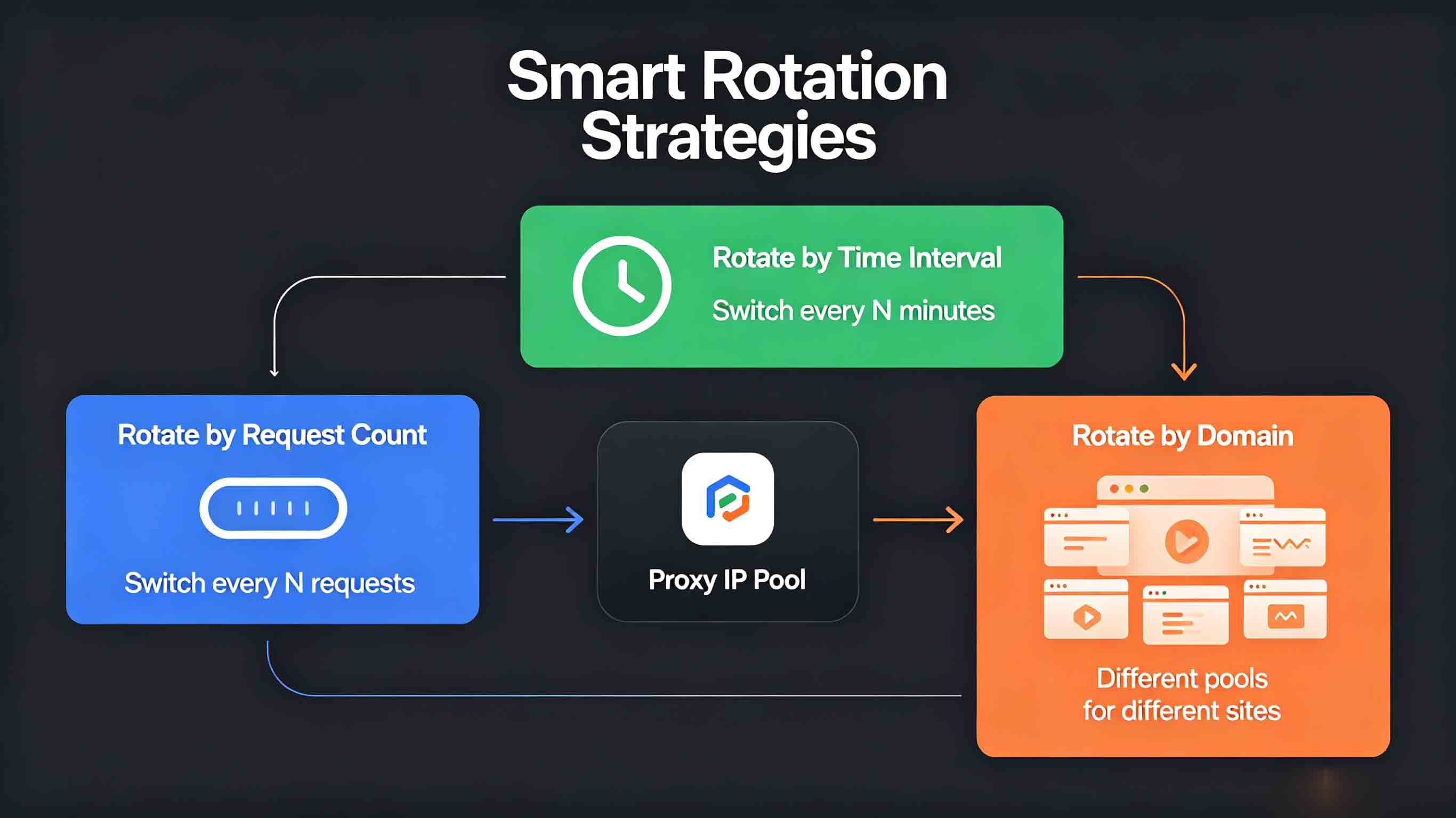
Strategy 3: Rotate by Domain
Different proxy pools for different target sites.
Best for:
Scraping multiple sites simultaneously
Need isolation between different scraping environments
def get_proxy_for_domain(domain):
if 'amazon' in domain:
return amazon_proxy_pool.get()
elif 'google' in domain:
return google_proxy_pool.get()
else:
return default_proxy_pool.get()
Recommended: Combine All Three
In real projects, layering strategies works best:
Request-level: Rotate every 50 requests
Time-level: Force rotation every 5 minutes
Domain-level: Different sites, different pools
Any trigger causes a rotation. Three layers of protection, ban rate drops to near zero.
4. The Step Most Tutorials Skip: Request Masking
Even the best proxies won't save you if your requests look like a bot.
Core Request Masking Elements
Element 1: User-Agent Rotation
Use a different UA for each request:
user_agents = [
'Mozilla/5.0 (Windows NT 10.0; Win64; x64) AppleWebKit/537.36',
'Mozilla/5.0 (Macintosh; Intel Mac OS X 10_15_7) AppleWebKit/537.36',
'Mozilla/5.0 (X11; Linux x86_64) AppleWebKit/537.36',
# ... more UAs
]
This makes your scraper look like a real human user.
5. The Step Most Tutorials Skip: Failure Handling
This is the final distinction between "works sometimes" and "rock solid."
Automatic Retry Logic
def fetch_with_retry(url, max_retries=3):
for attempt in range(max_retries):
try:
proxy = get_next_proxy()
response = requests.get(url, proxy=proxy, timeout=10)
if response.status_code == 200:
return response
elif response.status_code == 403:
# IP flagged—switch immediately
mark_proxy_banned(proxy)
continue
else:
return response
except Exception as e:
# Request failed—switch and retry
mark_proxy_unavailable(proxy)
continue
return None</code></pre><h3>Proxy Health Checks</h3><p>Run periodic checks on your proxy pool:</p><pre><code class="language-python">def health_check():
for proxy in proxy_pool:
try:
response = requests.get('http://httpbin.org/ip',
proxy=proxy,
timeout=5)
if response.status_code != 200:
mark_proxy_unhealthy(proxy)
except:
mark_proxy_unhealthy(proxy)</code></pre><h3>Failover Strategy</h3><p>When your primary pool starts dying, switch to backup:</p><pre><code class="language-python">def get_proxy():
if primary_pool.available() > 10:
return primary_pool.get()
elif backup_pool.available() > 0:
return backup_pool.get()
else:
# Wait for pool refresh
wait_for_pool_refresh()
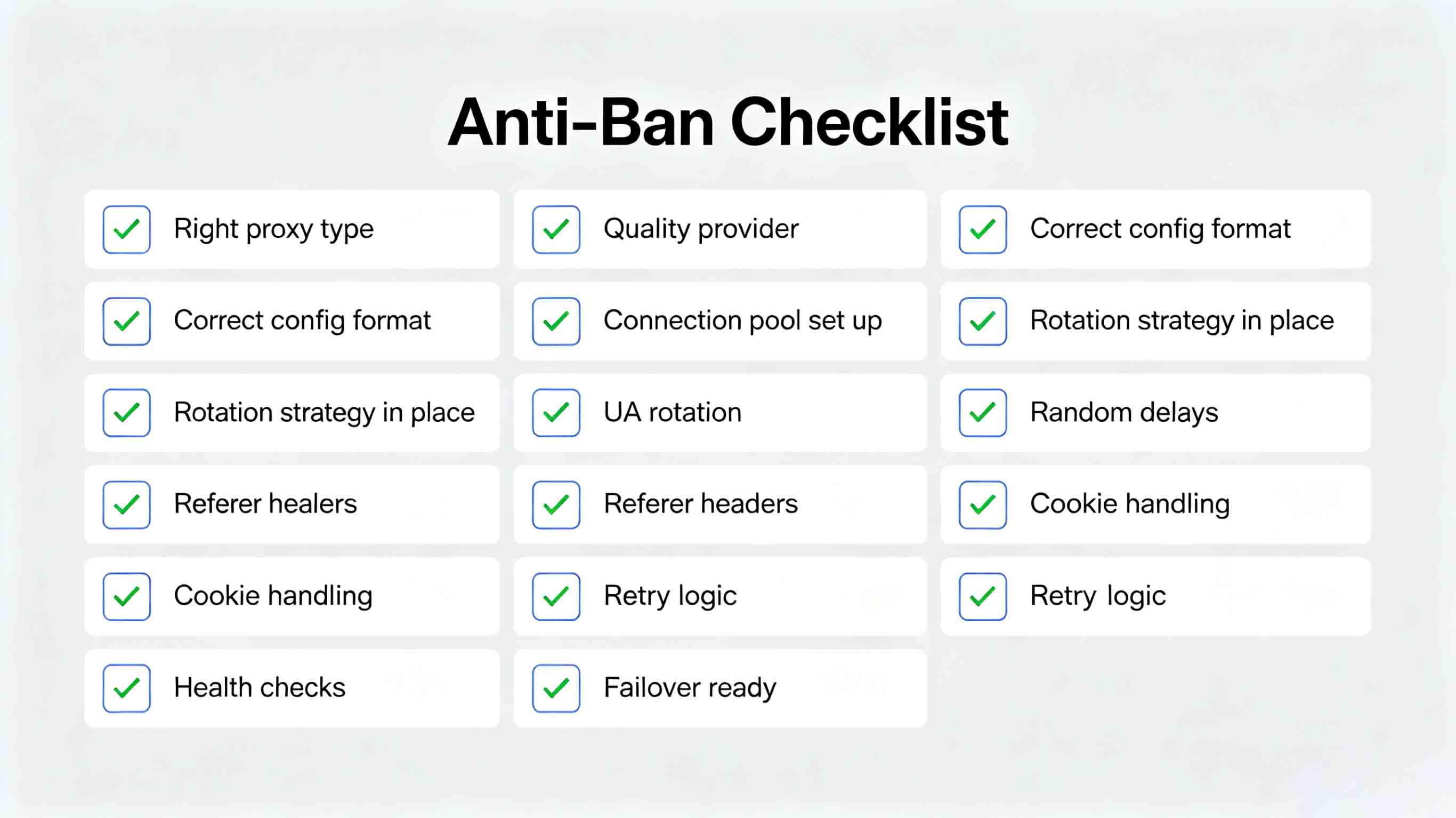
return primary_pool.get()</code></pre><hr><h2>6. Anti-Ban Checklist</h2><p>Here's your complete checklist:</p><table style="min-width: 75px;"><colgroup><col style="min-width: 25px;"><col style="min-width: 25px;"><col style="min-width: 25px;"></colgroup><tbody><tr><th colspan="1" rowspan="1"><p>Check</p></th><th colspan="1" rowspan="1"><p>Description</p></th><th colspan="1" rowspan="1"><p>Done?</p></th></tr><tr><td colspan="1" rowspan="1"><p>✅ Right proxy type</p></td><td colspan="1" rowspan="1"><p>Residential for high-security sites</p></td><td colspan="1" rowspan="1"><p>□</p></td></tr><tr><td colspan="1" rowspan="1"><p>✅ Quality provider</p></td><td colspan="1" rowspan="1"><p>95%+ success rate, 5M+ pool</p></td><td colspan="1" rowspan="1"><p>□</p></td></tr><tr><td colspan="1" rowspan="1"><p>✅ Correct config format</p></td><td colspan="1" rowspan="1"><p>protocol://user:pass@addr:port</p></td><td colspan="1" rowspan="1"><p>□</p></td></tr><tr><td colspan="1" rowspan="1"><p>✅ Connection pool set up</p></td><td colspan="1" rowspan="1"><p>Reuse connections, boost efficiency</p></td><td colspan="1" rowspan="1"><p>□</p></td></tr><tr><td colspan="1" rowspan="1"><p>✅ Rotation strategy in place</p></td><td colspan="1" rowspan="1"><p>Request + time + domain level</p></td><td colspan="1" rowspan="1"><p>□</p></td></tr><tr><td colspan="1" rowspan="1"><p>✅ UA rotation</p></td><td colspan="1" rowspan="1"><p>20+ UAs, refreshed regularly</p></td><td colspan="1" rowspan="1"><p>□</p></td></tr><tr><td colspan="1" rowspan="1"><p>✅ Random delays</p></td><td colspan="1" rowspan="1"><p>1-3 second random intervals</p></td><td colspan="1" rowspan="1"><p>□</p></td></tr><tr><td colspan="1" rowspan="1"><p>✅ Referer headers</p></td><td colspan="1" rowspan="1"><p>Simulate normal browsing</p></td><td colspan="1" rowspan="1"><p>□</p></td></tr><tr><td colspan="1" rowspan="1"><p>✅ Cookie handling</p></td><td colspan="1" rowspan="1"><p>Keep sessions alive on login pages</p></td><td colspan="1" rowspan="1"><p>□</p></td></tr><tr><td colspan="1" rowspan="1"><p>✅ Retry logic</p></td><td colspan="1" rowspan="1"><p>Auto-retry on failure, switch proxies</p></td><td colspan="1" rowspan="1"><p>□</p></td></tr><tr><td colspan="1" rowspan="1"><p>✅ Health checks</p></td><td colspan="1" rowspan="1"><p>Periodic proxy availability checks</p></td><td colspan="1" rowspan="1"><p>□</p></td></tr><tr><td colspan="1" rowspan="1"><p>✅ Failover ready</p></td><td colspan="1" rowspan="1"><p>Backup pool when primary dies</p></td><td colspan="1" rowspan="1"><p>□</p></td></tr></tbody></table><hr><img class="rounded-md border border-border" src="https://data.ipipd.cn/common/image/2026/06/11/5cb62e98292b46d7937d5392bc2fedd1.jpg" alt="Complete anti-block guide including UA rotation, random delay, request header configuration, automatic retry & proxy health check mechanism, and full crawler anti-ban checklist." title="scraper-request-masking-failure-handling-anti-ban-checklist"><h2>7. Summary</h2><p>Five steps to build an unbannable scraper:</p><ol><li><p><strong>Pick the right proxy type</strong> — Residential for tough targets</p></li><li><p><strong>Configure proxies correctly</strong> — Connection pools + grouping</p></li><li><p><strong>Smart rotation strategies</strong> — Request + time + domain layers</p></li><li><p><strong>Request masking</strong> — UA rotation + delays + Referer + cookies</p></li><li><p><strong>Failure handling</strong> — Retry + health checks + failover</p></li></ol><p>Get these five right, and you're looking at 95%+ success rates.</p><blockquote><p>💡 <strong>Recommended tool:</strong> Need reliable proxy IPs? Try <a target="_blank" rel="noopener noreferrer nofollow" href="https://www.ipipd.com/en-US/pricing">IPIPD Residential Proxy</a>—195+ countries, 50M+ IPs, 95%+ success rate.</p></blockquote><hr><h2>8. Keep Reading</h2><ul><li><p><a href="/en-US/news/article/proxy-server-for-web-scraping">What Is a Proxy Server for Web Scraping? The Truth Nobody Tells You</a> — proxy basics</p></li><li><p><a href="/en-US/news/article/web-scraping-proxy-comparison">The Complete Web Scraping Proxy Solutions Comparison for 2026</a> — pick the right solution for your use case</p></li><li><p><a href="/en-US/news/article/web-scraping-proxy-tutorial">Web Scraping Proxy Setup: Build a High-Efficiency Data Collection System in 5 Minutes</a> — more hands-on tips</p></li></ul><hr>
Frequently Asked Questions
What's the most important thing for keeping scrapers unbanned?
It's not any single trick—it's the whole system working together: right proxy type + smart rotation + request masking + failure handling. Nail all four, and you're looking at 95%+ success rates.
What are the common proxy rotation strategies?
Three main approaches: 1) Rotate by request count—switch every N requests; 2) Rotate by time interval—switch every N minutes; 3) Rotate by domain—different proxy pools for different sites. Layering all three gives you the best results.
How do I make scraper requests look more human?
Four essentials: 1) Rotate User-Agents—maintain 20+ and refresh regularly; 2) Random delays—1-3 seconds between requests; 3) Set Referer headers—make it look like you navigated from somewhere else; 4) Manage cookies—keep login sessions alive.
What do I do when a proxy IP gets banned?
Build proper failure handling: 1) Auto-mark banned IPs and drop them from the pool; 2) Switch to the next available proxy immediately; 3) Run periodic health checks; 4) Keep a backup pool ready for failover.
How many proxy IPs do I need for web scraping?
Depends on scale: small (under 1K daily requests) needs 10-50 IPs; medium (1K-10K) needs 50-200; large (over 10K) needs 200+ IPs. Rotation strategy matters more than raw numbers.