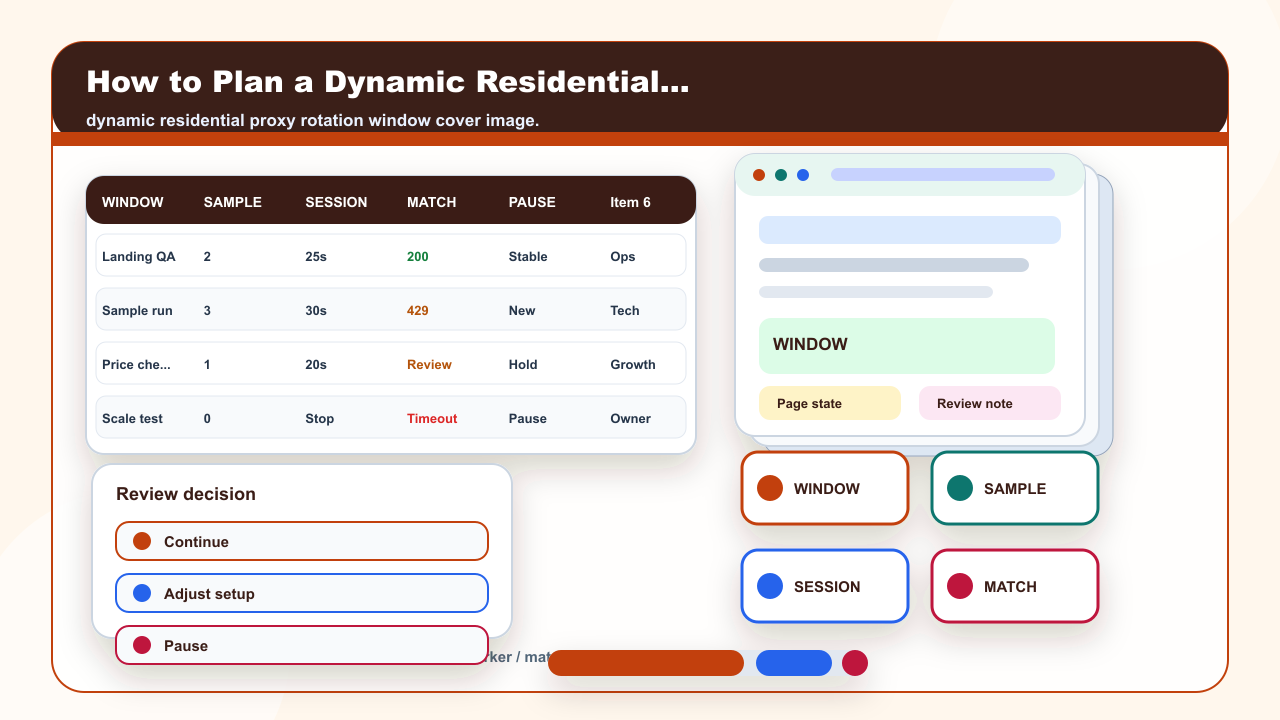
A rotation window is not a timer to shorten automatically. It is a review boundary between one usable sample and the next fresh session. The useful question is whether a new dynamic residential address will teach the team something, or only erase the evidence from the previous attempt.
Write the sample count before changing the rotation window. The discussion stays inside IPIPD's real product boundary: static residential addresses and dynamic residential addresses, with adjacent proxy terms used only as background or exclusions.
For dynamic residential proxy rotation window, the useful record names the task, evidence source, owner, and next action before any scale-up decision is made.
| Field | What to record |
|---|---|
| Window signal | The point where a fresh session is useful without breaking evidence comparison. |
| Best fit | Dynamic residential addresses for sampling; static residential addresses for continuity review. |
| Common mistake | Rotating after every error before the error type is known. |
| Review owner | The person who decides sample size and stop rule. |
dynamic residential proxy rotation window should be treated as an evidence workflow, not as a broad proxy definition. The team should keep the target page, selected region, browser state, address mode, result row, and owner decision in one record before changing settings or adding more volume.
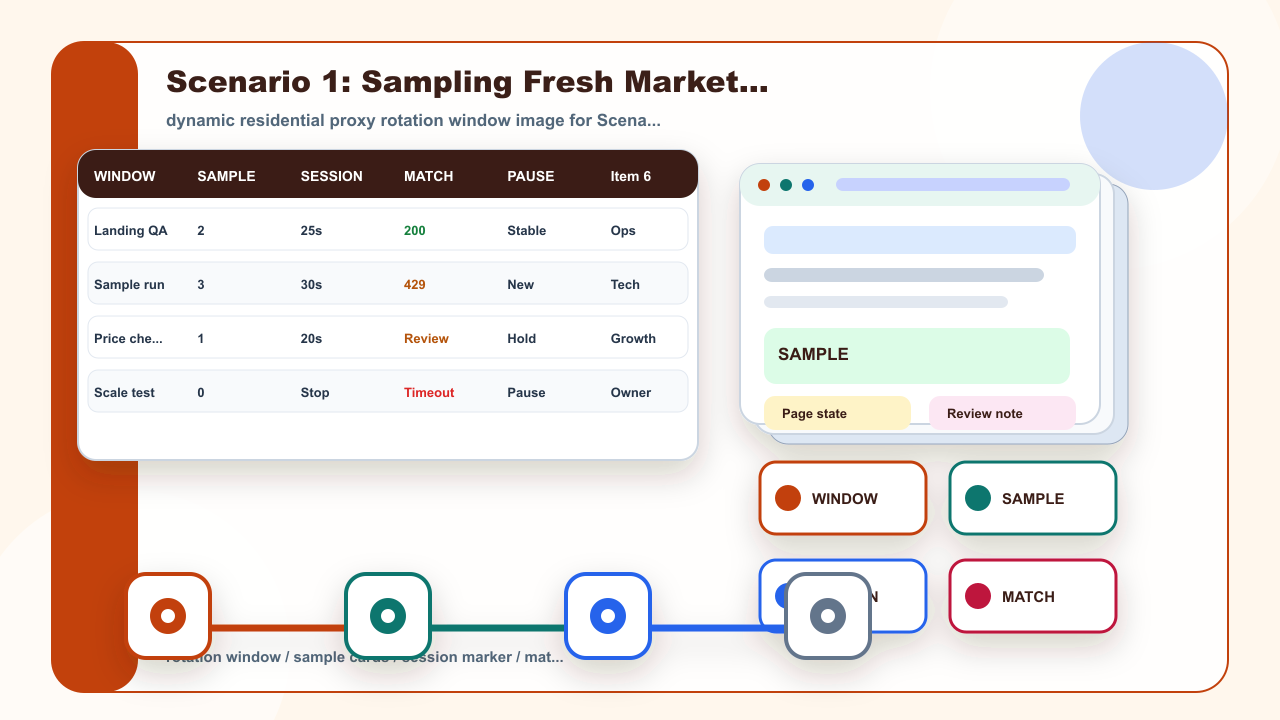
dynamic residential proxy rotation window image for Scenario 1: Sampling Fresh Market Views.The product boundary remains narrow. IPIPD content can explain static residential addresses and dynamic residential addresses, and it can mention adjacent proxy terms only as comparison or exclusion context. The article should not turn mobile, datacenter, VPN, SERP API, ISP, or backconnect concepts into IPIPD offerings.
Pause when rotation makes two attempts impossible to compare. This section should keep the before-and-after evidence visible. If the row cannot explain what changed between two attempts, it should not support scale-up, purchasing decisions, or a claim that one address mode has solved the task.

dynamic residential proxy rotation window should be treated as an evidence workflow, not as a broad proxy definition. The team should keep the target page, selected region, browser state, address mode, result row, and owner decision in one record before changing settings or adding more volume.
The product boundary remains narrow. IPIPD content can explain static residential addresses and dynamic residential addresses, and it can mention adjacent proxy terms only as comparison or exclusion context. The article should not turn mobile, datacenter, VPN, SERP API, ISP, or backconnect concepts into IPIPD offerings.
Pause when rotation makes two attempts impossible to compare. This section should keep the before-and-after evidence visible. If the row cannot explain what changed between two attempts, it should not support scale-up, purchasing decisions, or a claim that one address mode has solved the task.
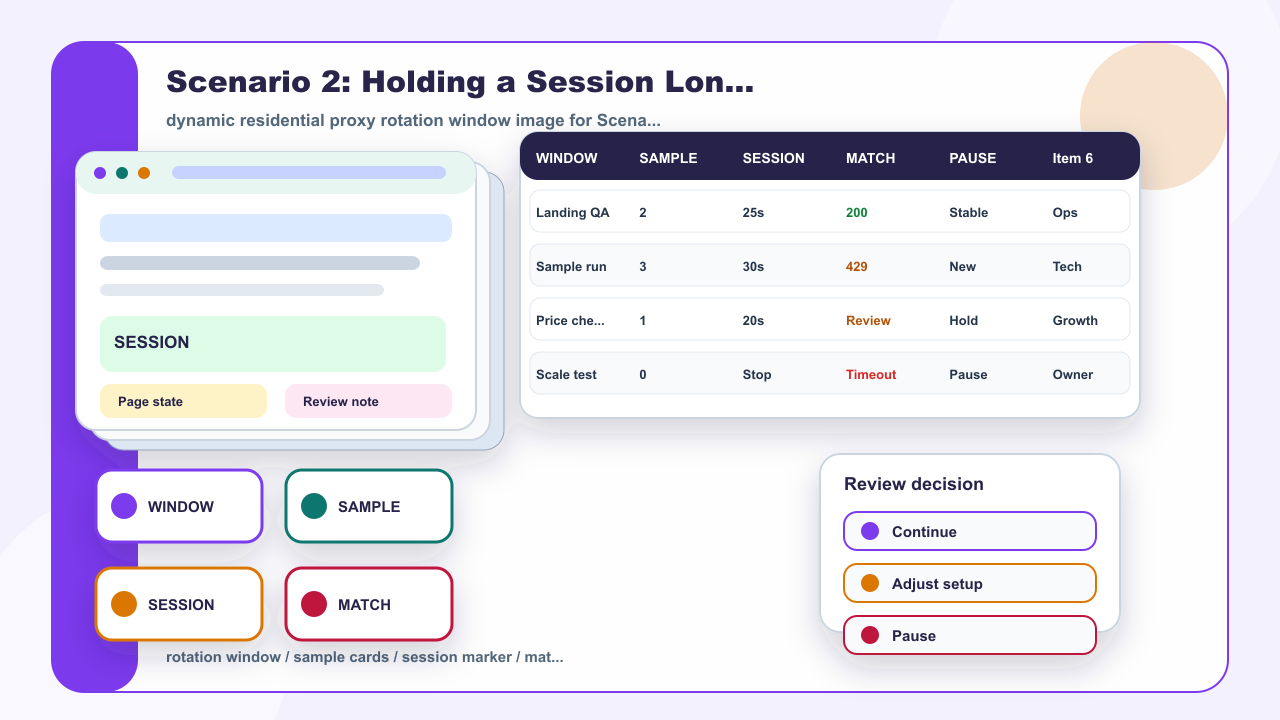
dynamic residential proxy rotation window image for Scenario 2: Holding a Session Long Enough to Compare Evidence.
dynamic residential proxy rotation window should be treated as an evidence workflow, not as a broad proxy definition. The team should keep the target page, selected region, browser state, address mode, result row, and owner decision in one record before changing settings or adding more volume.
The product boundary remains narrow. IPIPD content can explain static residential addresses and dynamic residential addresses, and it can mention adjacent proxy terms only as comparison or exclusion context. The article should not turn mobile, datacenter, VPN, SERP API, ISP, or backconnect concepts into IPIPD offerings.
Pause when rotation makes two attempts impossible to compare. This section should keep the before-and-after evidence visible. If the row cannot explain what changed between two attempts, it should not support scale-up, purchasing decisions, or a claim that one address mode has solved the task.
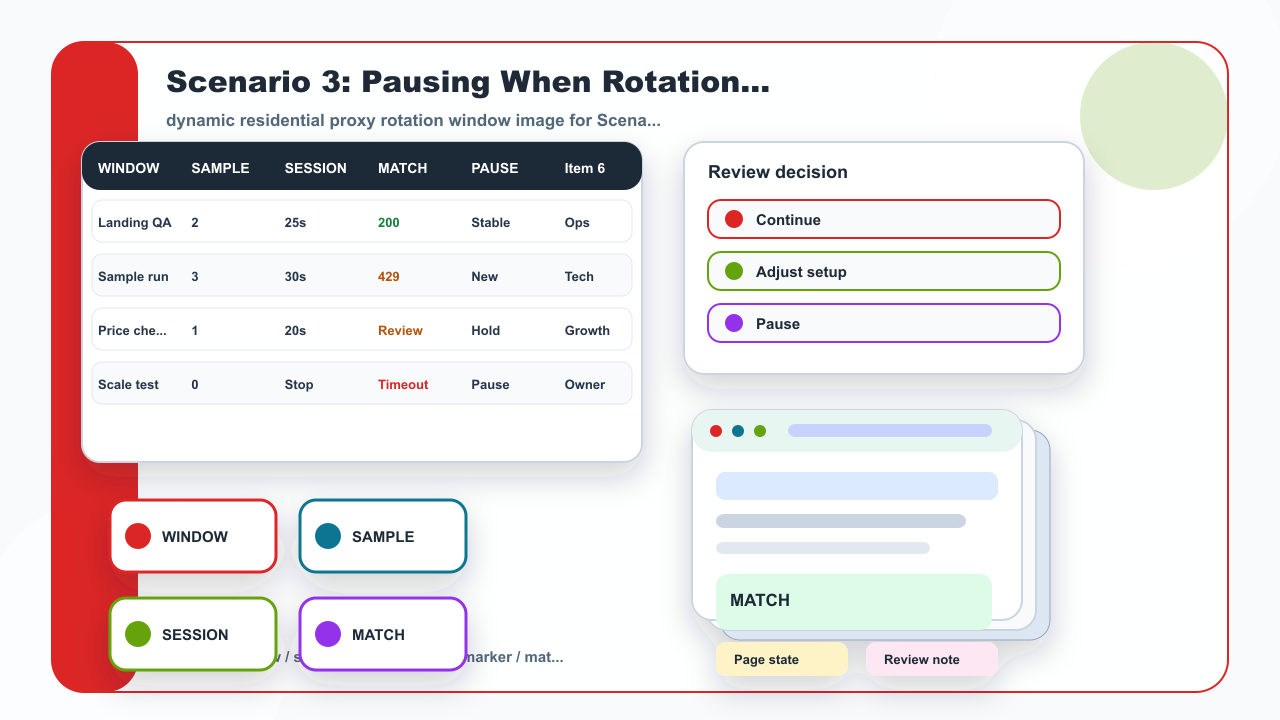
dynamic residential proxy rotation window image for Scenario 3: Pausing When Rotation Hides the Cause.
The review should separate the people who use the record. Operators need to know whether the task continues. Technical reviewers need to know which variable changed. Buyers need to know whether cost and effort remain controlled. Writing those roles into dynamic residential proxy rotation window makes the article useful beyond a generic definition.
A strong record also names rejected actions. It may say not to change address mode yet, not to expand the sample, not to raise concurrency, or not to adjust a buying plan. These rejected actions protect the static residential address and dynamic residential address boundary when evidence is still thin.
Image placement is part of the quality gate. The first body image should support the early evidence row, the second should support the middle comparison, and the third should support the final review. The third image must stay before quick reference or FAQ, not inside the FAQ block.
After publishing, both ordinary and cache-bust URLs should be checked for Quick Answer, Basic Facts, Quick Reference, FAQ JSON-LD, three body images, an independent cover, and visible product-boundary wording. If cache is delayed, record that state instead of repeatedly editing the article body.
dynamic residential proxy rotation window should be treated as an evidence workflow, not as a broad proxy definition. The team should keep the target page, selected region, browser state, address mode, result row, and owner decision in one record before changing settings or adding more volume.
The product boundary remains narrow. IPIPD content can explain static residential addresses and dynamic residential addresses, and it can mention adjacent proxy terms only as comparison or exclusion context. The article should not turn mobile, datacenter, VPN, SERP API, ISP, or backconnect concepts into IPIPD offerings.
Pause when rotation makes two attempts impossible to compare. This section should keep the before-and-after evidence visible. If the row cannot explain what changed between two attempts, it should not support scale-up, purchasing decisions, or a claim that one address mode has solved the task.
| Field | What to record |
|---|---|
| Record first | dynamic residential proxy rotation window |
| Address mode | static residential addresses or dynamic residential addresses |
| Evidence | screenshot, status, retry, owner |
| Next action | hold, adjust, pause, or review |
No. Too much rotation can make evidence harder to compare.
It helps when the task needs fresh sessions and can compare samples cleanly.
Use static residential addresses when continuity is required for page review.
Window length, sample size, address mode, target signal, retry result, and owner decision.
For internal review, keep the workflow connected to the static residential proxy guide, the dynamic residential proxy guide, and current IPIPD pricing so the technical decision, address mode, and cost expectation stay aligned.
When a record mentions status codes or target responses, a neutral reference such as MDN HTTP status documentation can keep terminology consistent, but the final decision should still come from the task screenshot, log row, and owner review.