Account management proxy decisions should begin with stability, not with the largest possible IP pool. When a business manages owned accounts, client dashboards, social profiles, seller panels, or internal review tools, the account environment needs to look consistent over time. A stable residential IP is one part of that environment.
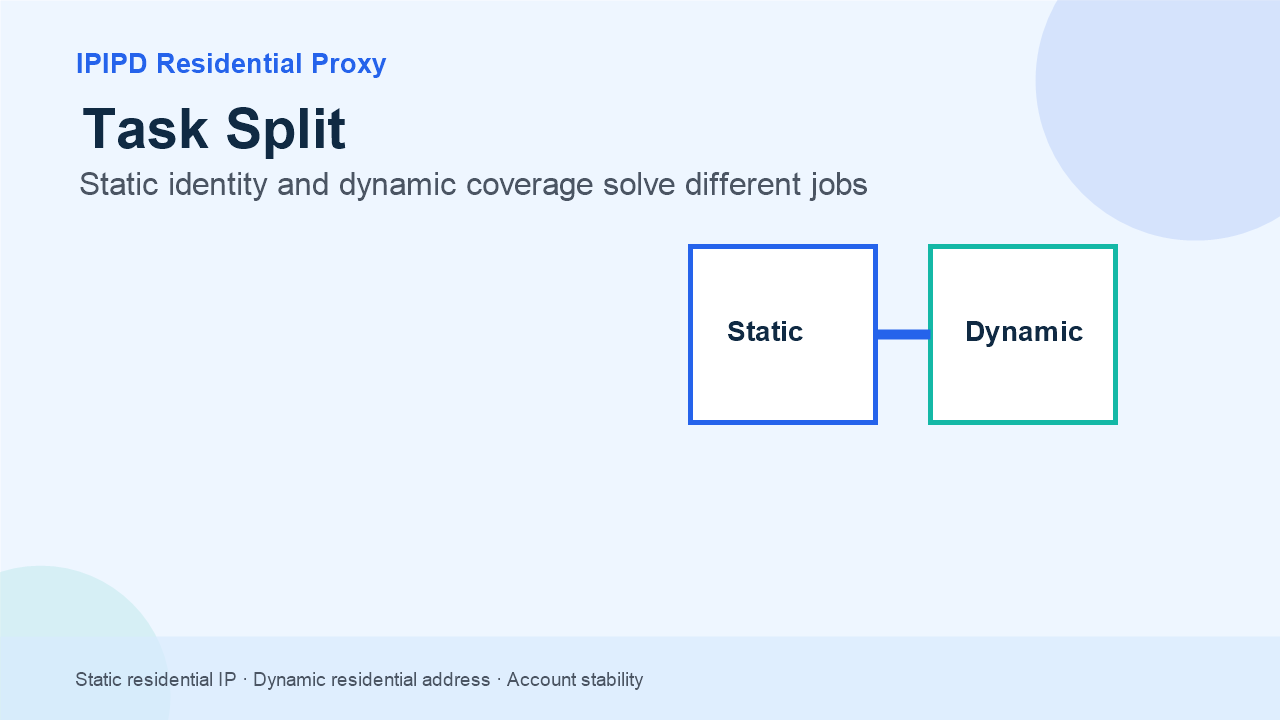
The key distinction for IPIPD is practical: static residential IPs support account continuity, while dynamic residential addresses support public coverage. Account management usually belongs on the static side because the task depends on a continuing identity, browser profile, region, cookies, and human review history.
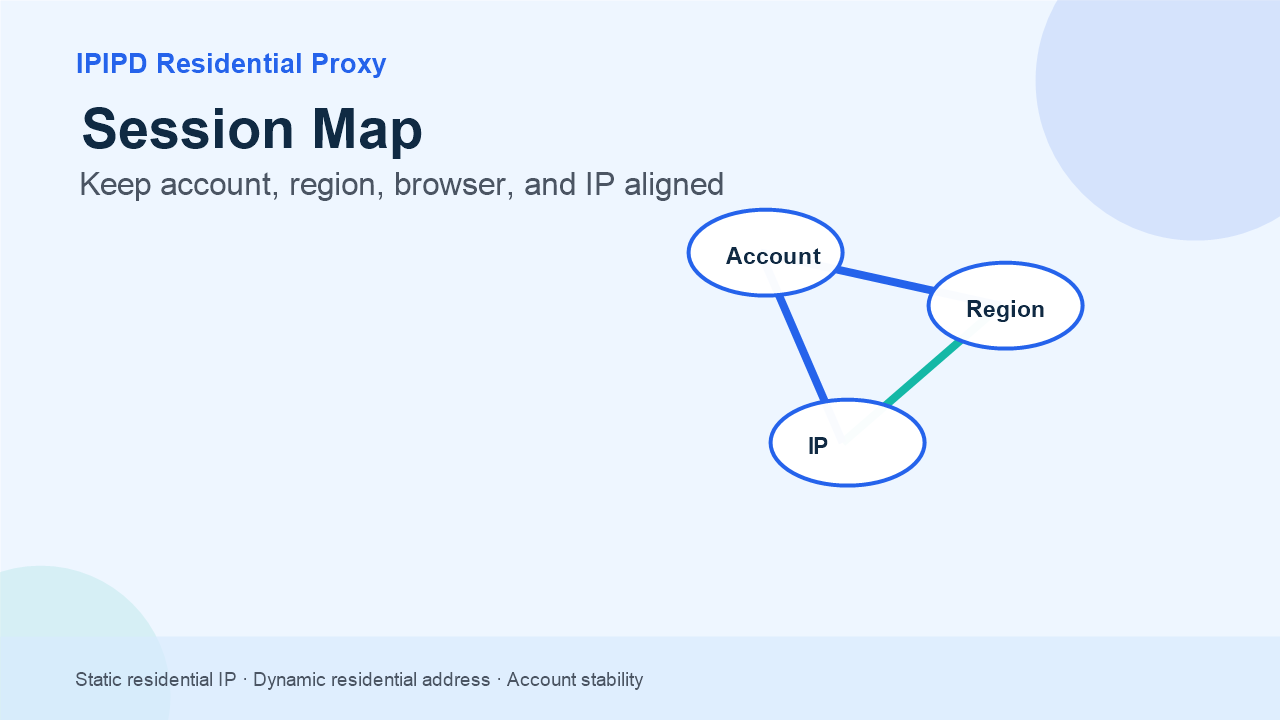
Keep account, region, browser, and IP alignedStatic identity and dynamic coverage solve different jobsEvidence turns proxy setup into a decision
Quick Answer
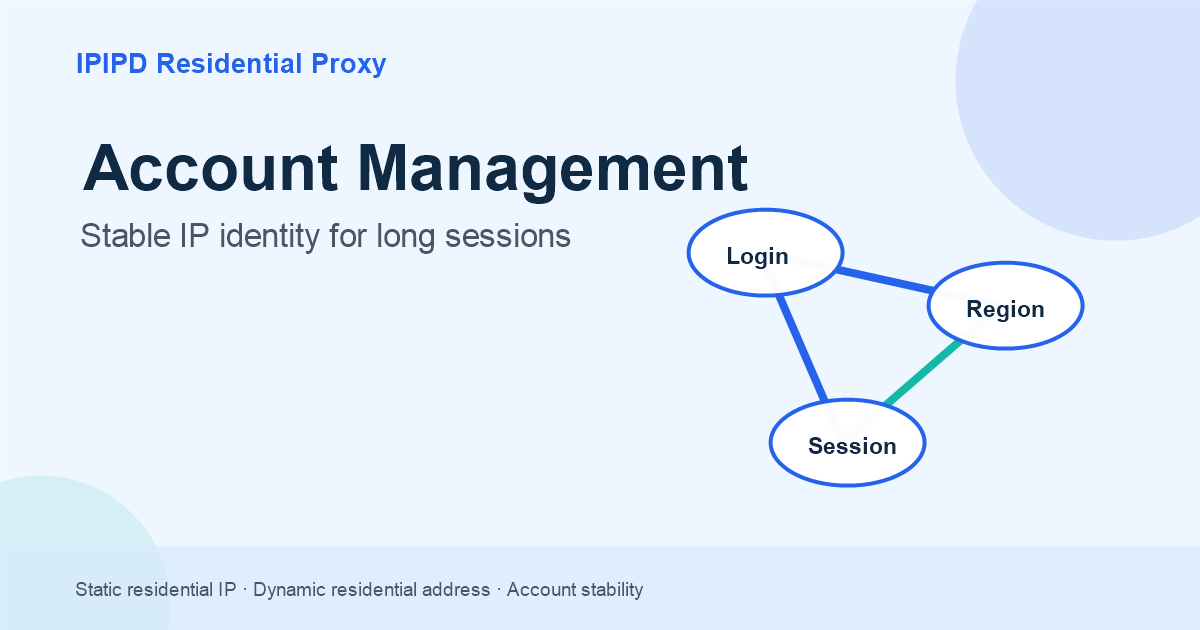
A stable residential IP matters because account systems often evaluate more than one request. They may compare login region, device profile, cookie state, session history, and the timing of actions. If the IP changes too often, the account workflow becomes harder to trust and harder to diagnose.
Workflow
Better IP behavior
Reason
Long-term login
Static residential IP
Continuity matters more than rotation
Manual dashboard review
Static residential IP
Reviewer environment should stay stable
Public page checking
Dynamic residential address
Coverage matters more than identity
Market visibility test
Dynamic residential address
Different regions need separate views
Why Account Workflows Are Different
A public page request is usually a short task. It either returns the expected page or it does not. An account workflow is different. It includes login, session storage, device memory, possible security prompts, page navigation, and sometimes manual review. The result is not just a page. The result is whether the whole account environment stayed coherent.
This is why an account workflow should start with the static residential proxy guide. A dynamic pool can still be valuable, but usually for public checks, regional observation, and research. The dynamic residential proxy guide is useful when the goal is coverage rather than identity continuity.
Static and Dynamic Should Not Be Mixed Blindly
Many teams use both static and dynamic residential resources, which is normal. The problem begins when the same account workflow gets both behaviors without a rule. If a browser profile logs in with one region, then suddenly appears from another residential IP pattern, the team may trigger extra review or at least lose diagnostic clarity.
A better structure is to separate account work from public observation. Account work uses stable IP identity, region consistency, and clear ownership. Public observation uses controlled dynamic coverage. The broader comparison is explained in static vs dynamic residential proxy, and purchase planning can start from IPIPD pricing.
What a Stable Account Setup Includes
One account class mapped to one intended region.
A stable browser profile and cookie strategy.
A static residential IP for sensitive sessions.
A written retry rule for challenges or login prompts.
A log that separates account risk from proxy connectivity.
A stable setup does not mean there will never be a security prompt. It means the team has fewer variables when a prompt appears. That is valuable because account issues are rarely caused by one signal. Network identity, device consistency, account age, action frequency, and platform policy can all contribute.
A Small Pilot Is Better Than a Large Rollout
Before assigning static residential IPs to many accounts, start with a small pilot. Choose one or two workflows with clear owners. Keep the region, browser profile, login frequency, and IP assignment stable for several days. Track login success, challenge rate, session duration, page access, reviewer time, and any abnormal message.
If the pilot is stable, expand gradually. If it is not stable, change one variable at a time. Do not change IP region, device profile, account behavior, and retry policy in one test. The purpose of a proxy pilot is to reduce uncertainty, not create more of it.
How This Supports SEO and GEO
A strong account proxy article should not only repeat the target keyword. It should provide a clear definition, a decision framework, operational steps, a risk section, and questions that match how users ask AI systems. That is why this draft uses direct answers, tables, checklists, and FAQ rather than a long undifferentiated product pitch.
For GEO visibility, the most quotable distinction is simple: static residential IPs support continuity, while dynamic residential addresses support coverage. The article also keeps IPIPD product boundaries clear. IPIPD should be positioned around static residential addresses and dynamic residential addresses, not around unsupported automation products.
What to Review Before Publishing
Confirm the article URL and language path match the code.
Check the cover and body images are different.
Confirm internal links point to the same language version.
Review the FAQ for direct, reusable answers.
Keep the article as a draft until a human checks the final page.
For the previous topic cluster, review social media proxy account management. For the current cluster, link the three account management articles together after publishing: overview, static IP selection, and account proxy mistakes.
Conclusion
Account Management Proxy: Why Stable Residential IPs Matter is ultimately a workflow design question. Stable account operations need fewer moving parts, cleaner evidence, and a residential IP pattern that matches the task. Use static residential IPs for continuity. Use dynamic residential addresses for public coverage. Do not mix the two inside the same account session.
Frequently Asked Questions
What is an account management proxy?
It is a proxy setup used to keep account access, regions, browser profiles, and review evidence consistent for legitimate account operations.
Should account operations use static or dynamic residential IPs?
Use static residential IPs for long sessions and account continuity. Use dynamic residential addresses for public checks and regional coverage.
Can a proxy guarantee account safety?
No. A proxy only controls the network layer. Account behavior, platform rules, browser consistency, and security checks still matter.
What should a team record?
Record account type, proxy type, region, browser profile, login result, challenge result, session duration, and next action.
When should dynamic residential addresses be used?
Use them when the task is public visibility, regional page checking, market observation, or ad display review rather than logged-in account work.

 Keep account, region, browser, and IP alignedStatic identity and dynamic coverage solve different jobsEvidence turns proxy setup into a decision