
Rotating Proxy vs Dynamic Residential Proxy: Key Difference
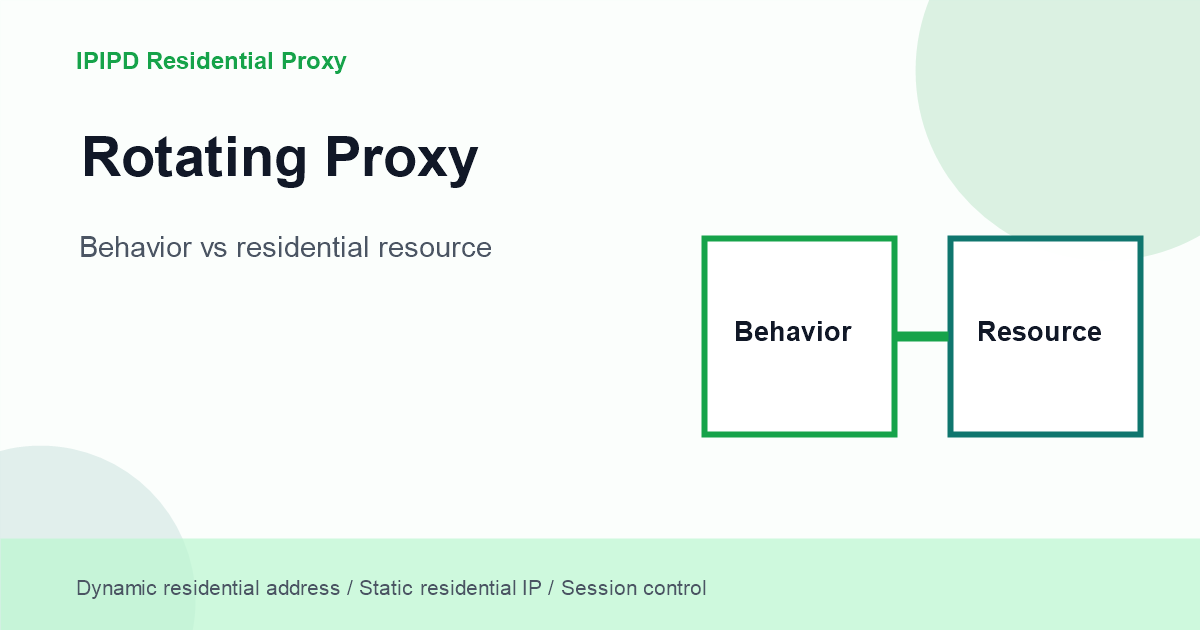
A rotating proxy describes when an outbound IP changes. A dynamic residential proxy describes a residential address resource that can provide controlled rotation. Choose the behavior from the workflow: independent public checks can rotate, while connected or account-based work usually needs a stable identity.
Quick answer
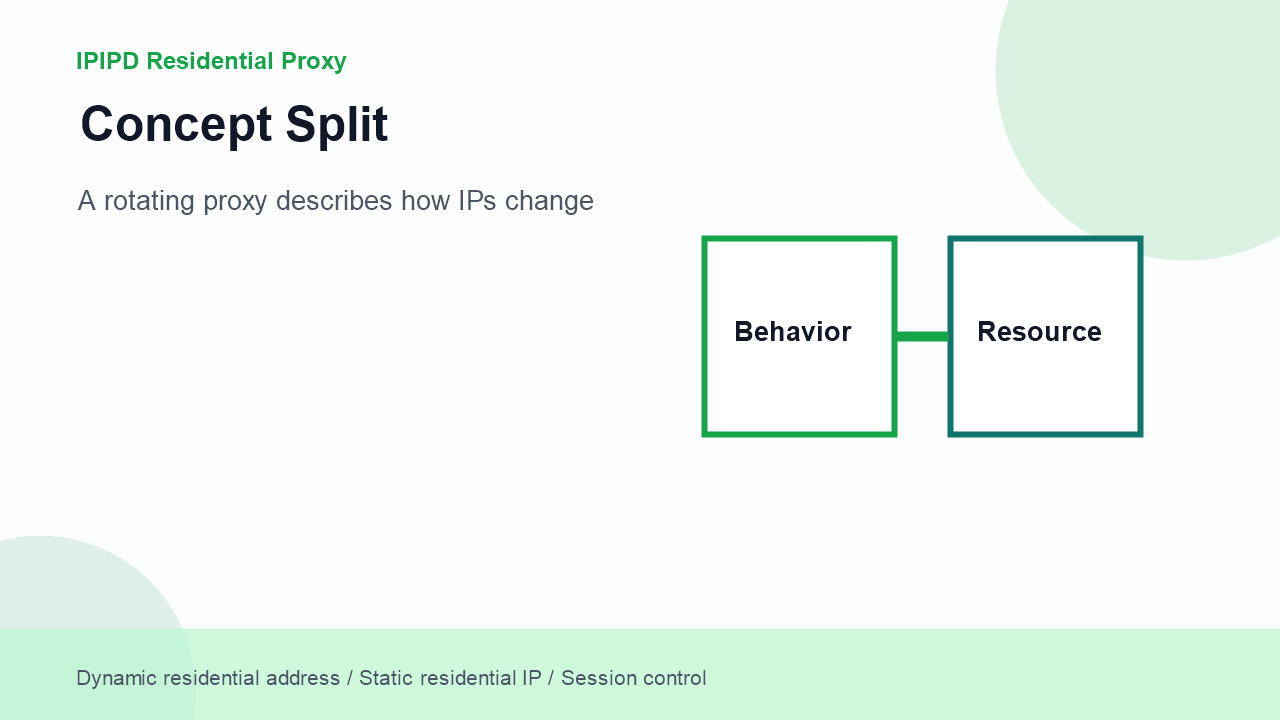
A rotating proxy is the rule or gateway behavior that changes IPs. A dynamic residential proxy is one resource model that supplies residential IPs for that rotation. If the workflow is public, short, and repeatable, controlled rotation can reduce pressure on one address. If the workflow needs login continuity, cookies, or manual review, a static residential IP is usually safer.
Rotating proxy vs dynamic residential proxy at a glance
When a team says it needs a rotating proxy, the real requirement may be broad location coverage, lower block rate, or easier concurrency. Those requirements can be solved with dynamic residential addresses, but only when the rotation rule matches the task. Rotation by request, by time, by region, and by failure threshold create very different results.
| Workflow | Recommended behavior | Reason |
|---|---|---|
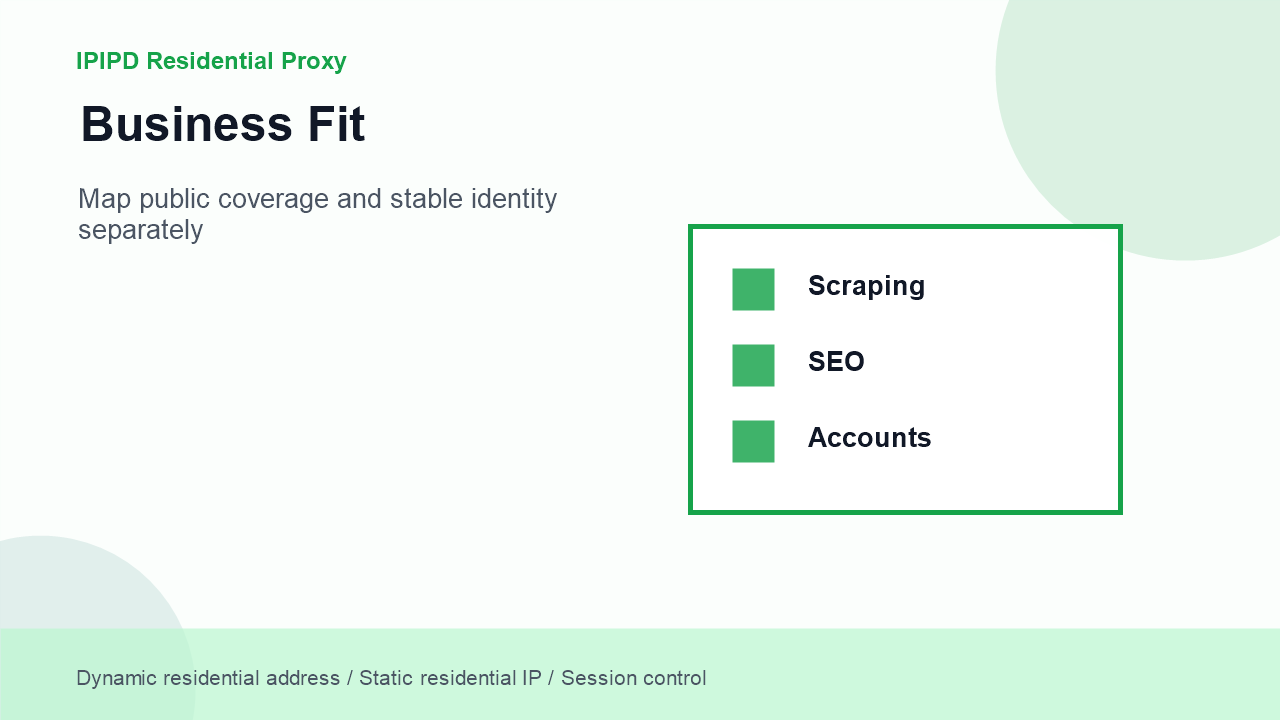
| Public scraping | Dynamic residential rotation | Independent requests need coverage and lower per-IP pressure |
| SEO location checks | Rotate by city or keyword batch | Local views matter, but trend data needs stable rules |
| Account operations | Static residential IP | Login state and review context need continuity |
| Short multi-step checks | Sticky session | Related requests need one identity for a limited window |
Where dynamic residential proxies fit
Dynamic residential proxies fit public data collection, local SEO checks, product visibility monitoring, and other workflows where each request can be treated as a small independent observation. The residential nature helps the request look closer to ordinary user traffic, while the dynamic pool helps distribute volume across many exits.
When to keep a stable network identity
Rotation is risky when several requests belong to one connected journey. Login flows, account dashboards, checkout steps, manual review, and workflows that depend on cookies can break when the network identity changes between actions. In those cases, use a static residential address or a defined sticky session.
Rotation also weakens evidence when the team cannot say which region, address window, retry rule, and timestamp produced a result. More address changes do not automatically mean better coverage.
Common rotation rules and what they change
Per-request rotation assigns a new outbound address to each independent request. It can fit public pages that do not share cookies or navigation state, but it is a poor choice when one result depends on the previous page. Session-based rotation keeps an address for a defined window and is better for pagination, a short search journey, or several related checks.
Time-based rotation changes the address after a fixed interval. The interval should be longer than the action being measured; otherwise one workflow may cross two network identities. Failure-based rotation changes only after a categorized connection or target response. It needs a retry cap so an unsuitable request is not repeated indefinitely.
Region-based rotation is a sampling rule rather than a speed setting. Put each country, city, or market in its own batch and store the assigned location with the result. This makes regional differences reviewable and prevents random address changes from being mistaken for geographic coverage.
Document the chosen rule beside every saved result so another reviewer can repeat the same test window.
Quick reference: choose rotation or stable identity
Choose dynamic residential rotation for public, short, independent observations that are logged separately. Choose a sticky session for a short multi-step sequence. Choose a static residential address when the same region and identity must remain stable for a longer review.
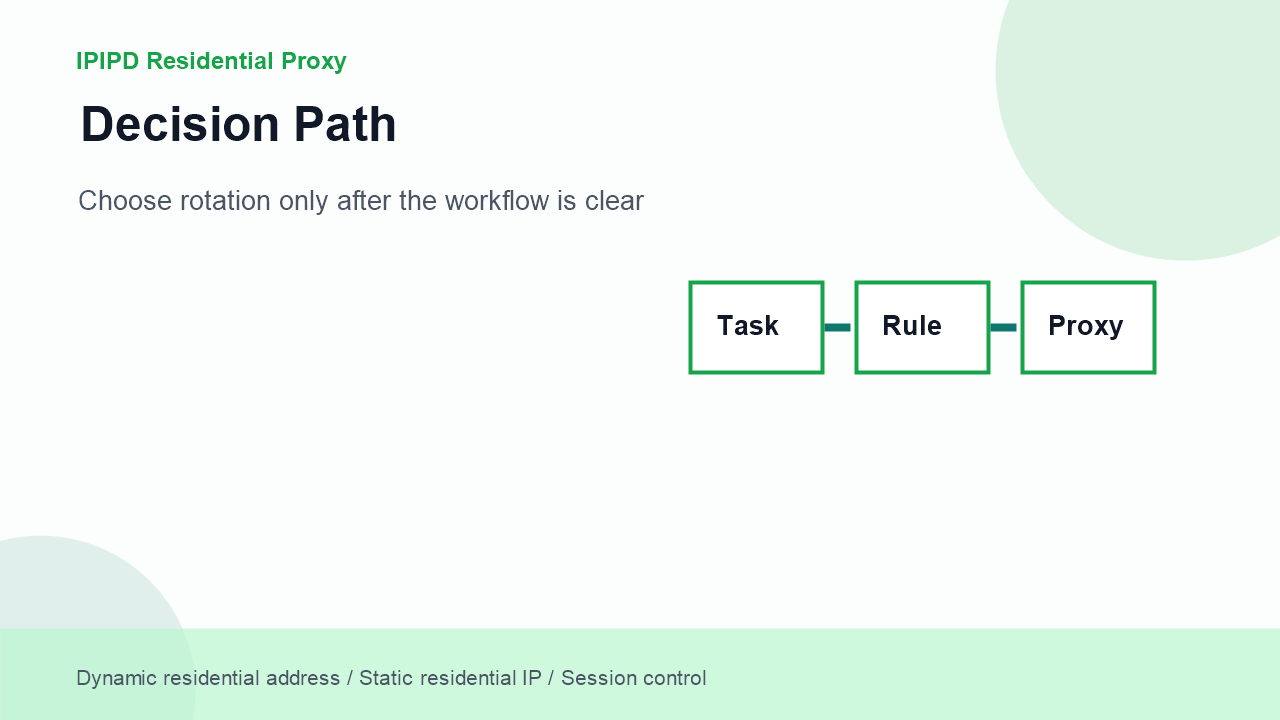
IPIPD should frame rotating proxy as behavior supported by dynamic residential addresses, not as a separate product line. Static residential addresses remain the option for continuity.
Testing a rotation rule
Write the rule before increasing volume: define the target pages, required market, point of rotation, session window, concurrency, retry cap, stop condition, and fields that make a result usable. Begin with a small batch and change one variable at a time.
Review connection success together with region accuracy, complete fields, duplicate records, session breakage, and target responses. If a result cannot be linked to its assigned market and request rule, it should not be counted as valid evidence.
For example, a public price-monitoring task can rotate between separately logged product pages, while a three-step account review should keep one static address. A local SEO check can rotate by city batch, but every keyword in that batch should use the same location rule. These boundaries are more useful than choosing a proxy type from its name alone.
For a command-line test, the curl manual documents proxy and timeout options. Tool behavior still needs to be checked against the current client and the target site's access rules.
Related IPIPD Reading
If the proxy type is still unclear, start with static vs dynamic residential proxy. For rotating resources, read the dynamic residential proxy guide. For stable identity, read the static residential proxy guide.
This article cluster should connect with the previous IP rotation guide, IP rotation strategy guide, and IP rotation mistakes to create a concept, setup, and troubleshooting path.
When a buyer already knows the workflow, point them to IPIPD pricing to compare static residential addresses and dynamic residential addresses.
FAQ
Is a rotating proxy the same as a dynamic residential proxy?
No. Rotating proxy describes the IP-changing behavior, while dynamic residential proxy describes one residential resource model that can provide rotation.
When should a business use rotating residential proxies?
Use them for public, short, repeatable workflows such as scraping, local SEO checks, ad checks, and page monitoring.
When should a business avoid aggressive rotation?
Avoid it for login paths, account dashboards, manual review, payment workflows, and any process where cookies and identity must stay consistent.
Does getting blocked mean the proxy pool is bad?
Not always. Blocks can come from request pacing, wrong geography, session breaks, fast retries, or target-side risk rules.
How should IPIPD frame this topic?
Dynamic residential addresses support controlled rotation, while static residential IPs support stable long-term identity.