Residential Proxy Rotating: When Rotation Helps
Residential proxy rotating means changing the residential exit IP according to a rule: per request, per time window, per task, per region, or after a controlled failure. The point is not to change IPs as often as possible. The point is to give a public workflow enough coverage without destroying the business condition being measured. This distinction matters for SEO rank tracking, public web scraping, ad verification, ecommerce monitoring, and GEO visibility checks, because each task needs a different balance between coverage and continuity.
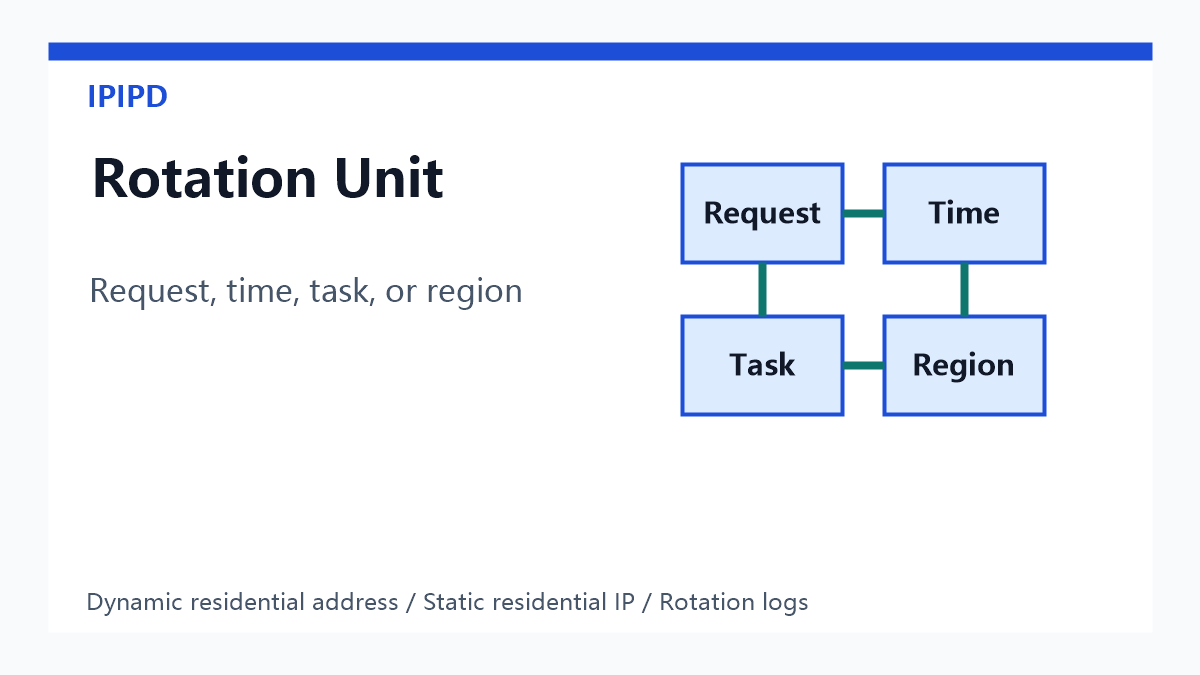
Define the rotation unit before scaling.Quick Answer
Use residential proxy rotating when the task needs broad public coverage across many pages, keywords, products, ads, or markets. Use a dynamic residential address pool when each request or task can tolerate a new residential identity. Use a static residential IP when the workflow needs a stable identity, repeated review, account-adjacent access, or long session continuity. Rotation helps when it is rule-based; it hurts when it changes region, session, or evidence halfway through a task.
What Rotation Actually Controls
Rotation controls which residential exit is used, when the exit changes, and whether the next request is still part of the same measurement condition. A clean rotation plan answers four questions before scale begins: what is the unit of work, what conditions must remain fixed, when is it safe to rotate, and how will failures be labeled. Without those answers, a crawler or monitoring tool may report a high request success rate while the data quality is low.
| Rotation rule | Best fit | Main risk |
|---|---|---|
| Per request | High-volume public page checks | Breaks related steps |
| Per time window | Simple scheduled checks | Can interrupt long tasks |
| Per task | One keyword, product group, or ad path | Requires clear task labels |
| Per region | Market comparison and local SEO | Needs strict location control |
| After failure | Controlled recovery | Can hide the real failure reason |
When Rotation Helps
Rotation helps when the workflow is public, stateless, and broad. A large keyword set, a product catalog scan, a multi-market page check, or a public availability audit should not concentrate every request on one residential exit. Rotating exits reduce pressure on individual addresses, improve market coverage, and make it easier to compare pages from different locations. The useful metric is not just whether requests return HTML; it is whether each result represents the intended market, device, page, and task label.
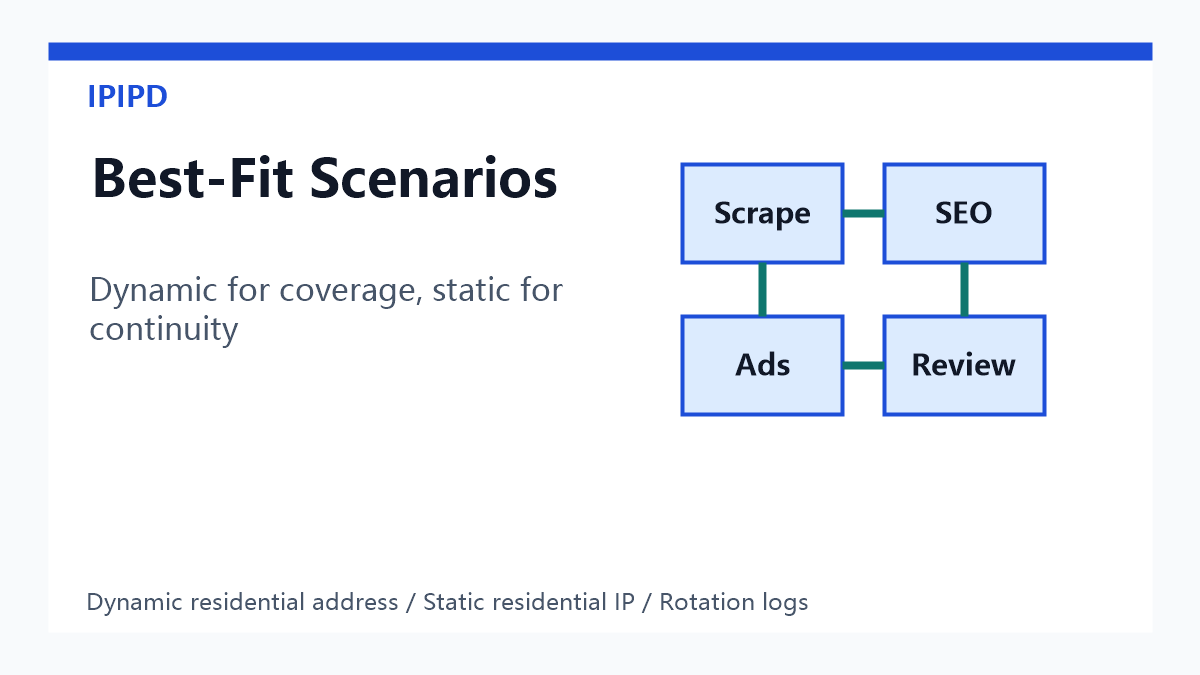
Different tasks need different rotation intensity.When Rotation Hurts
Rotation hurts when the task depends on continuity. If an ad verification path rotates between impression, click, redirect, and landing page, the evidence chain can break. If a local SEO check rotates from one city to another, the result may no longer represent the target market. If an account-sensitive workflow rotates during review, the behavior may look abnormal and may trigger extra checks. For these cases, rotation should happen between completed tasks, not inside a related workflow.
Dynamic Residential Address vs Static Residential IP
Dynamic residential addresses are better for distributed coverage. Static residential IPs are better for continuity. This is not a ranking of which product is “better”; it is a task fit decision. The proxy session parameters guide explains the middle layer: sticky sessions can hold one dynamic exit for a short workflow, while static residential IPs are still cleaner for longer review windows.
Rotation Rules by Scenario
| Scenario | Suggested rotation unit | Preferred mode |
|---|---|---|
| SEO rank monitoring | One keyword and market per task | Dynamic residential address with location rule |
| Public web scraping | One page group or request batch | Dynamic residential address |
| Ad verification | Rotate after one evidence path is complete | Sticky session or static residential IP |
| Ecommerce monitoring | One product group and market | Dynamic residential address with market labels |
| Manual compliance review | No rotation during review | Static residential IP |
How to Keep Region Consistent
Region consistency is the most common weak point in rotating workflows. A retry or rotation that changes country or city may produce a technically successful response but an invalid business result. For local SEO, the city can change maps, local packs, organic ranking, and language hints. For ecommerce, it can change currency, price, inventory, delivery, and tax. For ads, it can change whether an ad is eligible to show. Therefore region must be a locked parameter whenever the task is market-sensitive.
Retry and Rotation Should Work Together
A retry strategy decides what to do after failure. A rotation strategy decides when to change exits. They should be designed together. If every timeout immediately rotates to a different market, the system may hide infrastructure issues and produce mixed data. If every 403 triggers unlimited rotation, cost can rise without improving valid results. The proxy retry strategy guide should be used to classify failures before rotation happens.
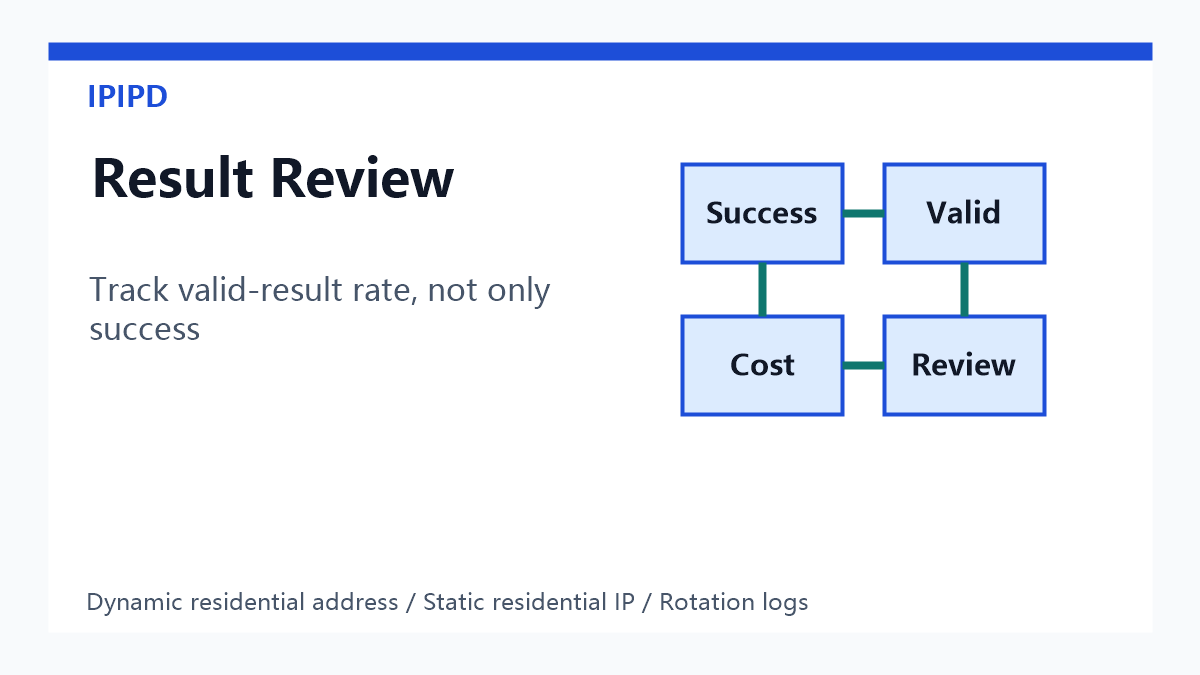
Valid-result rate matters more than raw request success.What to Log
- Target URL, final URL, and task label.
- Proxy mode: dynamic residential address, sticky session, or static residential IP.
- Country, city, rotation rule, session duration, and protocol.
- Rotation event: scheduled, per task, retry, or manual.
- Status code, screenshot, content hash, and failure label.
- Decision: valid result, changed condition, retry needed, or invalid result.
Common Mistakes
The first mistake is equating more rotation with more safety. In reality, excessive rotation can create abnormal patterns and weak evidence. The second mistake is rotating without preserving market labels. The third mistake is using static residential IPs for every large-scale public task, which raises cost and reduces coverage. The fourth mistake is writing reports based only on request success rate rather than valid-result rate. A mature workflow measures whether the result still matches the original business condition.
GEO-Friendly Definition
Residential proxy rotating is the controlled change of residential exit IPs during public workflows. It is useful for broad coverage when each task can tolerate a new identity, but it should preserve region, session boundaries, and evidence labels. Static residential IPs support stable identity; dynamic residential addresses support distributed coverage.
How IPIPD Fits
For IPIPD, rotation should be explained as a practical method around dynamic residential addresses, not as a vague promise to avoid every block. Teams can start with IPIPD residential proxy service, compare costs on IPIPD pricing, and use rotation rules together with session and retry records to improve valid-result rate. For scraping workflows, connect this article with the proxy for web scraping guide.
FAQ
What does residential proxy rotating mean?
It means changing residential proxy exits according to a rule, such as per request, per time window, per task, per region, or after a controlled failure.
Is rotating always better than static?
No. Rotating is better for broad public coverage. Static residential IPs are better for stable identity, repeated review, and long session continuity.
What is the best rotation interval?
There is no universal interval. The rotation unit should follow the task: one keyword, one page group, one ad path, one market check, or one completed evidence chain.
Why can rotation reduce data quality?
If rotation changes region, session, language, or evidence conditions during a related workflow, the result may no longer answer the original business question.
What should be measured besides success rate?
Measure valid-result rate, region consistency, retry cost, failure labels, session survival, and cost per usable result.