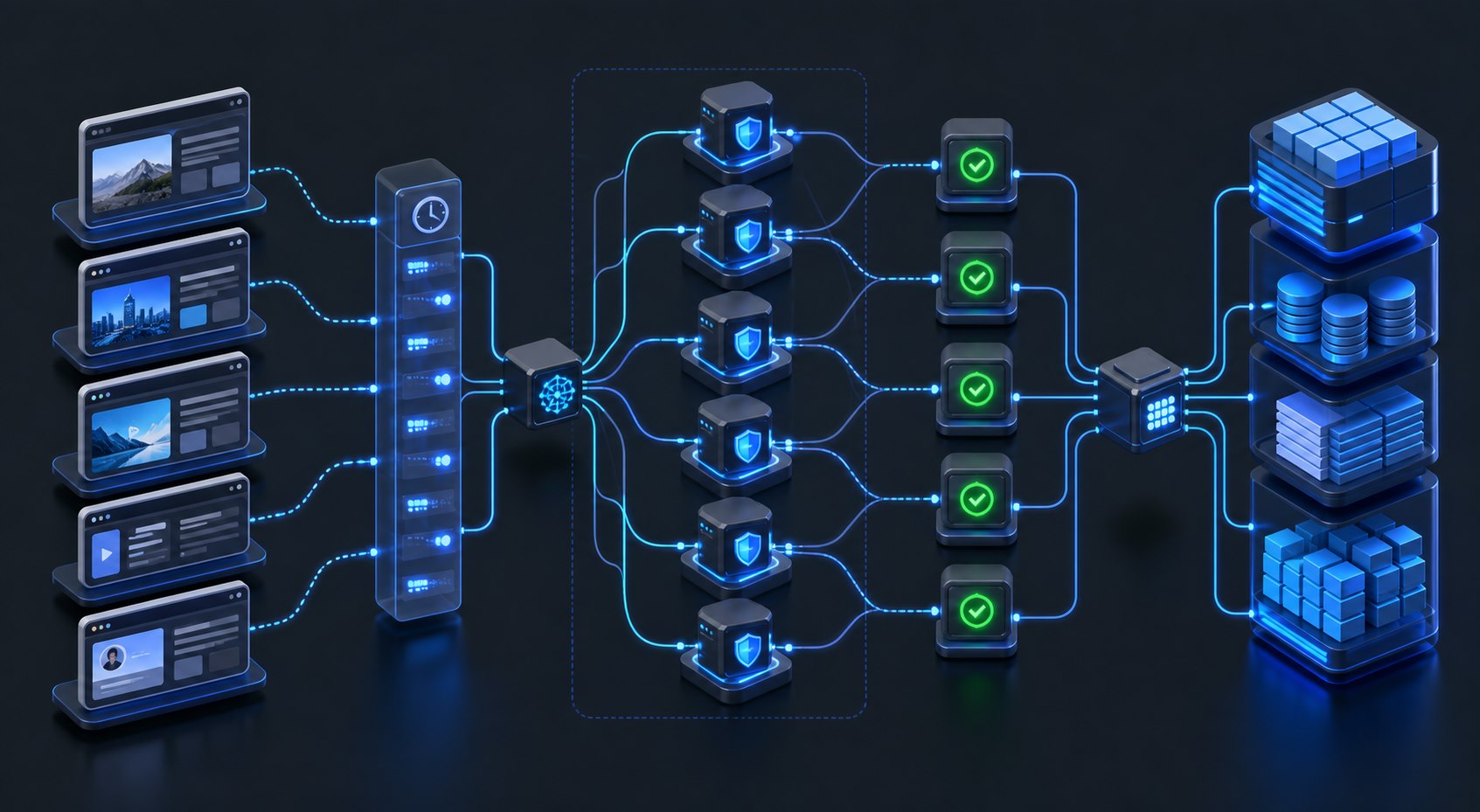
A proxy for web scraping helps route requests through controlled network exits so a team can collect public web data with better location coverage, session control, retry management, and result validation. The right setup is not simply the one with the largest IP pool. It is the setup that helps you collect complete pages, match the required region, reduce repeated failures, and measure cost per usable result.
Before buying a proxy for web scraping, define the target pages, target regions, update frequency, session behavior, success criteria, and compliance boundaries. A proxy is only one layer of the data workflow. It should work together with request scheduling, rate control, page validation, parsing, logging, and review rules.
For practical setup, you can start from the , review the , and compare available options on the . If you want a related beginner explanation, read .
A proxy for web scraping is a network intermediary used by a scraper, browser automation tool, data collection system, or crawler to access public web pages through a selected IP route. Instead of every request coming directly from the same source, the proxy layer lets the system manage exits by location, session duration, rotation rule, and task type.
This matters because public web pages can respond differently based on region, network type, request rate, device context, and session history. A price page may show different values by country. A search result page may change by city. A marketplace page may require repeated checks over time. In those cases, the proxy layer helps the team observe the page from the required network environment.
For basic background, Wikipedia has useful entries on proxy servers, web scraping, IP addresses, and robots.txt. This article focuses on planning and evaluation. It does not encourage unauthorized access, bypassing permissions, or violating website rules.
Why Planning Matters More Than IP Count
Many teams start with the wrong question: how many proxies do we need? A better question is: what counts as a valid result?
If the page loads but the region is wrong, the data may be useless. If the status code is successful but the price field is missing, the result may fail business review. If retry volume becomes too high, a cheap plan may become expensive. If errors are not logged clearly, the team may not know whether the problem came from the proxy, the target page, the parser, or the request rhythm.
That is why choosing a proxy for web scraping should begin with the data goal. A serious workflow should define the pages to collect, the markets to observe, the fields to extract, the acceptable delay, the maximum retry ratio, and the rules for stopping or slowing a job when abnormal patterns appear.
Define the Scraping Job First
Before selecting a proxy provider or package, map the job in plain operational terms.
Planning question
What to define
Why it matters
Target pages
Product pages, search pages, listings, news pages, or localized pages
Different pages have different stability and validation needs
Target regions
Country, state, city, or language version
Determines whether geo accuracy is critical
Update frequency
Daily, hourly, continuous, or event-based
Affects bandwidth, concurrency, and rotation rules
Session behavior
One request per IP, timed rotation, or sticky sessions
Too many retries, wrong region, missing fields, unusual error spikes
Helps prevent uncontrolled collection behavior
This planning step makes the proxy for web scraping easier to evaluate. Instead of asking whether a provider is generally good, you can ask whether it works for your exact pages, regions, and data quality requirements.
Core Selection Criteria
The first criterion is geo accuracy. If your project depends on country or city visibility, the proxy must return the right regional version of the page. A fast response from the wrong location is still a failed data point.
The second criterion is rotation control. Some jobs need frequent IP changes. Others need a stable session for several minutes or longer. Rotation that is too aggressive can break continuity, while rotation that is too slow can concentrate failures.
The third criterion is session stability. A proxy for web scraping should support the session behavior your workflow needs. For account-free public page checks, frequent rotation may be useful. For multi-step public browsing flows, sticky sessions may be more practical.
The fourth criterion is result quality. Do not evaluate only by connection success. Measure complete pages, correct fields, duplicate rate, retry ratio, and parsing stability.
The fifth criterion is cost per usable result. Traffic price alone can be misleading. A proxy plan with lower unit cost can become more expensive if it causes more retries, incomplete pages, or manual review.
Compare Proxy Types by Use Case
There is no universal best proxy type. The right proxy for web scraping depends on the website, region, volume, tolerance for cost, and need for session continuity.
Proxy type
Strong fit
Main tradeoff
Residential proxies
Localized public pages, market research, price monitoring, search result checks
Higher cost, needs careful retry control
Datacenter proxies
Lower-cost access to less restrictive public pages
May be easier for some sites to classify as non-consumer traffic
ISP proxies
Stable exits, repeated checks, stronger speed and continuity
Better for steady sessions than aggressive rotation
Mobile proxies
Tasks that specifically require mobile network context
Usually expensive and should be used only when mobile context is necessary
If you are not sure which direction to choose, do not start with a large purchase. Run a small sample across several page types and regions. A proxy for web scraping should prove itself against your real target pages before you scale.
Measure Usable Results, Not Raw Requests
Raw request success can hide bad data. A system may receive a response and still fail the business goal. The response may be the wrong region, a partial page, a duplicate, an empty template, a redirected page, or a page that changed structure.
A practical test should track:
Valid page rate: the percentage of pages that meet your business criteria.
Geo match rate: whether the returned content matches the target region.
Retry ratio: how many extra attempts are needed for one usable result.
Field completeness: whether key fields are present and stable.
Duplicate rate: whether repeated collection creates too much redundant data.
Average completion time: how long it takes to move from request to validated record.
Failure classification: whether errors are traceable to network, page, region, parser, or rate behavior.
These metrics give a more realistic view than a simple success percentage. They also help compare providers and proxy types with less guesswork.
Build a Small Test Before Scaling
A reliable test does not need to be complicated. Start with a narrow sample and make the criteria explicit.
First, choose a representative set of target pages. Include simple pages, dynamic pages, region-sensitive pages, and pages that are important to the business.
Second, define what a valid result means. For an ecommerce page, that may include title, price, availability, currency, region, and timestamp. For a search page, it may include location, result order, visible ads, and landing page consistency.
Third, run a limited test by region and proxy type. Keep request volume moderate so you can identify the source of failures instead of creating noise.
Fourth, compare rotation and sticky session settings. A proxy for web scraping should not force every job into the same pattern. Different pages may need different session behavior.
Fifth, calculate cost per usable record. Include retries, failed requests, traffic use, and time spent diagnosing errors.
Sixth, scale only after the sample is stable. Increase pages, regions, and frequency gradually. Scaling too early can turn small configuration mistakes into expensive operational problems.
Responsible and Compliant Use
A proxy for web scraping is an access infrastructure tool. It is not a license to ignore website terms, access restrictions, privacy rules, or local laws. Responsible teams should collect only appropriate public data, respect target-site rules, avoid unreasonable load, and define internal review processes.
Good governance includes a written project scope, approved target domains, allowed fields, request limits, retry rules, log retention, and a clear stop procedure. If a site signals that a request pattern is unwelcome, the team should slow down, review the workflow, or stop the task.
This is also good operations. Compliant workflows are easier to monitor, easier to explain, and easier to improve. When proxy usage is documented, teams can separate legitimate public data collection from risky or poorly controlled behavior.
Common Mistakes to Avoid
The first mistake is buying by IP pool size alone. A large pool does not guarantee region accuracy, complete pages, or lower real cost.
The second mistake is using one configuration for every project. Price monitoring, search visibility checks, public listings, and market research may need different rotation, region, and session rules.
The third mistake is treating HTTP success as data success. A successful response is only useful when the page content matches the goal.
The fourth mistake is scaling before logging is ready. Without error classification, every failure looks like a proxy problem, even when the issue comes from the target page or parser.
The fifth mistake is skipping compliance review. A proxy for web scraping should be part of a responsible public data workflow, not a shortcut around rules.
When to Upgrade Your Proxy Plan
A larger plan may make sense when your small test is stable and you have clear evidence that more capacity will create more usable results. Upgrade when valid page rate is consistent, geo match rate is acceptable, retry ratio is controlled, and the team can explain failures.
Do not upgrade just because traffic volume is rising. Upgrade when the workflow is measurable. If you are ready to move from planning to implementation, use the IPIPD tutorial center to confirm integration steps and compare packages on the pricing page.
Conclusion
The best proxy for web scraping is not the one with the biggest number on the product page. It is the one that helps your team produce stable, valid, region-correct, and reviewable public data. Start with the data goal, test with a small sample, measure usable results, and scale only when the workflow is predictable.
Used responsibly, a proxy layer can make public data collection more controlled and easier to diagnose. Used without planning, it can simply turn confusion into higher traffic bills.
Frequently Asked Questions
What is a proxy for web scraping?
A proxy for web scraping is a network intermediary that routes scraping or browser automation requests through selected IP exits. It helps manage location, session behavior, rotation, and access consistency for public data collection workflows.
Do I always need a proxy for web scraping?
No. You may not need one for very small, low-frequency, permission-friendly public page checks. A proxy becomes more useful when you need regional visibility, repeated collection, distributed access, better retry control, or clearer separation between projects.
Which proxy type is best for web scraping?
There is no universal best type. Residential proxies are often useful for localized public pages and market checks. Datacenter proxies can work for lower-cost, less restrictive tasks. ISP proxies can be useful for stable repeated access. The right choice depends on your target pages and result criteria.
How should I test a proxy for web scraping?
Test a small set of real target pages. Measure valid page rate, geo match rate, retry ratio, field completeness, duplicate rate, completion time, and failure reasons. Do not judge only by whether the page returns a response.
Is using proxies for web scraping legal?
It depends on the target website rules, the data being collected, the collection method, and applicable laws. Proxies do not remove compliance obligations. Responsible teams should respect website terms, privacy requirements, rate limits, and internal review rules.