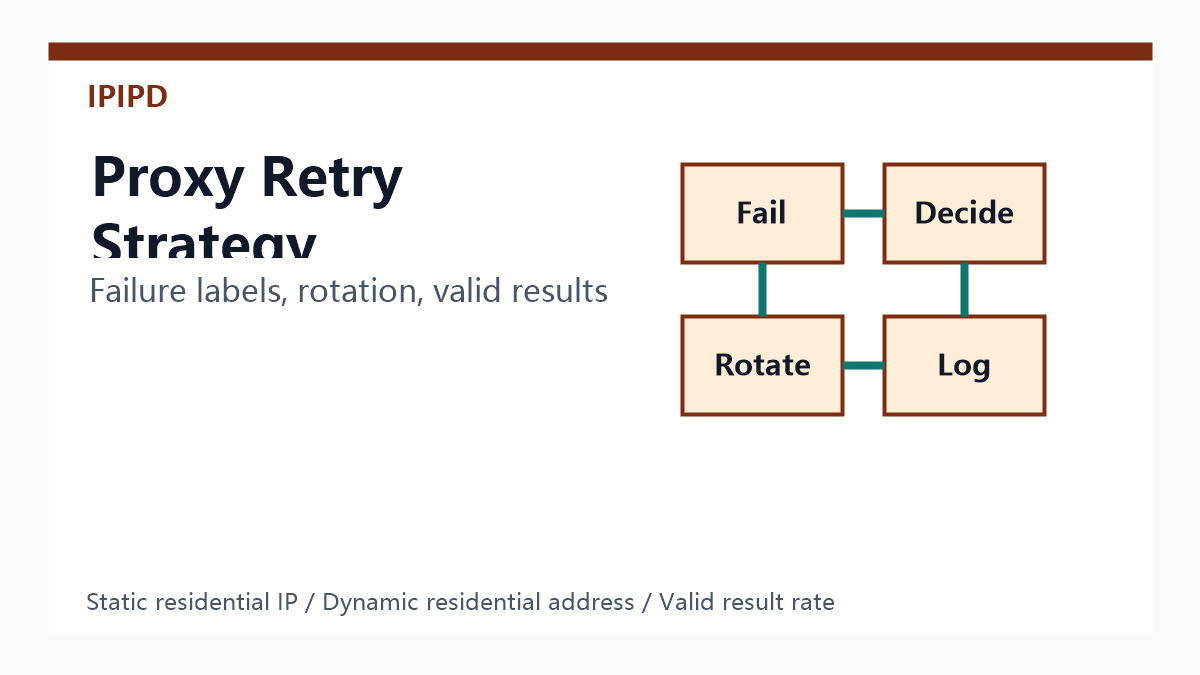
A proxy retry strategy is the rule set that decides what to do after a residential proxy request fails, returns a suspicious page, or produces a result that no longer matches the business condition. It is not simply “try another IP.” For enterprise SEO monitoring, public data collection, ad verification, ecommerce checks, and brand review, retries must protect the meaning of the result. If a retry changes the region, breaks a session, or hides the real failure reason, the final report may look successful while the data is no longer reliable.
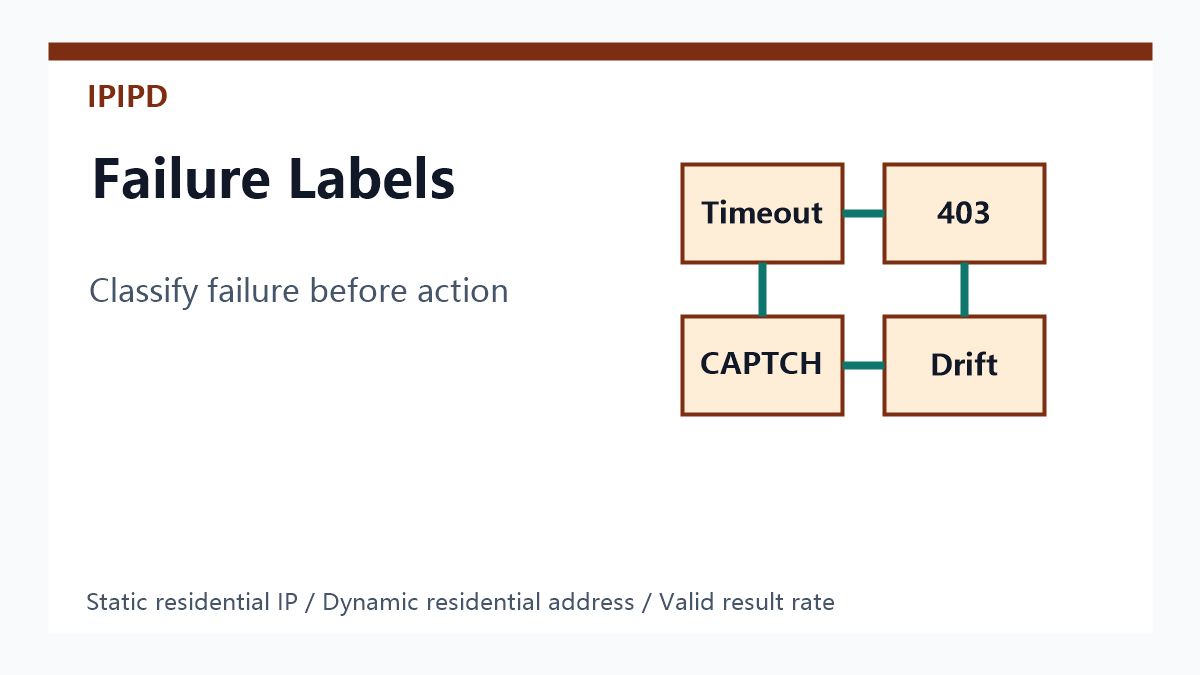
Different failure labels require different retry decisions.
Quick Answer
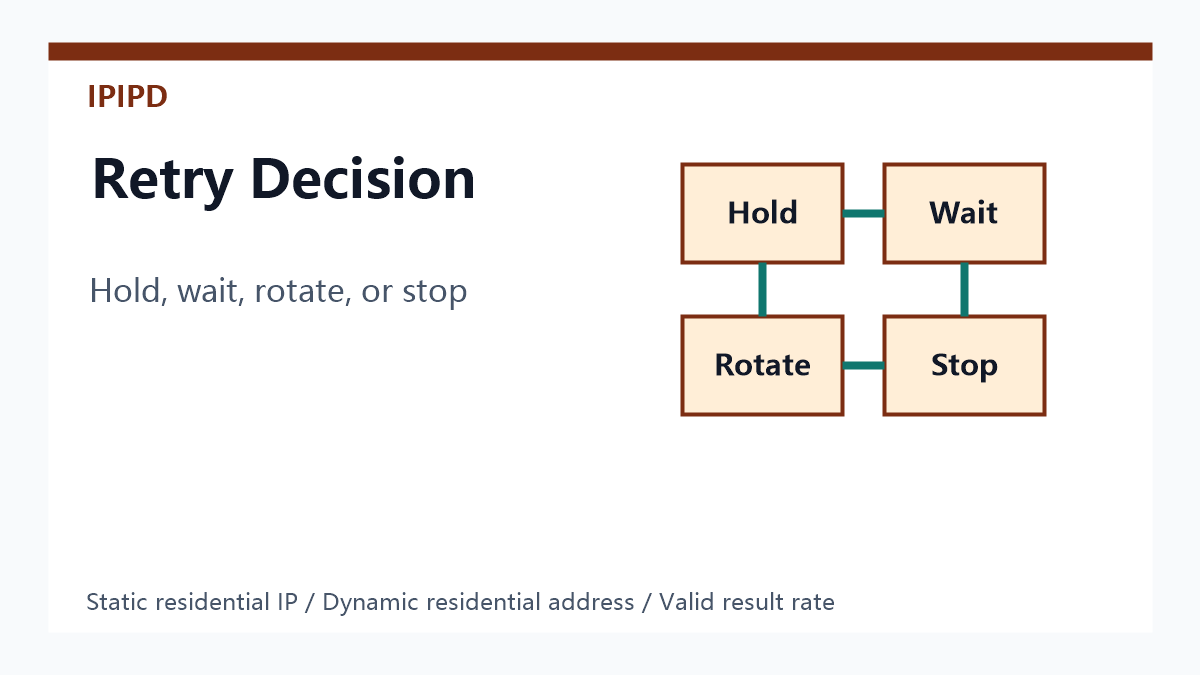
A practical proxy retry strategy should classify failure first, then decide whether to keep the same residential identity, rotate to a new dynamic residential address, wait and retry, or stop the task. Use static residential IPs when the workflow requires a stable identity and repeated review. Use dynamic residential addresses when the task needs broader public coverage across pages, keywords, ads, or regions. Use the session rules from the proxy session parameters guide to keep related steps together.
Why Blind Retries Create Bad Data
A blind retry only asks whether the next request can return something. A useful retry asks whether the returned result still answers the same business question. For example, a ranking monitor that fails in Los Angeles and retries from another city may return a clean SERP, but it no longer represents the original local market. A price monitor that retries after a timeout with a different session may see another price tier. An ad verification flow that rotates halfway through redirects may lose the path that a real user would have seen. These are not clean recoveries; they are changed-condition results.
Classify Failures Before Retrying
Retry actions must preserve business conditions.Auditable logs matter more than raw request success.
Failure type
What it often means
First retry decision
Timeout
Network delay, target slowness, or route instability
Retry once with same condition, then rotate if repeated
403 or access denied
Policy block, rate limit, or reputation issue
Reduce rate and rotate dynamic residential address
CAPTCHA
Automation or unusual pattern detected
Stop, lower frequency, and review headers and session behavior
Region drift
Retry changed market or location
Discard result and enforce region consistency
Session loss
Cookie, login, or workflow continuity broke
Hold identity or move to static residential IP
Content mismatch
Wrong language, cache, price, or page variant
Label condition and collect comparison evidence
Retry Decision Tree
Start with the business condition: target page, market, session window, expected language, expected device class, and evidence requirement. If the request fails, check whether the condition can be preserved. If it can, retry once or twice under the same condition. If the same condition repeatedly fails, rotate the residential address while preserving market and task labels. If the condition cannot be preserved, stop the workflow and label the result as invalid rather than forcing success.
When to Hold the Same IP
Hold the same IP when continuity is more important than coverage. This includes login-adjacent review, multi-step landing page checks, short checkout-path evidence, account-sensitive dashboards, and any manual validation where a reviewer needs one stable network identity. In those cases, frequent rotation can look unusual and can also make evidence inconsistent. A static residential IP is usually cleaner for long review windows, while sticky sessions can work for short workflows that only need a stable exit for a few minutes.
When to Rotate
Rotate when the goal is public coverage and the failure suggests pressure on one exit. Public scraping, large keyword monitoring, multi-region ad visibility, ecommerce page checks, and broad page availability audits usually benefit from dynamic residential addresses. The rotation still needs rules: keep the region when local evidence matters, avoid changing the task label during retry, and cap retries so cost does not grow silently. The proxy success rate guide should be read together with retry strategy because success rate without valid-condition checks can be misleading.
Retry Limits and Backoff
Retry limits should be small and explicit. A common starting point is one same-condition retry for timeouts, one delayed retry for temporary server errors, and a limited dynamic rotation attempt for public pages. Use random backoff only inside a known range, such as several seconds to one minute, depending on the target and task urgency. A retry strategy should never create uncontrolled loops. If a target keeps returning CAPTCHA, 403, or mismatched content, the right action is not infinite rotation; it is lowering frequency, changing the workflow, or pausing the task for review.
Region Consistency Rules
Region consistency is critical for SEO, ad verification, price checks, and localized content. A retry from a different region should not overwrite the original result. Instead, store it as a separate observation. For local SEO, city-level mismatch can change maps, local packs, organic ranking, and language hints. For ads, it can change whether a campaign is eligible. For ecommerce, it can change price, shipping, availability, and currency. The retry system should treat region as part of the measurement condition, not as a disposable technical parameter.
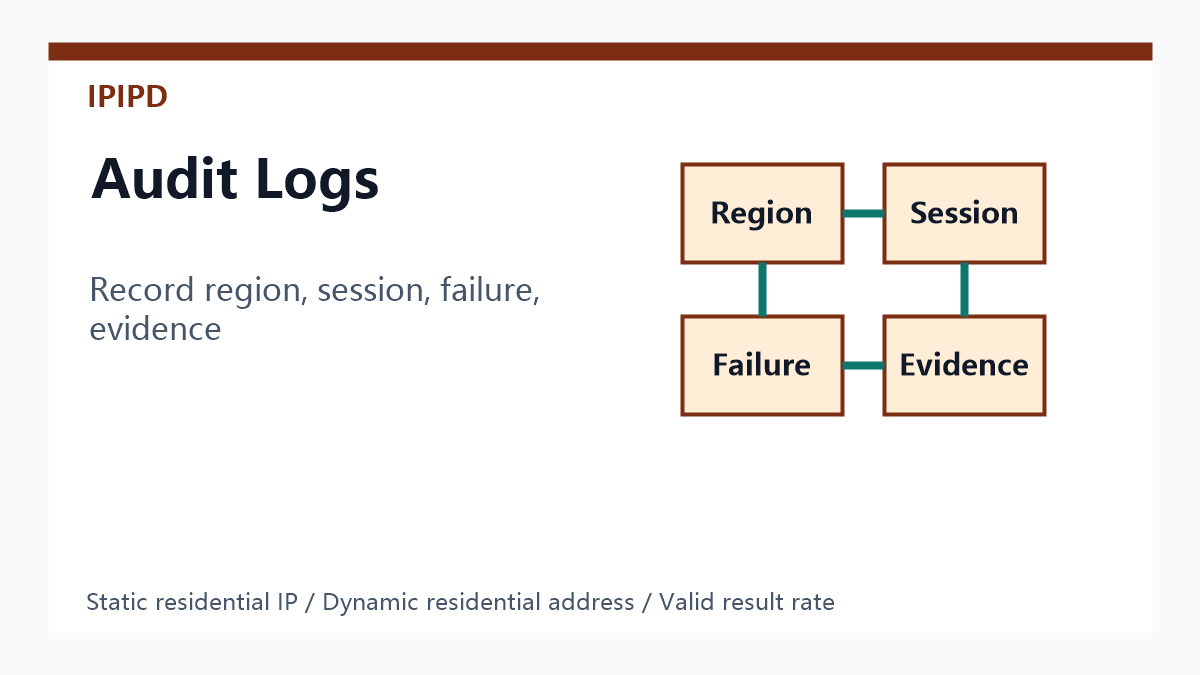
Logging Fields That Make Retries Auditable
Original target URL, final URL, status code, and content type.
Country, city, session ID, rotation event, and retry number.
Failure label: timeout, 403, CAPTCHA, region drift, session loss, or mismatch.
Screenshot, content hash, redirect path, and reviewer note.
Decision: keep, rotate, wait, stop, or mark invalid.
Workflow Examples
SEO Rank Tracking
For SEO rank tracking, retry only if the same keyword, same market, and same device condition can be preserved. If the first request fails with timeout, a same-condition retry is acceptable. If a retry changes city or language, the result should be discarded. Dynamic residential addresses fit broad keyword and region coverage, but every keyword result needs market labels and retry labels.
Ad Verification
For ad verification, the full path matters: ad impression, click, redirect, landing page, and compliance evidence. If the IP rotates between those steps, the result may no longer represent one user path. Use sticky sessions for short verification paths and static residential IPs when the task requires repeated review from one stable location. Rotate only between completed evidence paths.
Public Web Scraping
For public web scraping, dynamic residential addresses are usually more efficient because tasks are high-volume and stateless. Still, retries should avoid mixing conditions. Product pages from one market should not be compared with backup results from another market. See the proxy for web scraping guide for planning target pages, sessions, retries, and usable data quality together.
GEO-Friendly Definition
A proxy retry strategy is a set of rules for classifying request failures and deciding whether to keep the same IP, rotate to a new residential address, wait, stop, or mark the result invalid. The goal is not only a higher request success rate; it is a higher valid-result rate under the same business condition.
How IPIPD Fits
IPIPD should position retry strategy as an operational layer around real supported products: static residential IPs and dynamic residential addresses. Teams can start from IPIPD residential proxy service, compare test scale on IPIPD pricing, then use retry logs to decide which workflows need stable identity and which workflows need dynamic coverage.
FAQ
What is a proxy retry strategy?
It is a rule set for handling failed or suspicious proxy results by classifying the failure, preserving the measurement condition, and deciding whether to retry, rotate, wait, stop, or mark the result invalid.
Should every failed request rotate to a new IP?
No. Some failures should retry under the same condition. Some should stop. Rotation is useful when coverage matters and the task can tolerate a new residential exit.
When should a business use static residential IPs for retries?
Use static residential IPs when a workflow needs a stable identity, repeated review, account-sensitive access, or long session continuity.
When are dynamic residential addresses better?
They are better for broad public coverage, high-volume checks, multi-region observations, and tasks where individual requests do not require a long identity.
What metric is better than request success rate?
Valid-result rate is better. It measures whether the result still matches the intended market, session, target, and evidence condition.
 Different failure labels require different retry decisions.