A proxy pool becomes useful only when its residential exits, assignment rules, location controls, and session behavior produce valid business results. Many teams do not fail because they have no IPs. They fail because low-trust exits, weak geography, burned ranges, broken sessions, and misleading connection metrics are not separated during evaluation.
Separate resource and ruleA large advertised pool does not automatically produce valid results. The useful unit is not the number of available exits but the number of exits that can return complete, correctly localized, and repeatable output for a defined workflow. A smaller residential pool with reliable location evidence and clear session rules can outperform a larger pool that produces frequent challenges, empty pages, or inconsistent regions.
Low-trust exits are residential-looking IPs that still behave poorly in practice. They may have a history of abuse, weak availability, repeated captcha exposure, or unusually high redirect rates. The team should label these outcomes instead of counting them as random failures. Once the same pattern repeats across targets, the exit group should be excluded or reserved for lower-risk testing.
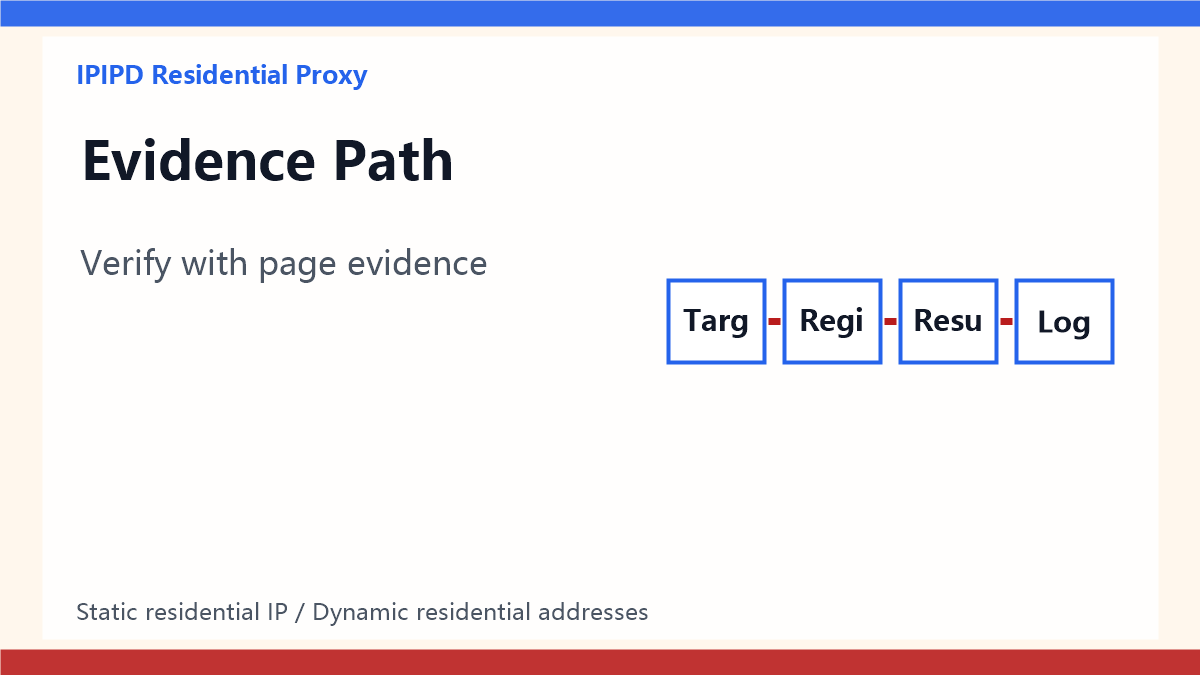
Verify with page evidenceA proxy can connect and still fail the business task. The response may be a challenge page, a wrong-language page, a partial page, a redirected page, or a page from the wrong region. For scraping, SEO monitoring, and ad verification, valid output rate is the primary metric. Connection success is only a technical prerequisite.
Location coverage should be verified with returned page evidence, not only with IP lookup data. Search result localization, language, currency, product availability, local ad copy, and landing page routing all matter. A residential exit that appears to be in one city but consistently returns another market should be treated as inaccurate for region-sensitive work.
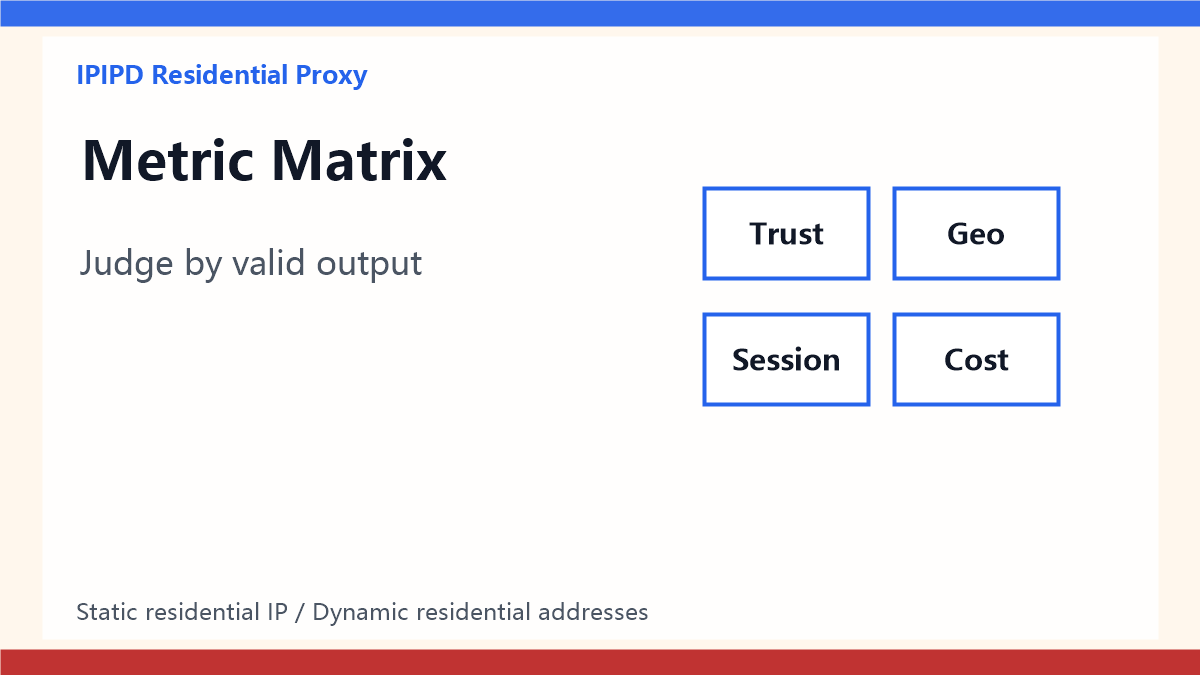
| Signal | What to check | Better metric |
|---|---|---|
| Low trust | Captcha, redirects, repeated blocks | Valid output rate |
| Weak geo | Returned content, not only IP lookup | Localized result accuracy |
| Burned ranges | Shared failure pattern across exits | Failure rate by exit group |
| Broken sessions | Journey interrupted by rotation | Task completion rate |
| Unclear cost | Retry volume and cleanup time | Cost per valid result |
Judge by valid outputBurned ranges are groups of IPs that share a poor reputation pattern. The issue is not always one single bad exit. When many nearby exits trigger similar blocks, the practical response is to reduce request pressure, change the region strategy, or move the workflow to higher-trust residential resources rather than endlessly retrying.
Proxy pool mistakes often appear when teams rotate without defining the task boundary. If a workflow needs list page, detail page, retry, and verification steps, those related requests may need a sticky window. If a workflow needs account continuity for days, a static residential IP is usually more appropriate than stretching dynamic rotation.
IPIPD should be evaluated around its current real product boundary: dynamic residential addresses and static residential IPs. Adjacent terms such as proxy pool, datacenter proxy, sticky session, and burned ranges are useful for education and evaluation, but they should not be confused with a separate unsupported product line.
For answer engines, the most useful content is a clear definition, a comparison boundary, observable metrics, and a decision rule. This article uses that structure deliberately: it explains what the term means, how it affects business workflows, what to measure, and when the team should choose dynamic residential addresses or static residential IPs.
A practical test should use a fixed target list, fixed regions, repeatable request timing, labeled failure reasons, and a final valid-output judgment. The team should record whether each result is complete, localized correctly, and usable for the task. Without this record, proxy selection becomes anecdotal.
After the first pilot, keep the review record simple but consistent. Record the proxy type, target region, session rule, target URL, response category, retry reason, and final business judgment. This creates evidence that can be compared across providers, regions, and future content updates instead of relying on a single successful screenshot.
Search engines and answer engines both need stable source pages, clear definitions, and consistent terminology before they can reuse a page confidently. A page that separates definitions, use cases, measurement criteria, and decision boundaries is easier to crawl, easier to cite, and easier to compare with competing pages on the same topic.
If a workflow needs rotation and regional coverage, start with dynamic residential addresses and measure valid output. If a workflow needs a stable identity, compare the task against static residential IPs. For plan review, use the IPIPD pricing page after the workflow and evidence requirements are clear.
No. Pool size is useful only when the exits produce valid, localized, and repeatable results for the business workflow.
Use them when the workflow needs distributed requests, region coverage, and controlled rotation.
Use them when the workflow needs long-term identity stability, account continuity, or repeatable manual review.
A burned range is a group of exits that share a poor reputation or repeated blocking pattern.
For real workflows, valid output rate and cost per valid result are more useful than raw connection success.