Residential Proxy vs VPN: Business Use Cases is a practical IPIPD guide for teams that need residential address workflows with clear product boundaries, measurable evidence, and responsible use.
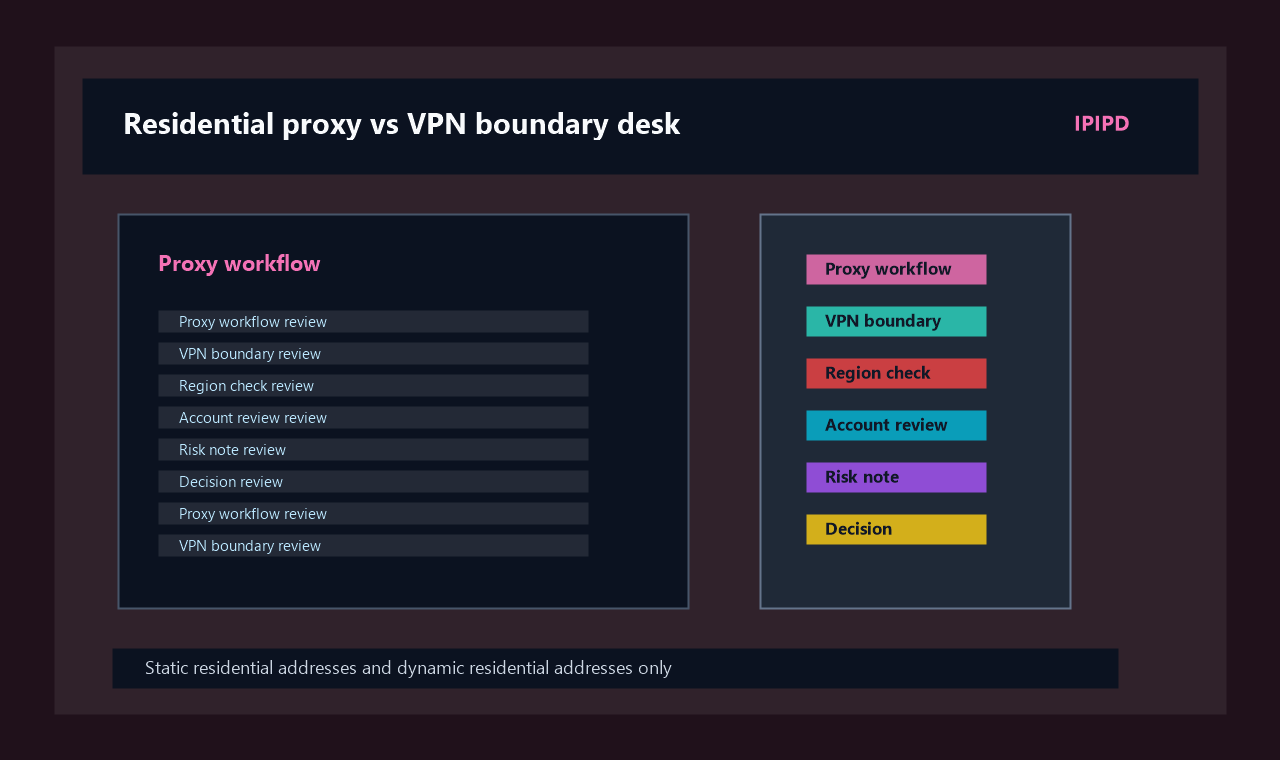
The focus keyword for this page is residential proxy vs VPN. The article uses related terms only where they support the same search intent and does not turn adjacent categories into unsupported IPIPD products.
Quick Answer: residential proxy vs VPN
Residential proxy vs VPN is a workflow choice, not a simple good-or-bad comparison. A VPN usually routes a device or connection through an encrypted tunnel, while a residential proxy routes application traffic through residential addresses that can be controlled by session, region, and rotation logic. IPIPD should be discussed only in terms of static residential addresses and dynamic residential addresses.
For business workflows, residential proxy vs VPN usually comes down to control. If the task needs region-labeled public-page checks, account continuity, or dynamic sampling, residential addresses are easier to fit into a controlled process. If the task is personal privacy on a device, a VPN may be the more familiar category, but it is not the IPIPD product described here.
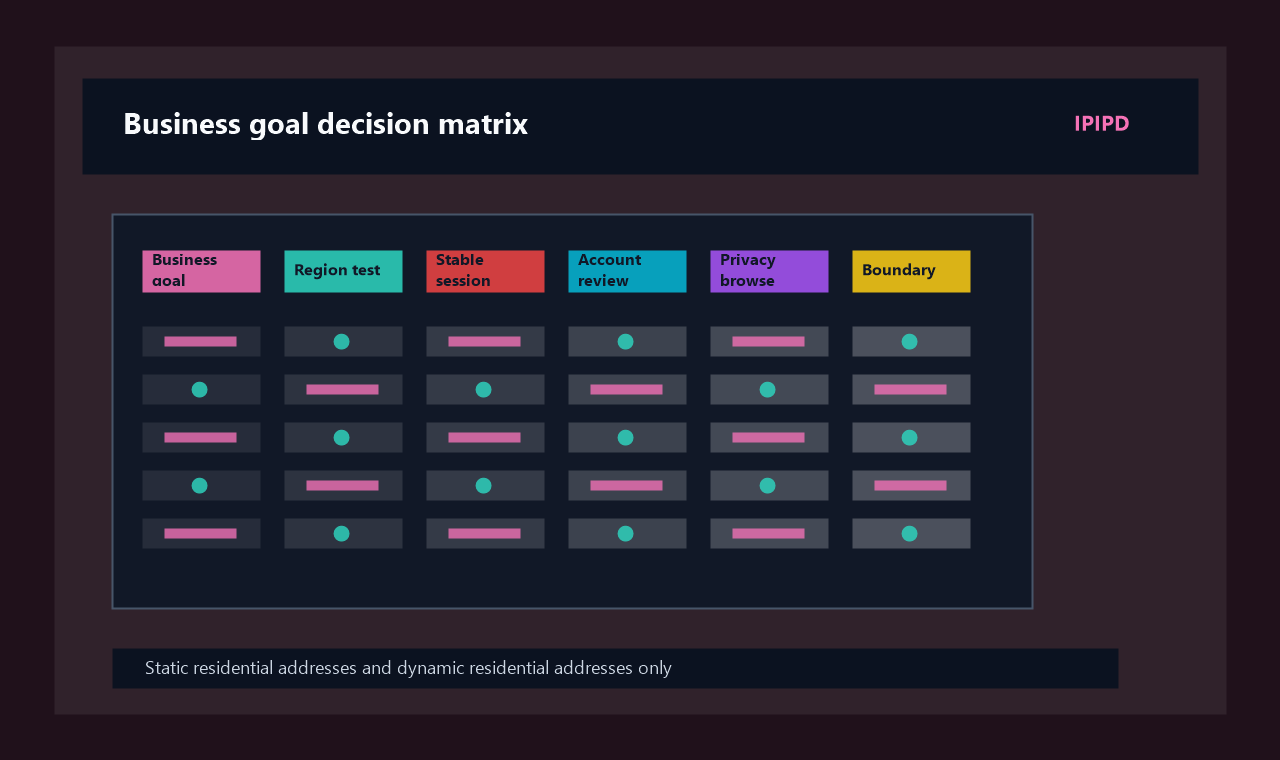
At a Glance: comparison table
Workflow map for residential proxy vs VPN.
The main difference is scope. A VPN often protects a whole device connection. A proxy is usually configured at an application, browser, tool, or request level. That makes residential proxy vs VPN important for teams that need different routes for different tasks.
A second difference is evidence. Static residential addresses can support repeatable region checks. Dynamic residential addresses can support broader sampling. A VPN may be useful for privacy or remote access, but it does not always give the same workflow-level logging and rotation control.
Check
Practical meaning
Decision checks for residential proxy vs VPN.Evidence review checklist for residential proxy vs VPN.
Frequently Asked Questions
Is IPIPD a VPN provider?
No. IPIPD content should focus on static residential addresses and dynamic residential addresses. VPN is only discussed here as a comparison category.
Which is better for localized business checks?
Residential proxy workflows are usually easier to label by region, session, and task. Static residential addresses can support repeat checks, while dynamic residential addresses support sampling.
Does a residential proxy encrypt all device traffic?
Not in the same way a typical VPN tunnel is used. A proxy is usually configured for a browser, app, tool, or request flow.
Can a VPN replace dynamic residential addresses?
Operational evidence for residential proxy vs VPN
A practical review of residential proxy vs VPN should also include ownership. One person should own the target list, one person should review exceptions, and one person should decide whether the workflow can scale beyond the first batch.
For residential proxy vs VPN, the record should show why static residential addresses, dynamic residential addresses, or a split workflow were chosen. That record protects the team from changing the setup later without understanding the original reason.
The workflow should be measured in completed business checks. A completed check includes the expected page state, the proxy mode, the region label, the time window, and a note about any retry or manual review.
If the first run produces mixed results, do not expand volume immediately. Separate wrong-region responses, blocked responses, slow responses, and pages that load but miss the required business field.
A stable operating routine is more useful than an aggressive proxy setting. IPIPD content should help the user choose a controlled residential address workflow rather than chase a feature that sounds powerful but does not fit the task.
Teams should also write down what they will not do. That includes avoiding sensitive data collection, login-only targets without permission, excessive request pressure, and unsupported product assumptions.
When the workflow is approved, keep the first production run small enough to inspect manually. A short evidence review after the run is often the fastest way to catch a location mismatch or session problem.
The final buying or configuration decision should be revisited after several runs. If the task needs more repeatability, move toward static residential addresses. If it needs broader coverage, refine the dynamic residential address sampling plan.
Operational evidence for residential proxy vs VPN
A practical review of residential proxy vs VPN should also include ownership. One person should own the target list, one person should review exceptions, and one person should decide whether the workflow can scale beyond the first batch.
For residential proxy vs VPN, the record should show why static residential addresses, dynamic residential addresses, or a split workflow were chosen. That record protects the team from changing the setup later without understanding the original reason.
The workflow should be measured in completed business checks. A completed check includes the expected page state, the proxy mode, the region label, the time window, and a note about any retry or manual review.
Primary use
Choosing between task-level proxy routing and device-level encrypted tunneling.
Best IPIPD fit
Static and dynamic residential addresses for business proxy workflows.
Not offered here
This article does not present VPN as an IPIPD product.
Main decision
Choose by workflow control, region evidence, session needs, and compliance.
When a residential proxy fits better
A residential proxy fits better when the team needs task-level routing. SEO checks, public price monitoring, ad verification, and localized QA often require a specific region, session policy, and evidence note. In those cases, residential proxy vs VPN usually favors residential addresses because the workflow needs more control than a simple tunnel.
Static residential addresses are useful when the same region and identity should remain stable. Dynamic residential addresses are useful when the task needs rotation across a region set. Both choices should be tested against the actual business process.
When a VPN is a separate category
A VPN can be relevant for personal security, employee remote access, or encrypted device traffic, but those are different jobs. If a user is comparing residential proxy vs VPN for web data QA or localized business checks, the VPN category may not answer the operational question.
Do not describe IPIPD as a VPN provider. The correct boundary is that IPIPD content can compare VPNs as a background category while explaining how static residential addresses and dynamic residential addresses support proxy workflows.
Session control and routing depth
Proxy workflows can be built around session duration, sticky windows, rotation frequency, and application-level credentials. That matters when a team needs one browser profile to stay stable while another process samples broadly. Residential proxy vs VPN becomes a question of routing depth.
A VPN may route everything together. That can be simpler, but it can also make testing less precise. If one task needs a US residential exit and another needs a UK sample, proxy-level routing is easier to document.
Compliance limits in the comparison
Neither a proxy nor a VPN makes an unsuitable task suitable. Terms, permission, privacy, rate limits, and data sensitivity still matter. Residential proxy vs VPN should never be framed as a way to bypass controls; it should be framed as a way to choose the right network tool for an allowed workflow.
For IPIPD, avoid unsupported product claims. The article can explain why a VPN is different, but the business CTA should return to static residential addresses or dynamic residential addresses when those fit the use case.
Quick reference: choose by workflow
Choose static residential addresses for stable repeat checks. Choose dynamic residential addresses for controlled sampling. Consider a VPN category only when the need is device-level encrypted tunneling rather than proxy workflow control.
The practical residential proxy vs VPN decision is based on scope, session control, location evidence, and compliance, not on which term sounds more technical.
No. IPIPD content should focus on static residential addresses and dynamic residential addresses. VPN is only discussed here as a comparison category.
Which is better for localized business checks?
Residential proxy workflows are usually easier to label by region, session, and task. Static residential addresses can support repeat checks, while dynamic residential addresses support sampling.
Does a residential proxy encrypt all device traffic?
Not in the same way a typical VPN tunnel is used. A proxy is usually configured for a browser, app, tool, or request flow.
Can a VPN replace dynamic residential addresses?
Not when the workflow needs rotation, region-labeled samples, or proxy-specific session controls.
What should I test before choosing?
Test the target workflow, region visibility, session duration, logging needs, and compliance requirements.
Not when the workflow needs rotation, region-labeled samples, or proxy-specific session controls.
What should I test before choosing?
Test the target workflow, region visibility, session duration, logging needs, and compliance requirements.
If the first run produces mixed results, do not expand volume immediately. Separate wrong-region responses, blocked responses, slow responses, and pages that load but miss the required business field.
A stable operating routine is more useful than an aggressive proxy setting. IPIPD content should help the user choose a controlled residential address workflow rather than chase a feature that sounds powerful but does not fit the task.
Teams should also write down what they will not do. That includes avoiding sensitive data collection, login-only targets without permission, excessive request pressure, and unsupported product assumptions.
When the workflow is approved, keep the first production run small enough to inspect manually. A short evidence review after the run is often the fastest way to catch a location mismatch or session problem.
The final buying or configuration decision should be revisited after several runs. If the task needs more repeatability, move toward static residential addresses. If it needs broader coverage, refine the dynamic residential address sampling plan.
Operational evidence for residential proxy vs VPN
A practical review of residential proxy vs VPN should also include ownership. One person should own the target list, one person should review exceptions, and one person should decide whether the workflow can scale beyond the first batch.
For residential proxy vs VPN, the record should show why static residential addresses, dynamic residential addresses, or a split workflow were chosen. That record protects the team from changing the setup later without understanding the original reason.
The workflow should be measured in completed business checks. A completed check includes the expected page state, the proxy mode, the region label, the time window, and a note about any retry or manual review.
If the first run produces mixed results, do not expand volume immediately. Separate wrong-region responses, blocked responses, slow responses, and pages that load but miss the required business field.
A stable operating routine is more useful than an aggressive proxy setting. IPIPD content should help the user choose a controlled residential address workflow rather than chase a feature that sounds powerful but does not fit the task.
Teams should also write down what they will not do. That includes avoiding sensitive data collection, login-only targets without permission, excessive request pressure, and unsupported product assumptions.
When the workflow is approved, keep the first production run small enough to inspect manually. A short evidence review after the run is often the fastest way to catch a location mismatch or session problem.
The final buying or configuration decision should be revisited after several runs. If the task needs more repeatability, move toward static residential addresses. If it needs broader coverage, refine the dynamic residential address sampling plan.
Operational evidence for residential proxy vs VPN
A practical review of residential proxy vs VPN should also include ownership. One person should own the target list, one person should review exceptions, and one person should decide whether the workflow can scale beyond the first batch.
For residential proxy vs VPN, the record should show why static residential addresses, dynamic residential addresses, or a split workflow were chosen. That record protects the team from changing the setup later without understanding the original reason.
The workflow should be measured in completed business checks. A completed check includes the expected page state, the proxy mode, the region label, the time window, and a note about any retry or manual review.
If the first run produces mixed results, do not expand volume immediately. Separate wrong-region responses, blocked responses, slow responses, and pages that load but miss the required business field.
A stable operating routine is more useful than an aggressive proxy setting. IPIPD content should help the user choose a controlled residential address workflow rather than chase a feature that sounds powerful but does not fit the task.
Teams should also write down what they will not do. That includes avoiding sensitive data collection, login-only targets without permission, excessive request pressure, and unsupported product assumptions.
When the workflow is approved, keep the first production run small enough to inspect manually. A short evidence review after the run is often the fastest way to catch a location mismatch or session problem.
The final buying or configuration decision should be revisited after several runs. If the task needs more repeatability, move toward static residential addresses. If it needs broader coverage, refine the dynamic residential address sampling plan.
Operational evidence for residential proxy vs VPN
A practical review of residential proxy vs VPN should also include ownership. One person should own the target list, one person should review exceptions, and one person should decide whether the workflow can scale beyond the first batch.
For residential proxy vs VPN, the record should show why static residential addresses, dynamic residential addresses, or a split workflow were chosen. That record protects the team from changing the setup later without understanding the original reason.
The workflow should be measured in completed business checks. A completed check includes the expected page state, the proxy mode, the region label, the time window, and a note about any retry or manual review.
If the first run produces mixed results, do not expand volume immediately. Separate wrong-region responses, blocked responses, slow responses, and pages that load but miss the required business field.
A stable operating routine is more useful than an aggressive proxy setting. IPIPD content should help the user choose a controlled residential address workflow rather than chase a feature that sounds powerful but does not fit the task.
Teams should also write down what they will not do. That includes avoiding sensitive data collection, login-only targets without permission, excessive request pressure, and unsupported product assumptions.
When the workflow is approved, keep the first production run small enough to inspect manually. A short evidence review after the run is often the fastest way to catch a location mismatch or session problem.
The final buying or configuration decision should be revisited after several runs. If the task needs more repeatability, move toward static residential addresses. If it needs broader coverage, refine the dynamic residential address sampling plan.