ISP Proxy vs Residential Proxy: Boundary Guide is a practical IPIPD guide for teams that need residential address workflows with clear product boundaries, measurable evidence, and responsible use.
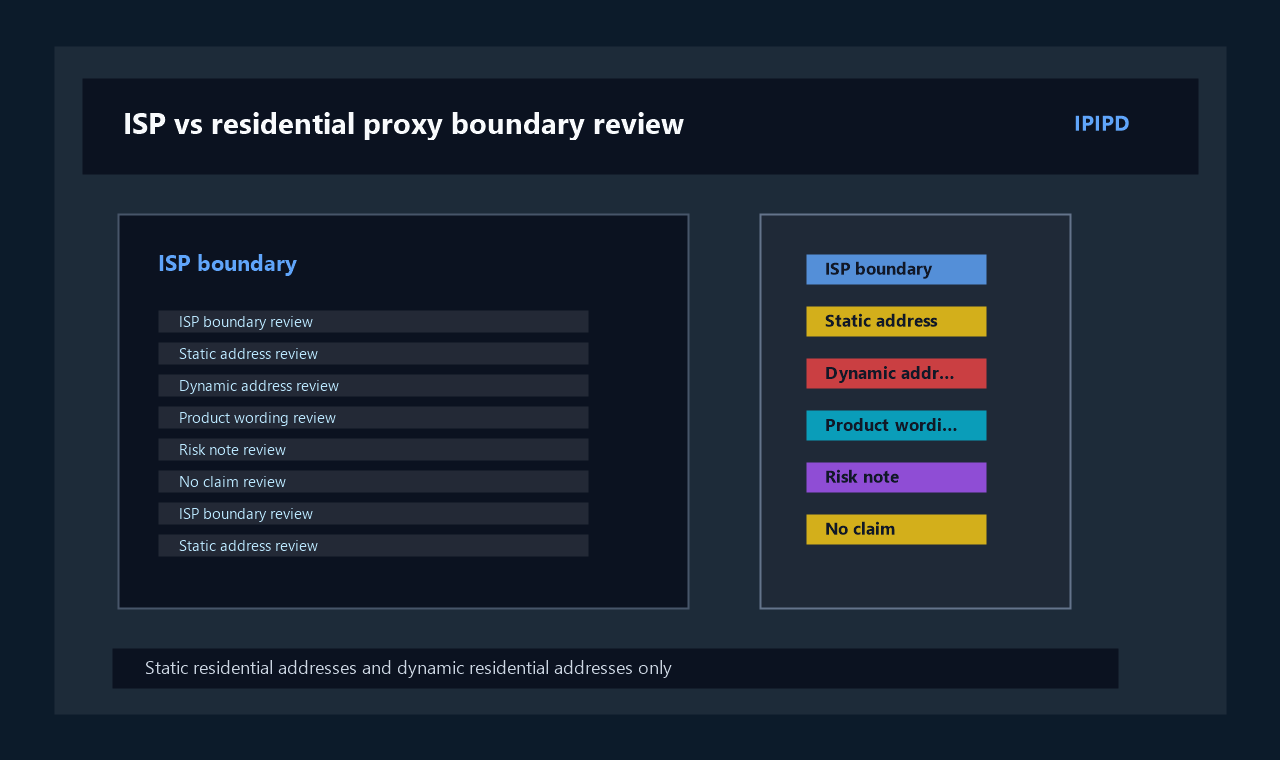
The focus keyword for this page is ISP proxy vs residential proxy. The article uses related terms only where they support the same search intent and does not turn adjacent categories into unsupported IPIPD products.
Quick Answer: ISP proxy vs residential proxy
ISP proxy vs residential proxy is often confusing because both terms can be associated with stable-looking IPs. A residential proxy is tied to residential address routing, while an ISP proxy is often marketed around ISP-assigned or hosted network characteristics. For IPIPD, the safe product boundary is static residential addresses and dynamic residential addresses, not a separate ISP proxy offer.
Use this ISP proxy vs residential proxy guide to clarify buying language. If the task needs long stable sessions, static residential addresses may fit. If the task needs broader sampling, dynamic residential addresses may fit. The term ISP should be treated as a comparison point unless the provider explicitly supports it.
At a Glance: source and stability
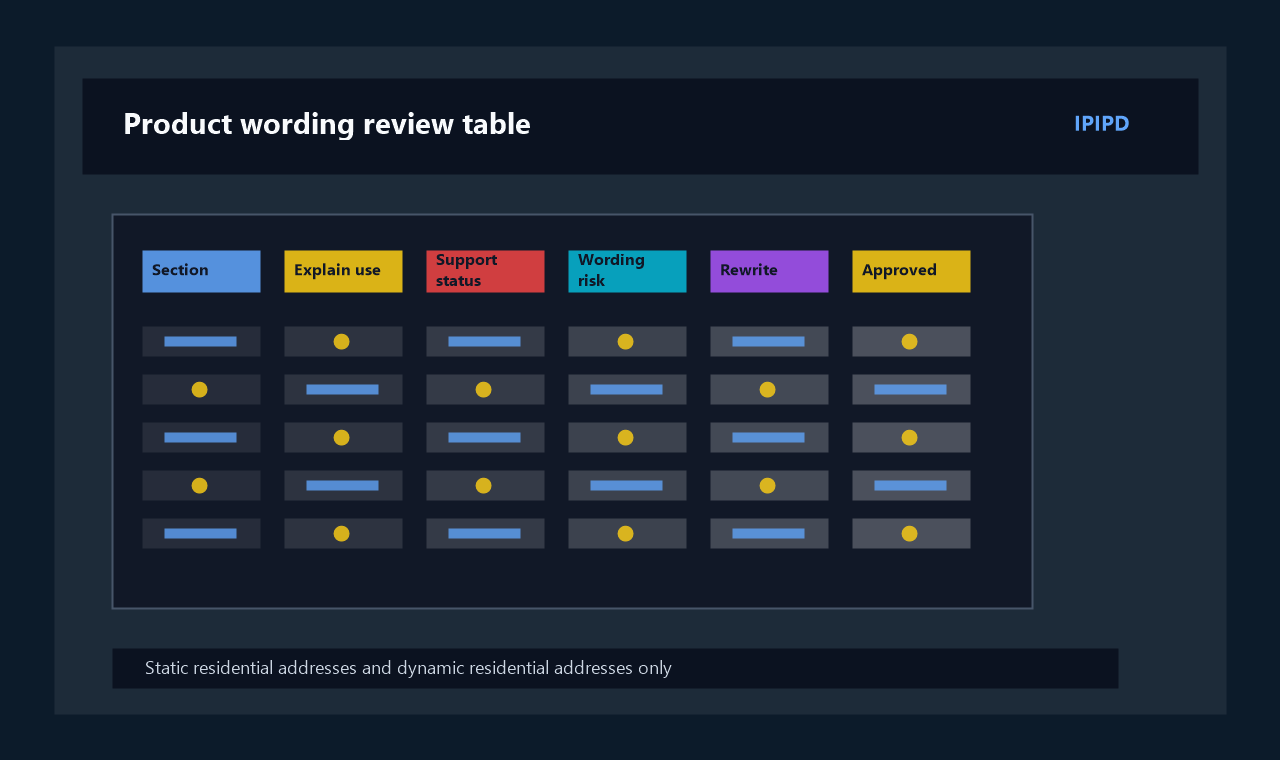
Workflow map for ISP proxy vs residential proxy.
The first difference is source explanation. Buyers need to know whether the address behaves like a residential route, a hosted route, or a hybrid. The second difference is session behavior. A static residential address can provide continuity, while a dynamic residential address can provide rotation. ISP proxy vs residential proxy should be judged by behavior and documentation, not label alone.
A strong product page should avoid vague claims. If the provider says ISP, ask what that means in routing, location, replacement, and allowed use. If the provider says residential, ask how region, session, and rotation are controlled.
Check
Practical meaning
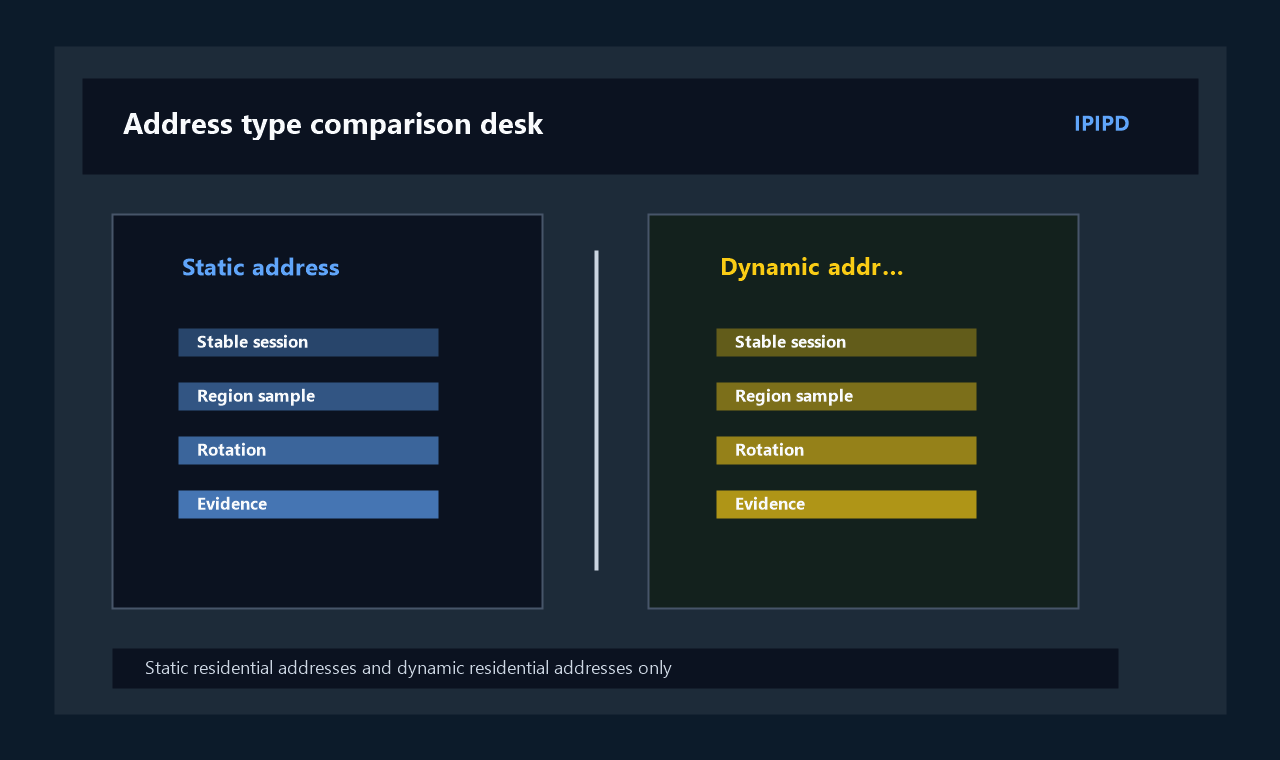
Decision checks for ISP proxy vs residential proxy.Evidence review checklist for ISP proxy vs residential proxy.
Frequently Asked Questions
Does IPIPD sell ISP proxy as a separate product?
This page should not claim that. IPIPD current product language should stay with static residential addresses and dynamic residential addresses.
Why compare ISP proxy vs residential proxy at all?
Many buyers see both terms while researching stable IP access. A comparison helps them avoid buying based only on labels.
When is static residential enough?
Static residential addresses may be enough when the task needs a stable residential exit, repeat checks, and clear session behavior.
When is dynamic residential better?
Operational evidence for ISP proxy vs residential proxy
A practical review of ISP proxy vs residential proxy should also include ownership. One person should own the target list, one person should review exceptions, and one person should decide whether the workflow can scale beyond the first batch.
For ISP proxy vs residential proxy, the record should show why static residential addresses, dynamic residential addresses, or a split workflow were chosen. That record protects the team from changing the setup later without understanding the original reason.
The workflow should be measured in completed business checks. A completed check includes the expected page state, the proxy mode, the region label, the time window, and a note about any retry or manual review.
If the first run produces mixed results, do not expand volume immediately. Separate wrong-region responses, blocked responses, slow responses, and pages that load but miss the required business field.
A stable operating routine is more useful than an aggressive proxy setting. IPIPD content should help the user choose a controlled residential address workflow rather than chase a feature that sounds powerful but does not fit the task.
Teams should also write down what they will not do. That includes avoiding sensitive data collection, login-only targets without permission, excessive request pressure, and unsupported product assumptions.
When the workflow is approved, keep the first production run small enough to inspect manually. A short evidence review after the run is often the fastest way to catch a location mismatch or session problem.
The final buying or configuration decision should be revisited after several runs. If the task needs more repeatability, move toward static residential addresses. If it needs broader coverage, refine the dynamic residential address sampling plan.
Operational evidence for ISP proxy vs residential proxy
A practical review of ISP proxy vs residential proxy should also include ownership. One person should own the target list, one person should review exceptions, and one person should decide whether the workflow can scale beyond the first batch.
For ISP proxy vs residential proxy, the record should show why static residential addresses, dynamic residential addresses, or a split workflow were chosen. That record protects the team from changing the setup later without understanding the original reason.
Primary use
Clarifying proxy sourcing, stability, and business fit before purchase.
Best IPIPD fit
Static residential addresses and dynamic residential addresses.
Not offered here
This page does not claim IPIPD sells ISP proxy as a separate product.
Main decision
Choose by source clarity, session stability, rotation needs, and evidence.
Why buyers mix up ISP and residential terms
Buyers often mix the terms because both may appear in account, QA, and monitoring discussions. The real question is not which label sounds stronger. The real question is whether the address supports the task with stable region evidence, predictable session duration, and responsible use boundaries.
In IPIPD content, ISP proxy vs residential proxy should be written as education. The page can explain the difference, but it should return to the current products: static residential addresses and dynamic residential addresses.
Static residential addresses in the comparison
Static residential addresses are the IPIPD fit when a task needs a stable residential exit. Account continuity, repeated page checks, and controlled QA can benefit from fewer changes. This is where some buyers may be comparing ISP proxy vs residential proxy because they want stability.
The buying test should focus on region consistency, session duration, and support handling. If those pass, the workflow may not need an ISP-labeled product. It may simply need static residential address behavior.
Dynamic residential addresses in the comparison
Dynamic residential addresses answer a different need. They are useful when a workflow needs sampling across many addresses or regions. If the buyer is comparing ISP proxy vs residential proxy for public data sampling, the ISP label may be less important than rotation control, retry policy, and evidence quality.
A dynamic workflow should be measured by usable result rate, not only speed. Region labels, timestamps, and stop conditions matter more than a broad marketing label.
Questions to ask before buying
Ask what network source is actually provided, which regions are available, how sessions are controlled, what happens during replacement, and which use cases are unsupported. These questions reduce confusion around ISP proxy vs residential proxy and prevent unsupported assumptions.
Also ask whether the provider can explain limits. A credible answer should say when static residential addresses are better, when dynamic residential addresses are better, and when the task should not be run at all.
Quick reference: product wording
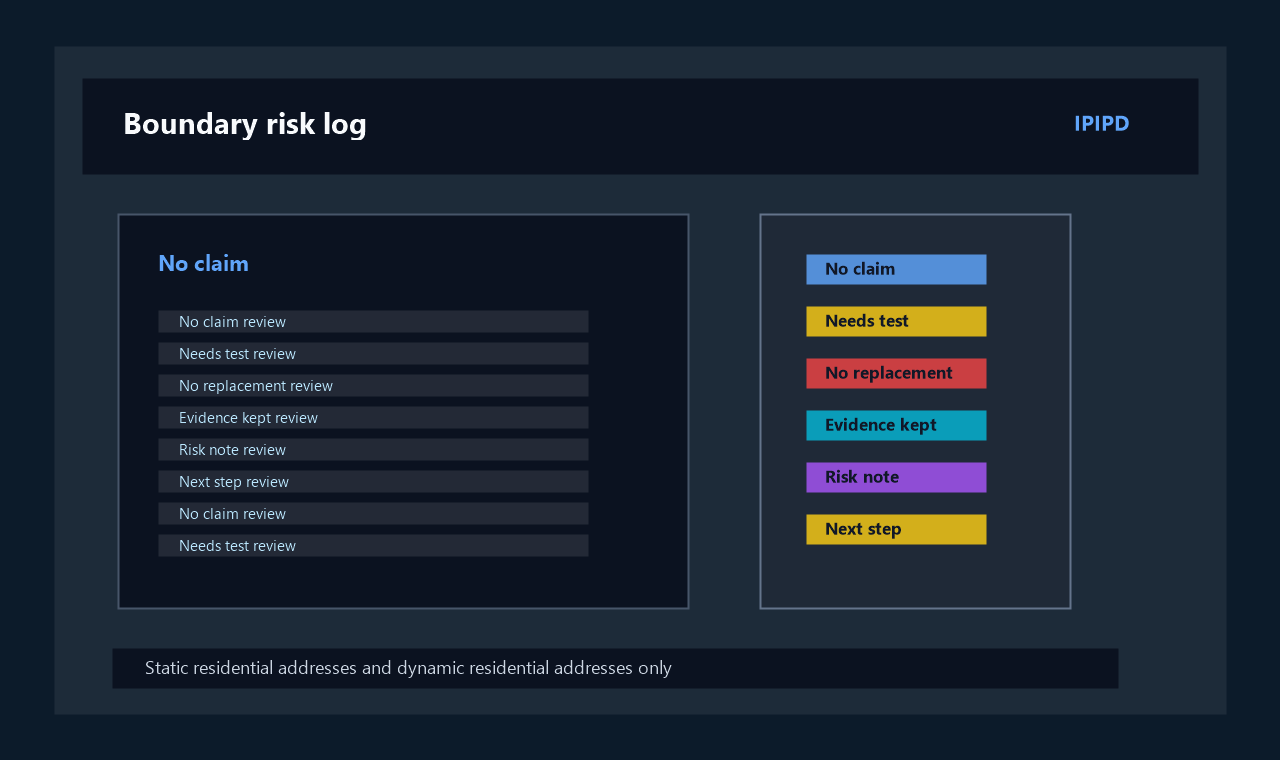
Write ISP as a comparison term, not as an IPIPD product line. Write residential proxy as static residential addresses or dynamic residential addresses depending on the workflow. Keep claims tied to observable behavior.
The useful ISP proxy vs residential proxy decision is not terminology. It is whether the selected address type supports the business task with enough stability, rotation, evidence, and compliance control.
This page should not claim that. IPIPD current product language should stay with static residential addresses and dynamic residential addresses.
Why compare ISP proxy vs residential proxy at all?
Many buyers see both terms while researching stable IP access. A comparison helps them avoid buying based only on labels.
When is static residential enough?
Static residential addresses may be enough when the task needs a stable residential exit, repeat checks, and clear session behavior.
When is dynamic residential better?
Dynamic residential addresses are better for broad public sampling, region rotation, and workflows where address diversity matters.
What is the safest buying question?
Ask what routing source, region control, session policy, replacement process, and allowed-use boundaries the provider can document.
Dynamic residential addresses are better for broad public sampling, region rotation, and workflows where address diversity matters.
What is the safest buying question?
Ask what routing source, region control, session policy, replacement process, and allowed-use boundaries the provider can document.
The workflow should be measured in completed business checks. A completed check includes the expected page state, the proxy mode, the region label, the time window, and a note about any retry or manual review.
If the first run produces mixed results, do not expand volume immediately. Separate wrong-region responses, blocked responses, slow responses, and pages that load but miss the required business field.
A stable operating routine is more useful than an aggressive proxy setting. IPIPD content should help the user choose a controlled residential address workflow rather than chase a feature that sounds powerful but does not fit the task.
Teams should also write down what they will not do. That includes avoiding sensitive data collection, login-only targets without permission, excessive request pressure, and unsupported product assumptions.
When the workflow is approved, keep the first production run small enough to inspect manually. A short evidence review after the run is often the fastest way to catch a location mismatch or session problem.
The final buying or configuration decision should be revisited after several runs. If the task needs more repeatability, move toward static residential addresses. If it needs broader coverage, refine the dynamic residential address sampling plan.
Operational evidence for ISP proxy vs residential proxy
A practical review of ISP proxy vs residential proxy should also include ownership. One person should own the target list, one person should review exceptions, and one person should decide whether the workflow can scale beyond the first batch.
For ISP proxy vs residential proxy, the record should show why static residential addresses, dynamic residential addresses, or a split workflow were chosen. That record protects the team from changing the setup later without understanding the original reason.
The workflow should be measured in completed business checks. A completed check includes the expected page state, the proxy mode, the region label, the time window, and a note about any retry or manual review.
If the first run produces mixed results, do not expand volume immediately. Separate wrong-region responses, blocked responses, slow responses, and pages that load but miss the required business field.
A stable operating routine is more useful than an aggressive proxy setting. IPIPD content should help the user choose a controlled residential address workflow rather than chase a feature that sounds powerful but does not fit the task.
Teams should also write down what they will not do. That includes avoiding sensitive data collection, login-only targets without permission, excessive request pressure, and unsupported product assumptions.
When the workflow is approved, keep the first production run small enough to inspect manually. A short evidence review after the run is often the fastest way to catch a location mismatch or session problem.
The final buying or configuration decision should be revisited after several runs. If the task needs more repeatability, move toward static residential addresses. If it needs broader coverage, refine the dynamic residential address sampling plan.
Operational evidence for ISP proxy vs residential proxy
A practical review of ISP proxy vs residential proxy should also include ownership. One person should own the target list, one person should review exceptions, and one person should decide whether the workflow can scale beyond the first batch.
For ISP proxy vs residential proxy, the record should show why static residential addresses, dynamic residential addresses, or a split workflow were chosen. That record protects the team from changing the setup later without understanding the original reason.
The workflow should be measured in completed business checks. A completed check includes the expected page state, the proxy mode, the region label, the time window, and a note about any retry or manual review.
If the first run produces mixed results, do not expand volume immediately. Separate wrong-region responses, blocked responses, slow responses, and pages that load but miss the required business field.
A stable operating routine is more useful than an aggressive proxy setting. IPIPD content should help the user choose a controlled residential address workflow rather than chase a feature that sounds powerful but does not fit the task.
Teams should also write down what they will not do. That includes avoiding sensitive data collection, login-only targets without permission, excessive request pressure, and unsupported product assumptions.
When the workflow is approved, keep the first production run small enough to inspect manually. A short evidence review after the run is often the fastest way to catch a location mismatch or session problem.
The final buying or configuration decision should be revisited after several runs. If the task needs more repeatability, move toward static residential addresses. If it needs broader coverage, refine the dynamic residential address sampling plan.
Operational evidence for ISP proxy vs residential proxy
A practical review of ISP proxy vs residential proxy should also include ownership. One person should own the target list, one person should review exceptions, and one person should decide whether the workflow can scale beyond the first batch.
For ISP proxy vs residential proxy, the record should show why static residential addresses, dynamic residential addresses, or a split workflow were chosen. That record protects the team from changing the setup later without understanding the original reason.
The workflow should be measured in completed business checks. A completed check includes the expected page state, the proxy mode, the region label, the time window, and a note about any retry or manual review.
If the first run produces mixed results, do not expand volume immediately. Separate wrong-region responses, blocked responses, slow responses, and pages that load but miss the required business field.
A stable operating routine is more useful than an aggressive proxy setting. IPIPD content should help the user choose a controlled residential address workflow rather than chase a feature that sounds powerful but does not fit the task.
Teams should also write down what they will not do. That includes avoiding sensitive data collection, login-only targets without permission, excessive request pressure, and unsupported product assumptions.
When the workflow is approved, keep the first production run small enough to inspect manually. A short evidence review after the run is often the fastest way to catch a location mismatch or session problem.
The final buying or configuration decision should be revisited after several runs. If the task needs more repeatability, move toward static residential addresses. If it needs broader coverage, refine the dynamic residential address sampling plan.