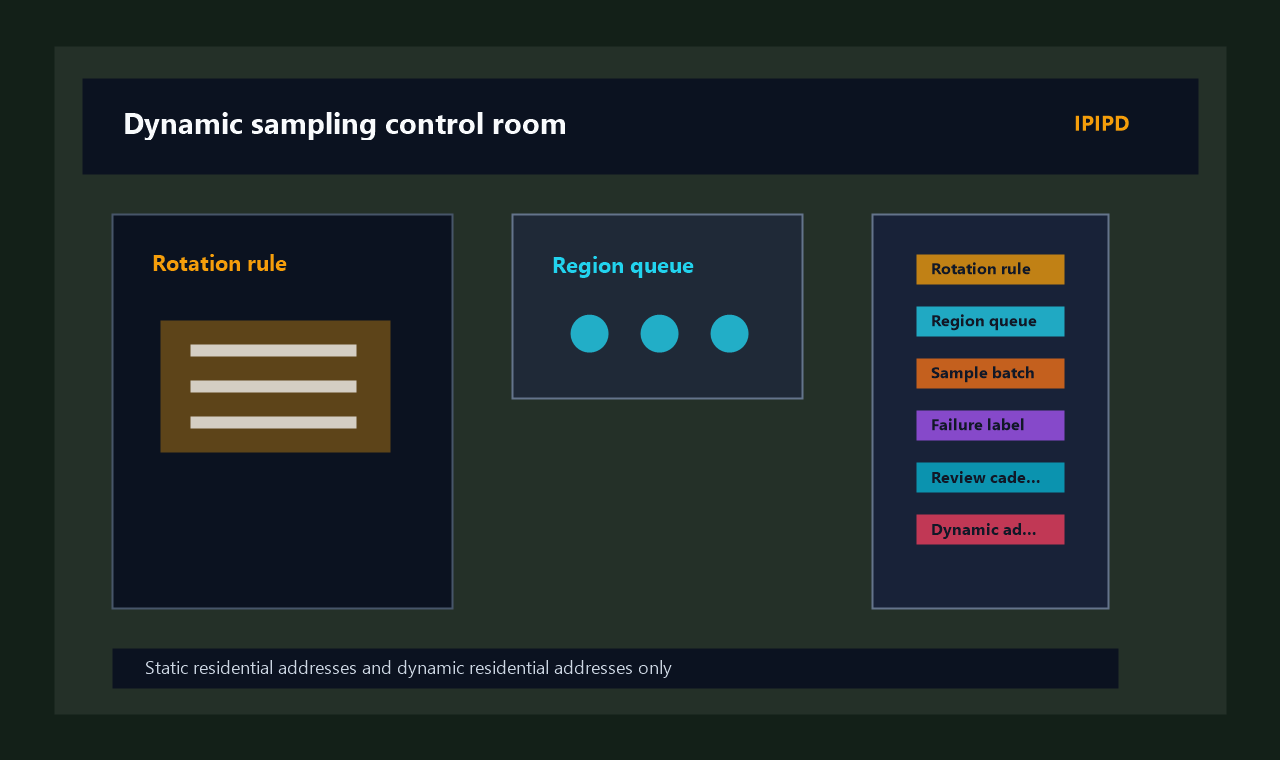
Dynamic Residential Proxy Sampling Strategy is a practical IPIPD guide for teams that need residential address workflows with clear product boundaries, measurable evidence, and responsible use.
The focus keyword for this page is dynamic residential proxy sampling strategy. The article uses related terms only where they support the same search intent and does not turn adjacent categories into unsupported IPIPD products.
A dynamic residential proxy sampling strategy defines when to rotate, how to label each region, how many retries are allowed, and what counts as a usable result. IPIPD should be positioned around dynamic residential addresses for breadth and static residential addresses for repeat checks. The strategy matters because uncontrolled rotation can create more noise than insight.
Use a dynamic residential proxy sampling strategy when the task involves many public pages, regions, or comparison points. Do not use it as a replacement for compliance review, target selection, or data quality checks. Rotation is a tool; the sampling design decides whether the result can be trusted.
At a Glance: sample design
Workflow map for dynamic residential proxy sampling strategy.
A useful sample unit includes the target URL, region, time window, proxy mode, request result, and evidence note. Without those fields, a team may collect many pages but fail to explain why one result differs from another. A dynamic residential proxy sampling strategy should make every result traceable.
Start small. Select a narrow target group and write down the exact question the sample should answer. For example, a price-monitoring team might ask whether a public page shows a different offer in three regions. That question needs fewer requests than a blind crawl and produces stronger evidence.
Check
Practical meaning
Decision checks for dynamic residential proxy sampling strategy.Evidence review checklist for dynamic residential proxy sampling strategy.
Frequently Asked Questions
What is a dynamic residential proxy sampling strategy?
It is a written plan for using dynamic residential addresses to collect public-page samples with region labels, rotation rules, retry limits, and evidence checks.
Should every request rotate?
No. Rotate according to the task. Region sampling may rotate often, while a multi-step flow may need session stability or a static residential address.
How many retries are reasonable?
Use a small fixed retry count and review repeated failures. Unlimited retries can hide bad target choice or compliance issues.
What makes a result usable?
Operational evidence for dynamic residential proxy sampling strategy
A practical review of dynamic residential proxy sampling strategy should also include ownership. One person should own the target list, one person should review exceptions, and one person should decide whether the workflow can scale beyond the first batch.
For dynamic residential proxy sampling strategy, the record should show why static residential addresses, dynamic residential addresses, or a split workflow were chosen. That record protects the team from changing the setup later without understanding the original reason.
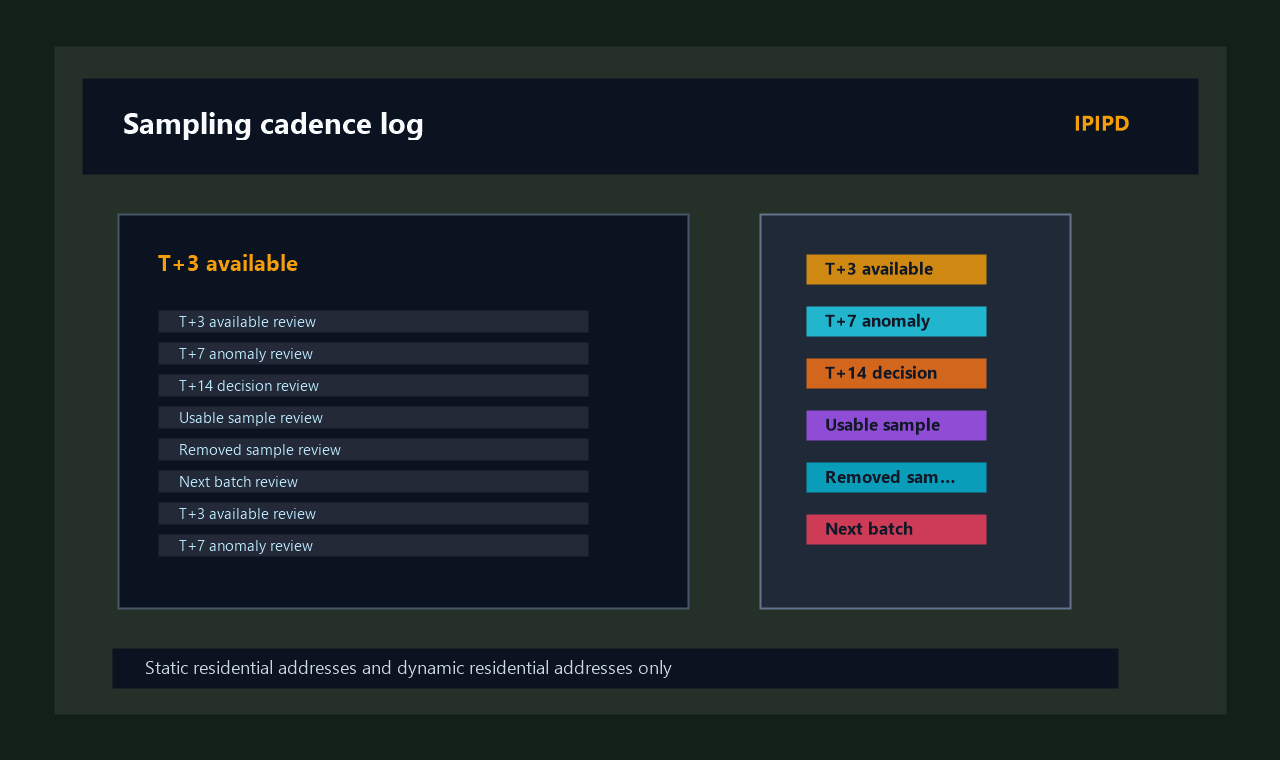
The workflow should be measured in completed business checks. A completed check includes the expected page state, the proxy mode, the region label, the time window, and a note about any retry or manual review.
If the first run produces mixed results, do not expand volume immediately. Separate wrong-region responses, blocked responses, slow responses, and pages that load but miss the required business field.
A stable operating routine is more useful than an aggressive proxy setting. IPIPD content should help the user choose a controlled residential address workflow rather than chase a feature that sounds powerful but does not fit the task.
Teams should also write down what they will not do. That includes avoiding sensitive data collection, login-only targets without permission, excessive request pressure, and unsupported product assumptions.
When the workflow is approved, keep the first production run small enough to inspect manually. A short evidence review after the run is often the fastest way to catch a location mismatch or session problem.
The final buying or configuration decision should be revisited after several runs. If the task needs more repeatability, move toward static residential addresses. If it needs broader coverage, refine the dynamic residential address sampling plan.
Operational evidence for dynamic residential proxy sampling strategy
A practical review of dynamic residential proxy sampling strategy should also include ownership. One person should own the target list, one person should review exceptions, and one person should decide whether the workflow can scale beyond the first batch.
For dynamic residential proxy sampling strategy, the record should show why static residential addresses, dynamic residential addresses, or a split workflow were chosen. That record protects the team from changing the setup later without understanding the original reason.
Primary use
Sampling many public pages or regions without losing evidence quality.
Best IPIPD fit
Dynamic residential addresses with controlled rotation and measured retries.
Not a promise
Rotation does not guarantee successful access or compliant use.
Main decision
Define sample units, rotate by rule, and stop when evidence quality drops.
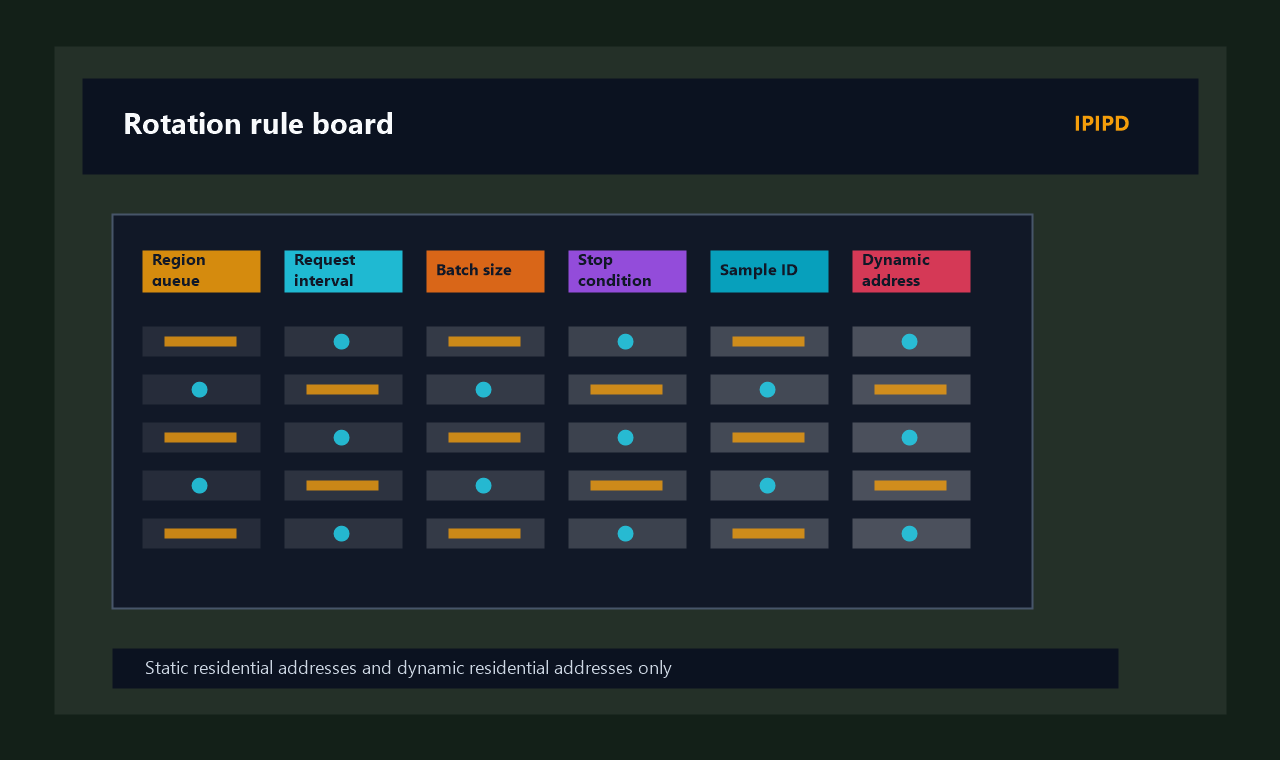
Set rotation rules before the first request
Rotation should be a rule, not a reaction. Decide whether the dynamic residential address changes per request, per domain, per region, or after a failed attempt. Each choice affects cookies, language, pricing, and risk signals. A dynamic residential proxy sampling strategy that rotates randomly can break the comparison it is trying to measure.
The rule should match the business task. Public regional sampling can rotate more often. A multi-step flow should rotate less often. A repeated QA check may need static residential addresses instead of dynamic rotation.
Label regions and sessions clearly
Every sample should carry a region label and a session label. Region labels show where the result was expected to come from. Session labels show whether the request belonged to a stable window or a fresh rotation. These labels prevent confusion when results are reviewed later.
A dynamic residential proxy sampling strategy is especially useful when region evidence matters. If a public page changes currency, language, availability, or delivery message, the team needs to know whether the change came from the page or from the proxy setup.
Control retries and stop conditions
Retries are part of quality control, but unlimited retries can distort results. Define how many retries are allowed, whether a retry can change the address, and when a target should be paused. A failed page that succeeds after twenty attempts may not represent a stable workflow.
Stop conditions are also compliance controls. If a target repeatedly blocks requests, the safer response is review, not pressure. A dynamic residential proxy sampling strategy should include the point where automation stops and a human checks the target manually.
Review sample quality before scaling
Before increasing volume, inspect a small batch. Check whether expected fields are present, whether the region matches, whether response time is acceptable, and whether failed results share a pattern. Scaling before this review can multiply an unnoticed mistake.
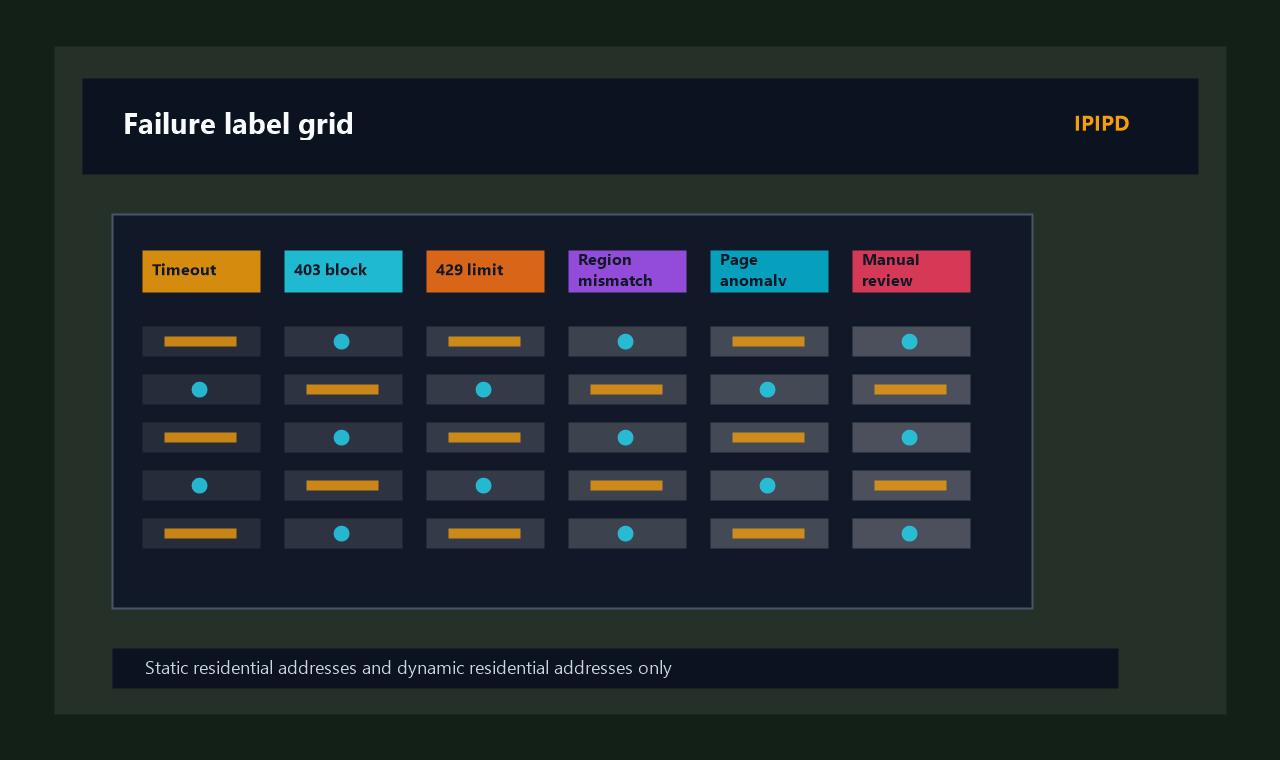
Good sampling reports separate technical failure from business outcome. A timeout, a blocked page, a wrong region, and a missing field are different events. Treating them as one failure number hides the next action.
Quick reference: sampling strategy notes
Define the question, target group, region set, rotation rule, retry limit, usable-result definition, and evidence fields. Use dynamic residential addresses for breadth and static residential addresses for stability. Keep the first run narrow enough to inspect manually.
A dynamic residential proxy sampling strategy is successful when the team can explain the result, reproduce a subset, and decide whether the proxy setup helped the business question.
What is a dynamic residential proxy sampling strategy?
It is a written plan for using dynamic residential addresses to collect public-page samples with region labels, rotation rules, retry limits, and evidence checks.
Should every request rotate?
No. Rotate according to the task. Region sampling may rotate often, while a multi-step flow may need session stability or a static residential address.
How many retries are reasonable?
Use a small fixed retry count and review repeated failures. Unlimited retries can hide bad target choice or compliance issues.
What makes a result usable?
A usable result has the expected page state, required data fields, correct region evidence, and enough logs to explain how it was collected.
How does IPIPD fit this strategy?
IPIPD can be evaluated through dynamic residential addresses for broader sampling and static residential addresses for repeatable validation.
A usable result has the expected page state, required data fields, correct region evidence, and enough logs to explain how it was collected.
How does IPIPD fit this strategy?
IPIPD can be evaluated through dynamic residential addresses for broader sampling and static residential addresses for repeatable validation.
The workflow should be measured in completed business checks. A completed check includes the expected page state, the proxy mode, the region label, the time window, and a note about any retry or manual review.
If the first run produces mixed results, do not expand volume immediately. Separate wrong-region responses, blocked responses, slow responses, and pages that load but miss the required business field.
A stable operating routine is more useful than an aggressive proxy setting. IPIPD content should help the user choose a controlled residential address workflow rather than chase a feature that sounds powerful but does not fit the task.
Teams should also write down what they will not do. That includes avoiding sensitive data collection, login-only targets without permission, excessive request pressure, and unsupported product assumptions.
When the workflow is approved, keep the first production run small enough to inspect manually. A short evidence review after the run is often the fastest way to catch a location mismatch or session problem.
The final buying or configuration decision should be revisited after several runs. If the task needs more repeatability, move toward static residential addresses. If it needs broader coverage, refine the dynamic residential address sampling plan.
Operational evidence for dynamic residential proxy sampling strategy
A practical review of dynamic residential proxy sampling strategy should also include ownership. One person should own the target list, one person should review exceptions, and one person should decide whether the workflow can scale beyond the first batch.
For dynamic residential proxy sampling strategy, the record should show why static residential addresses, dynamic residential addresses, or a split workflow were chosen. That record protects the team from changing the setup later without understanding the original reason.
The workflow should be measured in completed business checks. A completed check includes the expected page state, the proxy mode, the region label, the time window, and a note about any retry or manual review.
If the first run produces mixed results, do not expand volume immediately. Separate wrong-region responses, blocked responses, slow responses, and pages that load but miss the required business field.
A stable operating routine is more useful than an aggressive proxy setting. IPIPD content should help the user choose a controlled residential address workflow rather than chase a feature that sounds powerful but does not fit the task.
Teams should also write down what they will not do. That includes avoiding sensitive data collection, login-only targets without permission, excessive request pressure, and unsupported product assumptions.
When the workflow is approved, keep the first production run small enough to inspect manually. A short evidence review after the run is often the fastest way to catch a location mismatch or session problem.
The final buying or configuration decision should be revisited after several runs. If the task needs more repeatability, move toward static residential addresses. If it needs broader coverage, refine the dynamic residential address sampling plan.
Operational evidence for dynamic residential proxy sampling strategy
A practical review of dynamic residential proxy sampling strategy should also include ownership. One person should own the target list, one person should review exceptions, and one person should decide whether the workflow can scale beyond the first batch.
For dynamic residential proxy sampling strategy, the record should show why static residential addresses, dynamic residential addresses, or a split workflow were chosen. That record protects the team from changing the setup later without understanding the original reason.
The workflow should be measured in completed business checks. A completed check includes the expected page state, the proxy mode, the region label, the time window, and a note about any retry or manual review.
If the first run produces mixed results, do not expand volume immediately. Separate wrong-region responses, blocked responses, slow responses, and pages that load but miss the required business field.
A stable operating routine is more useful than an aggressive proxy setting. IPIPD content should help the user choose a controlled residential address workflow rather than chase a feature that sounds powerful but does not fit the task.
Teams should also write down what they will not do. That includes avoiding sensitive data collection, login-only targets without permission, excessive request pressure, and unsupported product assumptions.
When the workflow is approved, keep the first production run small enough to inspect manually. A short evidence review after the run is often the fastest way to catch a location mismatch or session problem.
The final buying or configuration decision should be revisited after several runs. If the task needs more repeatability, move toward static residential addresses. If it needs broader coverage, refine the dynamic residential address sampling plan.
Operational evidence for dynamic residential proxy sampling strategy
A practical review of dynamic residential proxy sampling strategy should also include ownership. One person should own the target list, one person should review exceptions, and one person should decide whether the workflow can scale beyond the first batch.
For dynamic residential proxy sampling strategy, the record should show why static residential addresses, dynamic residential addresses, or a split workflow were chosen. That record protects the team from changing the setup later without understanding the original reason.
The workflow should be measured in completed business checks. A completed check includes the expected page state, the proxy mode, the region label, the time window, and a note about any retry or manual review.
If the first run produces mixed results, do not expand volume immediately. Separate wrong-region responses, blocked responses, slow responses, and pages that load but miss the required business field.
A stable operating routine is more useful than an aggressive proxy setting. IPIPD content should help the user choose a controlled residential address workflow rather than chase a feature that sounds powerful but does not fit the task.
Teams should also write down what they will not do. That includes avoiding sensitive data collection, login-only targets without permission, excessive request pressure, and unsupported product assumptions.
When the workflow is approved, keep the first production run small enough to inspect manually. A short evidence review after the run is often the fastest way to catch a location mismatch or session problem.
The final buying or configuration decision should be revisited after several runs. If the task needs more repeatability, move toward static residential addresses. If it needs broader coverage, refine the dynamic residential address sampling plan.