When people compare proxies, they often start with the wrong question:
“Which proxy is the best?”
The better question is:
“Which proxy is best for this specific task?”
An ISP proxy server, a residential proxy, and a data center proxy can all be useful. The difference is not just the name. The real difference is how each proxy type performs when you need stability, rotation, speed, trust, or lower cost.
If you are managing accounts, checking SEO rankings, verifying ads, collecting web data, monitoring prices, or testing regional pages, the right choice will depend on your workflow.
Before we compare them, it helps to remember what a proxy does. A forwards requests between your device or tool and the target website. The website sees the proxy address instead of your original address.
This guide compares the three common options and helps you decide when an ISP proxy server is worth using, when a residential proxy is better, and when a data center proxy is enough.
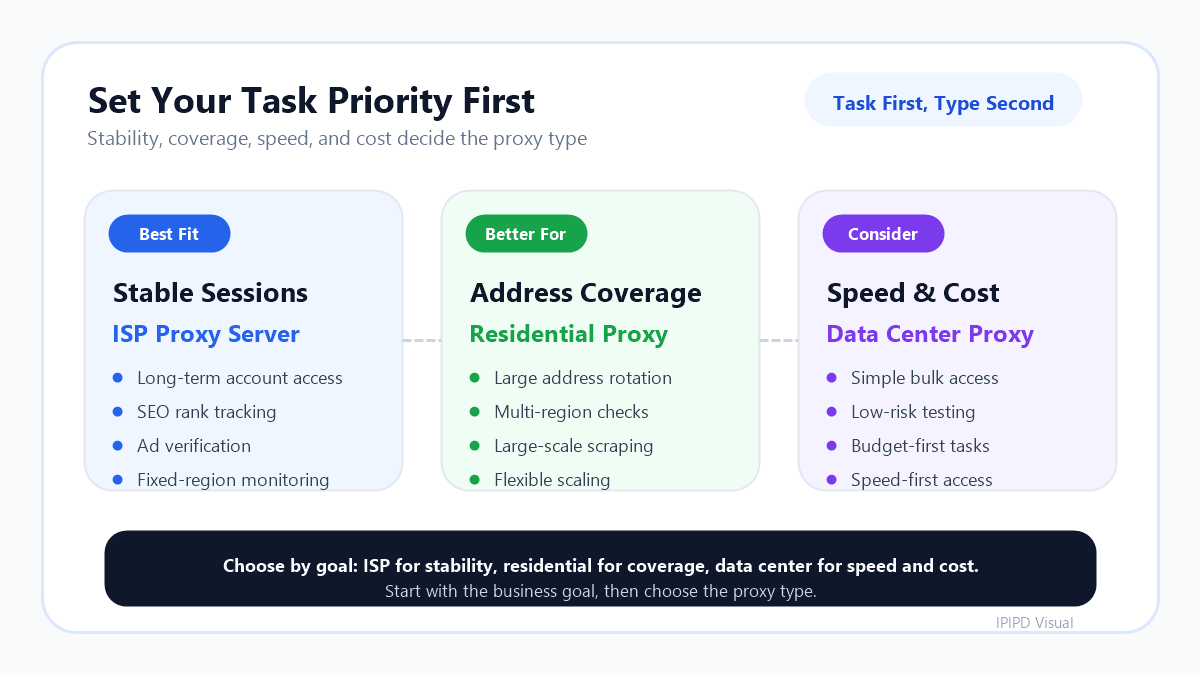
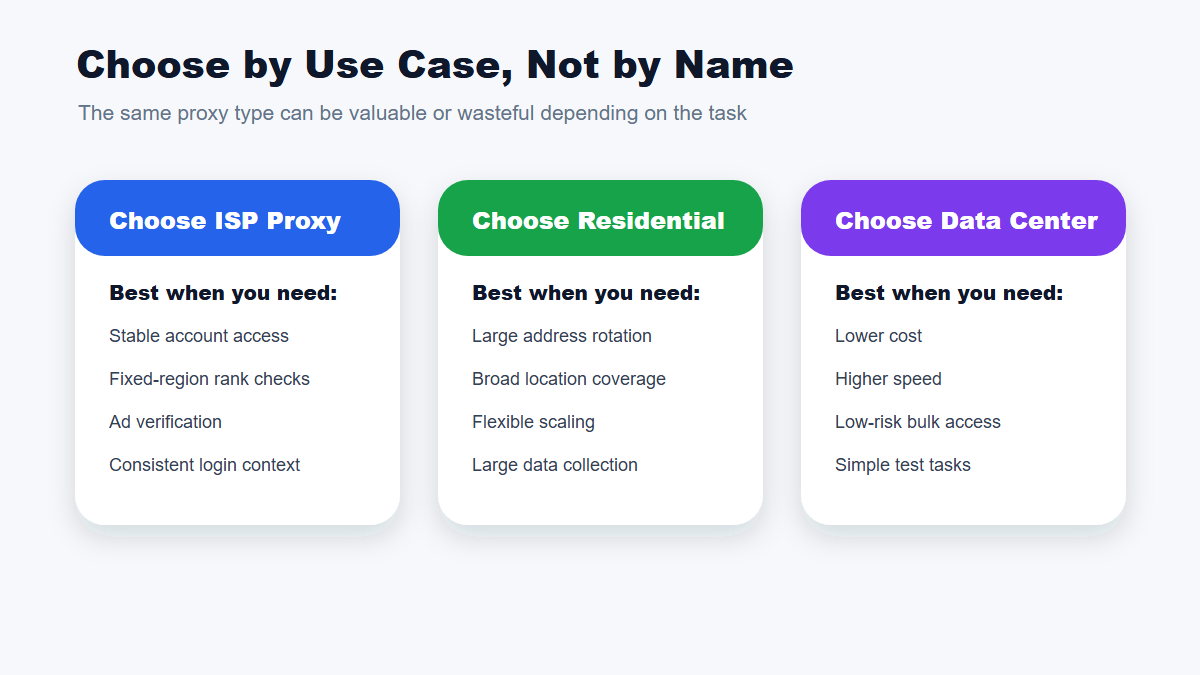
Choose an ISP proxy server when you need a stable address, long sessions, and a more consistent account or testing environment.
Choose a residential proxy when you need a large pool, broad location coverage, and frequent address rotation.
Choose a data center proxy when you need speed, lower cost, and simple low-risk access.
Use Case
Better Choice
Long-term account access
ISP proxy server
SEO rank monitoring
ISP proxy server
Ad verification
ISP proxy server
Large-scale web scraping
Residential proxy
Multi-region content testing
Residential proxy
Simple bulk access
Data center proxy
Cost-first tasks
Data center proxy
Speed-first tasks
Data center proxy
The important point is this: an ISP proxy server is not automatically the best choice for every situation. It is best when stability and trust matter more than the lowest price or the largest rotating pool.
When Should You Use an ISP Proxy Server?
The main strength of an ISP proxy server is stability.
It uses an address associated with an Internet Service Provider and often runs on a more controlled server environment. This gives it a different profile from a basic hosting address and more predictability than many traditional residential proxy connections.
Think of it as a long-term working identity.
If a task needs repeated access, stable login behavior, or comparable results over time, an ISP proxy server can be a strong fit.
1. SEO Rank Monitoring
Search results can change by country, city, language, device, and network environment.
If you check the same keywords every day, you need the access environment to stay as consistent as possible. Otherwise, you may not know whether the ranking changed or the proxy environment changed.
An ISP proxy server can provide a steadier network identity for long-term rank tracking.
2. Ad Verification
Advertisers often need to confirm whether ads are showing correctly in a target region.
If your team is in one location but needs to check ad delivery in another, you need a stable regional access environment.
An ISP proxy server works well here because it focuses on session continuity instead of constant address rotation.
3. Account Management
Many platforms are sensitive to login environment changes.
If an account appears to move between unrelated regions or network types, it may trigger extra verification.
Using a stable proxy environment can reduce unnecessary friction and keep account access more consistent.
This should only be used for legitimate business workflows, not to violate platform rules.
4. Long-Term Market Monitoring
If you track prices, inventory, competitor pages, or regional content over time, stability becomes more important than one-time access.
A stable proxy environment makes long-term data easier to compare.
When Should You Use a Residential Proxy?
A residential proxy is strongest when you need coverage and flexibility.
It is usually better for tasks that need many changing addresses instead of one stable address.
If your workflow requires frequent location switching, address rotation, and broader access coverage, a residential proxy may be the better fit.
1. Large-Scale Web Data Collection
Some data collection projects need to visit many pages.
If all requests come from the same address, the traffic can become too concentrated. Residential proxies can rotate addresses and spread requests across a larger pool.
For this kind of task, flexibility can matter more than the long-session stability of an ISP proxy server.
2. Multi-Region Content Checks
If you need to check how content appears in different countries or cities, residential proxies can be useful because they often provide broad location coverage.
They make it easier to switch between target regions.
3. Flexible Scaling
Some projects start small and then grow quickly.
Residential proxies are often easier to scale by usage volume, location, or rotation needs.
If you are still learning how to configure different proxy types, the proxy tutorial center is a useful next step. Understanding the use case first makes the technical setup much easier.
When Should You Use a Data Center Proxy?
A data center proxy is usually fast and cost-efficient.
Its main weakness is that the address often looks like hosting or server traffic. In sensitive workflows, this can make it less trustworthy than residential proxies or ISP proxies.
The phrase “data center” refers to infrastructure where servers and networking equipment are hosted. If you want a general reference, Wikipedia has a useful overview of a data center.
Data center proxies are best for low-risk tasks where trust is less important.
1. Simple Bulk Access
If you are accessing public pages, running basic tests, or handling low-risk tasks, a data center proxy may be enough.
Not every workflow needs a more expensive proxy type.
2. Cost-Sensitive Projects
If your budget is limited and the target websites are not strict about access environment, a data center proxy can reduce cost.
3. Speed-First Tasks
Data center proxies are often hosted on high-bandwidth infrastructure, so speed can be a major advantage.
If the task mainly needs speed and does not require a high-trust network profile, this proxy type can work well.
But if accounts, ads, rankings, or high-value business data are involved, be careful. Cheap does not always mean cost-effective.
Core Comparison: Stability, Trust, Speed, Cost, and Scale
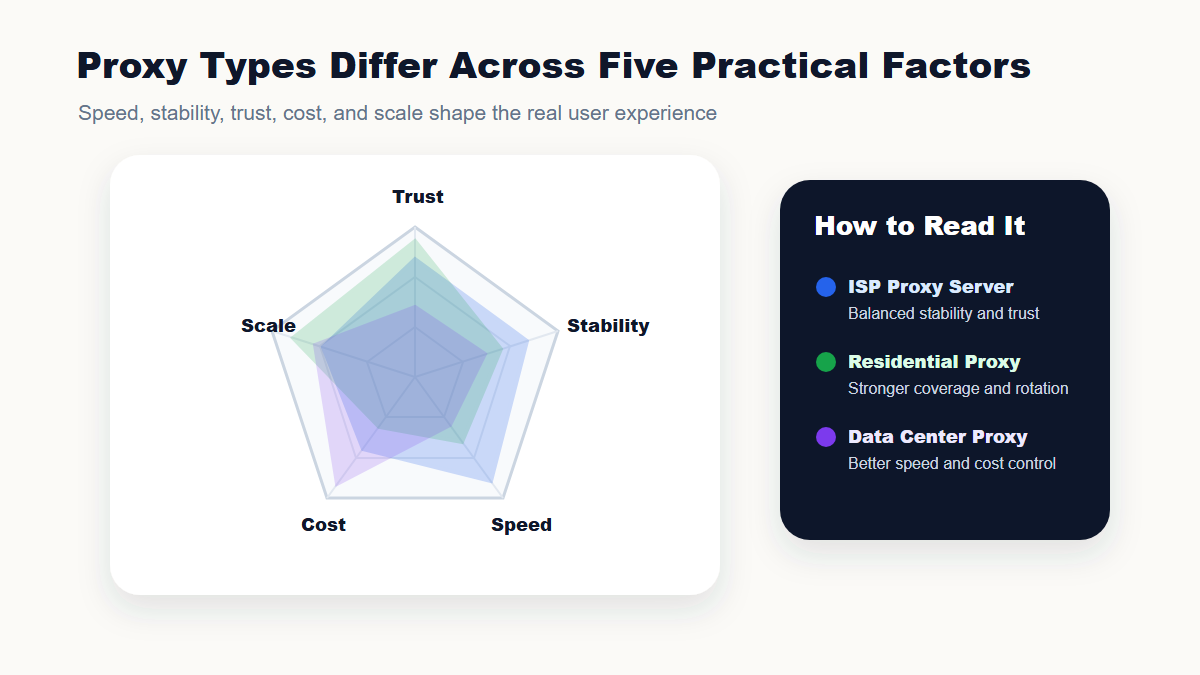
The easiest way to compare proxy types is to look at five practical factors.
1. Stability
An ISP proxy server is usually stronger for stable sessions and repeated access.
Residential proxies vary by type. Rotating residential proxies are flexible, but they are not always the best for long stable sessions.
Data center proxies can be technically stable, but their address profile may not look natural enough for sensitive workflows.
2. Trust Profile
Residential proxies and ISP proxies usually look closer to ordinary user networks.
Data center proxies are easier to identify as server traffic.
If the target website is sensitive to access environment, an ISP proxy server or residential proxy is usually a safer choice.
3. Speed
Data center proxies are often the fastest.
An ISP proxy server can also perform well because it often runs on controlled infrastructure.
Residential proxy speed can vary more, especially when real user devices are involved.
4. Cost
Data center proxies are usually the cheapest.
Residential proxy pricing depends on location, traffic, and usage model.
An ISP proxy server is often more expensive because it focuses on stability and address quality.
5. Scale
Residential proxies usually provide the largest pools and are better for large-scale rotation.
An ISP proxy server is better for stable sessions, not massive address switching.
Data center proxies can also scale, but they may face more limitations in high-trust workflows.
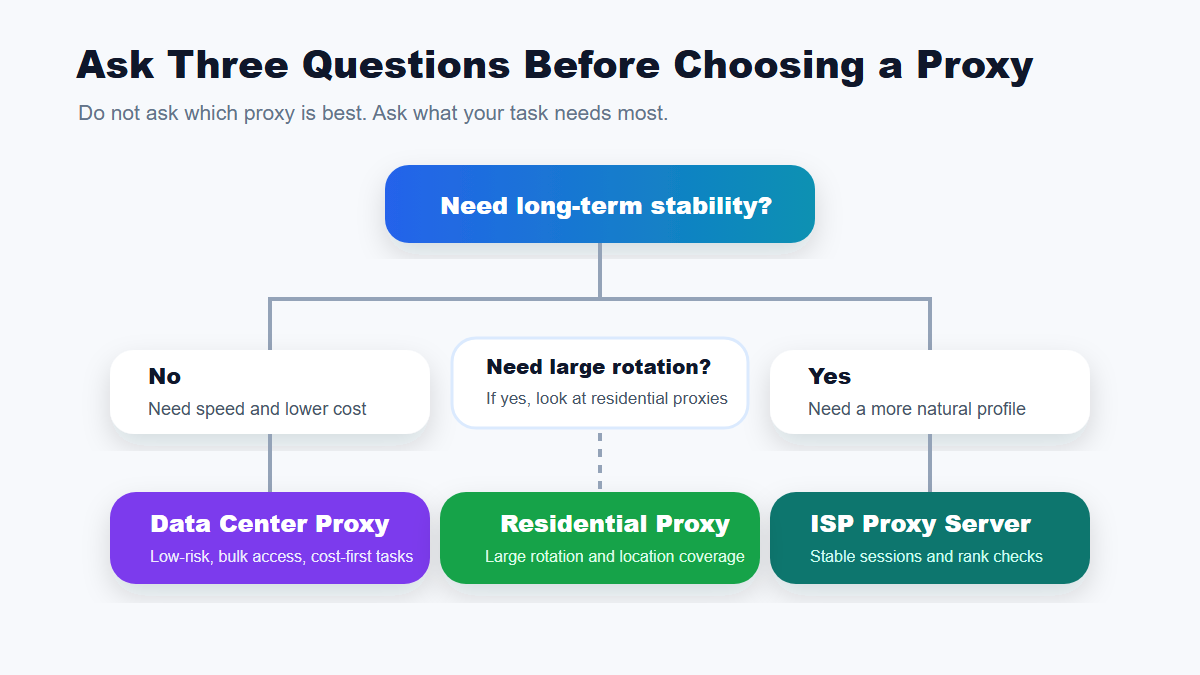
A Simple Decision Process
Use these three questions to decide.
Question 1: Do You Need a Fixed Access Environment?
If yes, consider an ISP proxy server.
Account login, SEO rank monitoring, ad verification, and long-term price monitoring all benefit from a stable environment.
If not, move to the next question.
Question 2: Do You Need Large-Scale Address Rotation?
If yes, consider residential proxies.
Large-scale scraping, multi-region checks, and high-volume page visits usually need a larger and more flexible pool.
If you do not need heavy rotation, compare ISP proxies with data center proxies.
Question 3: Is Cost the Main Priority?
If the task is low-risk and budget-sensitive, a data center proxy may be enough.
If the task involves valuable accounts, ads, or long-term data, do not choose only by price.
In many cases, the money saved on cheap proxies can come back as failed requests, extra verification, or account risk.
Common Mistake: Choosing Only by Price
Many people choose proxies by price first.
Low cost is not bad by itself. The problem is using the cheapest proxy in a workflow where stability or trust matters.
If you only need simple access to public pages, a data center proxy can be fast and affordable.
But if you manage accounts, verify ads, or track rankings over time, low-quality access can create more problems later.
The opposite is also true. If your task is low-risk bulk access, using a high-cost ISP proxy server may be wasteful.
The best choice is not the most expensive proxy or the cheapest proxy. It is the proxy that matches the risk and goal of the task.
Choose by Business Scenario
Here is another way to think about it by business scenario.
E-Commerce
For store accounts, ad dashboards, and long-term operational accounts, an ISP proxy server or static residential proxy is usually a better fit.
For product data collection, price monitoring, and multi-region viewing, residential proxies may be more flexible.
Social Media Operations
Social media accounts often depend on a stable login environment.
If the account is valuable, an ISP proxy server is better for long-term use.
For content viewing, regional checks, and lower-risk tasks, residential proxies may be enough depending on budget.
Ad Verification
Ad verification needs both regional visibility and stable access.
For long-term verification in fixed regions, an ISP proxy server is usually a strong fit.
For quick coverage across many locations, residential proxies are more flexible.
Data Collection
Data collection depends on scale.
For smaller tasks that need stable sessions from fixed sources, an ISP proxy server can work well.
For large-scale, multi-page, multi-region collection, residential proxies are usually better.
For low-risk public page access, data center proxies may be enough.
Final Recommendation
If you are still unsure, use this simple rule:
Need stability? Choose an ISP proxy server.
Need large rotation? Choose a residential proxy.
Need speed and lower cost? Choose a data center proxy.
If the task has high business value, do not look only at the monthly proxy cost. Think about the cost of one failed login, one broken data set, or one wrong ad verification result.
If you are ready to test a stable proxy setup, start small from the proxy pricing page. Test success rate, session stability, and location quality before scaling.
Conclusion
An ISP proxy server, a residential proxy, and a data center proxy each have a place.
An ISP proxy server is best for stable sessions, account environments, SEO monitoring, ad verification, and long-running tasks.
Residential proxies are better for large rotation, broad location coverage, and flexible data collection.
Data center proxies are better for low-cost, high-speed, low-risk access.
The professional way to choose is to start with the business scenario, then choose the proxy type.
In one sentence:
The best proxy is not the most advanced proxy. It is the one that fits the task.
Frequently Asked Questions
What is the difference between an ISP proxy server and a residential proxy?
An ISP proxy server focuses on stable addresses and long sessions, while residential proxies focus more on pool size, location coverage, and flexible rotation. Use ISP proxies when stability matters. Use residential proxies when large rotation matters.
Is an ISP proxy server better than a data center proxy?
Not always. An ISP proxy server is better for tasks that need stability and trust. A data center proxy is better for low-cost, high-speed, low-risk tasks. The right choice depends on the workflow.
Which proxy should I use for account management?
Account management usually needs a stable access environment, so an ISP proxy server or static residential proxy is often a better fit. Frequent address changes may increase verification risk.
Which proxy should I use for web scraping?
For large-scale, multi-page, multi-region scraping, residential proxies are usually more flexible. For fixed-source, long-session scraping, an ISP proxy server may work well. For low-risk public pages, data center proxies can be enough.
What should I choose if my budget is limited?
Do not choose only by the lowest price. If the task is low-risk, a data center proxy may be enough. If the task involves accounts, ads, or long-term data, test ISP proxies or residential proxies on a small scale first.