Picking a proxy service can feel overwhelming when you see ISP proxies and residential proxies listed side by side—and they often cost about the same. So what's the actual difference? And which one actually makes sense for your setup?
Let's break it down.
##1. Getting the Basics Right
What are residential proxies?
Residential proxies are IP addresses that come from real home internet connections. Your home broadband, your office fiber line—anything allocated by an ISP to a regular consumer—falls into this category.
What makes them work:
Genuine IP origins: These IPs belong to actual households, so they look just like regular internet users
Strong stealth: Harder for platforms to flag as proxy traffic since they come from real consumer connections
Two flavors available: You can choose between dynamic (rotating) or static (fixed) options depending on what you need
What are ISP proxies?
Here's the key insight: ISP proxies are technically a type of residential proxy—the difference is that the IP stays the same.
Here's the breakdown:
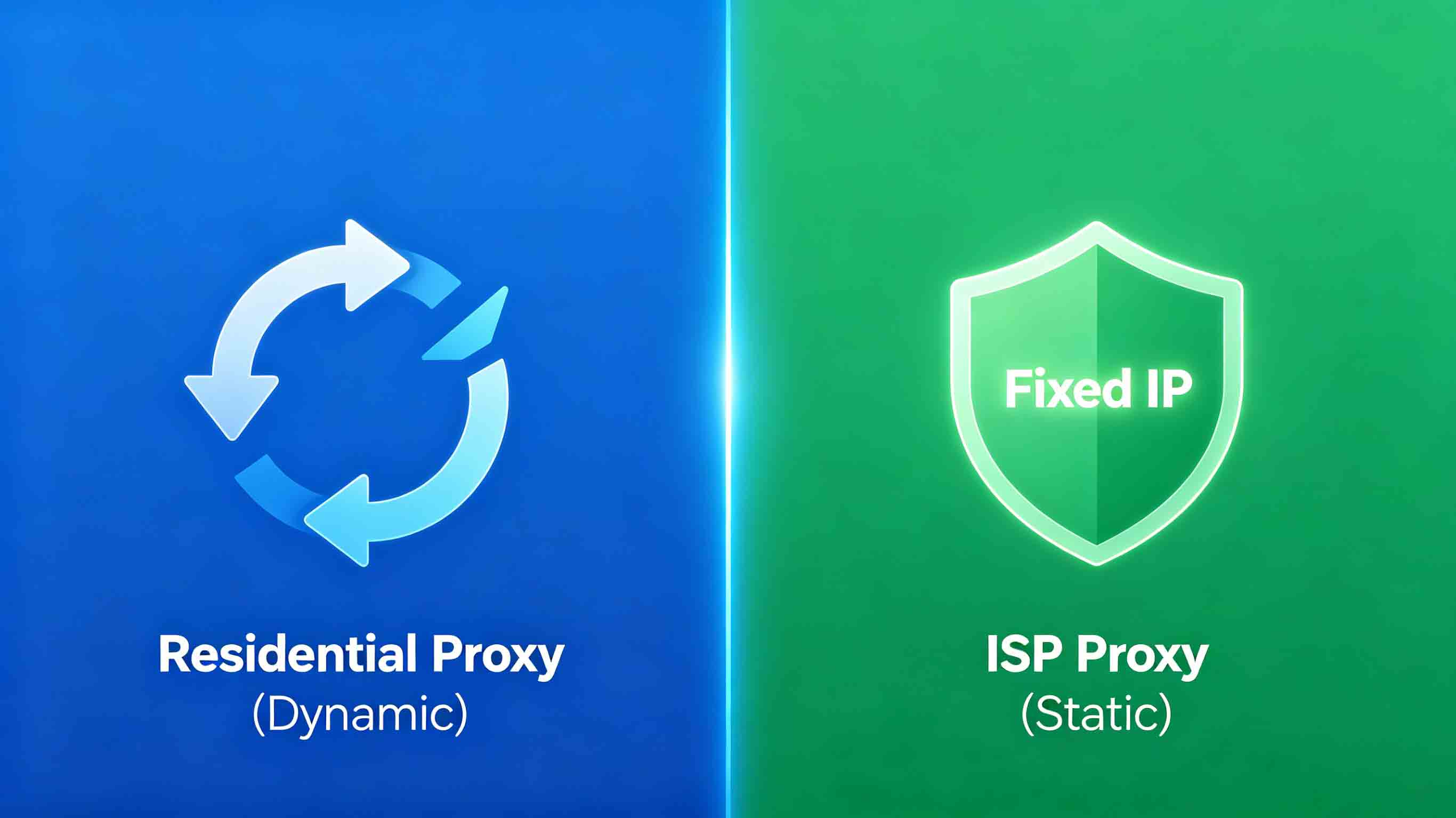
Dynamic residential proxies: IP addresses that rotate on a schedule
Static residential proxies: IP addresses that stay fixed (also called ISP proxies)
Think of it this way: ISP proxy = a residential IP that never changes. It's the "static branch" of the residential proxy family.
2. Side-by-Side Comparison
Factor
ISP Proxy (Static Residential)
Dynamic Residential Proxy
IP changes
Stays the same
Rotates automatically
IP source
Real home network
Real home network
Stealth level
High
High
Stability
Rock solid
Moderate
Price
Higher
Mid-range
IP pool size
Limited
Massive
Flexibility
Lower
Higher
Best for
Long-term stable sessions
High-volume IP rotation
3. Breaking It Down Further
3.1 Stability
ISP proxies give you a fixed IP that stays constant throughout your session. Your account always appears to log in from the same household network, making it much harder for platforms to detect anything unusual.
Dynamic residential proxies rotate IPs on a schedule—maybe every 10 minutes, maybe every 24 hours—depending on your settings. This works well when you need to cycle through many different addresses.
Bottom line: Need an account to stick with one IP forever? Go ISP. Need fresh IPs regularly? Go dynamic residential.
3.2 Cost
ISP proxies come with a higher price tag because you're getting exclusive, fixed IPs. For US residential IPs, expect to pay roughly 30%-50% more than dynamic residential options (exact numbers vary by provider).
Dynamic residential proxies let you rotate through a shared pool, bringing the per-IP cost down significantly—great if you need volume.
Bottom line: Tight budget + need lots of IPs? Dynamic residential. Money's not the issue + need reliability? ISP.
3.3 IP Volume
ISP proxies are limited to what you buy. Get 5 IPs, use 5 IPs. No sharing, no rotation.
Dynamic residential proxies typically give you pool access instead of a fixed number. Buy the right to rotate through 10,000 IPs? That's your playground.
Bottom line: Need to burn through thousands of IPs? Dynamic residential. Need dedicated IPs per account? ISP.
3.4 Use Case Match
What you're doing
Best proxy choice
Why
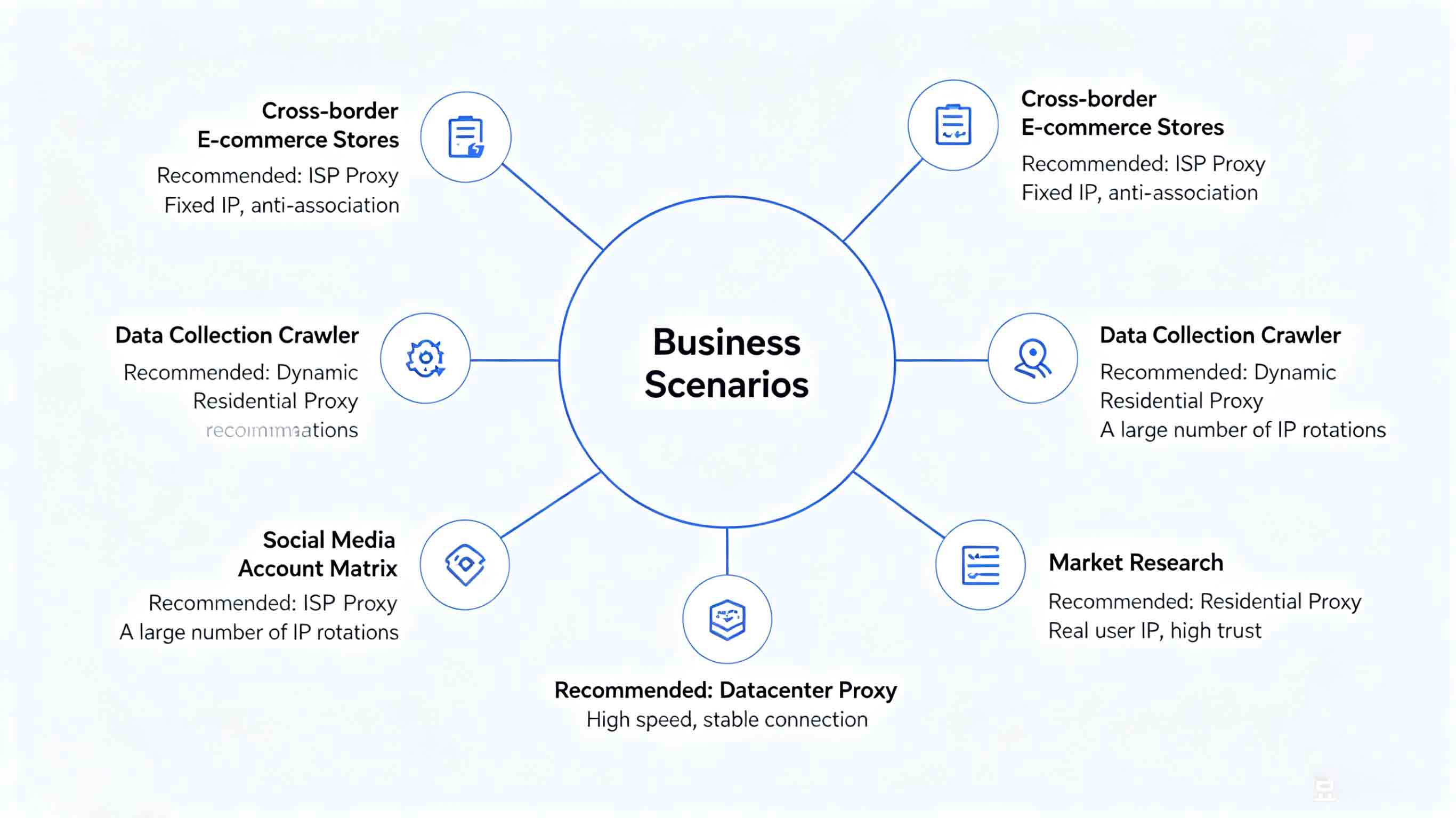
Multiple e-commerce stores
ISP / Static residential
Each store needs its own consistent IP
Social media account stacks
ISP / Static residential
Long-term account health matters
High-value account registration
ISP / Static residential
Security is non-negotiable
Web scraping / data collection
Dynamic residential
You need IP volume
Market research
Dynamic residential
Frequent访问 without getting flagged
Price monitoring
Dynamic residential
Need coverage across regions
4. Which One Is Right for You?
Go with ISP proxies if...
Your situation ticks any of these boxes:
You need long-term stable logins
Accounts that need to stay healthy for months or years
High-value profiles where association risk isn't acceptable
Fixed IPs are a must
One store, one account, one IP—non-negotiable
Platforms that flag IP changes aggressively
Stability directly impacts your bottom line
Financial accounts, business emails, premium e-commerce seller accounts
Where even small disruptions cause real damage
You need permanent IPs for compliance
TikTok account stacks
Amazon seller accounts
eBay seller profiles
Go with dynamic residential proxies if...
Any of these sound like your situation:
You need serious IP volume
Scraping projects, data extraction at scale
Running tools that hit hundreds or thousands of pages
Frequent IP rotation is part of your workflow
Market research, price tracking
Competitive intelligence gathering
Budget is a real constraint
Startup phase, every dollar counts
Need maximum output for minimum spend
This is a short-term play
One-off projects, quick tests
Need to validate an idea fast without long-term commitment
5. Why ISP Isn't Always the Answer
Even though ISP proxies sound more "premium," they're not automatically the best fit for every scenario.
ISP proxy limitations
Higher cost adds up
Fixed IPs mean fixed overhead
Long-term use gets expensive fast
Finite IPs can bottleneck you
No rotation magic like dynamic proxies offer
Scaling up means buying more—each one at premium rates
Less adaptable to change
Doesn't play well with workflows that need frequent switching
Can't pivot quickly when needs evolve
Dynamic residential proxy strengths
Flexibility is built in
Switch IPs on demand, adapt to whatever project needs
Scale up or wind down without friction
Better bang for your buck
Get more done without draining the budget
Ideal for high-volume operations
Broader coverage
More countries and regions available
Larger pools mean more options
6. Picking the Right Proxy: Ask Yourself Three Questions
Before you buy, work through this:
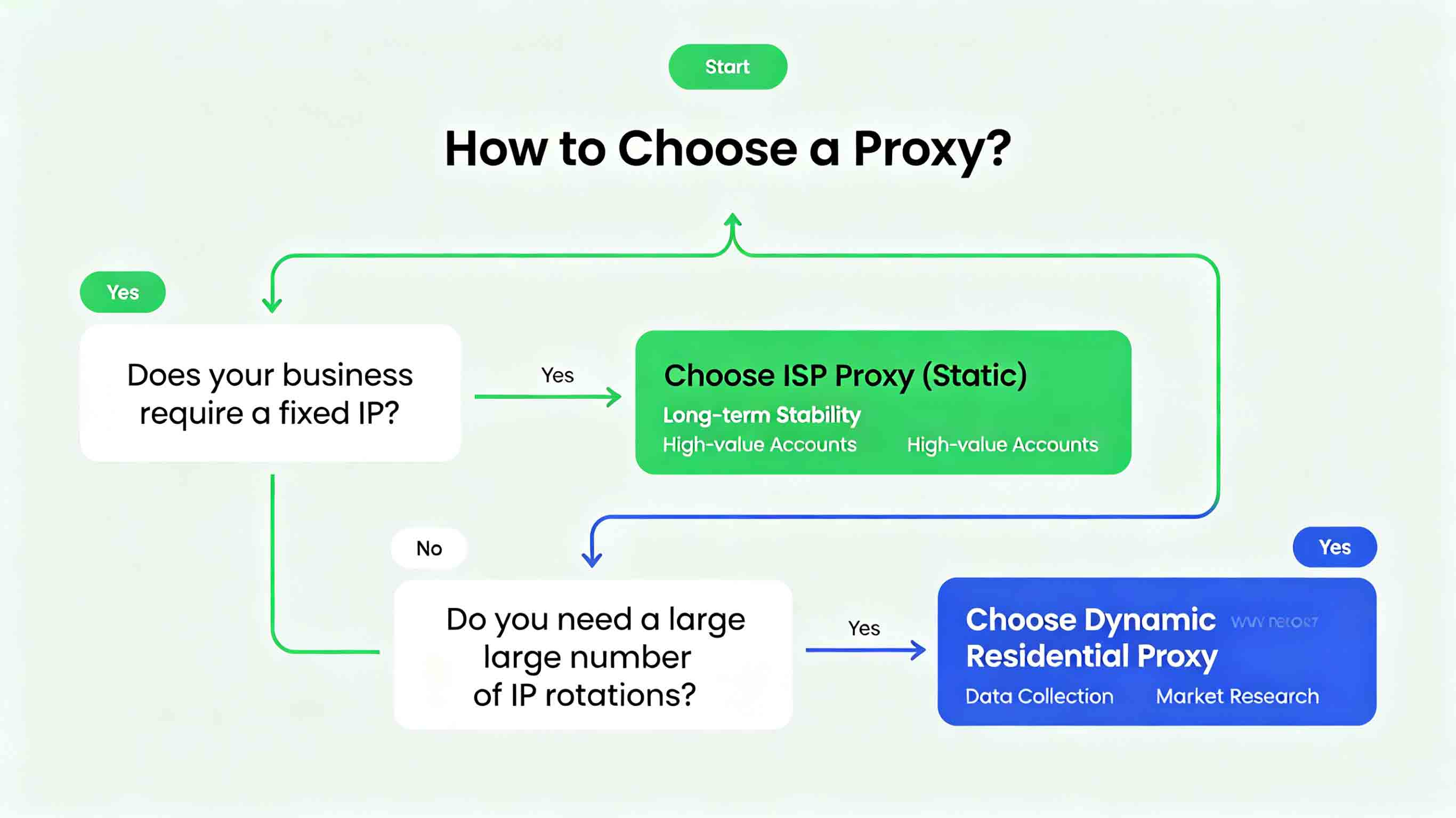
Question 1: Do I need a fixed IP?
Yes → ISP or static residential No → Keep going
Question 2: Do I need high-volume IP rotation?
Yes → Dynamic residential No → ISP is still on the table
Question 3: Is budget a limiting factor?
Yes → Dynamic residential No → ISP makes more sense
7. The Bottom Line
There's no universal "best" proxy—only what's best for your specific situation.
Start by understanding your actual needs, then match to the right product:
Need stability? → Static residential (fixed IP)
Need flexibility? → Dynamic residential (rotating IPs)
Whatever you choose, let your use case drive the decision—not the price tag or the fanciest-sounding option.
Frequently Asked Questions
ISP Proxy vs Residential Proxy: What's the Difference?
ISP proxies are fixed residential IPs from real home networks. Residential proxies come in two types: dynamic (rotating) and static (fixed/ISP). Both share the same IP source, but ISP proxies offer more stability while dynamic residential proxies offer more flexibility.
Which Should I Choose: ISP Proxy or Residential Proxy?
It depends on your needs. Go with ISP proxies if you require fixed IPs and long-term stability. Choose dynamic residential proxies if you need high-volume IP rotation and flexibility.
Is ISP Proxy Better Than Residential Proxy?
Not necessarily. ISP proxies cost more and offer limited IPs, making them less suitable for volume-heavy tasks. Dynamic residential proxies offer better flexibility and value for most use cases.
Does IPIPD Offer ISP Proxies?
IPIPD offers residential proxy products including static residential proxies (equivalent to ISP proxies) and dynamic residential proxies, covering e-commerce, social media, and other business scenarios.
Which Proxy Is Best for E-Commerce?
Static residential proxies are recommended for e-commerce multi-store operations. They provide fixed IPs for each store while costing less than traditional ISP proxies.
9. Quick Reference
Factor
ISP Proxy (Static Residential)
Dynamic Residential Proxy
IP stays the same
Yes
No
Stability
Excellent
Moderate
Flexibility
Lower
Higher
Price
Higher
Mid-range
IP availability
Limited
Massive
Best for
Long-term accounts, high-value operations
IP rotation, volume tasks
Right fit if...
You prioritize stability
You need flexibility and scale
Remember: the "better" proxy is the one that actually fits your workflow—not the most expensive or most hyped option.
Start with your actual needs, then make the call. That's the smart approach.