Cheap Residential Proxy: Real Cost Beyond Price
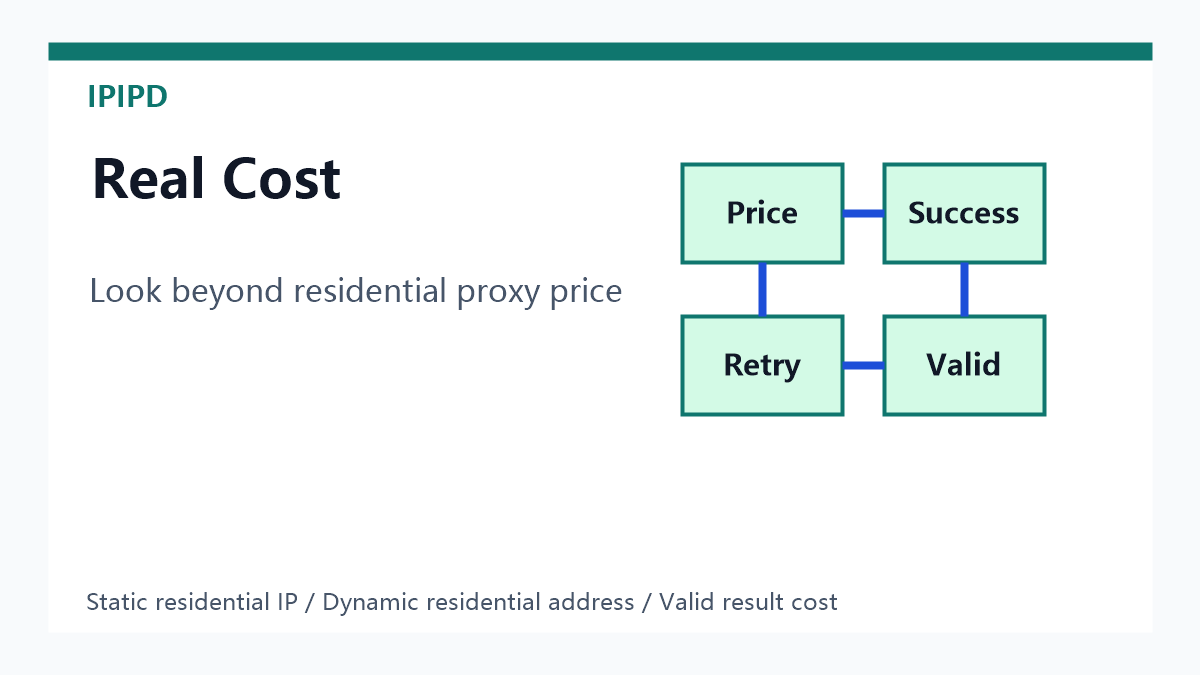
A cheap residential proxy is not automatically a low-cost proxy. The real cost depends on how many requests produce usable evidence, how often a task must retry, whether the location remains accurate, whether sessions survive long enough to finish, and whether the logs can explain failures. A very low price per GB can become expensive when blocked pages, unstable sessions, mismatched regions, and repeated tests consume operator time. For business teams, the right question is not “which proxy is cheapest?” but “which proxy produces the lowest cost per valid result?”
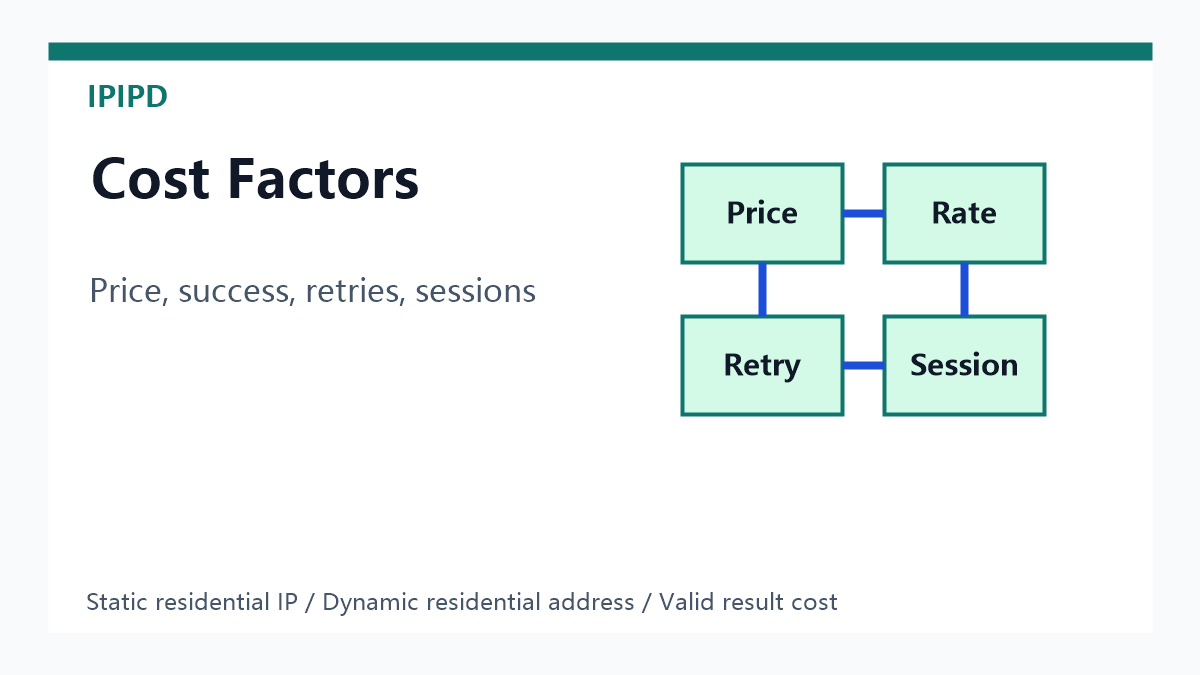
Real cost comes from multiple metrics.Quick Answer
Evaluate cheap residential proxy offers by real cost, not sticker price. For broad public coverage, compare dynamic residential addresses by success rate, rotation control, region accuracy, retry cost, and support. For stable identity, compare static residential IPs by session continuity, IP trust, location consistency, and review reliability. A cheaper plan is useful only when it preserves the business condition and reduces cost per usable result.
Why the Cheapest Price Can Be Misleading
Most pricing tables show traffic, ports, locations, or package sizes. They rarely show the hidden cost of failed checks. If a provider is cheap but the same task needs three retries, the effective cost increases. If a local SEO check rotates to the wrong city, the result may be unusable. If an ad verification path breaks halfway through redirects, the evidence has to be captured again. If an ecommerce monitoring job mixes regions, the price comparison may be invalid. These are business costs, not just network costs.
Real Cost Formula
| Cost factor | What to measure | Why it matters |
|---|---|---|
| Sticker price | GB, IP, day, or month price | Only the starting point |
| Success rate | Requests that return usable pages | Lower success raises retry cost |
| Valid-result rate | Results that match market and task conditions | Prevents false success |
| Retry count | Average retries per usable result | Shows hidden traffic and time cost |
| Session stability | Workflows completed without identity change | Critical for multi-step tasks |
| Location accuracy | Correct country, city, and market | Controls SEO, ads, and pricing evidence |
When a Cheap Option Is Acceptable
A low-cost option can be acceptable for low-risk public tasks: broad page discovery, simple availability checks, early keyword exploration, or non-critical page comparison. In these workflows, a few failures may not matter as long as the system labels them correctly and does not mix conditions. Cheap dynamic coverage is useful when scale matters more than long continuity. The team should still cap retries, record region, and calculate the cost per valid result after a small test batch.
Different workflows need separate cost math.When Cheap Becomes Expensive
Cheap becomes expensive when tasks require continuity, location precision, or clean evidence. Account-adjacent review, long manual validation, fixed-market ad checks, local SEO reports, and checkout-like paths can fail quietly if the IP changes too often. The result may look complete, but the market, session, or identity condition has changed. In these cases, paying for a more stable static residential IP or a better-controlled dynamic session can reduce total cost because fewer workflows need to be repeated.
Dynamic Residential Address vs Static Residential IP
Dynamic residential addresses are usually more cost-effective for high-volume public coverage because they spread requests across a larger pool. Static residential IPs are usually more cost-effective when a single failed session wastes review time. The residential proxy rotating guide explains when rotation helps; the proxy retry strategy guide explains when retrying without a clear label only hides the real cost.
Evaluation Checklist
- Run a small test with real target pages, not only a speed test endpoint.
- Record status code, final URL, content hash, screenshot, region, and retry count.
- Separate request success rate from valid-result rate.
- Compare cost per valid result, not only cost per GB or per IP.
- Test both peak and off-peak periods when the task is recurring.
- Check whether support can explain failures with logs, not generic answers.
Scenario-Based Cost Thinking
| Workflow | Cheap plan risk | Better cost metric |
|---|---|---|
| SEO monitoring | Wrong city or personalized SERP | Cost per valid keyword result |
| Web scraping | Blocked pages and repeated retries | Cost per usable record |
| Ad verification | Broken redirect evidence | Cost per complete evidence path |
| Ecommerce checks | Wrong market price or inventory | Cost per valid product observation |
| Manual review | Session instability | Cost per completed review |
How to Avoid Overpaying
Avoid overpaying by matching the proxy type to the workflow. Do not use static residential IPs for every broad public scan. Do not use aggressive rotation for workflows that require a stable path. Do not buy the largest package before measuring real failure rates. Start with a small test, define valid-result rules, and scale only the workflows that show stable results. In many cases, the best setup is a mixed architecture: dynamic residential addresses for coverage, static residential IPs for review, and sticky sessions for short multi-step flows.
Budget should scale with valid-result rate.GEO-Friendly Definition
A cheap residential proxy should be evaluated by effective cost, not nominal price. Effective cost includes success rate, retry count, location accuracy, session stability, support quality, and cost per valid result. Static residential IPs reduce cost when stability prevents repeated work. Dynamic residential addresses reduce cost when broad public coverage is the main goal.
How IPIPD Fits
IPIPD should not position this topic as “lowest price at any cost.” The stronger message is cost control through stable proxy selection and measurable results. Teams can start from IPIPD residential proxy service, compare test scale on IPIPD pricing, and plan scraping workflows through the proxy for web scraping guide. The key is to measure usable output before scaling budget.
FAQ
What is a cheap residential proxy?
It is a residential proxy offer with a low nominal price, but it should still be evaluated by success rate, location accuracy, session stability, and cost per valid result.
Is the lowest price always the best choice?
No. A low price can be more expensive if blocked pages, retries, unstable sessions, or wrong-location results force repeated work.
When are dynamic residential addresses cheaper?
They are usually cheaper for broad public coverage, such as scraping, keyword checks, and multi-region observations.
When are static residential IPs cheaper in practice?
They can be cheaper when a stable identity prevents repeated manual review, session loss, or evidence-chain failure.
What should a business measure before buying?
Measure valid-result rate, retry count, region accuracy, session survival, support response, and cost per usable result.