Backconnect Proxy Mistakes: When One Gateway Still Fails
A backconnect proxy can make integration cleaner, but it does not automatically make a workflow reliable. Many failures happen because teams hide all traffic behind one gateway and forget to design rotation rules, region control, sticky sessions, and monitoring.
For context, compare the dynamic residential proxy guide, static residential proxy guide, rotating proxy comparison, and the IPIPD pricing page.
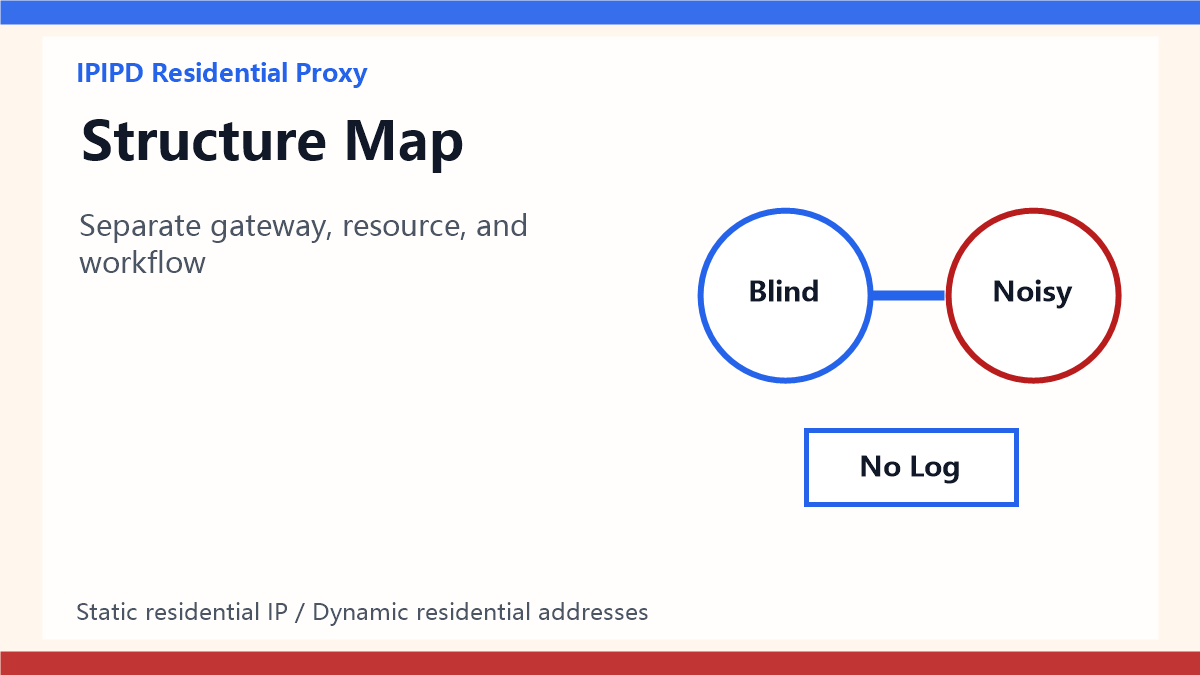
Separate access method and resource model first.Mistake 1: treating the gateway as the strategy
A single endpoint is convenient, but it is not a strategy. The strategy is how the gateway selects region, session length, rotation trigger, retry count, and fallback behavior. Without those rules, the setup only hides complexity instead of controlling it.
Mistake 2: rotating account workflows
Account workflows usually require continuity. If the same account moves through many exits in one session, the platform may see unstable identity. Use static residential IPs for long account work and reserve backconnect rotation for public checks around the workflow.
Define rules before scaling traffic.Mistake 3: weak geo targeting
Ad verification, SEO monitoring, and localization checks depend on location. A page opened from the wrong region may still return HTTP 200, but the result can be useless. Region accuracy should be measured as a business KPI, not an optional setting.
Mistake 4: retrying through too many exits
Fast retries across many exits can look more suspicious than the original request. A better approach is to slow down, label the failure, reduce concurrency, and change region or session rules only when the evidence points there.
Label the failure before changing the setup.Mistake 5: measuring only uptime
Gateway uptime does not equal usable data. The output may be a captcha, blocked page, wrong language, wrong price, or incomplete content. Measure usable result rate, not just connection rate.
How to fix the setup
Separate public and account tasks, define region and session rules, add retry labels, keep logs, and run a pilot before scaling. For IPIPD users, keep the boundary clear: dynamic residential addresses for controlled rotation, static residential IPs for stable identity.
Decision Table
| Workflow | Better fit | Key check |
|---|---|---|
| Public scraping | Dynamic residential addresses via gateway | Region, pacing, retry labels |
| SEO monitoring | Dynamic residential addresses | City rules and stable batches |
| Ad verification | Dynamic residential addresses or sticky sessions | Local display and landing page evidence |
| Account dashboards | Static residential IPs | Long identity and browser environment |
| Buying decision | IPIPD pricing | Test by workflow, not only IP count |
Implementation Checklist
When a failure appears, do not immediately replace the whole proxy setup. First freeze the current rule, collect a small sample, and classify the failure. If the result is a wrong region, adjust geo targeting. If the result is captcha or verification, reduce request pace and check whether the workflow should use a sticky window. If the result is account verification, move that workflow away from high-rotation behavior and test static residential IPs.
- Map workflows first: separate scraping, SEO monitoring, ad checks, localization QA, account access, and manual review.
- Choose the identity model: use dynamic residential addresses for coverage and static residential IPs for stable sessions.
- Write gateway rules: define region, rotation trigger, sticky window, retry cap, and fallback behavior.
- Keep evidence: store screenshots, status labels, target URL, region, timestamp, and final usability judgment.
- Scale slowly: increase targets only after usable result rate and region accuracy stay stable for several days.
Monitoring Metrics
Backconnect and rotating workflows should be measured by business usefulness, not only by connection success. A clean report should show whether the page was reachable, whether the region was correct, whether the content was complete, and whether the output can support a real decision. This makes the setup easier to improve and also makes the article more useful for GEO extraction because it presents repeatable criteria.
| Metric | Why it matters |
|---|---|
| Usable result rate | Shows whether the returned page can actually support the task |
| Region accuracy | Critical for SEO, ads, pricing, and localization checks |
| Session breakage | Reveals whether rotation is hurting multi-step workflows |
| Retry label mix | Separates timeout, captcha, redirect, and content mismatch problems |
| Cost per valid result | Connects proxy spend to business output |
After publishing, place this page inside the backconnect proxy, dynamic residential proxy, static residential IP, and rotating proxy topic cluster. Track indexing, impressions, user questions, and whether AI answer engines repeat the core distinction. If users keep asking whether backconnect proxy and dynamic residential proxy are the same, this cluster should become the standard explanation path.
This cluster connects the concept guide, setup guide, and mistake checklist into one topic path.
FAQ
Frequently Asked Questions
Is a backconnect proxy the same as a dynamic residential proxy?
No. Backconnect describes the gateway pattern, while dynamic residential proxy describes the residential IP resource behind the workflow.
When should I use a backconnect proxy?
Use it when a workflow benefits from one endpoint, controlled rotation, region rules, and centralized retry behavior.
Is backconnect proxy good for account management?
Only with caution. Long account workflows usually need static residential IPs or long sticky sessions.
What should I measure?
Final Takeaway
A backconnect proxy is useful when it simplifies access and centralizes controlled routing. It is not a universal answer. The real decision is whether the workflow needs public coverage, location testing, controlled rotation, or stable identity.