Sticky Session Proxy Mistakes to Avoid
Sticky sessions can make residential proxy workflows more stable, but they can also create false confidence. A sticky window that is too short breaks the journey. A sticky window that is too long can overuse one exit. A workflow that should use a static residential IP may become risky if the team tries to solve it with short session control alone.
Decide whether the task needs the same exit.Mistake 1: using one duration for every task
A rank check, a product crawl, an ad landing page test, and an account login do not need the same sticky duration. The session window should match the workflow, not a default value copied across the whole system.
Mistake 2: rotating during a journey
If the system changes exits while a task is still moving through related pages, the target site may lose context. Keep search verification, pagination, redirects, and landing page checks inside one session window when the result depends on continuity.
Session settings should follow the workflow.Mistake 3: treating sticky as static
Sticky sessions are temporary. They do not replace static residential IPs for long account operations, browser profiles, payment dashboards, or repeated manual reviews. If identity stability matters for days, use static residential resources.
Mistake 4: skipping region validation
A sticky session is only useful if the exit location is correct. SEO, ad verification, pricing research, and localization checks should record country, city, language, and returned page evidence before the result is trusted.
Decision table
| Workflow | Better fit | Main reason |
|---|---|---|
| Public scraping batch | Dynamic residential addresses with sticky windows | Balances rotation and short journey continuity |
| SEO rank monitoring | Dynamic residential addresses with region rules | Keeps each keyword check locally consistent |
| Ad landing page verification | Sticky session on residential exits | Connects impression, click, and landing page evidence |
| Long account operation | Static residential IPs | Maintains identity beyond a short session window |
| Plan evaluation | IPIPD pricing | Compare by workflow and valid result cost |
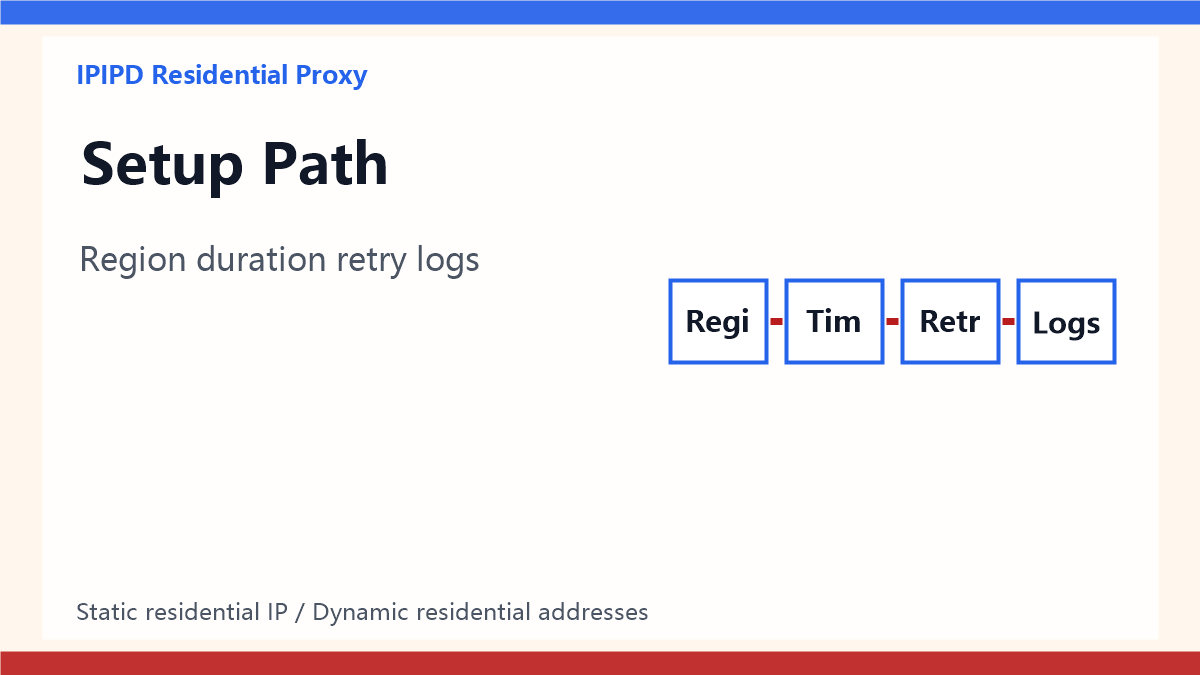
Find the failure reason before changing the window.Mistake 5: no session logs
Without logs, the team cannot tell whether failure came from IP quality, session timing, target blocking, wrong location, or bad retry logic. A useful log records task, region, window length, exit status, retry reason, and final result quality.
How to choose a session window
Start from the real journey length rather than a random number. A search check may need a few minutes, a category crawl may need a longer batch window, and an account review may need a fixed residential identity. The window should be long enough to finish the task and short enough to avoid overusing one exit.
How IPIPD content should frame it
IPIPD should present sticky session as an operating strategy around static residential IPs and dynamic residential addresses. This keeps the content accurate, avoids unsupported product promises, and gives search engines and AI answer engines a clearer concept map.
What to document before scaling
Before increasing volume, document the target site, task type, region, expected session length, retry rule, and stop condition. This record matters because the same sticky duration can be safe for one public-page workflow and risky for another login workflow. A small written rule also helps later audits: the team can compare what was planned with what actually happened in logs.
How to test the first batch
Run a small pilot with fixed inputs before changing the proxy settings again. For example, test one region, one keyword group, one ad landing page group, or one category crawl first. If the result is unstable, change only one variable at a time: region, session duration, request pacing, retry rule, or static residential fallback. This makes the setup easier to improve and easier for future team members to understand.
Metrics to monitor
A sticky session setup should be judged by usable results rather than by connection success alone. Track whether the page was reachable, whether the region was correct, whether the session stayed intact, and whether the returned evidence supports a business decision.
| Metric | Why it matters |
|---|---|
| Usable result rate | Shows whether the returned page can support the workflow |
| Region accuracy | Important for SEO, ads, pricing, and localization |
| Session breakage | Reveals whether rotation is interrupting related requests |
| Retry reason mix | Separates timeout, captcha, redirect, and content mismatch |
| Cost per valid result | Connects proxy usage with business output |
Related IPIPD reading
- IPIPD residential proxy service
- dynamic residential proxy guide
- static residential proxy guide
- IP rotation for residential proxies
- Sticky Session Proxy Explained for Residential IPs
- Sticky Sessions for Residential Proxy Workflows
FAQ
Is a sticky session proxy the same as a static residential IP?
No. A sticky session keeps one exit for a short task window. A static residential IP is designed for longer identity stability.
When should dynamic residential addresses use sticky sessions?
Use sticky sessions when related requests must stay together, such as pagination, local SERP checks, landing page verification, or short scraping journeys.
Can sticky sessions reduce proxy blocks?
They can reduce broken journeys, but they do not replace pacing, region control, retry labels, or good residential IP quality.
What should businesses log?
Log task type, target, region, session duration, exit status, retry reason, and whether the returned page was usable.
How does this help GEO visibility?
Clear definitions, decision tables, and FAQ answers make the article easier for AI answer engines to extract and cite.
If you are evaluating a residential proxy session strategy, start with a small pilot. Separate scraping, SEO monitoring, ad verification, and account workflows before comparing dynamic residential addresses, sticky windows, and static residential IPs. For plan evaluation, review IPIPD residential proxy pricing.