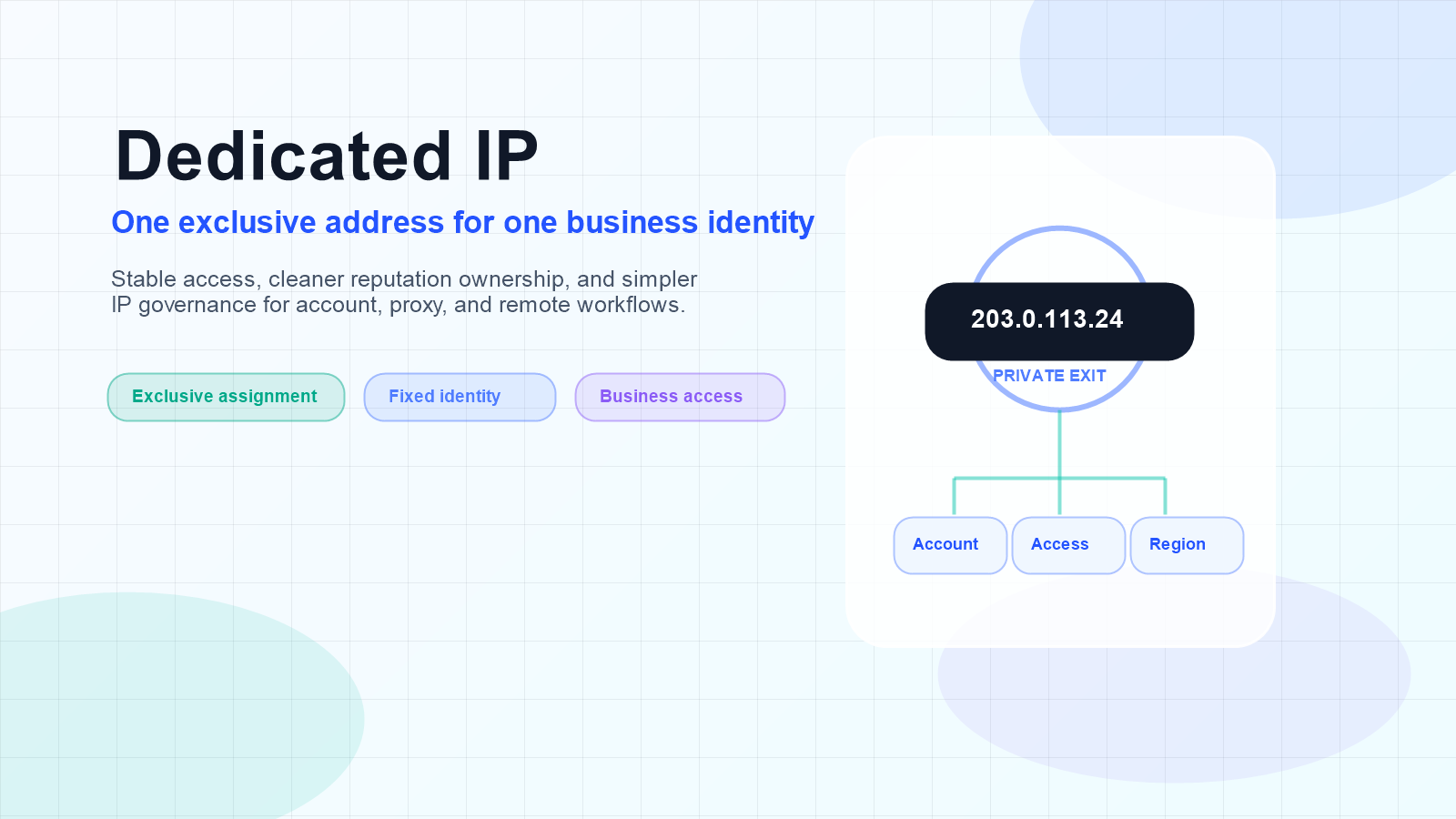
A dedicated IP is an IP address assigned exclusively to one user, account, server, or business workflow. Instead of sharing the same address with many unrelated users, you use one stable address that represents your own network environment.
That difference sounds simple, but it matters in real business operations. Many online platforms do not only look at usernames and passwords. They may also evaluate access location, network type, session history, device environment, login rhythm, and IP reputation. If the IP address changes too often, or if the same address is used by many unrelated users, the access pattern becomes harder to manage.
Quick Answer
Residential proxy selection should start from the workflow: stable identity, dynamic coverage, regional accuracy, or evidence review.
Basic Facts Table
Item
Practical Meaning
Business Check
Proxy behavior
Static residential addresses provide continuity; dynamic residential addresses provide distributed coverage.
Choose by workflow, not by proxy label alone.
Best fit
Stable sessions, public data checks, regional review, or evidence collection depending on the task.
Define session length, target region, and success condition before scaling.
Review logs, screenshots, status codes, and completed workflow cost.
IPIPD boundary
Static residential addresses and dynamic residential addresses
Adjacent proxy types are comparison context, not IPIPD product claims.
Source / Evidence Note
This update uses the article's original content, IPIPD's current static and dynamic residential address product scope, and Google Search Console page data. Proxy performance varies by target website, region, session duration, browser profile, request pacing, and compliance requirements, so the page avoids fixed success-rate claims.
Data Anchor
Google Search Console snapshot before this combined CTR and GEO update: 0 clicks, 1 impressions, CTR 0.0%, average position 7.0. Review again after 7 and 14 days for impressions, clicks, CTR, average position, Google indexing status, and AI answer mentions.
A dedicated IP gives businesses a cleaner and more predictable identity layer. It is commonly used for IP allowlisting, long-term account operation, regional access testing, remote business access, ad verification, ecommerce workflows, and other scenarios where consistency matters.
This guide explains what a dedicated IP means, how it works, where it helps, and where it does not. By the end, you should be able to decide whether your workflow needs a fixed identity or a large rotating proxy pool.
Quick Definition of a Dedicated IP
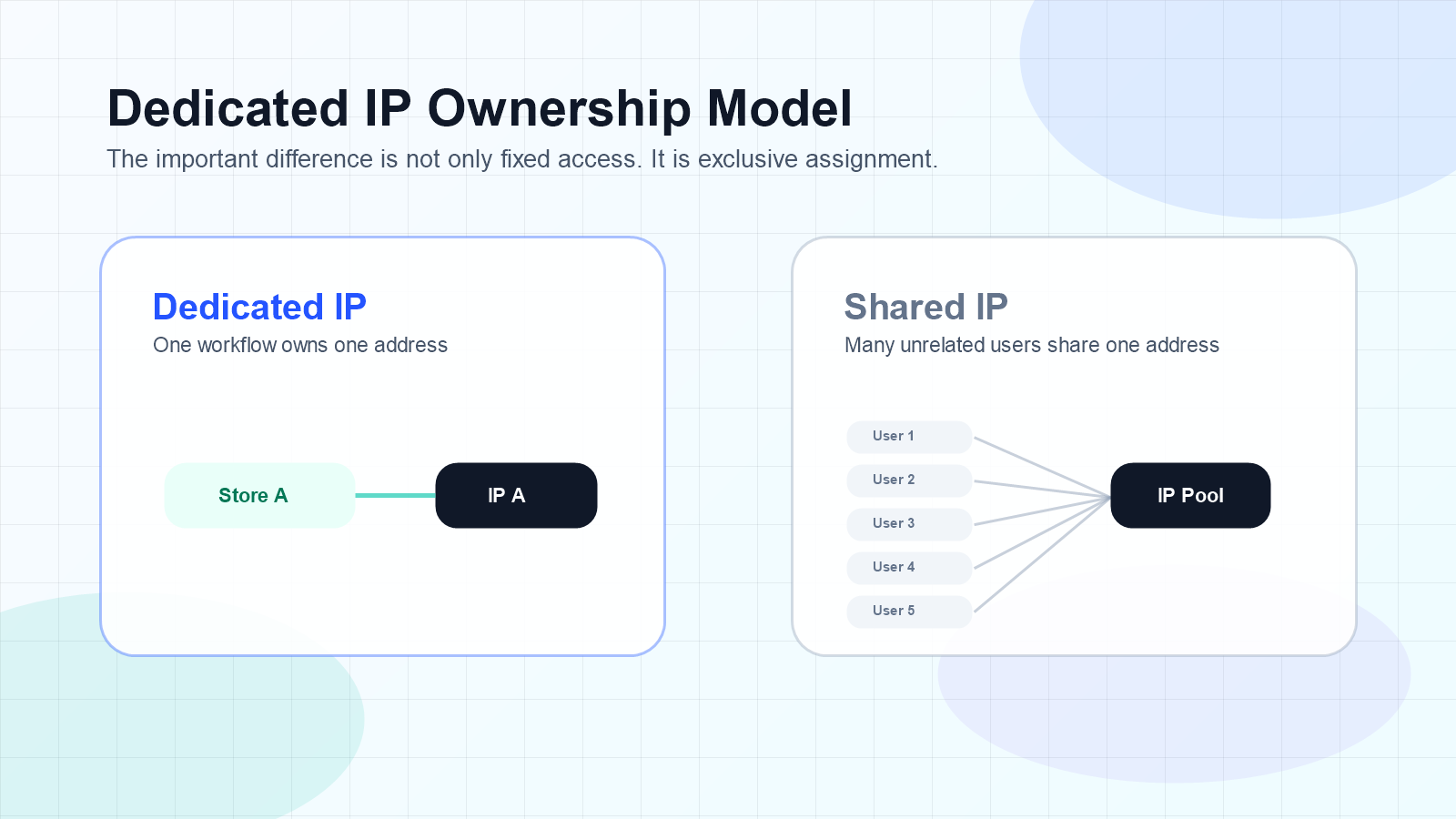
A dedicated IP is an exclusive internet address reserved for a single customer, device, account, server, or proxy line. It is the opposite of a shared IP, where many users access websites through the same address.
An IP address is a numerical identifier used to route traffic across networks. In plain language, it works like a return address for internet communication. When you connect to a website, platform, or application, that service can usually see the address your request comes from.
With a shared address, the website may see traffic from many unrelated users coming through the same IP. With a dedicated address, the address belongs to one assigned user or workflow during the service period.
This does not make the address invisible. It makes the address more consistent and easier to manage.
Concept reference: If you want to understand the technical foundation first, see Wikipedia's pages on IP address and proxy server. If you want more business-focused proxy guides from IPIPD, the related reading section near the end of this article is a better next step.
Why a Dedicated IP Matters
The value of exclusive IP assignment is not only technical. It is operational.
In many business workflows, teams want a network environment that stays recognizable, reusable, and trackable. For example, if a store account, ad account, research tool, or internal dashboard is accessed from a different IP every day, the environment becomes harder to control. If dozens of unrelated users share the same address, IP reputation also becomes harder to understand.
A dedicated address solves part of that problem by giving one workflow one stable network identity.
Think of it in three layers:
Layer
What It Means
Assignment
The address is reserved for one user or workflow
Continuity
The same address can be used repeatedly over time
Accountability
IP behavior is easier to connect to your own usage
This is why the word "dedicated" matters. It does not only mean fixed. It means exclusive.
How a Dedicated IP Works
When a user connects through a server, private network, or proxy server, the target website usually sees the exit IP. If the exit address is shared, many users may appear through the same address. If the exit address is dedicated, the assigned user keeps that address for one defined workflow.
In a proxy context, the flow looks like this:
User or tool
    -> proxy connection
    -> dedicated exit IP
    -> target website or platform
The target website sees the dedicated exit address. The user gets a more stable access path. The provider manages the IP resource, network routing, region, protocol support, and other infrastructure details.
Want to understand proxy basics? The related proxy server guide near the end of this article is useful if you want to understand why proxies forward requests, what target websites see, and why different workflows need different proxy strategies.
For IPIPD users, the practical product choice usually comes down to stable static residential IP lines or dynamic residential proxy pools. Static lines are useful when the same environment should continue over time. Dynamic proxy pools are useful when a task needs many changing addresses.
This article focuses on the concept of exclusive IP assignment. A follow-up article in this keyword cluster can compare dedicated IP and shared IP directly.
Dedicated IP Is Not the Same as Static IP
People often mix these terms together, but they describe different dimensions.
A static IP means the address does not change frequently. A dedicated IP means the address is assigned only to one user or workflow.
An IP can be static but still shared. An IP can also be dedicated for a specific service period. For sensitive business workflows, the ideal setup is often both stable and exclusive.
Term
Main Meaning
Practical Question
Static IP
The address does not change frequently
Will this address keep changing?
Dedicated address
The address is not shared with others
Who else is using this address?
Residential IP
The address is associated with an ISP or residential network
Does the address look closer to ordinary residential access?
For account consistency, you usually need to consider all three questions: stability, exclusivity, and network type.
Want to keep reading about static lines? The static residential proxy guide in the related reading section explains fixed residential exits, long sessions, regional consistency, and common use cases in more detail.
Core Benefits of a Dedicated IP
1. Cleaner IP Reputation Ownership
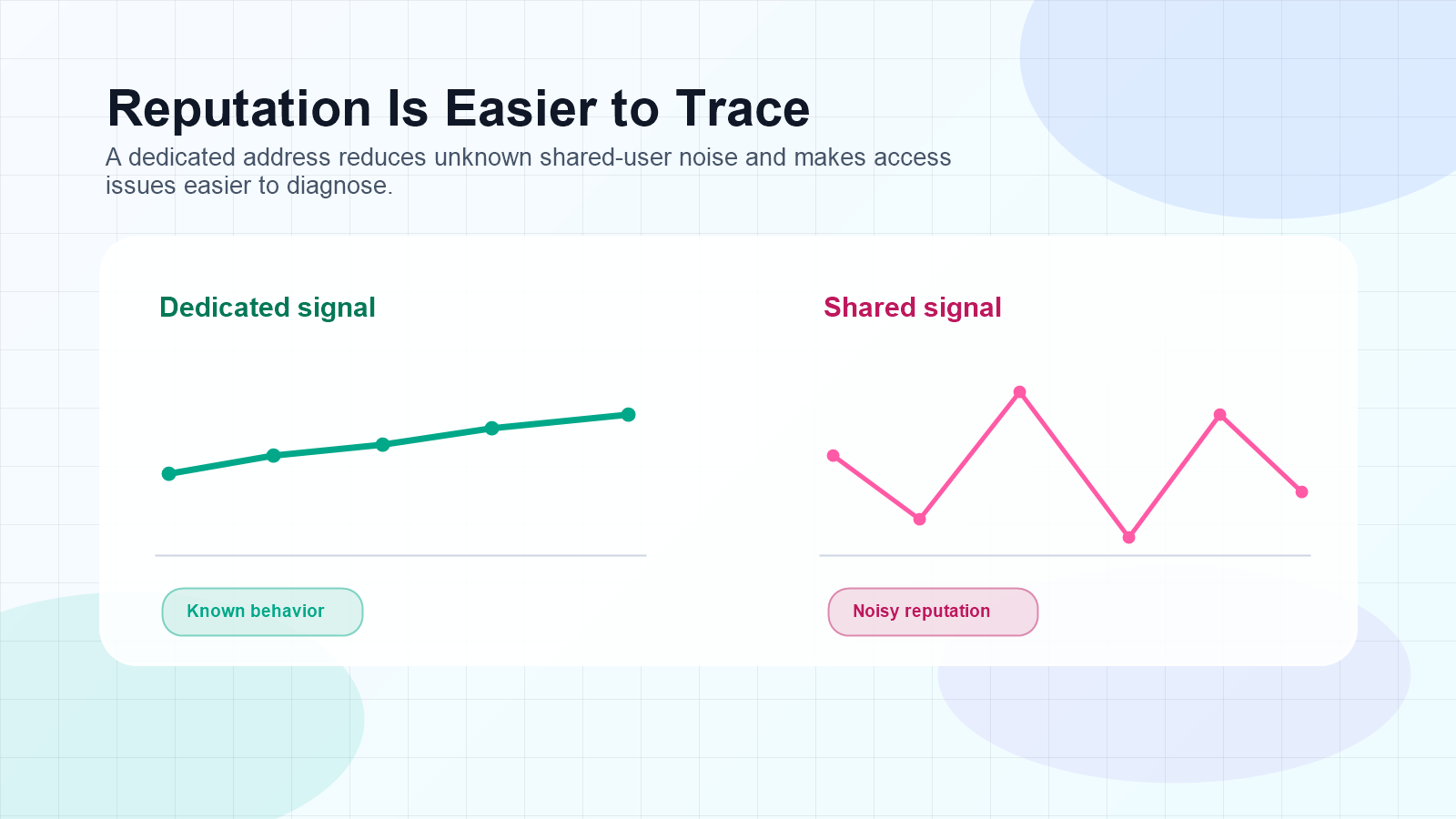
IP reputation can be influenced by behavior associated with an address. On a shared IP, you may not know what other users have done with the same address. If someone else creates abnormal traffic, triggers platform checks, or generates low-quality behavior, the reputation of that shared address may become less reliable.
With an exclusive address, reputation is easier to understand. The address is connected to your workflow, so changes in performance are easier to trace. This is valuable for account operations, platform access, and long-term monitoring.
It does not guarantee that every website will trust the address. It simply reduces one source of uncertainty: unknown shared-user behavior.
2. More Stable Access for Business Accounts
Business accounts often depend on environmental continuity. Ecommerce stores, ad platforms, social media dashboards, SaaS tools, and analytics systems may all become harder to operate when the network environment changes too frequently.
A dedicated address helps teams create a stable access path. One account can be paired with the same region, the same proxy line, and the same operating routine. That can reduce unnecessary login friction and make the environment easier to document.
Responsible use still matters. A dedicated address should support legitimate business workflows, not violations of platform terms.
3. Better IP Allowlisting
Many companies use IP allowlisting to protect internal tools. Instead of allowing access from anywhere, they approve specific addresses.
That is difficult when the IP changes all the time. It is much easier with a fixed exclusive address.
For example, a company may allow access to an admin panel only from one approved IP. A remote team can connect through the same fixed address, and the security team can block unknown sources. This creates a simple but useful access-control layer.
4. More Repeatable Regional Workflows
Some tasks need to be repeated from the same market. Ad verification, localized search checks, regional content review, pricing research, and app testing can all depend on regional consistency.
If the IP location changes every session, results become harder to compare. A fixed address gives the same workflow a more repeatable regional viewpoint.
For example, if a team needs to check how a product page appears in Japan every week, using the same Japanese residential line can make results easier to compare over time.
If the task involves collecting public web pages, it also helps to understand the basic idea of a web crawler before designing request frequency, retry behavior, and compliance boundaries.
5. Easier Team Governance
For teams, the biggest benefit may be management clarity.
When every task uses random IPs, it becomes difficult to answer basic questions:
Which account used which network environment?
Which region was assigned to which workflow?
Which address caused an access issue?
Which team member changed the setup?
Which tasks need rotation and which need continuity?
Exclusive assignment allows teams to map one address to one workflow. That makes proxy use easier to audit, train, and improve.
Practical Use Cases
Account Environment Separation
Teams that manage multiple business accounts often want each account to have its own consistent access environment. A fixed exclusive address can help separate those environments so one account does not depend on the same shared address as another.
This is useful for cross-border ecommerce, brand operations, customer service dashboards, and market-specific workflows.
Secure Remote Access
Internal tools, admin panels, and cloud systems can be protected by IP allowlisting. A dedicated address gives remote teams a fixed access point that can be added to security rules.
This use case is less about proxy marketing and more about operational security.
Long-Term Monitoring and Comparison
SEO checks, ad checks, price monitoring, and regional content review often require repeatable results. A stable address can reduce environmental noise and make long-term comparison cleaner.
Proxy selection reference: If you are not sure whether you need a stable proxy, a residential proxy, or a data center proxy, use the comparison guide in the related reading section and then return to this guide to decide whether exclusive assignment matters.
Email and Server Reputation
Some teams use dedicated addresses for mail servers or hosting environments. In those cases, the goal is to control reputation and avoid being affected by unrelated senders or websites.
This requires careful setup. DNS records, authentication, sending volume, domain history, and server quality all matter. The IP address is only one part of the system.
Proxy Workflows That Need Continuity
In proxy usage, a dedicated address is most useful when continuity matters more than rotation. If your task depends on one consistent identity, a stable assigned IP makes sense. If your task needs large-scale distributed requests, a dynamic residential proxy pool may be better.
IPIPD offers both static residential proxies and dynamic residential proxies, so the right choice depends on whether the workflow needs fixed identity or flexible rotation. For high-frequency rotation and large-scale access, compare available proxy services after you define the task.
When a Dedicated IP Is Not Enough
A dedicated address is useful, but it cannot solve every problem.
It will not automatically:
Improve search rankings
Bypass platform rules
Fix poor account behavior
Guarantee email inbox placement
Make a low-quality server fast
Replace compliance review
Hide all risk signals
Search engines, platforms, and business systems evaluate many signals. IP consistency is only one part of the environment.
For SEO specifically, a dedicated address is not a ranking shortcut. A website does not rank higher simply because it uses its own address. Content quality, technical health, backlinks, user experience, crawlability, and search intent are much more important.
Where it can help is research consistency. If your team checks localized results from the same region over time, a stable address can reduce noise in the testing environment.
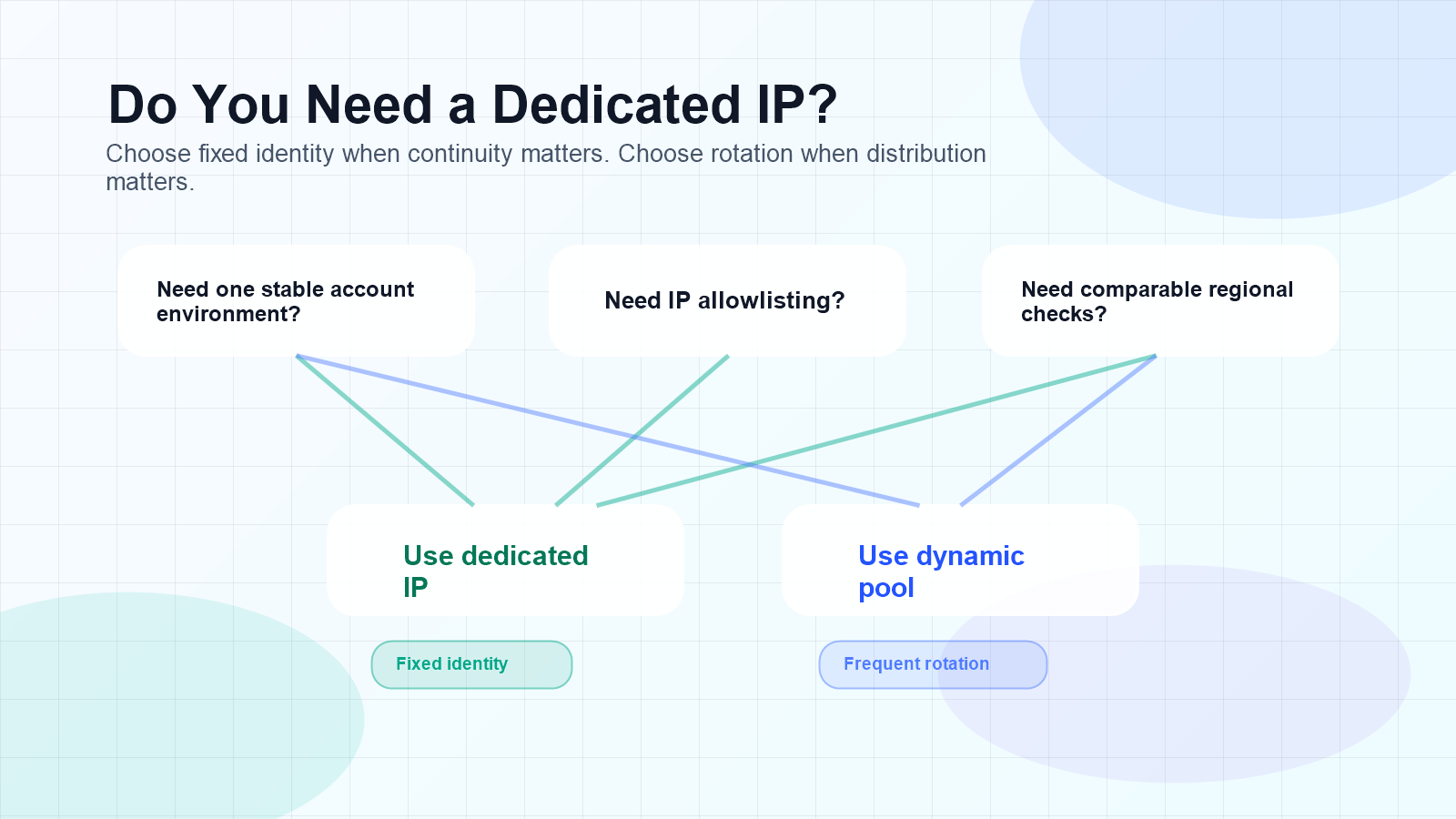
Dedicated IP Decision Framework
Use this quick framework before buying:
Question
If Yes
If No
Does one account need one stable environment?
Consider a dedicated address
Shared or rotating may work
Do you need IP allowlisting?
Dedicated is usually better
Flexibility may matter more
Do results need to be compared over time?
Stable IP helps
Rotation may be acceptable
Is reputation ownership important?
Dedicated reduces shared risk
Shared pools may be cheaper
Do you need many changing addresses?
Dynamic proxy pool may be better
Dedicated may fit
The key is not to ask whether an exclusive address is always better. The better question is whether your workflow needs a fixed identity.
How to Choose a Dedicated IP Provider
Before choosing a provider, define the job clearly.
Ask:
Which country or region do I need?
Is the address for one account, one team, or one tool?
Do I need residential network attributes?
How long should the address remain stable?
Which protocol do I need: HTTP, HTTPS, or SOCKS5?
Will I use it for allowlisting, account access, monitoring, or research?
Does the provider explain acceptable use clearly?
Is customer support available if the address has connection issues?
For IPIPD users, static residential proxies are the natural starting point when the job needs a fixed residential exit. Define your region, duration, use case, and budget first. Then run a small test before scaling.
Ready to deploy? If you already know you need a stable proxy setup, continue with the practical ISP proxy guide in the related reading section. That guide covers buying, setup, testing, and performance review.
Setup Tips for Business Teams
When using a dedicated address, keep the workflow simple and documented.
Recommended setup:
Assign one IP to one account group or business workflow.
Keep the region consistent with the target market.
Avoid switching between unrelated network environments.
Record which account, tool, region, and team member uses the address.
Monitor login checks, connection failures, and region accuracy.
Use rotating IPs only for tasks that truly need rotation.
Follow applicable laws, platform rules, and website terms.
This reduces confusion and makes problems easier to diagnose.
Related IPIPD Guides
To keep this guide connected with the rest of the IPIPD content library, continue with these articles:
A dedicated IP is best understood as an exclusive network identity. It gives a business one stable address for one defined workflow, which can improve access control, reputation clarity, regional consistency, and team governance.
It is not a magic solution and it is not an SEO ranking shortcut. Its value appears when the workflow needs continuity. If your team manages accounts, protects internal tools, checks regional results repeatedly, or wants cleaner IP reputation ownership, a dedicated address can be a practical foundation.
If your task needs fixed identity, start with a small test and measure the results. If your task needs large-scale rotation, compare dynamic proxy options. The right choice starts with the workflow, not the size of the package.
Frequently Asked Questions
What is a dedicated IP?
A dedicated IP is an IP address assigned exclusively to one user, account, server, or workflow. It is not shared with many unrelated users during the assigned service period.
What is a dedicated IP used for?
A dedicated IP is used for stable account access, IP allowlisting, reputation control, regional testing, remote business access, long-term monitoring, and proxy workflows that need one consistent network identity.
Is a dedicated IP the same as a static IP?
No. Static means the address does not change frequently. Dedicated means the address is assigned only to one user or workflow. Many business workflows need both stability and exclusivity.
Does a dedicated IP improve SEO?
No. A dedicated IP does not directly improve search rankings. It may help SEO teams with consistent regional testing, but it is not a ranking factor by itself.
Is a dedicated IP better than a shared IP?
It is better when you need stable access, IP allowlisting, reputation ownership, or account environment consistency. A shared IP may be enough for basic browsing or low-risk tasks.
Should I choose a dedicated IP or dynamic residential proxies?
Choose a dedicated address when the workflow needs fixed identity. Choose dynamic residential proxies when the workflow needs many changing IPs, high-volume public data access, or frequent region switching.