Residential Proxy Location Accuracy: Business Guide

Residential proxy location accuracy should be judged by returned page evidence, not by IP lookup alone. For SEO monitoring, ad verification, price checks, and localized page review, the goal is not to prove that an IP appears to be in a market. The goal is to prove that the workflow returns the correct market result.
Do not stop at IP lookupDefinition: what location accuracy means
Residential proxy location accuracy means the observed web result matches the market the team intended to test. It is not enough for an IP database to say that an exit belongs to a country or a city. The useful question is whether the target website returns the correct language, currency, search result, ad creative, local inventory, consent page, and landing-page route for that market. A proxy is accurate only when the returned page evidence supports the claimed location.
Why IP lookup alone is weak evidence
IP lookup tools are useful for a first check, but they are not final proof. Databases can disagree, and websites may use their own routing logic. A city-level IP can still return a national page, a wrong-language page, or a page from a nearby market. Teams should treat lookup data as a signal, then confirm it with real page output from the workflow they care about.
From target to page resultDynamic residential addresses fit broad market sampling
Dynamic residential addresses are useful when the task needs coverage across many countries, cities, or user contexts. SEO teams can check search results from several markets, ad teams can review local creative, and data teams can compare product availability. Rotation should be controlled by market and task batch so that results remain explainable. Random rotation without labels makes the final report hard to trust.
Static residential IPs fit stable regional review
Static residential IPs are better when a team needs the same regional identity for repeated checks, manual review, account-adjacent workflows, or long browser sessions. If the same city and browser profile must be preserved for several days, a static residential IP produces cleaner continuity than constantly rotating exits. The tradeoff is coverage: one static IP represents one stable context, not a broad market sample.
Decision table
| Check | Why it matters | How to use it |
|---|---|---|
| IP lookup matches target | Useful first signal | Confirm with returned page |
| Page language and currency match | Stronger business evidence | Save screenshot and final URL |
| SERP or ad result matches region | Workflow-valid evidence | Log query, device, and market |
| Redirect chain is expected | Prevents false local results | Record initial and final URLs |
Judge by business outputEvidence fields to record
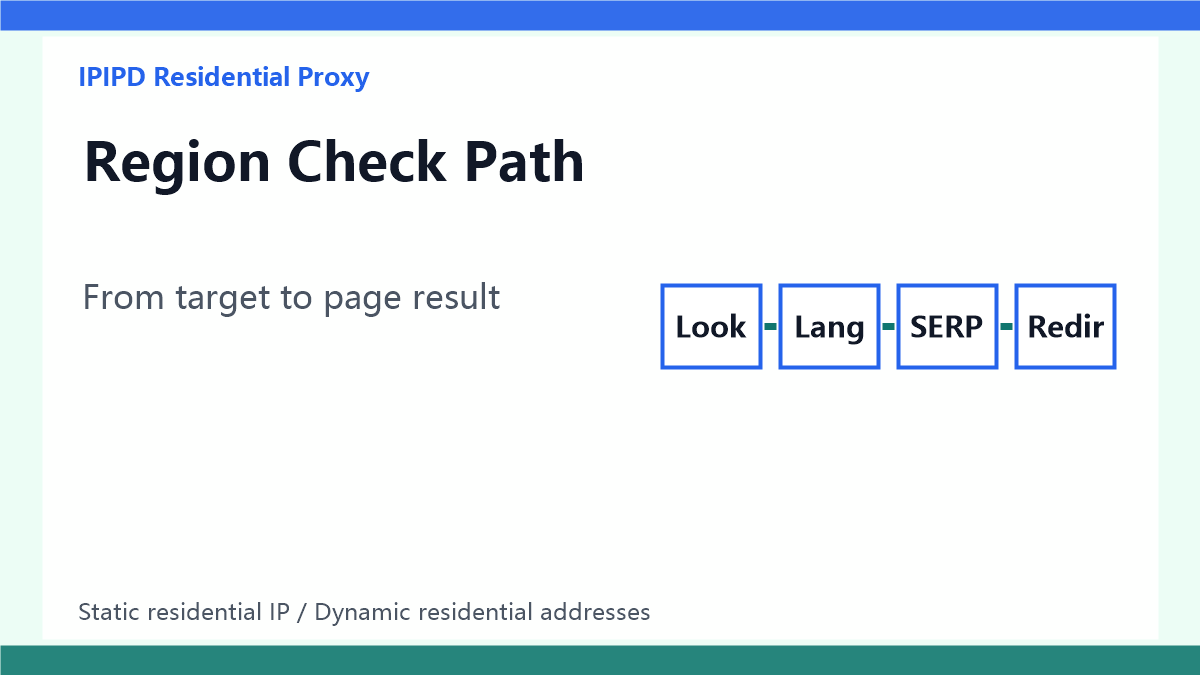
A location test should save target country, target city, proxy type, IP lookup result, browser language, timezone, returned page language, currency, search-result domain, final URL, redirect chain, screenshot, timestamp, and status label. These fields make the result auditable. If the page is blocked, redirected, or ambiguous, the record should say so instead of treating it as a normal success.
Common failure patterns
The most common failures are database mismatch, wrong language, wrong currency, national page instead of city page, unexpected redirects, empty local inventory, consent screens that hide content, and search results from the wrong region. These failures are business failures even if the proxy connection technically succeeded. The final metric should therefore be region-valid output rate, not only connection success rate.
How to run a small pilot
Start with two or three target regions and a fixed page list. Run the same checks several times at different hours. Compare returned language, page layout, redirect, and content blocks. If the same proxy rule produces inconsistent regions, reduce rotation, adjust browser signals, or separate that task into a static residential IP workflow. Once the pilot is stable, expand the test to more regions.
Buying decision boundary
Choose dynamic residential addresses when the business needs geographic coverage and public checks across markets. Choose static residential IPs when the business needs one stable regional identity, repeatable manual review, or account continuity. For many companies, the practical answer is a mixed setup: dynamic resources for coverage, static resources for controlled review.
IPIPD product boundary
This article stays within IPIPD's current product boundary: dynamic residential addresses for controlled rotation and coverage, and static residential IPs for stable identity and longer sessions. Related ideas such as geo targeting, latency, proxy pools, and sticky sessions are evaluation concepts, not separate product promises.
Minimum operating checklist
Before scaling, define the target market, target page list, proxy type, browser profile, evidence fields, retry rule, and exclusion rule. Keep failed checks in the report with clear labels. If the team removes failures from the data, it will overestimate real speed, accuracy, and reliability.
Related reading
For a broader setup path, compare the residential proxy pool guide, sticky session proxy guide, SEO monitoring proxy guide, ad verification guide, and IPIPD pricing. These pages help connect the metric to a real buying or configuration decision.