
6 Things the Residential Proxy Industry Doesn't Want You to Know

You've spent hundreds of dollars on residential proxies—and still only getting 40% success rate?
You've seen ads claiming "99% success rate" and "real residential IPs"—but your accounts still get banned and your scrapers still get blocked.
The problem isn't you. It's that the residential proxy industry has a lot of secrets they don't want you to know.
This article reveals 6 industry insider truths that will make you smarter than most residential proxy users—and help you avoid wasting money and time.

Secret #1: How Success Rate Numbers Are Manipulated
That "90% success rate" the ads promise? It's probably tested under ideal conditions.
Most residential proxy providers publish success rates based on tests where:
Target websites have low security levels
Testing happens during off-peak hours
A very limited IP sample is used
The reality:
High-security platforms (Instagram, Amazon, Google) might only achieve 30-50% success
Success rates drop significantly during peak hours or sales events
IP quality varies dramatically by region
The right question to ask:
"What's your success rate for Instagram/Amazon?"
Not just "what's your success rate?"
Secret #2: IP Pool Size Doesn't Equal Quality
"Millions of IPs" doesn't mean "quality IPs."
Many providers brag about their IP count, but here's what actually matters:
Old IPs might already be identified and blocked
Popular regions have IP reuse issues
Short IP lifespan means constant rotation increases risk
What really matters:
IP freshness: How recently has the IP been active?
Geographic distribution: Does it cover your target markets?
IP history: Has it been flagged by any platforms?
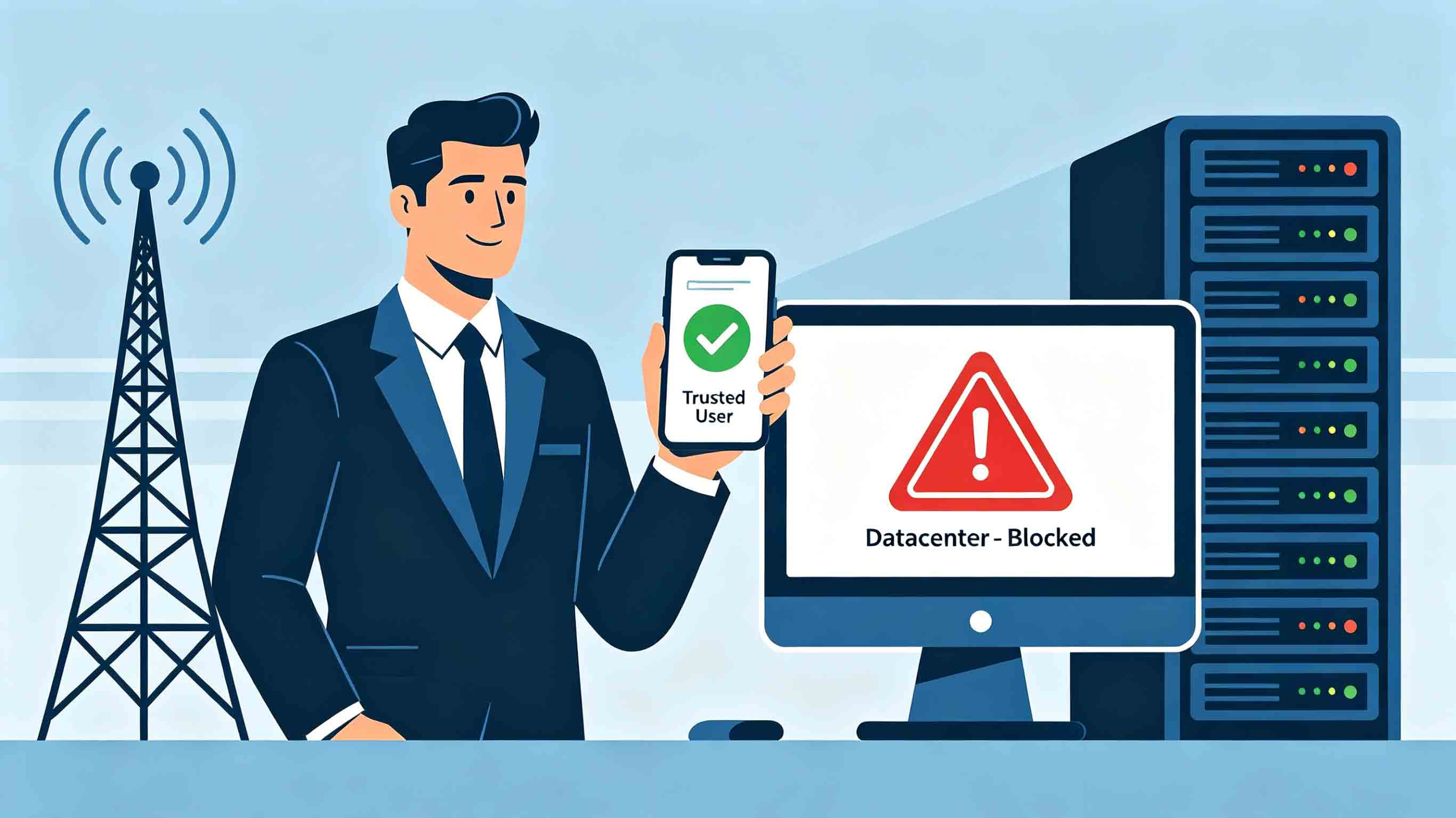
Secret #3: Residential Proxy Is Sometimes Easier to Detect Than Mobile Proxy
This is a counter-intuitive truth many people don't know.
Mobile proxy IPs come from real mobile devices. With massive user volume and natural rotation, platforms struggle to block them.
Residential proxy IPs come from home networks, which means:
IP ranges are more fixed and easier to identify
Home bandwidth usage patterns differ from commercial scraping
Detection systems track behavior patterns, not just IP addresses
Real numbers:
Mobile proxy success rate on high-security platforms: 80-95%
Residential proxy success rate on high-security platforms: 40-70%
For certain use cases, mobile proxy is actually more reliable.

Secret #4: The Real Reasons Behind Price Differences
Why do residential proxy prices range from $2/GB to $20/GB?
Price differences aren't about "quality"—they're about:
Price Factor | What It Means |
|---|---|
IP source | Own network vs. resold |
Authorization | User consent vs. background install |
IP quality | Clean pool vs. shared pool |
Support | 24/7 response vs. email tickets |
Be wary of anything under $5/GB:
Likely resold from middlemen with no quality control
May lack proper user authorization, creating legal risks
Support and service response will be slow
Secret #5: Your "Anonymity" Is Limited
No proxy is 100% anonymous.
Even with residential proxies, websites can still identify you through:
Detection Method | What It Does |
|---|---|
Browser fingerprinting | Canvas, WebGL, fonts |
Behavioral analysis | Access frequency, patterns |
Cookie tracking | Device ID recognition |
JavaScript fingerprints | Hardware specs, screen resolution |
Solutions:
Use anti-fingerprint browsers
Set reasonable access intervals
Clear cookies and cache regularly
Residential proxy only makes your IP look like a real user. Other detection methods still need to be addressed.
Secret #6: Terms of Service Might Be Limiting Your Use
Many residential proxies have usage restrictions you might already be violating.
Common restrictions:
Platform limits: Social media automation often prohibited
Traffic limits: Monthly caps with overage charges
Concurrency limits: Maximum simultaneous connections
Use restrictions: Data collection typically not allowed
Must-ask questions before buying:
Do you support my target website?
What's the monthly traffic cap?
How many concurrent connections allowed?
Are there usage restrictions?