For web scraping workflows, residential proxy selection should be based on request pacing, rotation control, session needs, validation logs, and usable result cost.
Basic Facts Table
Item
Practical Meaning
Business Check
Proxy behavior
Static residential addresses provide continuity; dynamic residential addresses provide distributed coverage.
Choose by workflow, not by proxy label alone.
Best fit
Stable sessions, public data checks, regional review, or evidence collection depending on the task.
Define session length, target region, and success condition before scaling.
Review logs, screenshots, status codes, and completed workflow cost.
IPIPD boundary
Static residential addresses and dynamic residential addresses
Adjacent proxy types are comparison context, not IPIPD product claims.
Source / Evidence Note
This update uses the article's original content, IPIPD's current static and dynamic residential address product scope, and Google Search Console page data. Proxy performance varies by target website, region, session duration, browser profile, request pacing, and compliance requirements, so the page avoids fixed success-rate claims.
Data Anchor
Google Search Console snapshot before this combined CTR and GEO update: 0 clicks, 7 impressions, CTR 0.0%, average position 5.71. Review again after 7 and 14 days for impressions, clicks, CTR, average position, Google indexing status, and AI answer mentions.
Different business scenarios, different site types, different budgets—each calls for a different proxy setup.
Let's break it down:
Which proxies fit which business scenarios
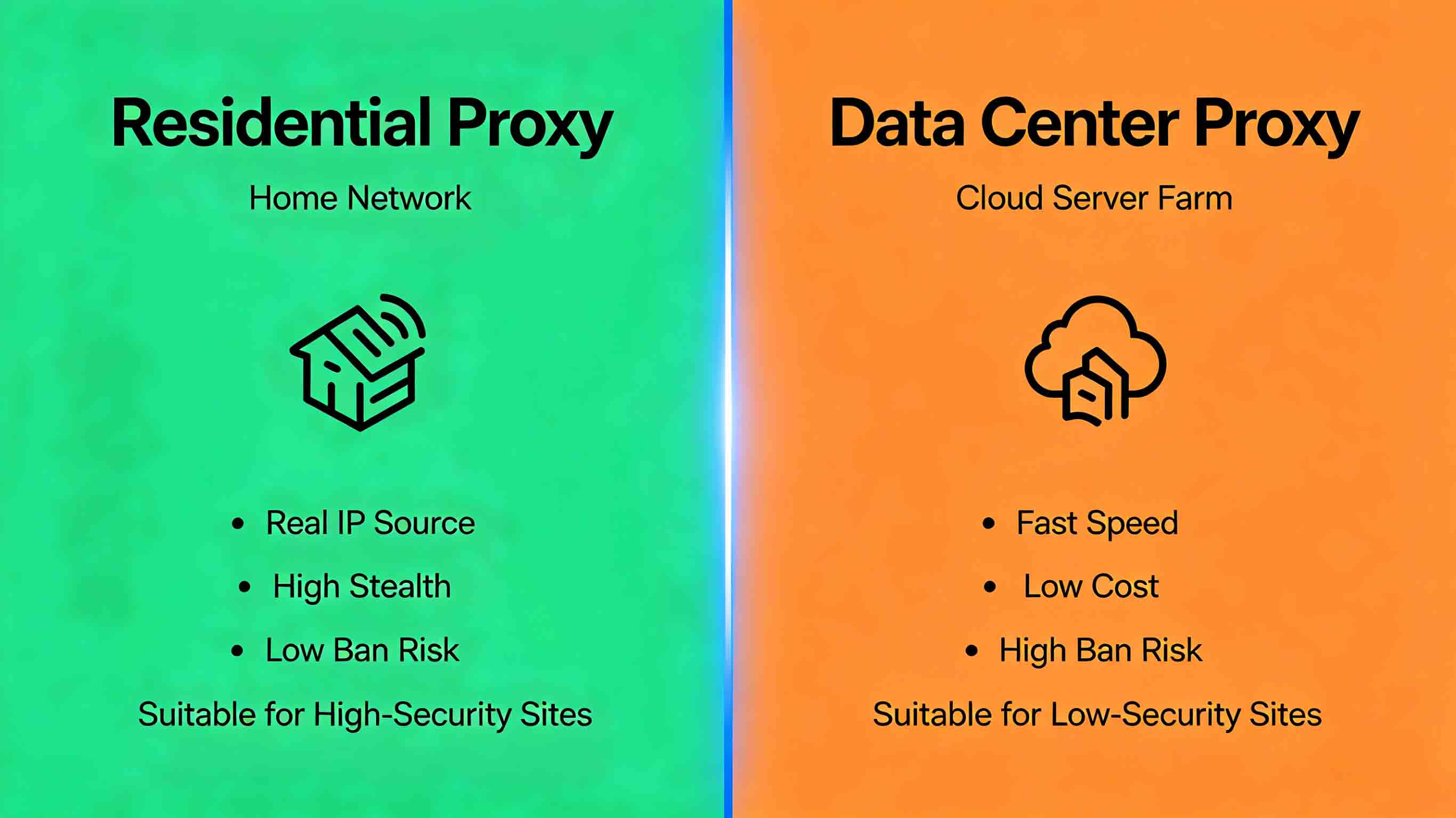
Residential vs data center proxies—how to pick
How to evaluate proxy providers
1. Common Business Scenarios
Before choosing a proxy, figure out which category your business falls into.
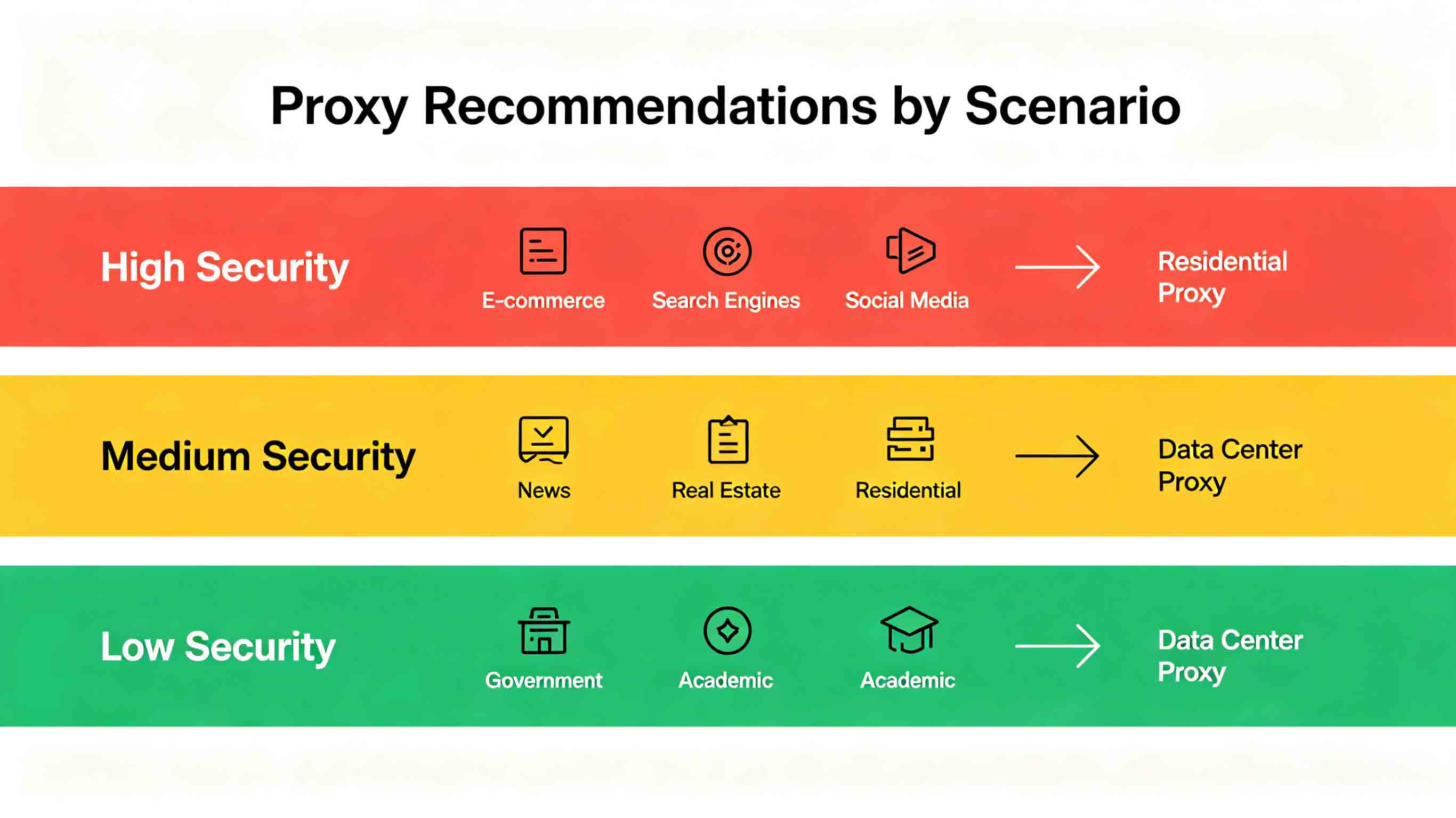
High-Security Sites
These sites have strict anti-bot defenses:
E-commerce: Amazon, eBay, Shopify, Walmart
Search engines: Google, Bing
Social media: Facebook, Instagram, TikTok
Travel sites: Booking, Airbnb, Expedia
Medium-Security Sites
These sites have basic anti-bot measures, but nothing extreme:
News sites: Major news portals
Real estate: Zillow, Realtor
Job boards: LinkedIn, Indeed
Finance sites: Yahoo Finance, MarketWatch
Low-Security Sites
These sites have weak or no anti-bot protections:
Government databases: Public data repositories
Academic research: Journals, paper databases
Public statistics: Census, government open data
Basic content sites: Regular business websites, blogs
Core operations use residential proxies for reliability
Supporting collection uses data center proxies for cost savings
Testing environments use data center proxies to conserve budget
4. Proxy Provider Comparison
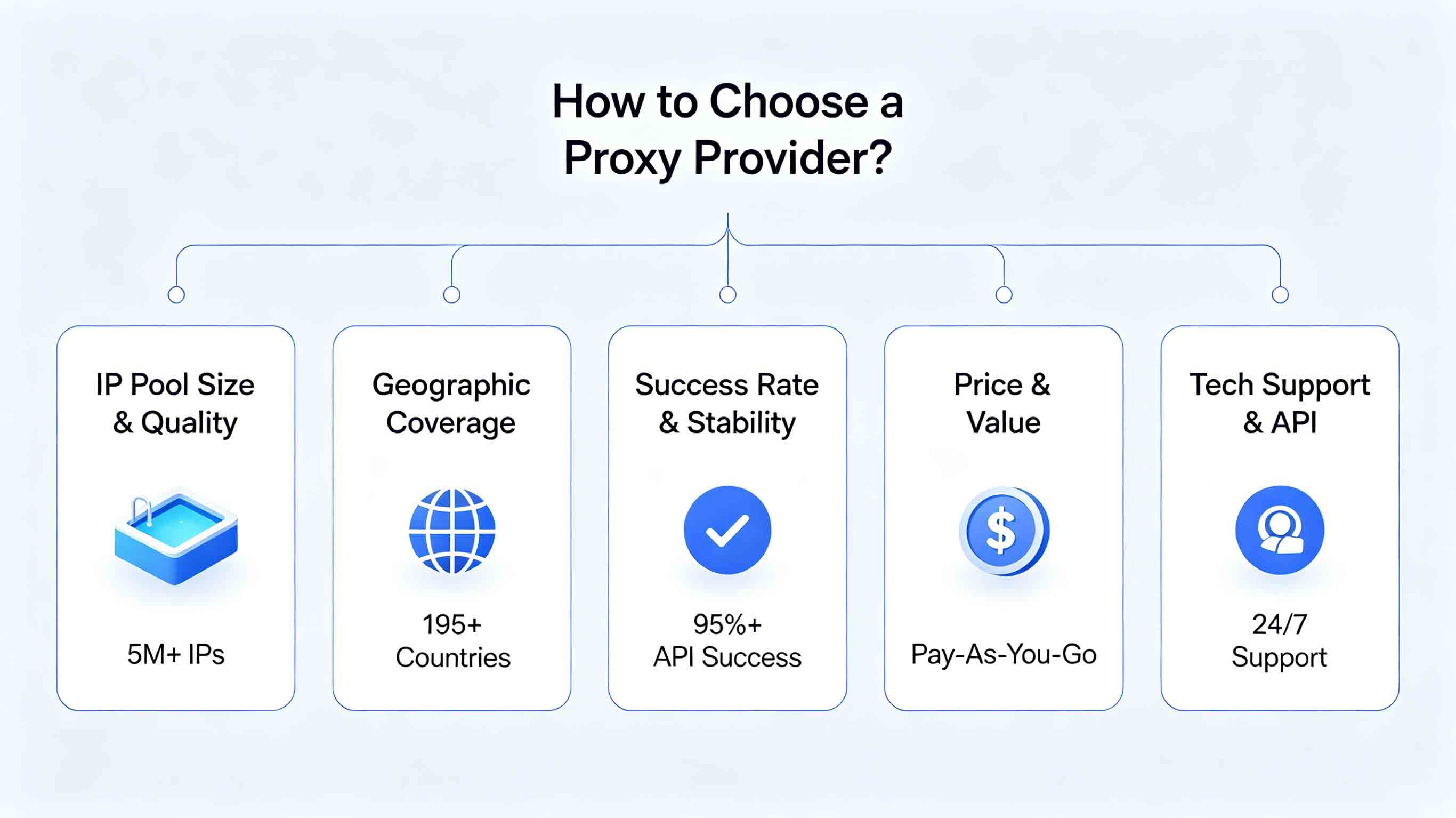
When evaluating proxy providers, focus on these 5 dimensions:
Dimension 1: IP Pool Size and Quality
Pool size: Bigger is better—more rotation options
IP quality: Higher residential proxy ratio is better
IP cleanliness: IPs that have been overused can cause problems
Good standard: 5M+ IPs, 80%+ residential ratio
Dimension 2: Geographic Coverage
Country count: More is better
City coverage: Major cities have more options
ASN diversity: IPs from different carriers add variety
Good standard: 195+ countries, 1000+ cities
Dimension 3: Success Rate and Stability
API success rate: Should be 95%+
Connection stability: No drops, no timeouts
IP availability: 90%+ of purchased IPs should work
Good standard: 95%+ API success rate, 90%+ IP availability
Dimension 4: Price and Value
Billing model: Per GB vs per IP
Minimum spend: Any minimum purchase requirements?
Plan flexibility: Pay-as-you-go available?
Good standard: No minimum, pay-as-you-go, flexible billing
Dimension 5: Tech Support and API
API docs: Complete and clear?
Code examples: Common languages covered?
Support response: 24/7 availability?
Technical help: Dedicated team available?
Good standard: Complete docs, multi-language examples, 24/7 support
5. Quick Reference by Scenario
Scenario
Recommended Proxy
Why
E-commerce scraping
Residential
High stealth, high success rate
Search engine scraping
Residential + rotation
High stealth, avoids bans
Social media scraping
Residential + static IP
Account security, stable login
Travel site scraping
Residential (rotating)
Geolocation, price comparison
Real estate scraping
DC (small) / Residential (large)
Cost vs success rate
Competitor price monitoring
Residential (rotating)
Large-scale, cost-effective
Market research
DC / Residential (budget-based)
Cost-sensitive
SEO analysis
Residential
Geolocation, high stealth
Academic research
Data center
Weak anti-bot, low cost
Financial data
Residential + static IP
Stability, high stealth
Frequently Asked Questions
How much more expensive are residential proxies compared to data center proxies?
The price gap is roughly 2-5x: data center proxies run $2-5/GB while residential proxies run $5-15/GB. But residential proxies have higher success rates and better data completeness, so they often deliver better overall value. Don't just look at price—look at total cost.
Can proxy IPs get banned?
Any IP can get banned. Residential proxies have low ban risk (under 5%), while data center proxies have high ban risk (20-50%). Minimize ban risk by using residential proxies, setting reasonable request rates, using rotation strategies, and picking providers with large pools.
How many IPs do I need?
It depends on collection volume and frequency: small scale (under 1K requests/day) needs 10-50 IPs; medium scale (1K-10K/day) needs 50-200 IPs; large scale (over 10K/day) needs 200+ IPs.
Can I use both residential and data center proxies together?
Absolutely—this is a common approach for experienced users. Use residential proxies for core operations, data center proxies for supporting collection, and data center proxies for testing environments to manage costs.
How do I evaluate proxy providers?
Focus on 5 key points: 1) IP pool size and quality; 2) geographic coverage; 3) success rate and stability; 4) price and value; 5) tech support and API. Always test before you bulk buy.
💡 Check out IPIPD Residential Proxy—195+ countries, 50M+ IPs in the pool, 95%+ API success rate.
7. Summary
Core proxy selection principles:
High-security sites → Residential proxy
Low-security sites + tight budget → Data center proxy