The biggest mistake people make when picking proxies: assuming expensive = better.
ISP proxies cost more than residential proxies, but higher price doesn't mean better fit.
Let's figure out which proxy makes sense for which business.
1. Start With the Core Decision Criteria
Before choosing a proxy, understand this principle:
Different businesses have different proxy needs.
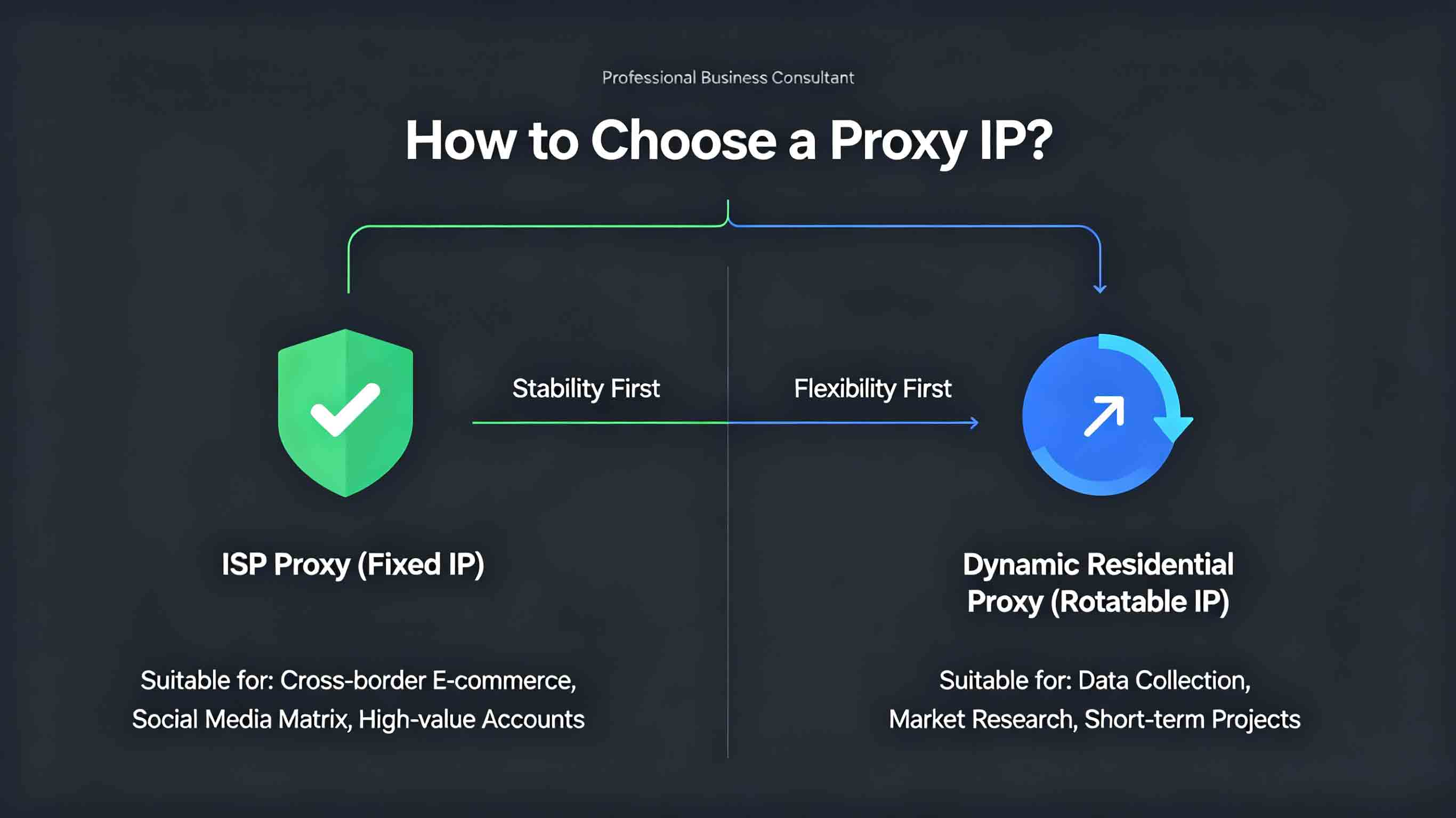
Some businesses need "stability"—one IP, forever. Others need "flexibility"—frequent IP rotation.
Pick the wrong type and you either waste money or hurt your operation.
Decision Framework
Ask yourself: Does my business prioritize stability or flexibility?
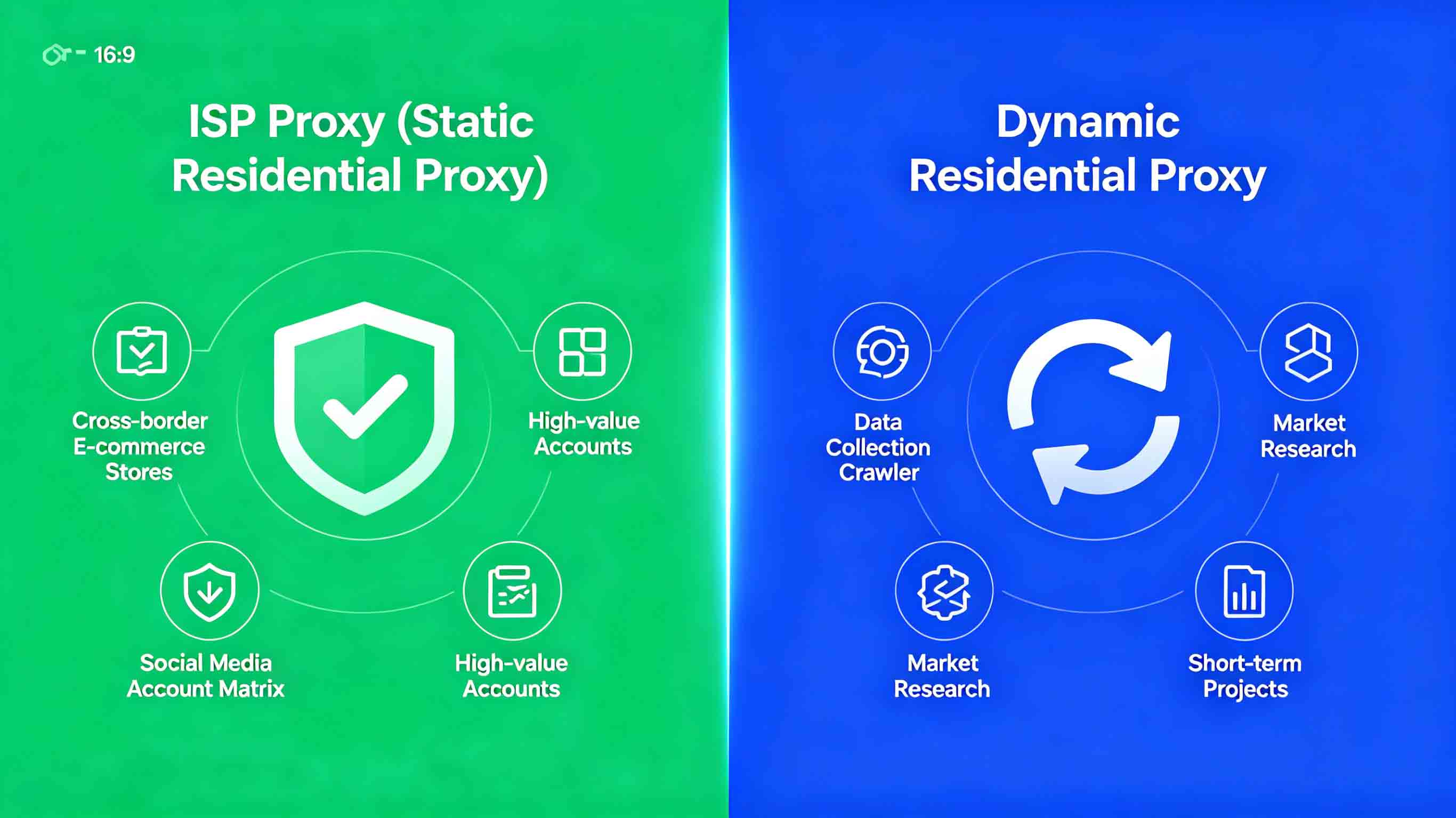
Stability first → ISP proxy (fixed IP)
Flexibility first → Residential proxy (rotating IPs)
2. When ISP Proxies Make Sense
Scenario 1: Multi-Store E-Commerce Operations
Business characteristics:
Running multiple stores across Amazon, eBay, Shopify, WooCommerce
Each store needs an isolated login environment
One link = instant ban, massive losses
Why ISP proxies work better:
Fixed IP keeps store environment stable long-term
Comes from real home networks, harder for platforms to flag
Dedicated IP—no collateral damage from other users
Your account always logs in from the "same household"—risk drops hard
Real case: An Amazon seller running 5 stores switched to ISP proxies and saw survival rate jump from 60% to 95%+. Each store had its own dedicated, fixed residential IP.
Scenario 2: Social Media Account Stacks
Business characteristics:
Managing accounts across TikTok, Instagram, Facebook, Twitter
Each account needs isolated login environment and IP
Ban = total loss of followers and content history
Why ISP proxies work better:
Fixed login IP = safer accounts
Dedicated IP—no sharing, no collateral damage
Long-term stable sessions, zero surprise IP changes
Perfect for high-value accounts that need nurturing and long-term operation
Brands need ongoing monitoring of e-commerce and social platforms for infringement
Need "local user" perspective in target markets to catch issues
Need stable long-term access patterns
Why ISP proxies work better:
Real local IP access surfaces issues platforms show to locals
Fixed IP makes tracking and documentation easier
Won't get flagged as suspicious access
Best for: counterfeit monitoring, trademark infringement, competitor tracking
3. When Residential Proxies Make Sense
Scenario 1: Data Collection & Web Scraping
Business characteristics:
Need high-volume access to target sites for data extraction
One or two IPs can't handle the load
Need coverage across multiple regions
Why residential proxies work better:
Massive IP pool, rotate through thousands as needed
Cost stays manageable (per-IP cost drops)
Better geographic coverage
Best for: e-commerce data, real estate listings, job board scraping
Real applications:
Competitor price and inventory tracking
Real estate site property data
Multi-platform job listing aggregation
Social media sentiment monitoring
Scenario 2: Market Research & Price Monitoring
Business characteristics:
Need frequent access to competitor sites
Pulling publicly available market and pricing data
Need multi-region perspectives
Why residential proxies work better:
Frequent IP rotation avoids anti-scraping blocks
Lower cost supports high-volume IP use
Wide coverage captures region-specific data
Best for: e-commerce price tracking, travel site data, flight monitoring
Real case: An e-commerce operator monitoring 200 competitor products uses dynamic residential proxies rotating hourly—gets real-time data without getting blocked.
Scenario 3: Short-Term Projects & Testing
Business characteristics:
Temporary use only, no long-term fixed IP needed
Short project cycle—maybe days or weeks
Need to validate an idea quickly
Why residential proxies work better:
Buy as needed, scale up or down on the fly
Lower cost fits short-term budgets
Easy testing—switch if not satisfied
Best for: promo monitoring, new market testing, product research
Scenario 4: Social Media Automation
Business characteristics:
Batch following, liking, commenting, posting
Need different IPs to avoid platform limits
Usually auxiliary work, doesn't need long-term stability
Why residential proxies work better:
IP rotation reduces detection risk
Cost-effective for bulk automation
High flexibility adapts to platform policy shifts
Best for: social media marketing, content promotion, account warm-up
Scenario 5: SEO Monitoring & Analysis
Business characteristics:
Check search results from different regions
Monitor keyword ranking changes
Analyze competitor SEO strategies
Why residential proxies work better:
Simulate search results from different locations
IP rotation avoids search engine throttling
Cost-effective for ongoing monitoring tasks
Best for: Google rank tracking, competitor analysis, SERP analysis
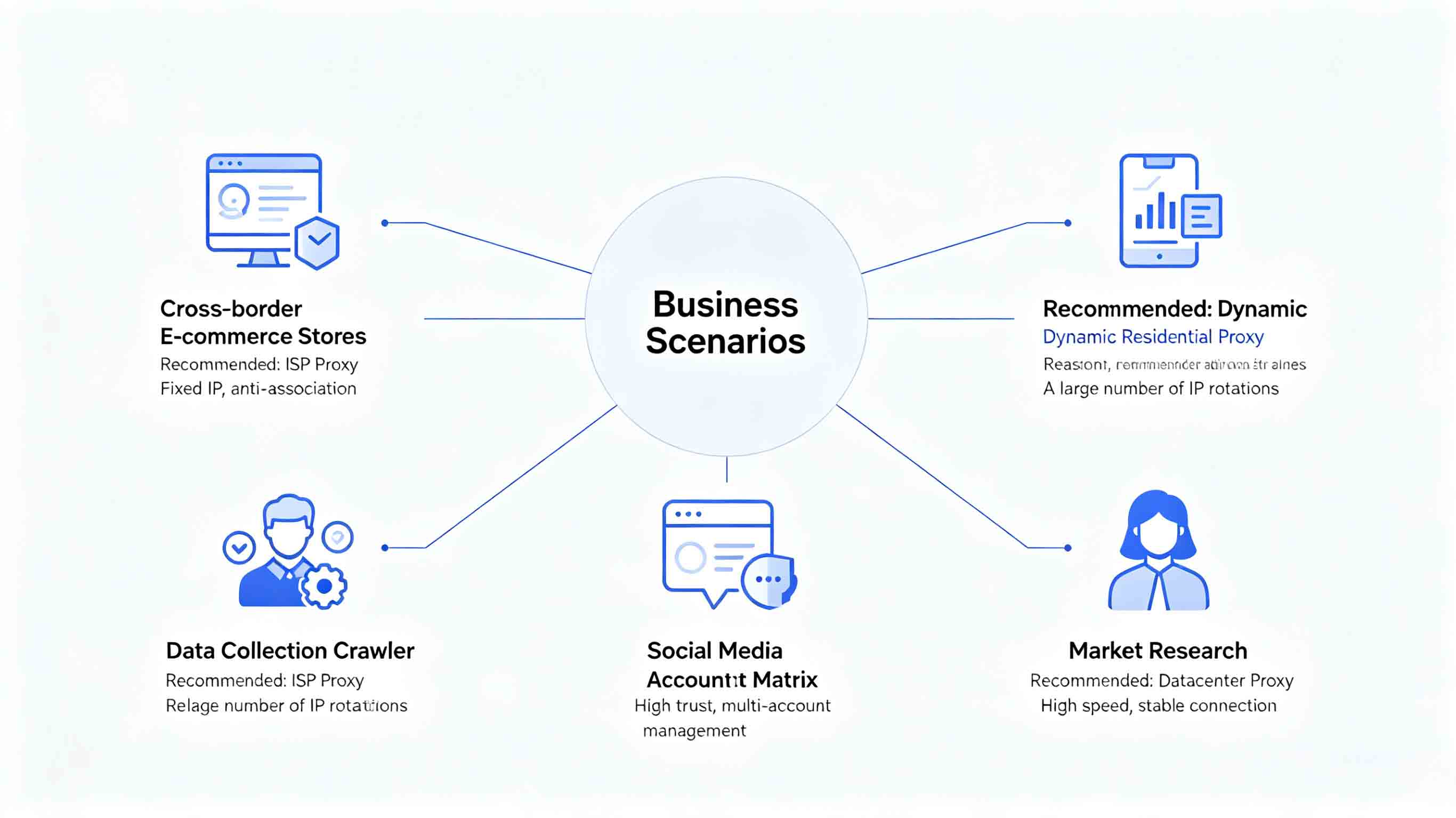
4. Quick Reference: Business Scenarios Matched to Proxy Types
Business Scenario
Recommended Proxy
Core Reason
Multi-store e-commerce
ISP / Static residential
Fixed IP, long-term stability
Social media account stacks
ISP / Static residential
Fixed login environment, prevent linking
High-value account registration
ISP / Static residential
Dedicated, secure, stable
Ad campaign verification
ISP / Static residential
Fixed regional IP, long-term tracking
Brand protection monitoring
ISP / Static residential
Stable long-term access
Data scraping
Dynamic residential
Mass IP rotation, cost control
Market research monitoring
Dynamic residential
Frequent switching avoids blocks
Short-term project testing
Dynamic residential
Flexible switching, lower cost
Social media automation
Dynamic residential
IP rotation lowers risk
SEO monitoring
Dynamic residential
Simulate multi-region users
5. How to Choose? Two Rules to Remember
Rule 1: Look at Business Priority
Stability first → ISP proxy (but higher cost)
Requirements:
Need long-term fixed IP
Account value is high, can't risk it
Business has zero tolerance for IP changes
Flexibility first → Residential proxy (better value)
Requirements:
Need mass IP rotation
Business can handle IP changes
Cost control matters
Rule 2: Look at Account Value
Simple formula:
Account Value × Association Risk > Proxy Cost → ISP proxy
Account Value × Association Risk < Proxy Cost → Residential proxy
Examples:
Amazon seller account (worth $100k), association risk = extreme
IPIPD offers static residential proxies and dynamic residential proxies, covering most business scenarios.
If you need "stability"
Choose static residential proxy:
Fixed IP from real residential networks
Equivalent characteristics to ISP proxies
Best for: cross-border e-commerce, social accounts, high-value profiles
Lower cost than traditional ISP proxies
If you need "flexibility"
Choose dynamic residential proxy:
Rotating IPs, massive pool
Best for: data collection, market research, short-term projects
Lower cost, higher flexibility
What both share
Real residential network origins
High stealth profile
Cover your business needs
Frequently Asked Questions
Which businesses should use ISP proxies?
Multi-store e-commerce operations, social media account stacks, high-value account registration and maintenance, ad campaign verification, and brand protection monitoring—businesses that need long-term fixed IPs and stable login environments benefit most from ISP proxies.
Which businesses should use residential proxies?
Data scraping, market research and price monitoring, short-term project testing, social media automation, and SEO monitoring—businesses that need mass IP rotation or flexible switching benefit most from residential proxies.
Can residential proxies work for cross-border e-commerce?
Yes. IPIPD's static residential proxies provide fixed IPs that meet multi-store e-commerce operational needs while costing less than traditional ISP proxies.
How do I decide which proxy type I need?
Look at two dimensions: 1) Stability priority vs flexibility priority; 2) Account value level. Stability priority + high account value → ISP proxy; Flexibility priority or cost control → residential proxy.
Can I use both proxy types together?
Yes. Use ISP proxies to manage high-value accounts and dynamic residential proxies for data collection and market research—protecting core operations while controlling costs.
8. Summary
Dimension
ISP Proxy (Static Residential)
Dynamic Residential Proxy
Core trait
Fixed
Rotating
Stability
Excellent
Moderate
Flexibility
Lower
Higher
Price
Higher
Mid-range
Best for
Long-term stability, high-value accounts
Mass rotation, flexible needs
Decision criteria
Stability priority + high account value
Flexibility priority + cost control
Remember: there's no universally "best" proxy—only the best proxy for your specific business.
Clarify your needs first, then choose the matching product. That's the smart approach.