When choosing a proxy, have you ever纠结过 this question: residential proxy or mobile proxy, which one should I choose?
The internet is full of conflicting opinions—some say "mobile proxy is the strongest," others claim "residential proxy offers better value." But the truth is: there's no absolute "which is better," only which is more suitable for your project.
Quick Answer
Comparison pages should explain the business boundary clearly and avoid presenting adjacent proxy types as IPIPD offerings.
Basic Facts Table
Item
Practical Meaning
Business Check
Proxy behavior
Static residential addresses provide continuity; dynamic residential addresses provide distributed coverage.
Choose by workflow, not by proxy label alone.
Best fit
Stable sessions, public data checks, regional review, or evidence collection depending on the task.
Define session length, target region, and success condition before scaling.
Absolutely. Many projects use residential proxy for research and testing, mobile proxy for critical operations. This combination optimizes both cost and results.
Can residential proxy be used for social media?
Yes, but the success rate is lower than mobile proxy. If social media accounts are high-value business assets, mobile proxy is recommended. For regular accounts or testing, residential proxy can also work.
Which proxy is better for beginners?
If you're new to proxies, start with residential proxy. Lower cost allows learning while using. Consider upgrading to mobile proxy once project needs are clear.
Does proxy speed matter?
Sources
Proxy comparison analysis based on aggregated user reports (2024-2026)
Platform detection level classification from industry benchmarks
Review logs, screenshots, status codes, and completed workflow cost.
IPIPD boundary
Static residential addresses and dynamic residential addresses
Adjacent proxy types are comparison context, not IPIPD product claims.
Source / Evidence Note
This update uses the article's original content, IPIPD's current static and dynamic residential address product scope, and Google Search Console page data. Proxy performance varies by target website, region, session duration, browser profile, request pacing, and compliance requirements, so the page avoids fixed success-rate claims.
Data Anchor
Google Search Console snapshot before this combined CTR and GEO update: 0 clicks, 501 impressions, CTR 0.0%, average position 72.19. Review again after 7 and 14 days for impressions, clicks, CTR, average position, Google indexing status, and AI answer mentions.
This article helps you think clearly. You'll understand the real differences between both proxy types and know when to choose which.
How They Work: The Basics
Residential Proxy
Residential proxy IPs come from real home networks. When you use residential proxy, your requests route through real users' home networks, who have agreed to share their bandwidth.
Key features:
IP addresses come from Internet Service Providers (ISP)
Looks like ordinary home users browsing
Can be fixed (static) or auto-rotating
Lower cost than mobile proxy
Mobile Proxy
Mobile proxy IPs come from real mobile devices. When you use mobile proxy, your requests route through 4G or 5G cellular networks.
Key features:
IP addresses come from mobile carriers
Looks like mobile users browsing
Auto-rotating, hard to track
Better detection resistance
Higher cost than residential proxy
Head-to-Head: Seven Key Dimensions
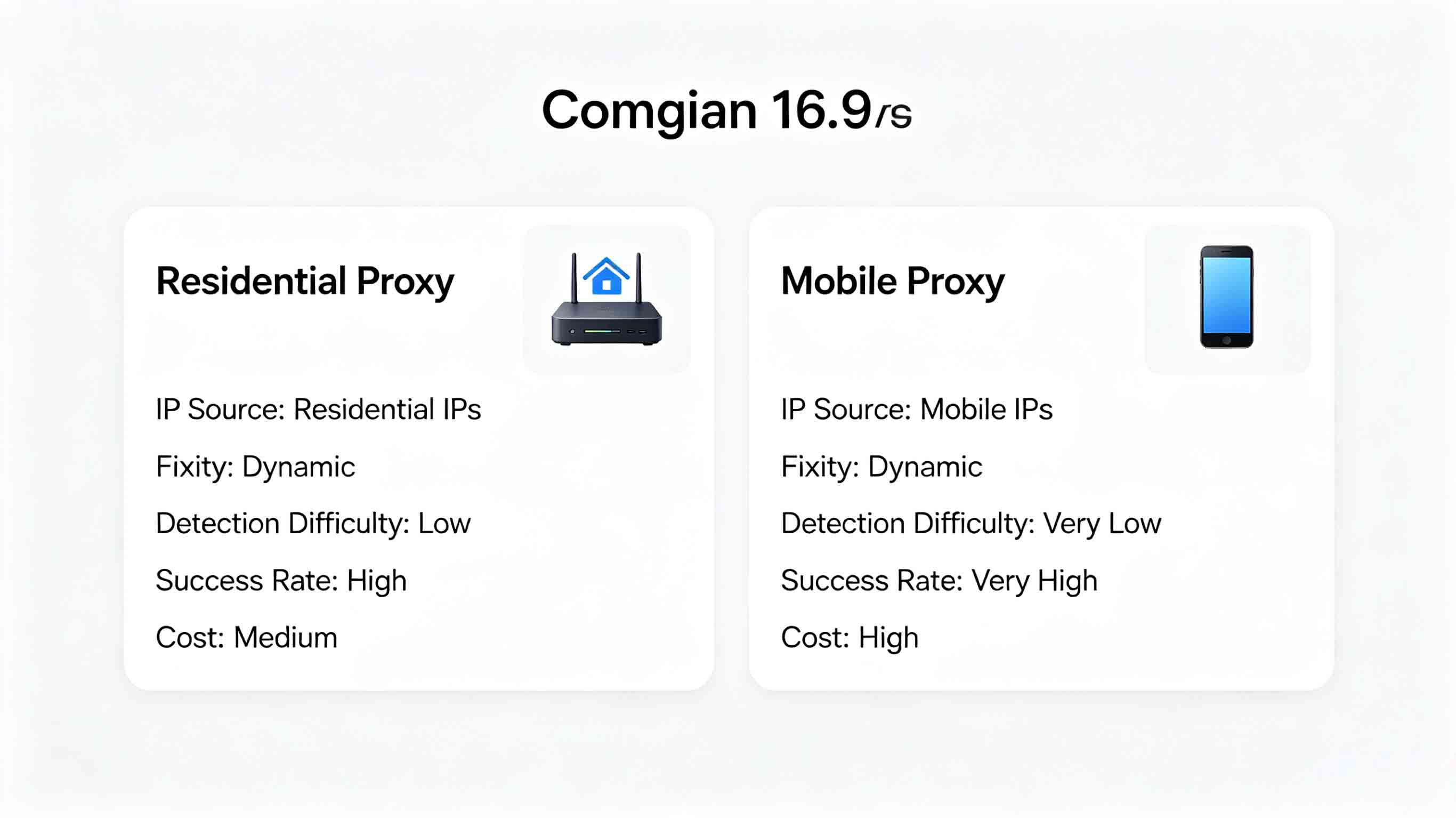
Dimension
Residential Proxy
Mobile Proxy
IP Source
Home network
Mobile 4G/5G
Stability
Static or rotating option
Auto-rotating
Detection Difficulty
Medium
Higher
Success Rate
40-70%
80-95%
Cost
Medium
Higher
Geographic Coverage
Wide
Medium
Best For
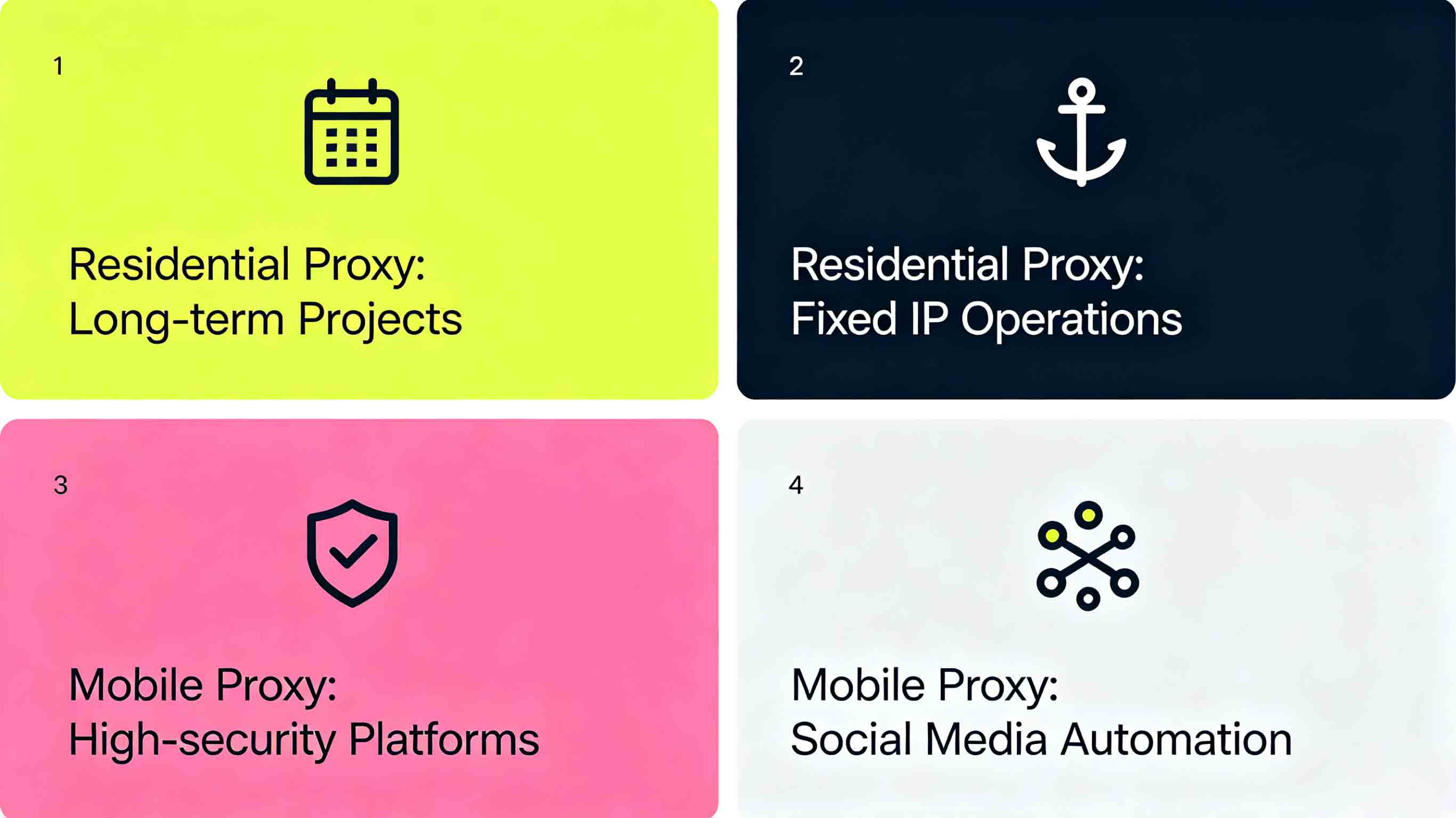
Long-term projects, fixed IP
High-security platforms
When to Choose Which
Choose Residential Proxy When...
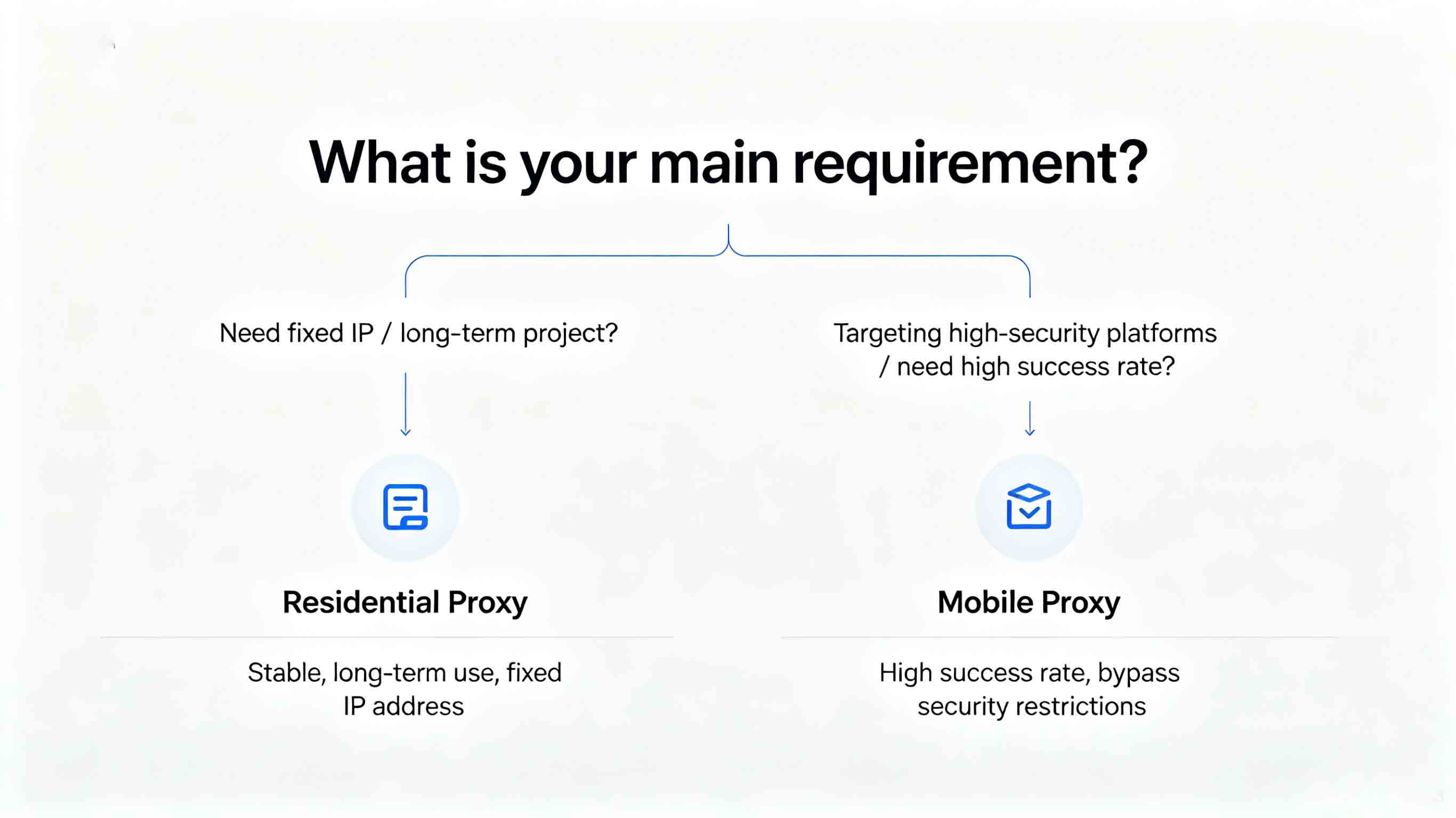
1. You need fixed IPs for account operations
Residential static IP can maintain the same IP address long-term, perfect for account management requiring stable login environments.
2. Your project runs for months
Long-term projects need stable proxy service. Residential proxy's cost-effectiveness makes it more suitable for continuous use.
3. Your target platform has low-medium security
For government data sites, news portals, job boards, etc., residential proxy is perfectly sufficient.
4. You have limited budget but need real IPs
Residential proxy is 30-50% cheaper than mobile proxy, suitable for budget-conscious projects requiring real user IPs.
Choose Mobile Proxy When...
1. Your target is Instagram, TikTok, or other high-security platforms
These platforms have very advanced detection systems. Mobile proxy's high concealment is essential.
2. You're managing high-value business accounts
Account bans mean business losses. Mobile proxy's success rate is more trustworthy.
3. Maximum success rate is critical
If project success rate is the key metric, mobile proxy is the more reliable choice.
4. You need social media automation
Social platforms have the highest proxy requirements. Mobile proxy is the industry standard.
Cost Comparison: Real Numbers
Residential Proxy
Standard price: $5-10 per GB
Static IP price: $5-15 per IP per month
Best for: Long-term, continuous, high-volume projects
Mobile Proxy
Standard price: $8-15 per GB
Usually has minimum consumption requirements
Best for: High-value, short-term, success-rate-critical projects
Real Example
Suppose you need to complete a data collection project:
Solution
Traffic
Success Rate
Estimated Cost
Residential Proxy
100GB
60%
$500-1,000
Mobile Proxy
60GB (to achieve same results)
90%
$480-900
Conclusion: For this case, both solutions have similar costs, but mobile proxy is more efficient.
Common Misconceptions
Misconception 1: More expensive means better
Mobile proxy costs more, but that doesn't mean it's suitable for all projects. For medium/low-security platforms, residential proxy is the more rational choice.
Misconception 2: Residential proxy is easy to detect
Residential proxy comes from real home networks. It's actually harder to detect than datacenter proxy. It's just not as good as mobile proxy on high-security platforms.
Misconception 3: You must choose one
Many professional projects use both proxy types. Use residential for routine tasks, mobile for critical operations.
Conclusion: Choose Right, Not Expensive
Residential and mobile proxy each have their advantages:
The smart approach: After understanding the differences, choose based on actual needs. In many cases, residential static IP offers the best value.
It matters, but it's not the top priority. Compared to speed, success rate and stability are more important. A fast but frequently blocked proxy is worse than a slightly slower but stable one.