Quick Answer: Set the Retry Budget Before You Scale
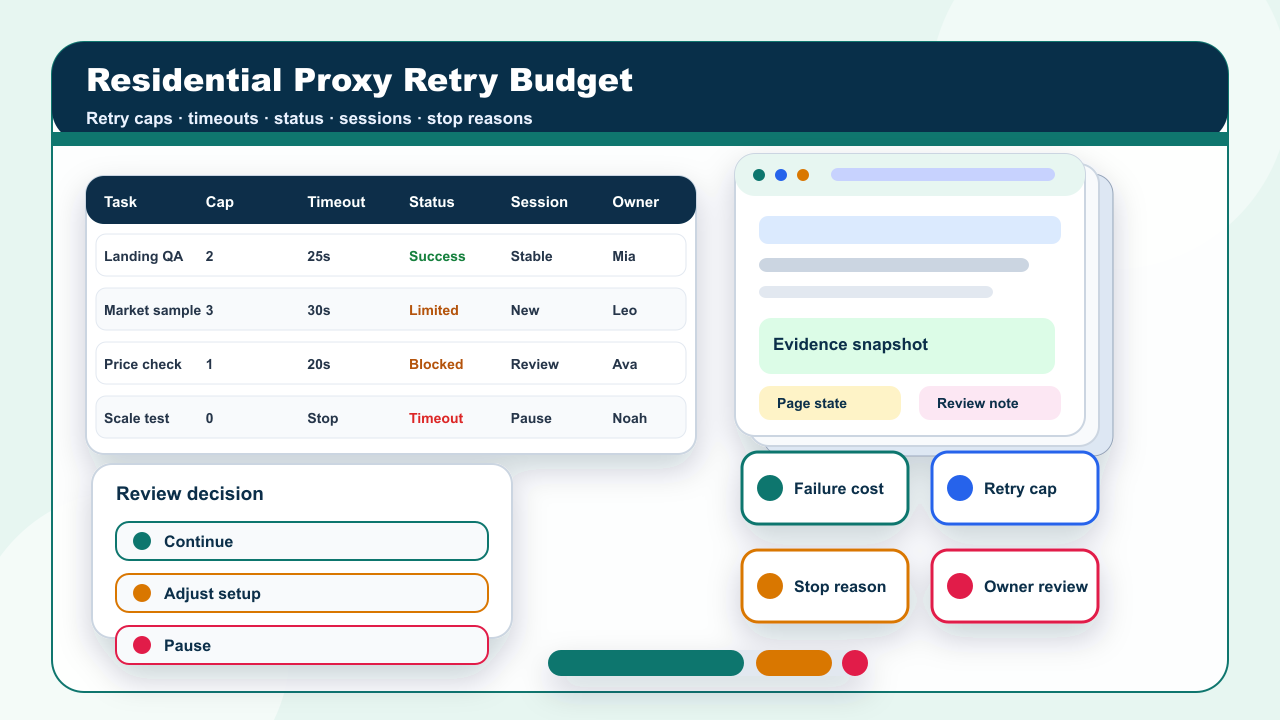
A residential proxy retry budget is the rule that says how many attempts a workflow can spend before the team stops, reviews evidence, or changes the setup. It should name the task, target page, address mode, timeout cap, status-code cap, session failure cap, manual review owner, and stop reason before traffic is scaled.
For IPIPD content, the boundary is simple. Static residential addresses fit repeat checks where a stable network identity matters. Dynamic residential addresses fit controlled sampling where separate attempts, regions, or page states need labels. A retry budget keeps those two modes from being judged with the same assumptions.
Basic Facts: What a Retry Budget Controls
Budget item
Default cap
Risk if missing
Review owner
Timeout retry
Usually a small fixed cap before manual review.
Silent timeouts can consume volume without adding evidence.
Operations owner
Status-code retry
Separate caps for rate limit, forbidden, server error, and not found states.
One error type can be hidden inside a blended success rate.
QA reviewer
Session retry
Limited attempts after cookie, login, or browser-state checks.
Teams may rotate addresses when the session is the real problem.
Workflow owner
Scale decision
Continue, adjust, or pause after the first reviewed sample.
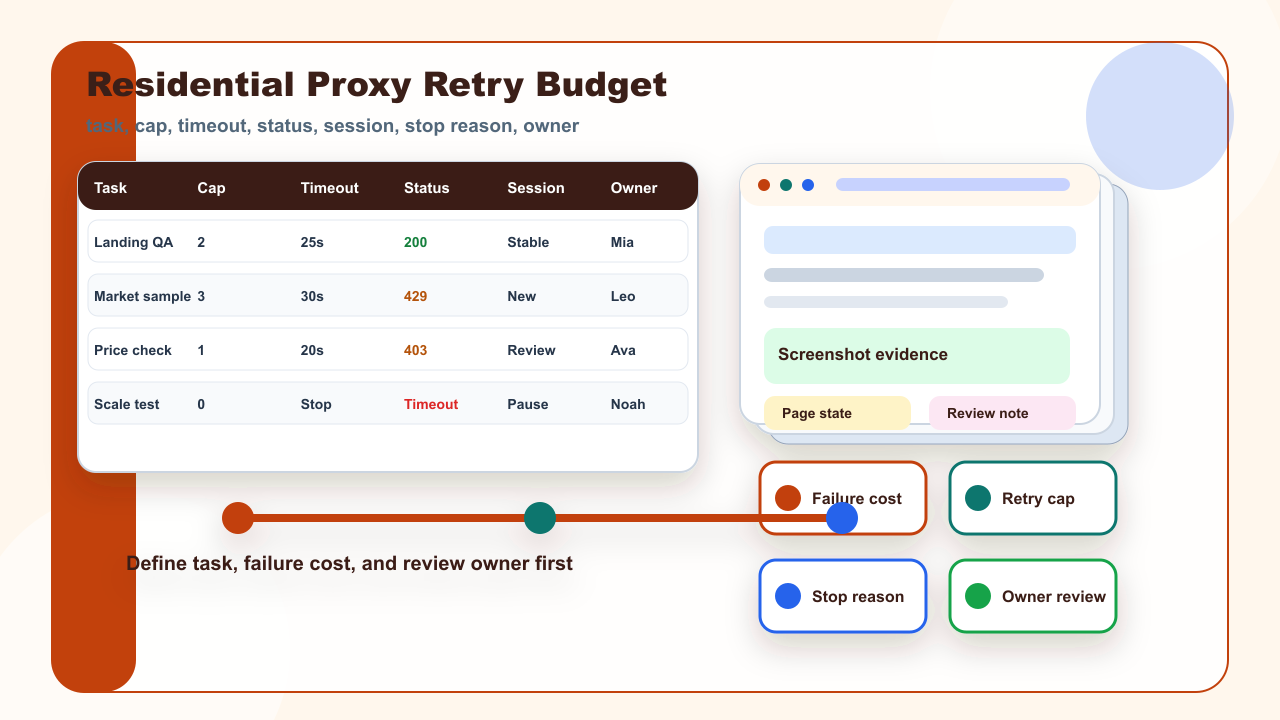
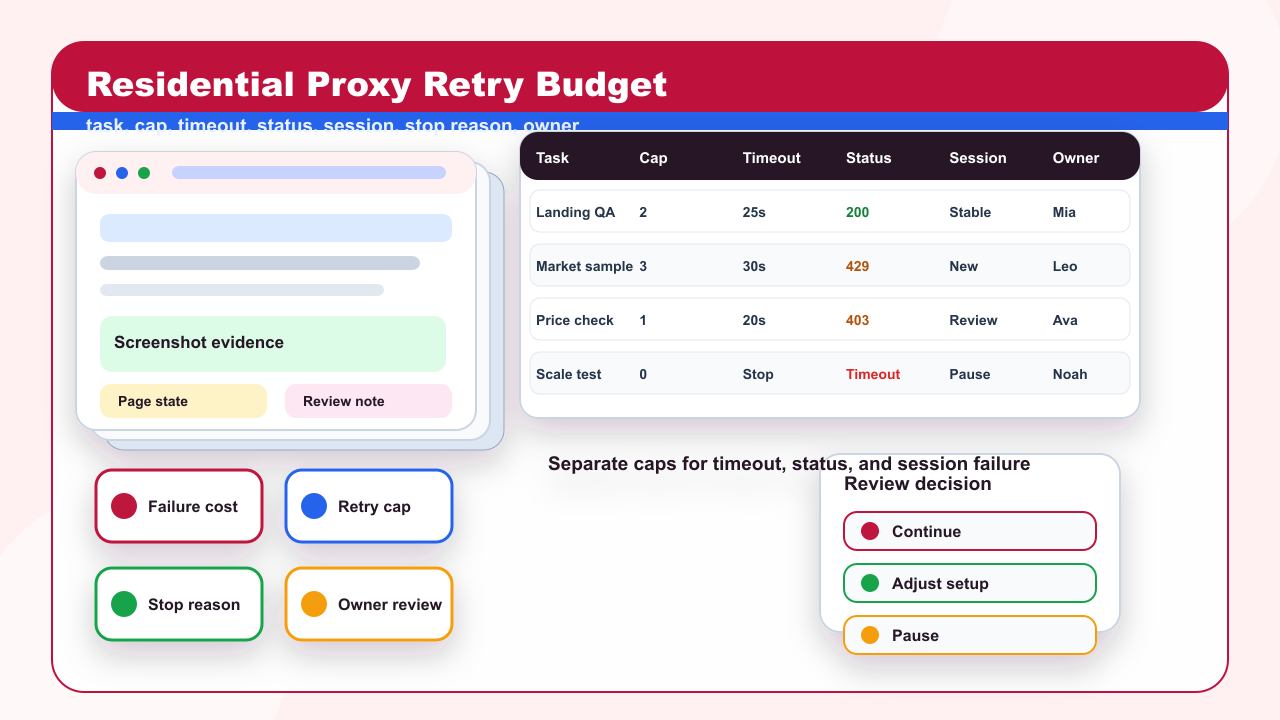
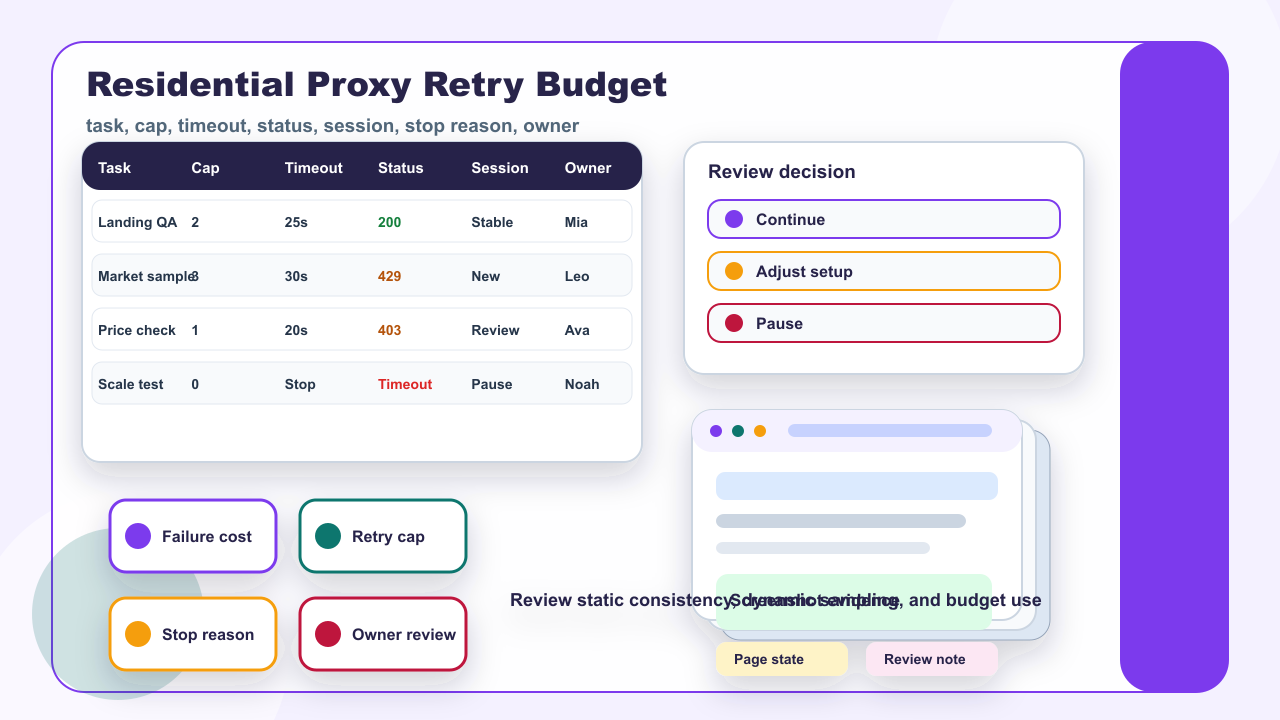
The first retry-budget step records task scope, failure cost, target page evidence, and owner review.Timeout, status-code, and session failures need separate caps before more attempts run.Static consistency, dynamic sampling, cost notes, and scale-or-pause decisions should be reviewed together.
Frequently Asked Questions
What is a residential proxy retry budget?
It is a written cap for timeout, status-code, and session retries, plus the stop reason and review owner that must be checked before a workflow scales.
Should every failed request be retried?
No. A failed request should first be classified by task, region, address mode, status, session state, and evidence quality. Some failures should stop the workflow instead of triggering another attempt.
How do static residential addresses affect retries?
Static residential addresses are useful when repeatability matters, so the retry budget should protect consistency and avoid changing identity before setup or session evidence is reviewed.
How do dynamic residential addresses affect retries?
More traffic can magnify a weak setup.
Project lead
The budget does not need to be complicated. It needs to be visible before the task starts. If the team only decides after a failure happens, the retry rule becomes emotional and inconsistent. A written cap makes the next action easier to defend.
Step 1: Define the Task and Failure Cost
Start with the task rather than the endpoint. A retry budget for a local price check is different from a retry budget for a weekly landing-page QA review. The first task may need more market samples, while the second may need stability and repeatability. The log should state which decision the retries are supposed to support.
The failure cost is the next field. Some failures are cheap because they happen before the workflow reaches a meaningful page state. Other failures are expensive because they consume manual review time, produce unclear screenshots, or trigger repeated target-page checks. The retry cap should be lower when the failure cost is high.
Teams should also define what evidence makes a retry worthwhile. A timeout with no page state, no screenshot, and no region label may not justify another automatic attempt. A regional mismatch with clear evidence may justify one controlled retry. A session error may require a browser or credential check before any new address is used.
For static residential address workflows, the cost of changing identity is higher because the value often comes from consistency. For dynamic residential address workflows, the cost may be lower per attempt, but the sample can still become noisy if every failure is retried without a reason.
Step 2: Set Caps for Timeout, Status, and Session Failures
A useful retry budget separates failure classes. Timeout retries, status-code retries, and session retries should not share one blended number. A timeout might be related to network path, target response time, or pacing. A status code may point to rate limit, forbidden state, server error, or a changed URL. A session failure may have nothing to do with the address.
Timeout caps should be conservative. If two or three attempts produce the same empty evidence, the next action is usually review rather than more volume. Status-code caps should be tied to the status family. A public HTTP reference can help teams describe the code consistently, but the local business context still decides whether to stop.
Session failures need an even stricter rule. If a login, cookie, browser profile, or whitelist assumption is wrong, rotating through more residential addresses only hides the original configuration problem. The retry budget should require a session check before the workflow spends more attempts.
The stop reason should be plain language: timeout repeated, region mismatch, session expired, rate limit suspected, target page changed, or manual review needed. This wording is more useful than a raw retry number because it tells the next person what to inspect.
Step 3: Review Static or Dynamic Address Fit Before Buying More Volume
Before buying more volume or increasing task frequency, review whether the selected address mode matches the decision. Static residential addresses are better when the same page needs a stable identity across repeated checks. Dynamic residential addresses are better when the task needs labeled sampling across attempts or regions. A high retry rate can mean the mode is wrong, not that the volume is too small.
The review should compare usable rows and rejected rows. Usable rows must match the task, region, session assumption, screenshot evidence, and expected result. Rejected rows should carry a reason. If most rejected rows are caused by one setting, such as session drift or region mismatch, changing that setting is better than adding more attempts.
Budget notes should be qualitative, not a price promise. Write whether retries are low, acceptable, high, or blocking. Write whether manual review is manageable or too heavy. The goal is to prevent a workflow from scaling just because the first sample produced a few successful rows.
The final decision should be one of three actions: continue with the same cap, adjust the setup and retest, or pause until evidence is cleaner. This is where the retry budget becomes a management tool rather than a technical counter.
Quick reference: Retry Budget Fields
Field group
What to record
Decision use
Task scope
Workflow name, target URL, market, page state, and owner.
Prevents retry rules from mixing unrelated tasks.
Address mode
Static or dynamic mode, region rule, endpoint group, and authentication method.
Shows whether consistency or sampling is the goal.
Retry cap
Timeout cap, status-code cap, session cap, and manual review trigger.
Stops automatic attempts before they create noise.
Review result
Usable row count, rejected reason, screenshot state, budget note, and next action.
Turns retry data into a continue, adjust, or pause decision.
Keep the budget close to the workflow record. If it is stored only in a separate planning note, the person running the task may not see it when failures start. A visible cap prevents accidental over-retry and makes later review much easier.
Evidence note: this article uses public HTTP terminology, IPIPD static and dynamic residential address guidance, and operational review rules. It does not promise access, ranking, scraping success, account safety, or target-site acceptance.
FAQ
What is a residential proxy retry budget?
It is a written cap for timeout, status-code, and session retries, plus the stop reason and review owner that must be checked before a workflow scales.
Should every failed request be retried?
No. A failed request should first be classified by task, region, address mode, status, session state, and evidence quality. Some failures should stop the workflow instead of triggering another attempt.
How do static residential addresses affect retries?
Static residential addresses are useful when repeatability matters, so the retry budget should protect consistency and avoid changing identity before setup or session evidence is reviewed.
How do dynamic residential addresses affect retries?
Dynamic residential addresses can support controlled sampling, but each retry still needs a reason, region label, and stop rule so the sample does not become noisy.
Dynamic residential addresses can support controlled sampling, but each retry still needs a reason, region label, and stop rule so the sample does not become noisy.