Residential Proxy Cache Validation: How to Avoid False Results
Quick Answer: Validate Cache Before Changing Address Mode
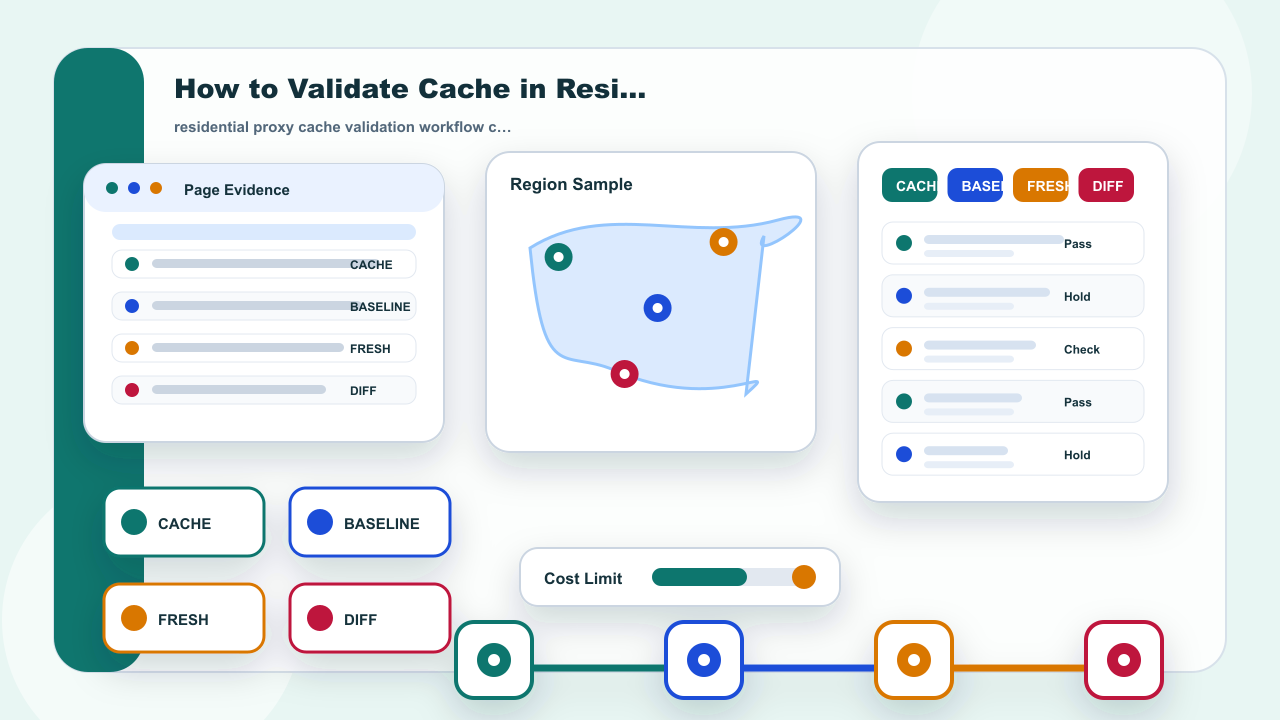
Cache disagreements are easiest to diagnose as a matched page pair. Start with the ordinary URL, then capture one cache-bust request in the same review window while the target path, region, browser profile, and residential address mode remain unchanged. The comparison is useful only when it identifies a visible difference that another reviewer can confirm.
In Quick Answer: Validate Cache Before Changing Address Mode, the field Page pair has a page-specific requirement: Ordinary URL and one cache-bust URL captured within the same review window. It should point to the same page attempt, time, region, and owner instead of using a vague label such as normal, failed, or handled.
The product boundary remains narrow. IPIPD content can explain static residential addresses and dynamic residential addresses, and it can mention adjacent proxy terms only as comparison or exclusion context. The article should not turn mobile, datacenter, VPN, SERP API, ISP, or backconnect concepts into IPIPD offerings.
A practical review starts with four questions: what task is being tested, which variable changed, whether the evidence can be reproduced, and who approved the next action. Applying those questions to residential proxy cache validation workflow keeps the decision smaller and easier to verify.
Review Stable variables beside it: Same target path, region, browser profile, and address mode. If those fields cannot form a reproducible evidence chain, reduce the sample or wait for review. Do not use the row to support scaling, an address-mode switch, or a buying decision.
Basic Facts: Cache Validation Evidence
| Field | What to record |
|---|---|
| Page pair | Ordinary URL and one cache-bust URL captured within the same review window. |
| Stable variables | Same target path, region, browser profile, and address mode. |