Fast Proxy or Fast Connection? How to Measure the Difference

Fast Proxy or Fast Connection? How to Measure the Difference
A fast proxy is not a universal product category, and the word “fast” is not proof of performance. A proxy is fast enough only when it meets a defined task threshold under repeatable conditions. That judgment should consider connection time, time to first byte, transfer rate, total time, errors, and consistency across several runs.
A single low number cannot establish that a proxy will perform the same way for another website, payload, device, network, or time of day. Measure the exact task you plan to run, compare it with a direct-connection baseline where that comparison is authorized, and keep the target, payload, client, and test window unchanged.
Start with the answer: a fast proxy is not a fixed product label
“Fast proxy” usually describes an observed result, not a technical class. One connection may open a small public page quickly but take much longer to download a large file. Another may connect promptly while waiting on a slow target server. A useful definition therefore needs a task, a test method, and an acceptance line.
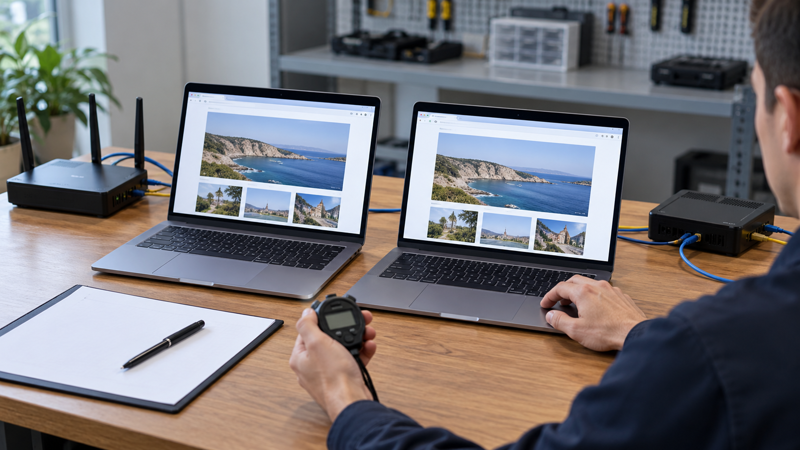
Write the task before testing: the exact public URL or authorized endpoint, expected response type, payload size, client, test location, and maximum acceptable wait. If those conditions change between runs, the result no longer isolates the proxy.
IPIPD currently offers static IP and VPS products. This article does not classify either one as residential, ISP, datacenter, or any other network category, and it does not infer supported protocols, locations, bandwidth, or performance. VPS is a server product, not a proxy type. Confirm current product details through current documentation or a qualified business contact before any configuration or purchase decision.
Measure the request in separate stages
The total duration hides several different stages. Separating them makes the result useful:
| Field | What it observes | What it cannot prove alone |
|---|---|---|
| Connection time |
Frequently Asked Questions
Does fast proxy mean the same thing for every website?
No. Target processing, payload size, route, client, local network, and time window all affect the observation. A result applies only to the defined test conditions.
Which metric should I check first when a proxy feels slow?
Start by separating connection time, time to first byte, and transfer time. That split shows whether to investigate connection setup, target response, or payload delivery first.
Does IPIPD guarantee proxy speed?
No performance guarantee is made in this article. Test the current static IP or VPS offer against your own authorized task and confirmed service terms.