Are Proxy Servers Illegal? Why Purpose and Permission Matter
Why Proxy Servers Are Illegal Is the Wrong Question
People asking “are proxy servers illegal” need to look beyond the tool name. A proxy server is a networking tool, and the useful questions are who is using it, for what purpose, with whose permission, against which system or content, and under which local rules.
Ordinary business uses may include authorized access to an organization's own systems, regional checks of public pages, or a stable network context for internal quality testing. By contrast, unauthorized access, control bypass, account abuse, privacy violations, and unlawful data handling remain risky activities even when a proxy is involved.
This article provides a general screening framework rather than legal advice. When the applicable rules are uncertain, pause the task and seek qualified legal, privacy, or information-security guidance.
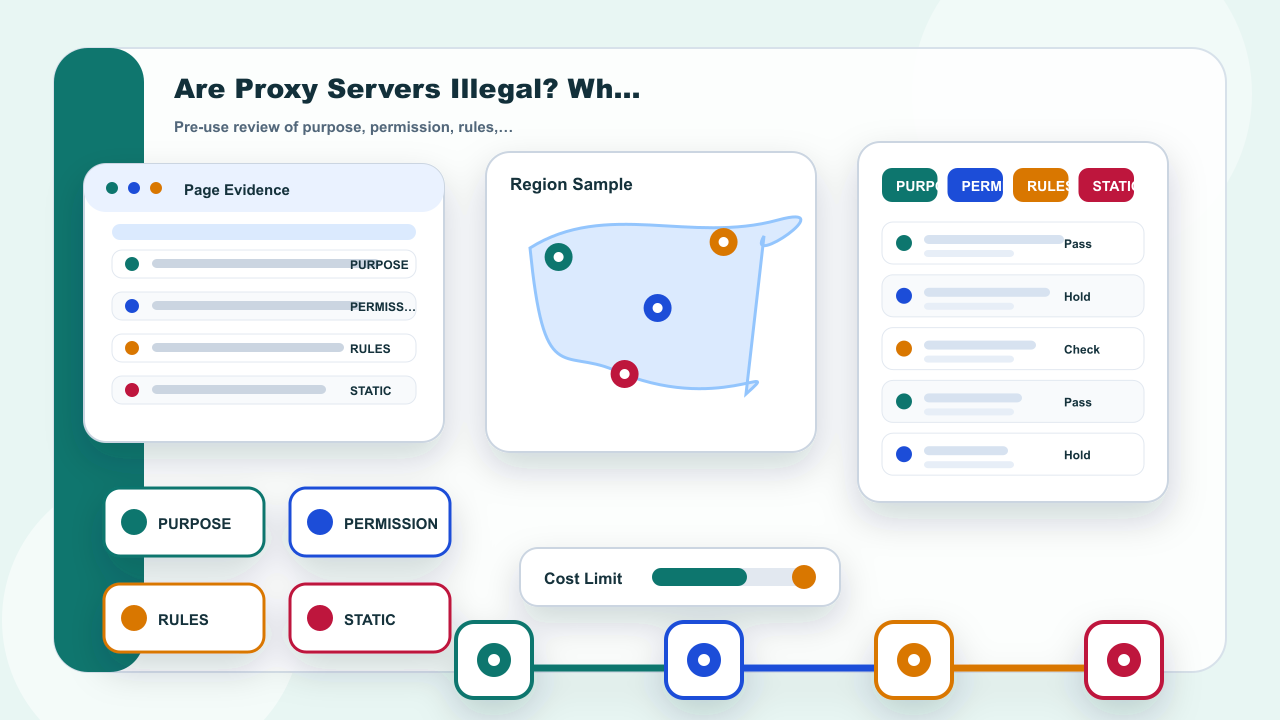
Four Questions to Check Before Using a Proxy
| Field | What to record |
|---|---|
| Risk and purpose | Describe the exact business task and the data or page involved. |
| Permission check | Confirm that the operator is authorized to access, test, or collect the material. |
| Rule boundary | Review the website terms, robots guidance where relevant, account rules, and technical limits. |
| Legal boundary | Check the laws that apply to the operator, data subjects, systems, and destination; obtain professional advice when uncertain. |
The Proxy Is a Tool; the Activity Creates the Risk
A common misconception is that the proxy itself creates the risk. In practice, the activity usually matters more. Changing an exit address inside an authorized test environment is very different from trying to defeat controls on someone else's system.