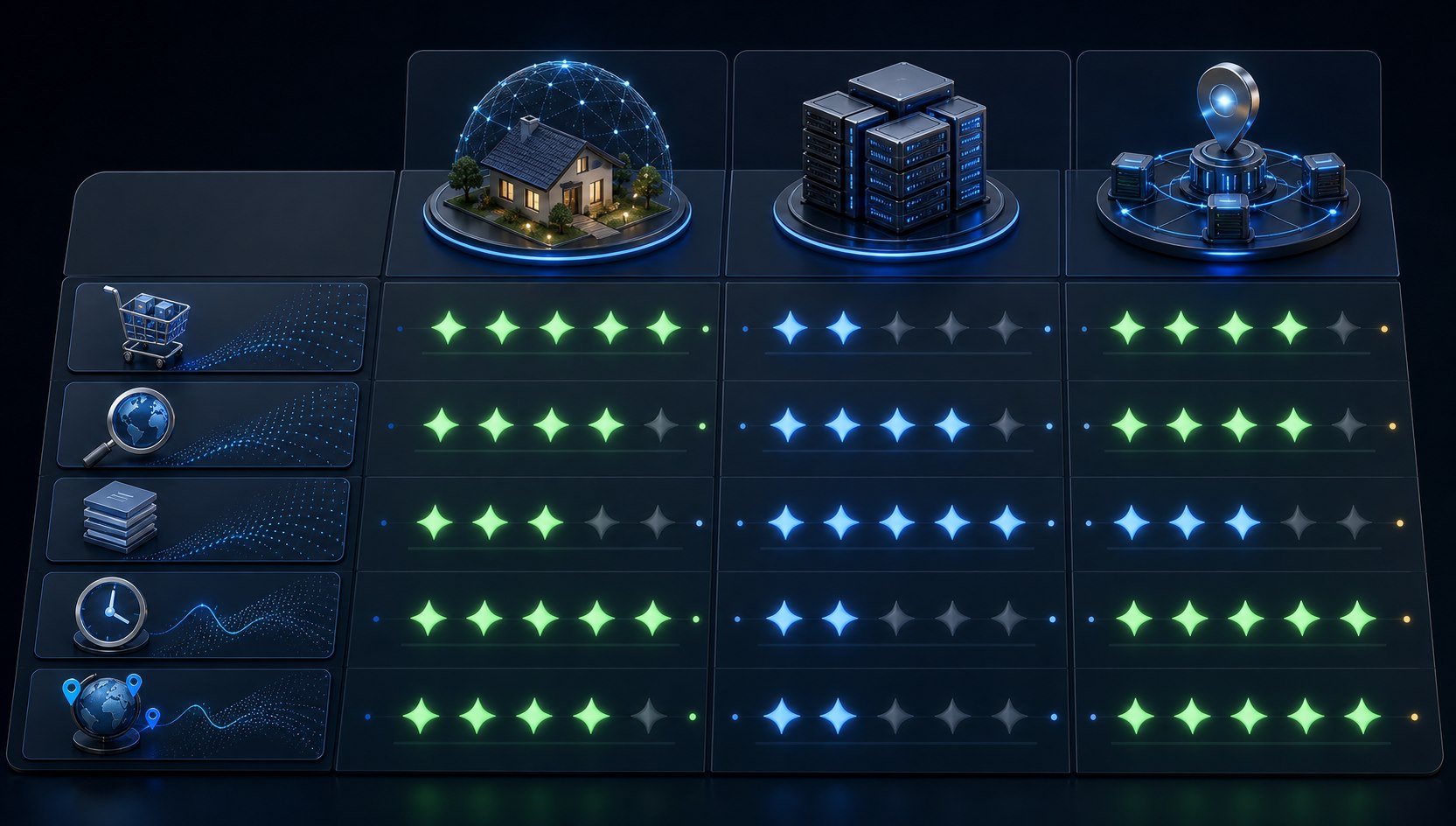
The main web scraping proxy types are residential proxies, datacenter proxies, and ISP proxies. Residential proxies are usually stronger for geo-sensitive public pages, market research, price monitoring, and tasks that need a network profile closer to ordinary users. Datacenter proxies are often better for low-cost, high-speed access to simple public pages with fewer restrictions. ISP proxies are useful when a scraping workflow needs stable exits, repeated checks, fixed regions, and better session continuity.
There is no single best proxy type for every scraping job. The right choice depends on target pages, region sensitivity, rotation needs, session behavior, speed requirements, and cost per usable result. Many mature teams do not choose only one option. They split different tasks across different web scraping proxy types, then compare results by valid pages, geo match, retries, and data quality.
A scraper does not only need a connection. It needs the right access environment for the target page. A product page may return different prices by country. A search result page may change by location. A public listing page may be easy to collect at small scale but harder to collect reliably at higher frequency. A monitoring task may need the same region and session behavior for repeated checks.
That is why web scraping proxy types should be evaluated by task outcome, not by name. A fast proxy is not useful if it returns the wrong regional content. A large pool is not useful if page validation fails. A low traffic price is not cheap if the retry ratio is high. A stable IP is not helpful if the job actually needs frequent rotation.
For basic background, Wikipedia has useful introductions to proxy servers, web scraping, IP addresses, and robots.txt. This article focuses on practical selection and testing. It does not encourage unauthorized access, bypassing access controls, or violating website rules.
Residential Proxies for Web Scraping
Residential proxies route requests through IP addresses associated with residential networks. In many public data collection workflows, this makes them useful when the target page is sensitive to region, language, local pricing, or consumer-like access patterns.
Residential proxies are often a strong fit for:
Scraping scenario
Why residential proxies help
Multi-region price monitoring
They can help observe public prices from different markets
Search result checks
They are useful when location and local visibility matter
Market research
They can provide a more consumer-like access environment
Geo-sensitive public pages
They help test how pages vary by country or city
Rotating collection workflows
They usually offer more flexible exit distribution
The main benefit is not simply having many IPs. The benefit is better alignment between the proxy route and the page environment you need to observe. If your team needs to compare product pages across countries, validate local search visibility, or collect public market signals from multiple regions, residential proxies may be the first web scraping proxy types to test.
The tradeoff is cost. Residential proxy traffic can be more expensive than datacenter traffic, especially if the scraper retries too often. To control cost, track valid page rate, geo match rate, duplicate rate, and retry ratio. A residential setup should be judged by how many usable records it produces, not by how much traffic it consumes.
Datacenter Proxies for Web Scraping
Datacenter proxies usually come from hosting or cloud infrastructure. They are often fast, easy to deploy, and cost-efficient. For simple public pages with lower access sensitivity, they can be the most practical starting point.
Datacenter proxies are often useful for:
Scraping scenario
Why datacenter proxies help
Simple public page collection
They can provide speed and low cost
Development and testing
They are easy to integrate while building the workflow
Non-geo-sensitive pages
They work when page content does not change much by location
Low-risk bulk access
They can be efficient when target pages are stable
Budget-sensitive pilots
They help validate whether a project is worth scaling
The risk is that some websites may classify datacenter traffic differently from residential or ISP traffic. That does not mean datacenter proxies are bad. It means they should be matched to suitable pages. If a page is public, stable, and not highly sensitive to network profile, datacenter proxies may deliver the lowest cost per usable record.
When comparing web scraping proxy types, use datacenter proxies as a baseline. If they produce valid pages with low retry cost, there may be no reason to use a more expensive route. If they fail on geo match, page completeness, or repeated access stability, test residential or ISP proxies next.
ISP Proxies for Web Scraping
ISP proxies are often positioned between residential and datacenter proxies. They can offer stable routes, strong speed, and a network profile that may be more trusted than standard datacenter infrastructure. For scraping tasks that need consistency rather than aggressive rotation, ISP proxies can be a good fit.
ISP proxies are often useful for:
Scraping scenario
Why ISP proxies help
Long-term page monitoring
Stable exits make repeated checks easier to compare
Fixed-region sampling
They help keep location behavior more consistent
Multi-step public browsing flows
Sticky sessions can reduce interruptions
Scheduled search checks
Stable routing supports repeated snapshots
Continuous market observation
They can balance speed, stability, and credibility
ISP proxies are not always the best option for high-frequency rotation. If a project needs many exits changing constantly, residential proxies may be more flexible. If a project only needs low-cost access to simple pages, datacenter proxies may be cheaper. ISP proxies are strongest when the workflow values continuity.
That makes ISP proxies important in a serious comparison of web scraping proxy types. They are not just a middle option. They are a stability option for jobs where repeated observations must stay comparable over time.
A Practical Decision Framework
You can simplify the selection process with five questions.
First, does the target page depend heavily on location? If yes, test residential proxies or ISP proxies first. If location does not change the data, datacenter proxies may be enough.
Second, does the job need frequent IP rotation? If the workflow needs many exits and distributed access, residential proxies are often more flexible. If the job needs the same route for repeated checks, ISP proxies may be better.
Third, is the page simple and stable? If the page is public, non-sensitive, and easy to validate, datacenter proxies may deliver the best cost structure.
Fourth, does the task require session continuity? If a flow includes several steps or repeated snapshots from the same region, ISP proxies or sticky residential sessions may be better than aggressive rotation.
Fifth, how will you measure cost? Do not compare web scraping proxy types by traffic price alone. Compare them by cost per valid page, cost per correct region, and cost per complete record.
This framework prevents a common mistake: using one proxy type for every project. A scraping workflow with multiple page groups may need multiple proxy strategies.
When to Combine Proxy Types
Many teams eventually use a hybrid setup. This does not mean the system has to be complicated. It means each task goes through the route that fits its risk, cost, and data quality requirements.
A simple hybrid model can look like this:
Task layer
Recommended proxy type
Reason
Simple public pages
Datacenter proxies
Lower cost and fast baseline collection
Geo-sensitive pages
Residential proxies
Better fit for local content observation
Repeated fixed-region checks
ISP proxies
More stable exits and session continuity
Error review or data verification
Residential or ISP proxies
Useful for checking suspicious or incomplete results
This approach helps control budget. The team does not waste expensive traffic on pages that do not need it. It also improves diagnosis. If datacenter proxies fail on a specific group of pages but residential proxies work, the issue may be related to network profile or region. If residential rotation breaks continuity but ISP proxies work, the issue may be session behavior.
How to Test Web Scraping Proxy Types
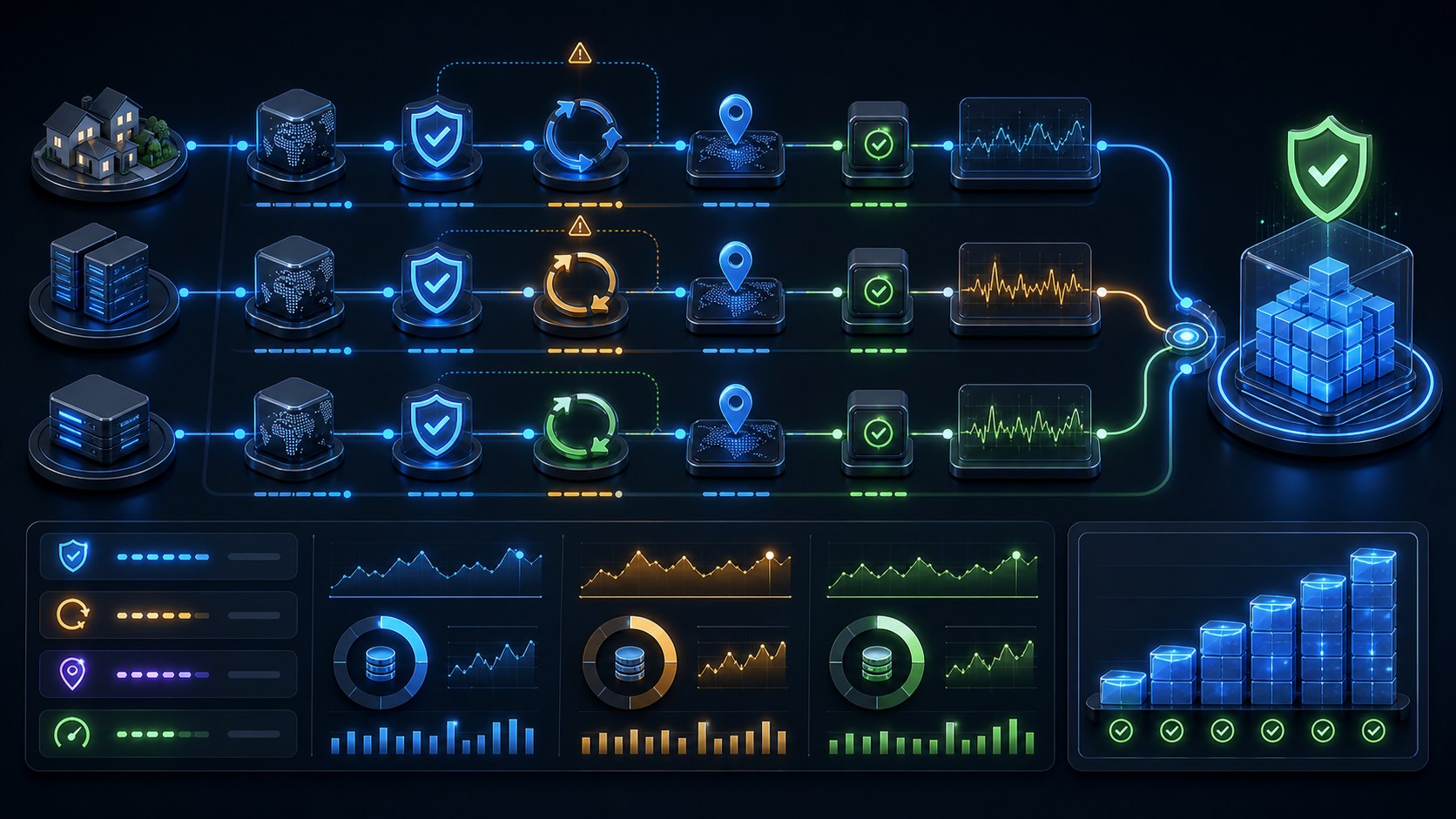
A good test uses the same pages, the same request rhythm, and the same validation rules for each proxy type. Otherwise, the comparison is not fair.
Start with a representative sample. Include easy pages, difficult pages, region-sensitive pages, and pages that are important to the business. Do not start with the full production workload.
Define a valid result before testing. For an ecommerce page, a valid result may require title, price, currency, availability, region, and timestamp. For a search page, it may require location, result order, ads, visible snippets, and landing page consistency.
Then test each proxy type against the same standards:
Valid page rate: how many pages meet the business criteria.
Geo match rate: whether content matches the target region.
Retry ratio: how many attempts are needed for one usable result.
Field completeness: whether required fields are present.
Duplicate rate: whether the workflow collects repeated data.
Average completion time: how long it takes to produce a usable record.
Failure classification: whether errors are traceable to network, page, parser, region, or request rate.
This is the most reliable way to compare web scraping proxy types. It shifts the conversation from "which proxy is best" to "which proxy produces the best usable output for this task."
Common Mistakes
The first mistake is choosing only by price. Datacenter proxies may be cheaper per unit, but not cheaper if they create more failed results. Residential proxies may look expensive, but may reduce rework on geo-sensitive pages. ISP proxies may cost more than datacenter routes, but may create more consistent repeated checks.
The second mistake is choosing only by speed. Speed matters, but a fast invalid page is still invalid. Web scraping proxy types should be compared by validated output.
The third mistake is overusing rotation. Rotation is useful, but too much rotation can break multi-step flows and make results harder to compare.
The fourth mistake is ignoring session needs. Some tasks need continuity. For those tasks, sticky residential sessions or ISP proxies may perform better than constantly changing exits.
The fifth mistake is skipping compliance review. Proxies are infrastructure. They do not remove the responsibility to respect website terms, access rules, privacy requirements, rate limits, and applicable laws.
Responsible Use and Compliance
Any proxy used for scraping should be part of a responsible public data workflow. Teams should collect appropriate public data, avoid unreasonable load, respect target-site rules, and define internal review processes.
Responsible workflows usually include approved target domains, allowed fields, request limits, retry limits, log retention rules, and a stop procedure. If a target site signals that a pattern is unwelcome, the team should slow down, review the workflow, or stop the task.
Compliance is also operationally useful. It makes scraping easier to monitor, explain, and improve. A documented workflow lets teams compare proxy types without turning the project into uncontrolled traffic.
Final Recommendation
Choose residential proxies when region accuracy, local page behavior, and consumer-like network context matter.
Choose datacenter proxies when pages are simple, region-insensitive, cost-sensitive, and suitable for fast baseline collection.
Choose ISP proxies when fixed regions, stable exits, session continuity, and repeated observation matter.
For complex public data collection, combine the three web scraping proxy types instead of forcing every page through the same route. Use datacenter proxies for simple pages, residential proxies for geo-sensitive pages, and ISP proxies for stable repeated checks. Then make the final decision by valid output, not by proxy labels.
In short, web scraping proxy types should be selected by task evidence: which route gives you the most complete, region-correct, and repeatable public data at a cost your team can sustain.
Frequently Asked Questions
What are the main web scraping proxy types?
The main web scraping proxy types are residential proxies, datacenter proxies, and ISP proxies. Residential proxies are useful for geo-sensitive and consumer-like public page access. Datacenter proxies are useful for low-cost and simple bulk access. ISP proxies are useful for stable exits, fixed-region checks, and repeated observations.
Are residential proxies always best for web scraping?
No. Residential proxies are often strong for region-sensitive public pages, market checks, and flexible rotation, but they are not always necessary. If the target pages are simple and not sensitive to location or network profile, datacenter proxies may be enough.
Are datacenter proxies bad for web scraping?
No. Datacenter proxies can work well for simple public pages, testing, development, and cost-sensitive workflows. They may be less suitable when target pages are highly sensitive to traffic source or local network context.
When should I use ISP proxies for scraping?
Use ISP proxies when the workflow needs stable exits, fixed-region access, repeated checks, and better session continuity. They are often a good fit for long-term monitoring and scheduled public page observation.
Can I combine different proxy types in one scraping workflow?
Yes. Many teams combine proxy types. Simple pages can use datacenter proxies, geo-sensitive pages can use residential proxies, and stable repeated checks can use ISP proxies. The best mix should be based on valid result metrics.