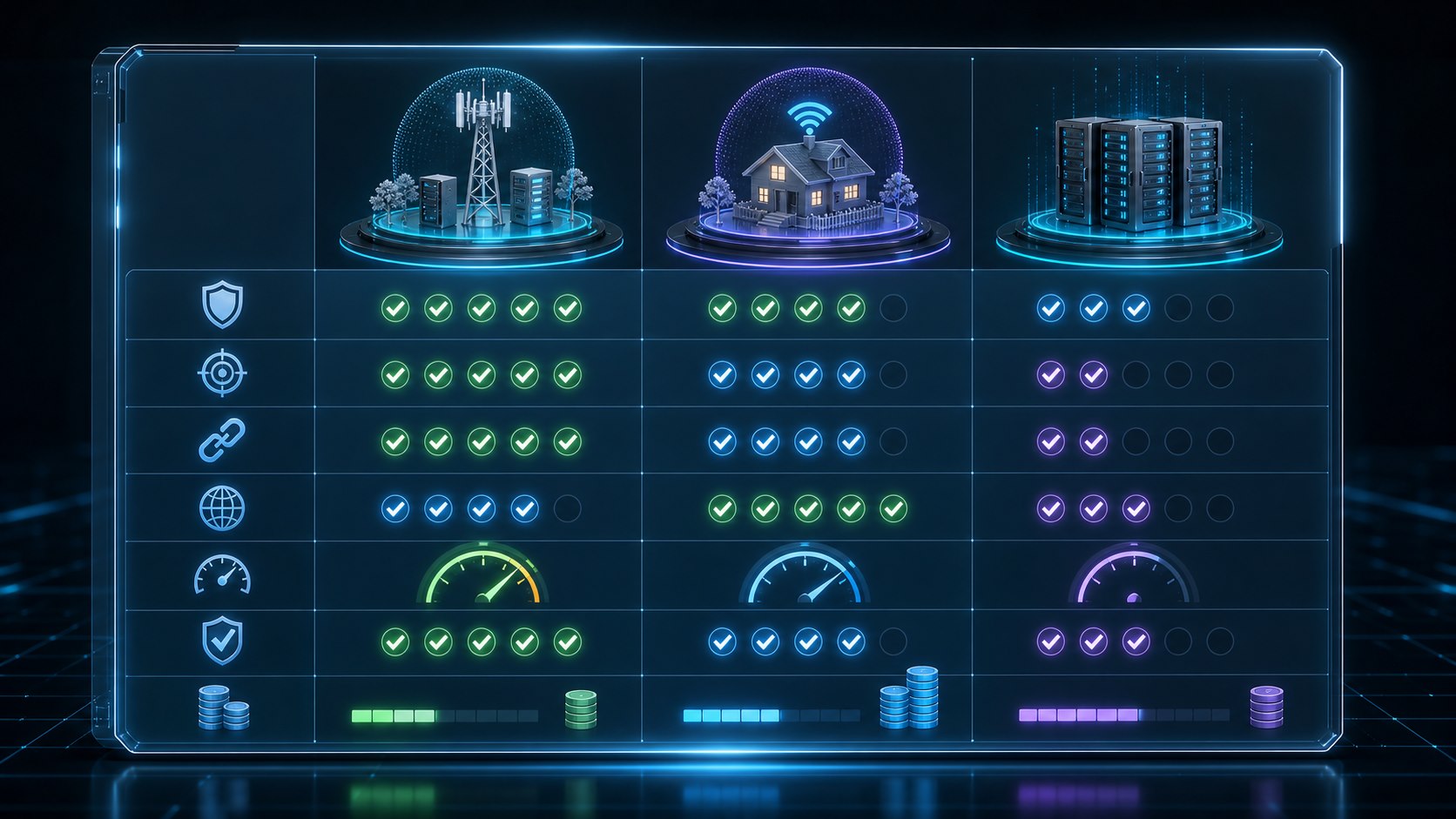
Choosing a proxy type is not about finding the one option that is always best. It is about matching the proxy to the job.
Static ISP proxies, residential proxies, and data center proxies solve different problems. Static ISP proxies are built for stable sessions and consistent network identity. Residential proxies are better for broad address coverage and flexible rotation. Data center proxies are usually stronger when speed and cost efficiency matter most.
The mistake many teams make is choosing by name instead of workflow. A proxy that works well for SEO monitoring may be inefficient for bulk public-page access. A low-cost proxy that works for simple testing may be the wrong fit for account environments, ad verification, or localized page review.
Choose static ISP proxies when your workflow needs a stable network identity, long sessions, and repeatable access from the same market view.
Choose residential proxies when your workflow needs broad coverage, many locations, and frequent IP rotation.
Choose data center proxies when your workflow is low risk, speed-sensitive, and cost-sensitive.
Here is the simple version:
Workflow need
Best starting point
Why it fits
Stable account environment
Static ISP proxies
The exit identity can stay more consistent
SEO monitoring in one market
Static ISP proxies
Stable location context makes results easier to compare
Ad landing page verification
Static ISP proxies
The same regional view can be repeated
Multi-region public page checks
Residential proxies
Broader location coverage is useful
Large public data sampling
Residential proxies
Rotating exits help distribute requests
Low-cost basic access
Data center proxies
Speed and cost are usually better
Internal technical testing
Data center proxies
Natural network profile may not be necessary
The best choice depends on what would break the workflow. If changing the network identity would create noise, start with static ISP proxies. If lack of coverage is the problem, start with residential proxies. If the job only needs fast and affordable access, data center proxies may be enough.
The Core Difference Between the Three Proxy Types
Proxy types differ in five practical areas: stability, location coverage, network profile, speed, and cost.
Static ISP proxies focus on stability. They usually use IP addresses associated with Internet Service Provider networks while keeping the exit address relatively fixed for the task. That makes them useful when a team needs a consistent access path.
Residential proxies focus on coverage. They are useful when a task needs many addresses, many regions, and flexible switching. They are often selected for broad public-page observation and distributed sampling.
Data center proxies focus on efficiency. They usually run from hosted server environments, which can make them fast and cost-effective. The tradeoff is that they may look less like ordinary consumer access.
The comparison looks like this:
Factor
Static ISP proxies
Residential proxies
Data center proxies
Session stability
High
Medium, depending on rotation settings
High connection stability
Natural network profile
Strong
Strong
Weaker
Location coverage
Medium to strong, provider-dependent
Strong
Medium
Speed
Usually strong
Varies more by source quality
Usually strong
Cost
Medium to high
Medium to high
Usually lower
Best for repeatable checks
Strong
Medium
Medium
Best for frequent rotation
Weak
Strong
Medium
One important detail: a data center proxy can be technically stable, but that does not mean it has a natural consumer-like network profile. A residential proxy can look natural, but if it rotates too often, it may not support stable long-running tasks. Static ISP proxies sit between those needs: more stable than many rotating residential options and often more natural-looking than ordinary hosted IPs.
When Static ISP Proxies Are the Better Choice
Static ISP proxies are strongest when the same task needs to be repeated under similar access conditions.
SEO Monitoring
Search results can change by country, city, language, device, account state, time, and network source. If the proxy changes constantly, the data becomes harder to interpret. A stable ISP-associated exit helps reduce one source of noise so ranking trends are easier to compare over time.
Ad Verification
Advertisers often need to verify that a landing page shows the right language, price, promotion, compliance message, or redirect path in a target region. Static ISP proxies help the team repeat the same review path instead of checking from a constantly shifting network view.
Localization Testing
Global websites may show different currencies, shipping options, tax rules, checkout flows, inventory, and language versions by region. If a QA team is testing one market, a stable exit can make the test cleaner.
Account Environment Consistency
Some account-based workflows benefit from a consistent access environment. A proxy cannot guarantee account safety, and it should never be used to violate platform rules. But static ISP proxies can reduce one obvious variable: sudden changes in network source.
Long-Term Market Observation
If a team tracks competitor pages, local pricing, product availability, or search experiences over days or weeks, stability matters. A fixed observation point helps the team understand whether a result changed because the market changed, not because the access identity changed.
Static ISP proxies are not ideal when the task needs massive IP rotation or very low-cost bulk traffic. Their value is continuity, not maximum address volume.
When Residential Proxies Are the Better Choice
Residential proxies are strongest when coverage matters more than continuity.
If you need to check public pages across many countries or cities, residential proxies can provide a broader range of network views. If you need to distribute requests across a larger pool, rotation can be useful. If the project is exploratory and the target regions may change, residential proxies can give the team more flexibility.
Common residential proxy use cases include:
Broad public page checks.
Multi-region content review.
Public web data sampling.
Price and availability observation across many markets.
Workflows that need frequent location switching.
The tradeoff is noise. If the task needs the same identity over time, too much rotation can make results harder to compare. A team may see different language, pricing, redirects, or search results and struggle to know whether the change came from the website or from the proxy exit.
Residential proxies are not automatically better because they sound more natural. They are better when coverage and rotation are the main requirements.
When Data Center Proxies Are the Better Choice
Data center proxies are strongest when the task is simple, fast, and cost-sensitive. The term data center refers to facilities and infrastructure used to host servers and networking equipment. Wikipedia has a general overview of a data center if you want background context.
For low-risk workflows, data center proxies can be a smart choice. They are often easier to manage, faster, and cheaper than residential or ISP-associated options.
They can fit:
Basic connectivity testing.
Internal system checks.
Low-risk public page access.
Simple automated QA.
Cost-first technical tasks.
The limitation is network profile. Many websites can recognize hosting or server-based traffic patterns. That does not matter for every workflow, but it can matter for ad verification, SEO monitoring, account environments, and localized page checks where the target website's interpretation of the visitor matters.
The rule is simple: do not pay for a more expensive proxy if the task does not need it, but do not force a low-cost proxy into a high-sensitivity workflow.
The Five-Factor Decision Matrix
If you are not sure which proxy type to choose, score the workflow across five factors.
1. Stability
Does the same task need to run under the same network identity over time? If yes, static ISP proxies are usually the best starting point.
2. Coverage
Does the task need many countries, cities, or IP changes? If yes, residential proxies may be a better fit.
3. Speed
Does the task mostly need fast access to low-risk pages? If yes, data center proxies may be the most efficient choice.
4. Cost
Do not measure cost only by the plan price. Measure cost by successful results. A cheaper proxy can become expensive if it creates more failed requests, more retries, and more manual checks.
5. Trust and Network Profile
Does the target website care about the visitor's network source? If yes, static ISP proxies or residential proxies may fit better than data center proxies. But network profile is only one part of responsible access. Browser behavior, request rate, cookies, login patterns, and compliance still matter.
Use Case Selection Guide
Here is how the decision usually works in real business workflows.
For SEO monitoring, start with static ISP proxies when you need to track the same keywords in the same market over time. The goal is clean comparison, not maximum rotation.
For ad verification, start with static ISP proxies when you need to repeat a target-region landing path and confirm redirects, language, offers, and compliance messages.
For localization testing, choose based on the test scope. If the team is testing one market deeply, static ISP proxies fit. If the team is scanning many markets broadly, residential proxies may be more efficient.
For public web data sampling, residential proxies are often the better starting point because coverage and rotation matter more than a fixed identity.
For basic low-risk technical access, data center proxies may be enough. They are practical when the target does not require a consumer-like network view.
For account environments, stability matters. Static ISP proxies may help reduce network-source changes, but they must be used with normal account behavior and platform compliance.
If you are comparing providers and not just proxy categories, the guide to residential proxy providers can help you evaluate support, resource quality, cost, and usage boundaries.
Do Not Use One Proxy Type for Every Task
Many teams waste money or create avoidable risk because they try to make one proxy type solve every problem.
SEO monitoring needs repeatability. Public data sampling needs coverage. Basic access needs cost efficiency. Localization testing needs regional accuracy. Account environments need continuity.
Those are different requirements.
A practical proxy strategy often uses more than one type:
Use static ISP proxies for stable, high-value, repeatable workflows.
Use residential proxies for broad, rotating, multi-region observation.
Use data center proxies for low-risk, fast, cost-efficient technical tasks.
This keeps expensive resources focused on the workflows that actually need them.
How to Test Before Choosing
Do not choose a proxy type only from a pricing page. Test a small real workflow.
First, define the task. Is it SEO monitoring, ad verification, localization testing, account access, public data sampling, or basic technical access?
Second, define the target region. Do not only check an IP lookup tool. Open the actual target website and check page language, currency, redirects, content version, login prompts, and local results.
Third, test session stability. Repeat the same task several times. Check whether the visible region, page result, and connection behavior stay consistent enough for the workflow.
Fourth, record speed and errors. Track timeouts, slow loads, failed redirects, blocked pages, and inconsistent responses.
Fifth, calculate effective cost. Include retries, failed checks, manual investigation, and unusable results.
Finally, choose the proxy type based on the test. If stability creates the most value, use static ISP proxies. If coverage creates the most value, use residential proxies. If cost and speed create the most value, use data center proxies.
Summary
Static ISP proxies, residential proxies, and data center proxies are not interchangeable. Each type has a different strength.
Static ISP proxies are best for stable sessions, repeatable regional checks, SEO monitoring, ad verification, localization testing, and account environment consistency. Residential proxies are best for broad location coverage, rotation, and public page sampling. Data center proxies are best for fast, low-cost, low-risk access.
The right choice comes from the workflow. If the task is harmed by network identity changes, choose stability. If the task is harmed by lack of coverage, choose rotation. If the task is harmed by cost, start with data center efficiency.
Define the task, run a small test, record the results, and scale only when the proxy type proves it fits.