SEO proxies are proxy setups used for rank tracking, local search checks, SERP comparison, competitor monitoring, and page verification from controlled network locations. The best proxy behavior depends on the SEO task. Static residential addresses are better for repeated checks from one stable location. Dynamic residential addresses are better for broader public sampling across regions, devices, or markets.
For IPIPD, this topic should not be framed as a separate "SEO proxy product." It should be framed as an SEO use case for static residential addresses and dynamic residential addresses. A team that wants stable weekly rank tracking may need static residential addresses. A team checking search visibility across many regions may need dynamic residential addresses with clear location and session rules.
Basic Facts
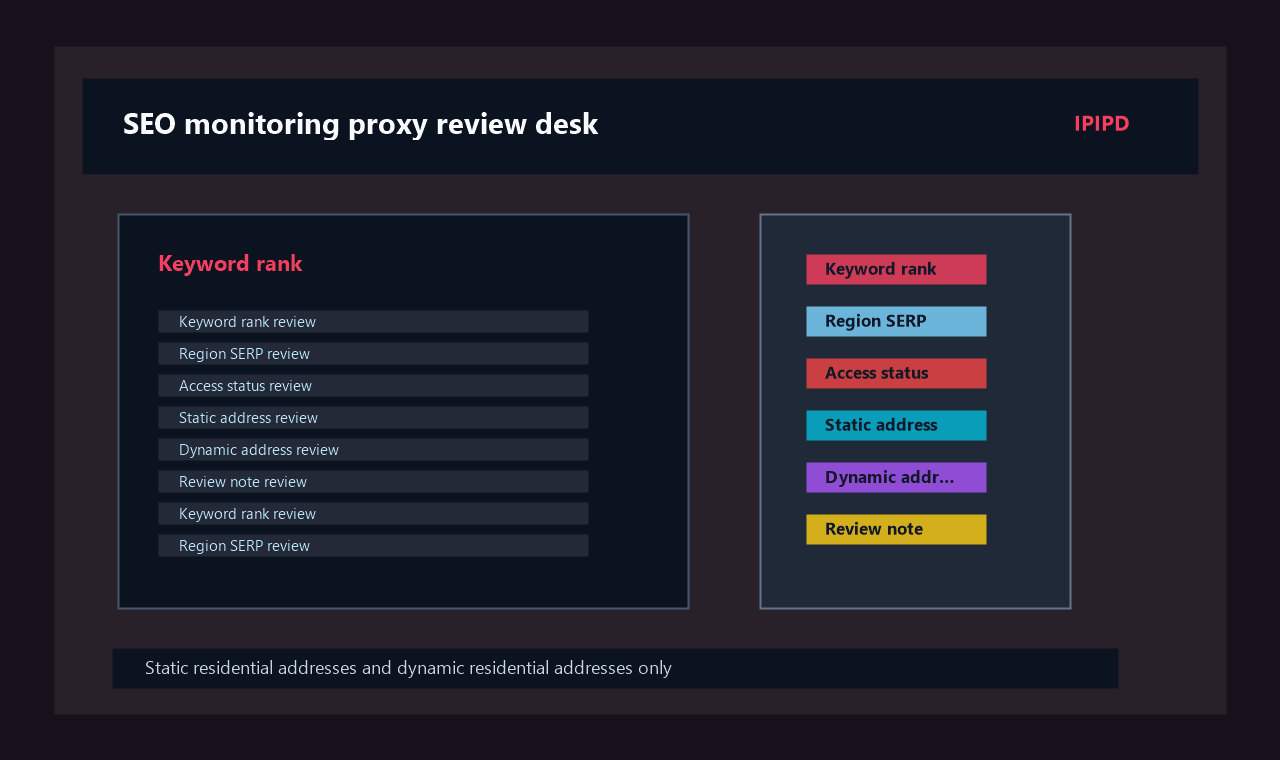
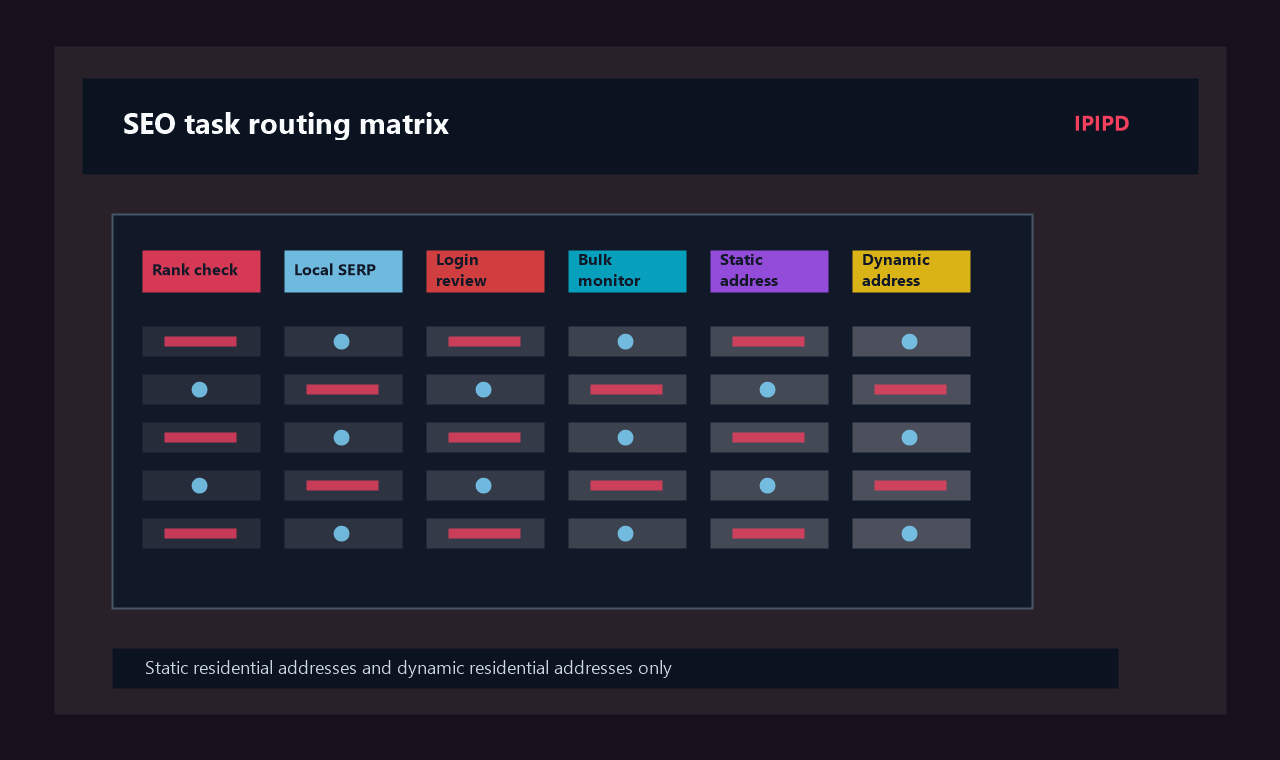
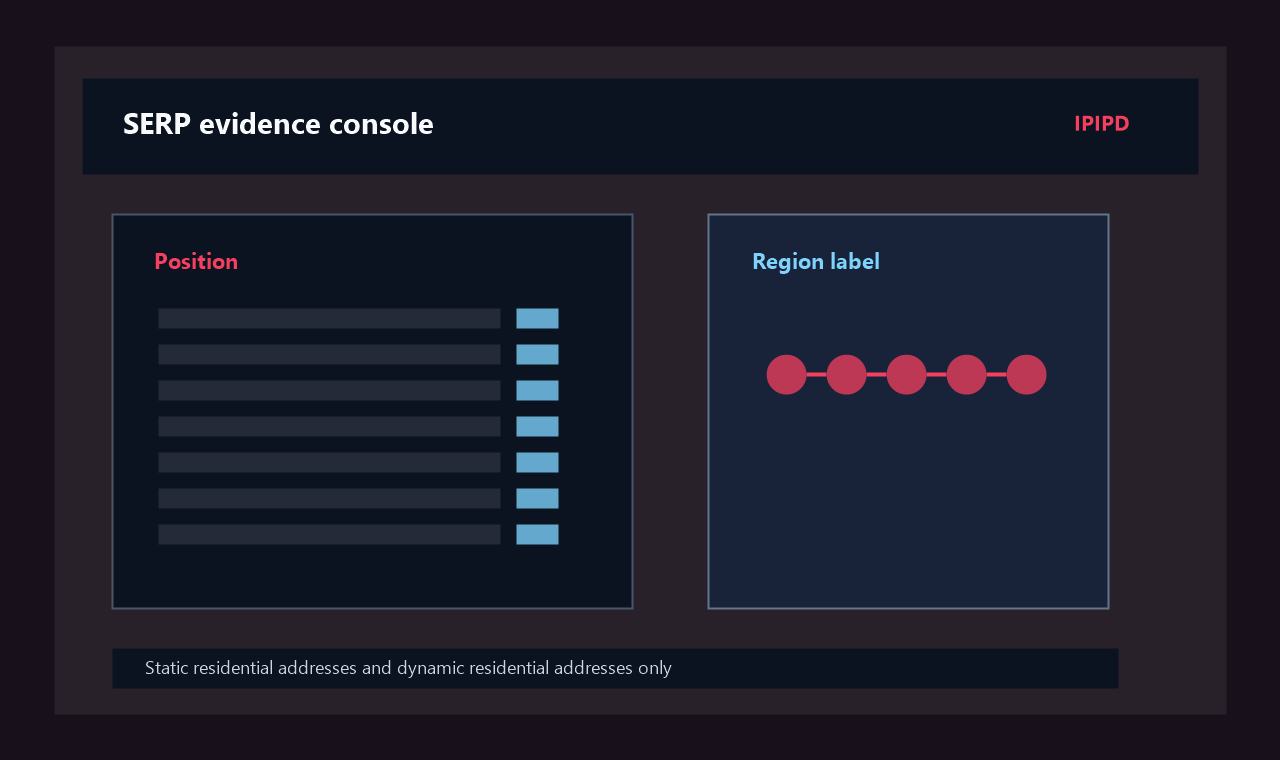
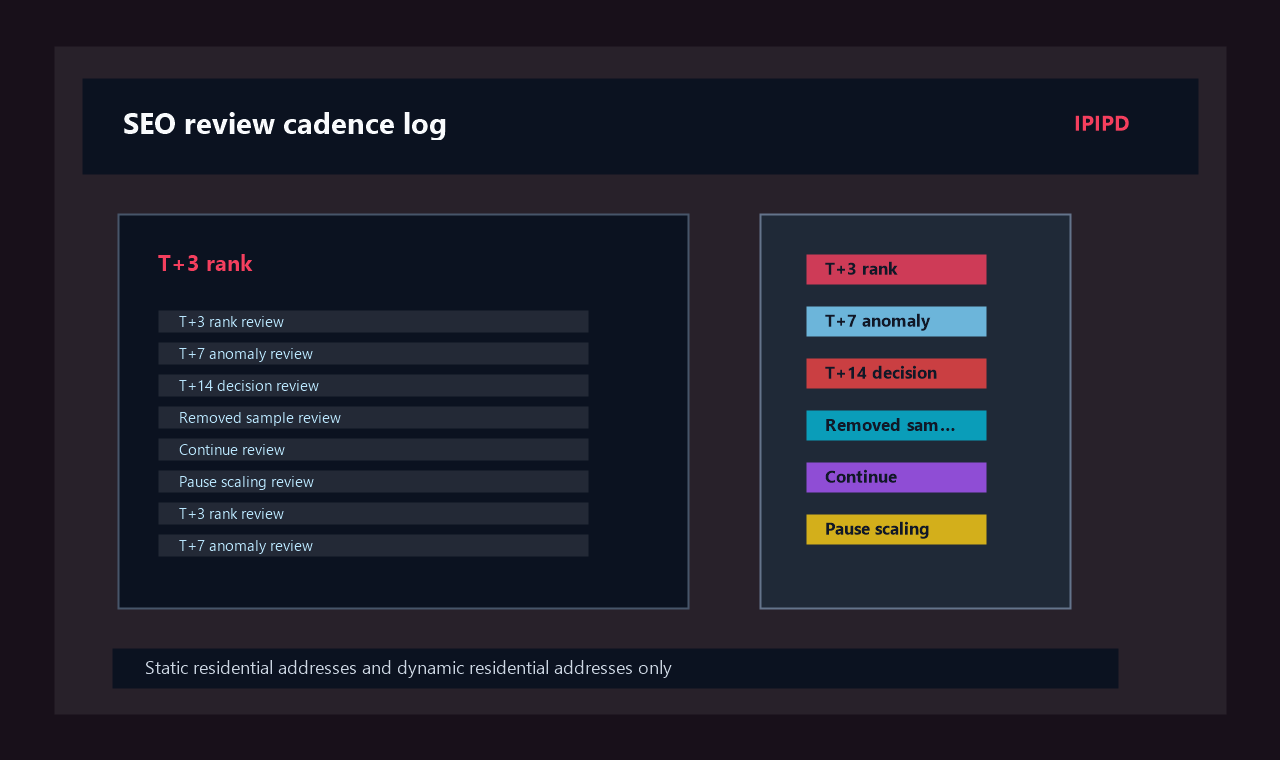
Split rank checks, localized SERP review, login review, and bulk monitoring into suitable address choices.Record position, region label, device type, status code, screenshot, and reviewer for each SEO check.Track T+3 rank movement, T+7 anomaly rate, T+14 decision, removed samples, and pause decisions.
Item
Practical meaning
SEO proxy
A proxy setup used to view search and public web results from controlled locations.
Static residential address
Better for repeatable checks from the same network identity.
Dynamic residential address
Better for broad regional sampling and public SERP observation.
Main risk
Mixing unstable rotation with a task that needs comparable trend data.
Best metric
Valid SERP snapshots, region match, consistency, and clean reporting.
What SEO proxies are used for
SEO teams use proxies because search results and public pages can vary by location, language, device, personalization signals, and network context. A rank tracking workflow from one office network may not reflect what users see in another city or country. A proxy setup allows the team to collect controlled observations and compare them over time.
Common SEO proxy tasks include local rank tracking, Google search result checks, competitor page monitoring, landing page verification, localized content review, ad landing observation, and public search feature tracking. These tasks do not all need the same IP behavior. Some require repeatability. Others require coverage.
The mistake is treating all SEO checks as one proxy job. A stable tracking dashboard and a broad market sampling study should not share the same rotation rule. The first needs consistency. The second needs coverage.
Static residential addresses for repeat checks
Static residential addresses fit SEO checks that need comparison over time. If a team checks the same keyword every Monday from the same target market, changing IP behavior too often can introduce noise. The rank may change because the SERP changed, or it may change because the proxy location, identity, or device assumptions changed. Stable inputs make the trend easier to trust.
Static residential addresses are useful for dedicated local rank baselines, manual SERP review, repeated competitor checks, and dashboard workflows that require login. They are also useful when one analyst needs to reproduce a result seen by another analyst. A stable residential address does not guarantee identical SERPs, but it reduces one source of variation.
For IPIPD content, static residential addresses should be described as a continuity tool. They help when SEO work needs a repeatable viewpoint.
Dynamic residential addresses for broader sampling
Dynamic residential addresses fit SEO work that needs broader public observation. A team may want to check how search results appear across many cities, compare public landing pages, review localized snippets, or test whether a content page behaves differently in different markets. In those cases, using one static view is too narrow.
Dynamic residential addresses help the team collect samples from multiple locations or sessions. The value comes from structured sampling, not random volume. The team should define regions, keyword sets, device assumptions, time windows, and retry behavior before collecting data. Otherwise the output becomes a pile of screenshots rather than a useful SEO dataset.
Rotation should still be controlled. If the task requires several steps, use a short sticky session. If the task is a single public SERP snapshot, more frequent rotation may be acceptable. The workflow determines the proxy behavior.
Static vs dynamic for SEO workflows
SEO workflow
Better starting point
Reason
Weekly local rank baseline
Static residential address
Reduces network variation across repeat checks.
Broad city-level SERP sampling
Dynamic residential addresses
Collects more public regional viewpoints.
Manual competitor page review
Static residential address
Helps analysts reproduce checks.
Landing page localization test
Dynamic residential with sticky session
Needs region coverage plus short continuity.
SEO tool dashboard login
Static residential address
Login workflows need stability.
The table is not a rule for every business. It is a starting point. A team with strict repeatability needs may choose more static addresses. A team doing market discovery may rely more on dynamic addresses. The important point is to avoid using one proxy behavior for every SEO task.
How to build a clean SEO proxy workflow
Start by defining the SEO question. Are you checking whether a page ranks? Are you comparing locations? Are you monitoring a competitor page? Are you validating whether a landing page displays the right language or offer? Each question has a different tolerance for variation.
Next, define the measurement fields. A clean SEO proxy log should include keyword, target market, device assumption, search engine, proxy type, session rule, timestamp, result URL, ranking position, SERP feature notes, screenshot reference, and analyst comments. If the workflow uses dynamic residential addresses, include the sampling rule. If it uses static residential addresses, include the repeat-check schedule.
Finally, separate data collection from interpretation. A proxy can help collect a cleaner view, but SEO decisions still require judgment. Ranking changes can come from algorithm updates, competitor changes, page quality, localization, technical SEO, or search personalization. The proxy is one control in the measurement system.
Quick reference
Use static residential addresses for repeatable SEO checks.
Use dynamic residential addresses for regional sampling and public SERP coverage.
Do not rotate aggressively inside a workflow that needs trend consistency.
Record region, device, keyword, time, proxy behavior, and result evidence.
Treat SEO proxies as a use case, not as a separate IPIPD product line.
Measure valid SERP snapshots, not raw request count.
Common SEO proxy mistakes
The first mistake is rotating too much. If every repeat check uses a different context, the team may lose the ability to compare results. The second mistake is using one static location for every market. That can hide regional differences. The third mistake is ignoring session behavior. Multi-step checks may need a short sticky window even when the broader workflow uses dynamic residential addresses.
Another mistake is overpromising. Proxies do not create rankings. They only help observe public results from controlled network contexts. SEO outcomes still depend on content quality, technical health, authority, relevance, and user behavior.
Frequently Asked Questions
What are SEO proxies?
SEO proxies are proxy setups used to collect or verify public search results, local rankings, landing pages, and competitor pages from controlled network locations.
Should SEO monitoring use static or dynamic residential addresses?
Use static residential addresses for repeat checks and trend baselines. Use dynamic residential addresses for broader regional sampling and public visibility checks.
Are Google SEO proxies a separate product?
For IPIPD, they should be treated as an SEO use case, not as a separate product. The real choice is static residential address behavior or dynamic residential address behavior.
Can proxies improve rankings?
No. Proxies do not improve rankings directly. They help teams observe and measure search results more accurately across locations and sessions.
What should an SEO proxy report include?
It should include keyword, region, device assumption, search engine, proxy type, session rule, timestamp, result URL, rank position, screenshot evidence, and notes.