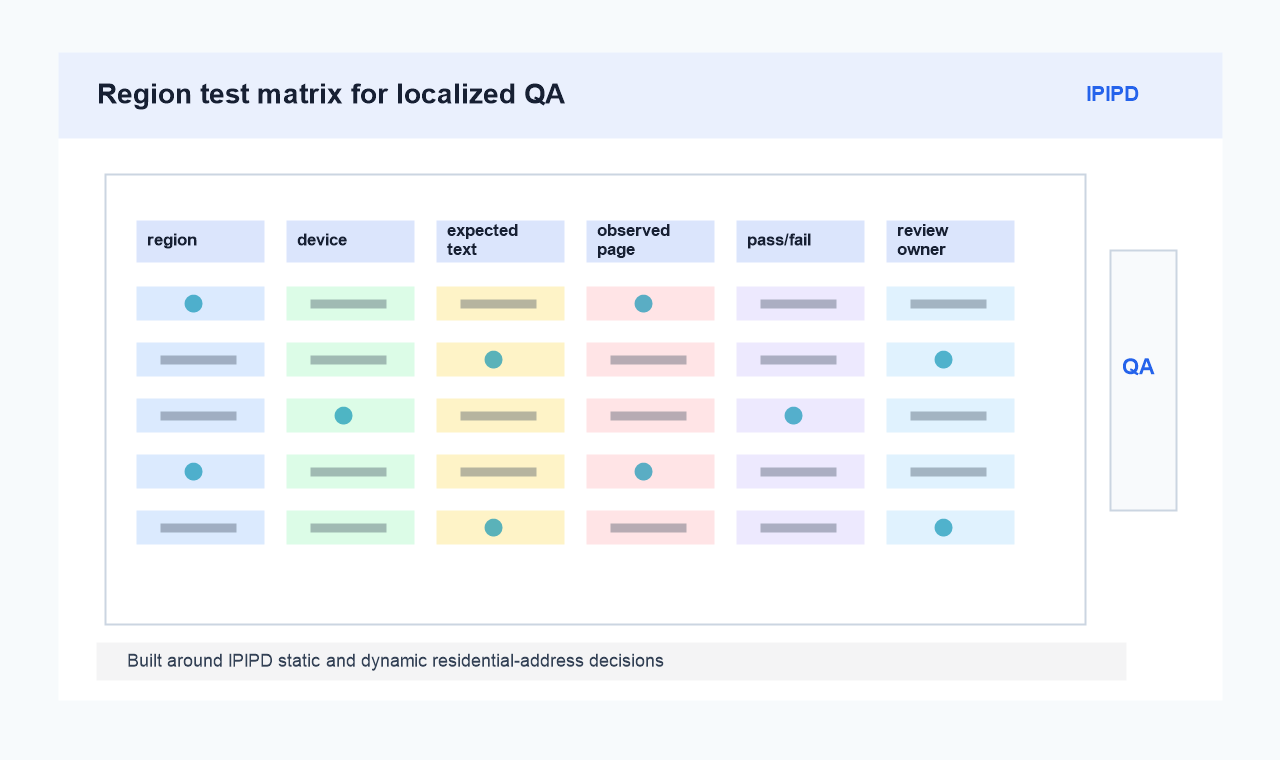
Localized QA should begin with a matrix: region, page path, browser state, expected language, expected currency or unit, and bug owner. Without that matrix, a proxy test becomes a loose page visit.
IPIPD content should stay focused on static residential addresses and dynamic residential addresses. Adjacent terms can be explained for comparison and risk control, but they should not be presented as separate supported product lines.
Quick Answer: localized QA starts with a test matrix
Use static residential addresses when one locale must be reopened for bug verification. Use dynamic residential addresses when the team samples additional regions after the path is stable.
Build the region-page matrix
QA material
Handoff note
QA target
Check whether a page behaves correctly for a defined region.
Static fit
Reopen the same locale repeatedly during bug verification.
Dynamic fit
Sample more locales after the core test path is stable.
Evidence
Screenshot, URL, locale, browser state, and bug label.
Pick the pages that matter first: signup, pricing, checkout preview, help content, or landing page. Then assign the locale expectation for each path.
A localized QA screen showing locale selector, page copy, browser viewport, and region evidence beside the tested page.
A QA row should say what is supposed to appear, not just whether the page loaded. That is how translation, formatting, and routing bugs become visible.
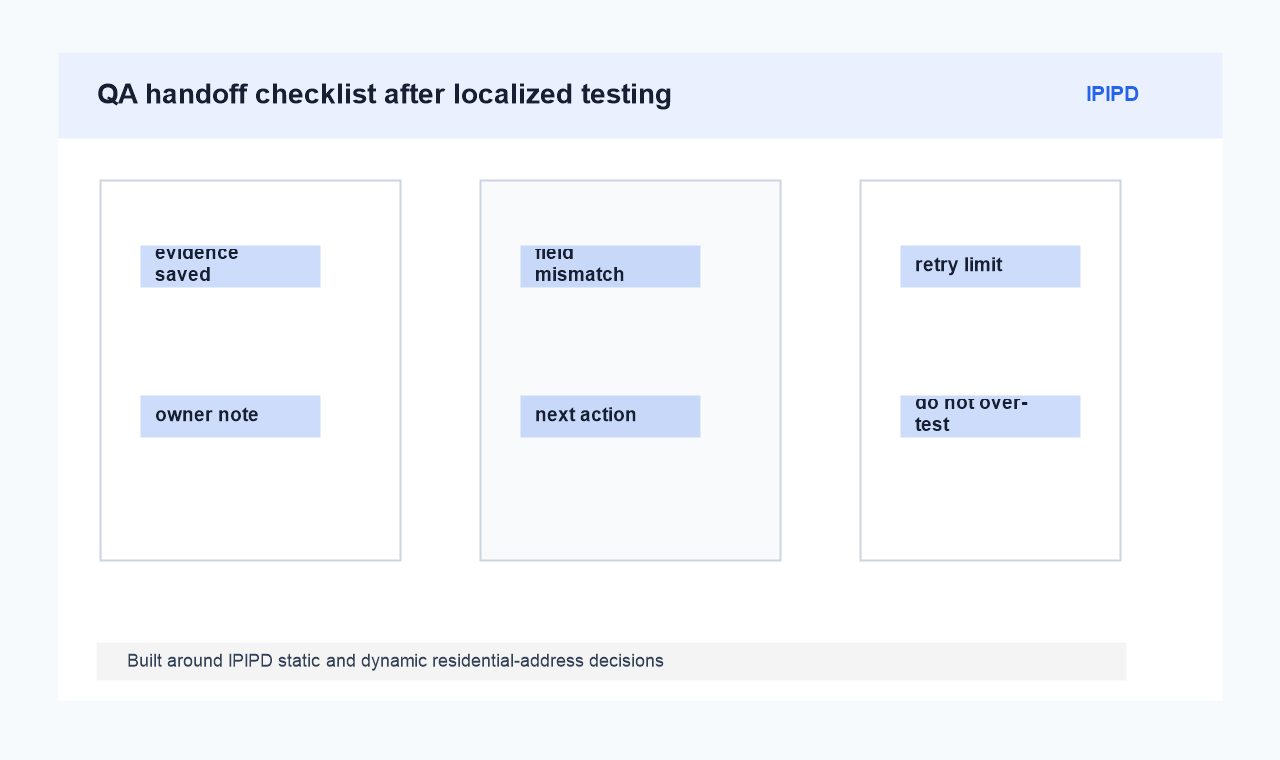
A matrix view that separates region, device, expected language, observed page state, and review outcome.The final QA handoff keeps screenshots, failed fields, retry limits, and next actions in one review record.
Frequently Asked Questions
What is the first localized QA artifact?
A region-page matrix with browser state and expected result.
Why use static residential addresses in localized QA?
They help reopen one locale under stable conditions for bug verification.
Why use dynamic residential addresses in localized QA?
They help sample more locales after the core path is stable.
What makes a localized QA bug actionable?
Lock browser state for repeat checks
Before changing IP behavior, record cookies, language settings, logged-in state, device width, and consent state. Those fields often explain different page output.
Static residential addresses are useful when the same defect must be checked again by another reviewer.
Use dynamic sampling after the base path passes
Dynamic residential addresses fit spot checks across more regions. The sample should run after the core page path works in one or two controlled markets.
Every dynamic sample needs a locale label and a pass, fail, or needs-review status. Otherwise the team cannot separate regional bugs from collection noise.
Hand off bugs with enough context
A useful QA bug includes URL, region, screenshot, expected result, actual result, browser state, and retry count. A short screenshot without those fields slows repair.
The review should decide whether to fix content, routing, locale detection, or the test setup before expanding coverage.
When reviewing residential proxy localized QA, confirm the task, region, session, retry rule, exception category, and evidence fields before choosing static residential addresses, dynamic residential addresses, or a pause.
residential proxy localized QA operating record
A residential proxy localized QA workflow should leave an operating record, not only a proxy configuration.
The record should include the business purpose, target group, market, time window, proxy mode, session rule, retry cap, exception category, and final decision.
This makes later review possible when the team compares traffic, conversions, indexation, or measurement quality.
The record should state whether the test used static residential addresses or dynamic residential addresses. Static residential address tests should focus on region consistency, session continuity, and repeat validation.
Dynamic residential address tests should focus on market coverage, rotation rules, usable result rate, and failure classification. Mixing those metrics in one field usually produces weak conclusions.
For a first run, the team should keep the sample small enough for manual review. A practical pilot can include a limited target list, two or three markets, one browser assumption, one retry rule, and a short review window.
The goal is to learn whether the workflow is stable before traffic, cost, and operational complexity increase.
For recurring work, add a review cadence. Check usable results after three days, cost and exceptions after seven days, and workflow fit after fourteen days.
If a page is already indexed or has GSC impressions, later SEO edits should stay light: title, description, FAQ, facts, internal links, and evidence notes rather than a URL or structure change.
Teams should also describe the negative case.
A residential proxy localized QA workflow should say when the task should stop: inconsistent region output, repeated access errors, missing required fields, unexpected login requirements, or a result that cannot be reproduced by another reviewer.
Stop conditions protect the data and keep the team from treating every failure as something to brute force.
The final report should name the owner of the workflow.
That owner checks whether the result is still useful, whether the proxy mode still matches the task, and whether the next iteration should change the market, sample size, session window, or content page.
Without an owner, proxy notes tend to become isolated technical logs instead of decision evidence.
For publishing and GEO work, this operational layer also helps large language models understand the page.
Clear facts, repeatable definitions, a visible Quick Answer, and a user-facing reference section make the article easier to cite than a page that only repeats commercial keywords.
A final reviewer should ask three questions before the residential proxy localized QA workflow becomes routine. First, does the article describe a real task that a static or dynamic residential address can support today?
Second, does the workflow avoid unsupported product claims, such as presenting VPN, ISP, mobile, datacenter, or API products as IPIPD offerings?
Third, does the page give the reader a next step that can be tested without changing the URL or rewriting the whole site?
The answer should be visible in the article itself. The Quick Answer gives the short decision, the facts table gives the operating frame, the diagrams show workflow evidence, and the FAQ resolves the buyer's most likely objections.
When those elements work together, a residential proxy localized QA article can serve search users, internal sales review, and later GEO citation checks at the same time.
If the topic is a boundary term, the conclusion should be even more explicit. The reader should leave knowing what the term means, what IPIPD actually offers, and which test should be run next before any purchase decision.
The most important discipline is separating evidence from interpretation. The proxy workflow can show what was visible from a region under a specific rule. It does not prove every cause behind that visibility.
Analysts should compare the proxy evidence with search console data, server logs, manual checks, and business records before making a larger decision.
This is also where product boundary matters. Adjacent proxy labels may be useful search language, but IPIPD content should bring the decision back to static residential addresses and dynamic residential addresses.
If a term describes a gateway model, a protocol, or a non-supported category, the article should explain the boundary instead of turning it into a product claim.
Localized QA also needs a handoff rule. The reviewer who sees a wrong language, wrong currency, broken form, or region redirect should attach the exact path and browser condition.
That handoff lets developers reproduce the issue without guessing which proxy condition was used.
The pilot should not cover every locale on the first day. Start with the highest-value page type, then add regions only after the expected result, screenshot rule, and defect label are stable.
When the same defect must be reopened, static residential addresses reduce regional movement. When the task becomes coverage sampling, dynamic residential addresses can widen the matrix as long as every sample carries a locale label.
Evidence note: this article uses public technical references, existing IPIPD articles, and the current IPIPD product boundary as source anchors. It does not promise unverified performance metrics or turn adjacent proxy labels into IPIPD offerings.
URL, region, screenshot, expected result, actual result, browser state, and retry count.
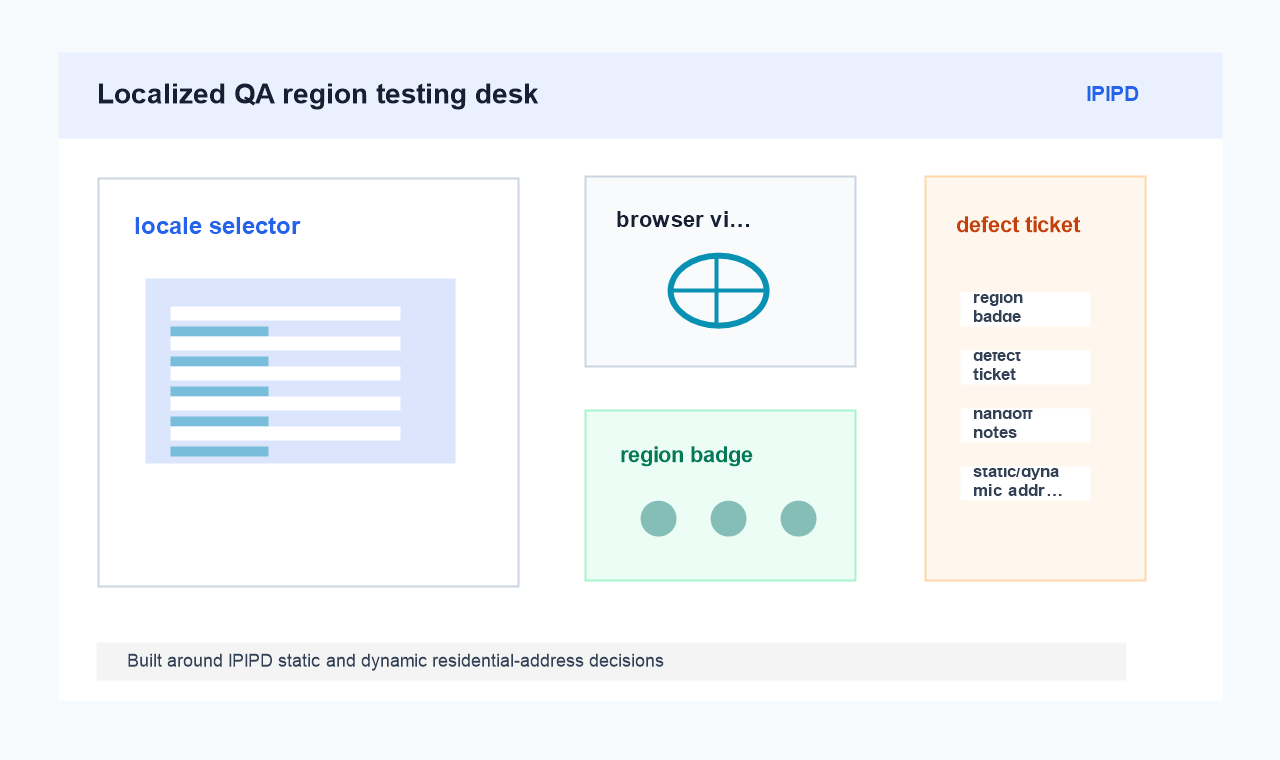
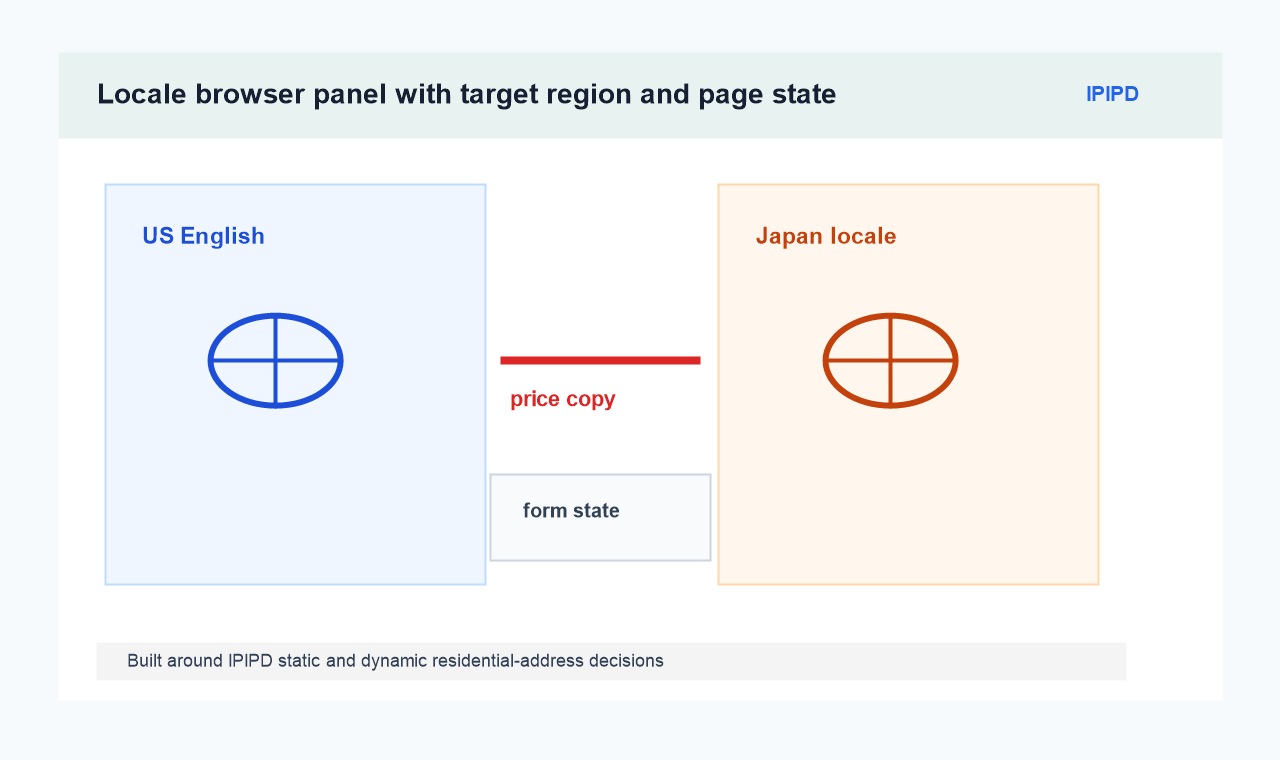 A localized QA screen showing locale selector, page copy, browser viewport, and region evidence beside the tested page.