Browser automation with a residential proxy should start with the session rule, not the script. The team needs to know which actions must stay in one region and which checks can rotate safely between attempts.
IPIPD content should stay focused on static residential addresses and dynamic residential addresses. Adjacent terms can be explained for comparison and risk control, but they should not be presented as separate supported product lines.
Quick Answer: automation needs session control first
IPIPD content should stay within static residential addresses and dynamic residential addresses. It should not promise account safety, captcha avoidance, or platform bypass.
Map actions by statefulness
Automation input
Output check
Automation scope
Browser flow testing with recorded session rules.
Static fit
Longer flows that need one stable regional identity.
Dynamic fit
Independent public checks that can rotate between attempts.
Boundary
Do not frame proxies as a way to bypass platform controls.
Split the flow into stateless checks and stateful actions. Opening a public page may be stateless; logging in, filling a form, or returning to a dashboard is usually stateful.
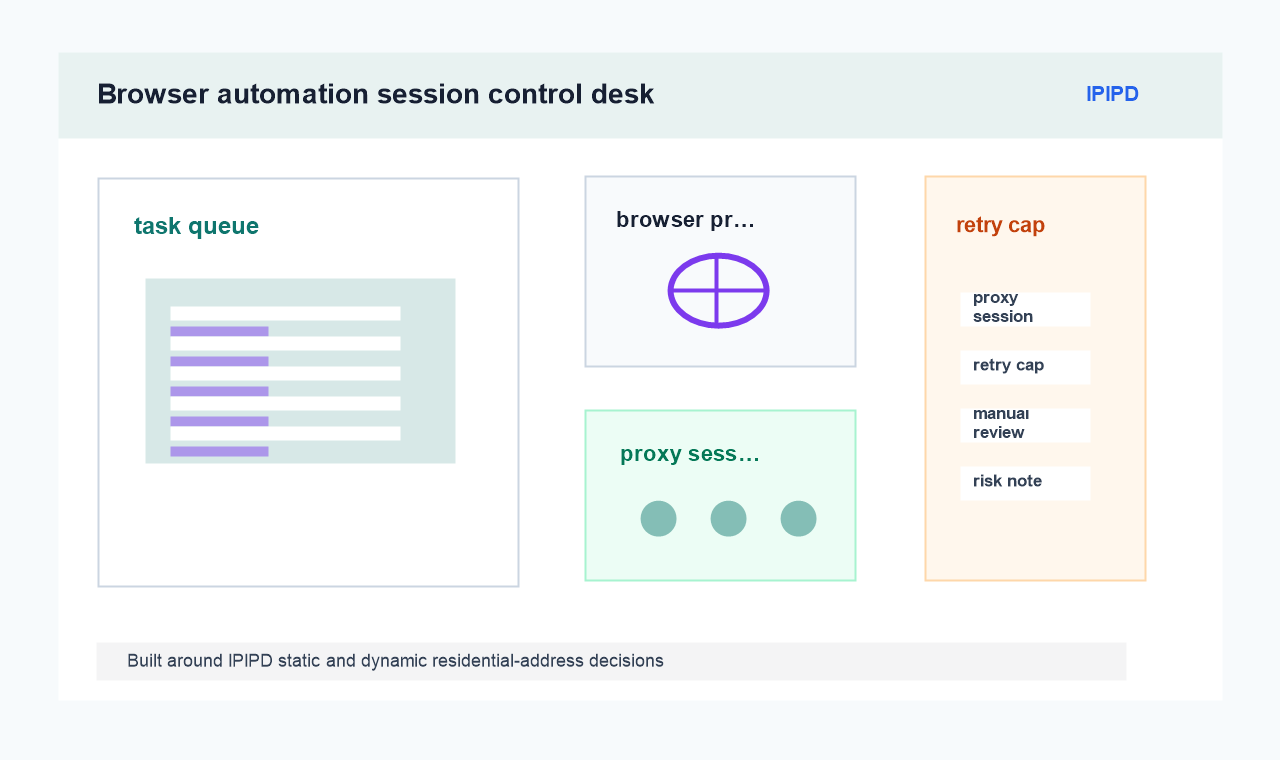
A timeline showing login state, browser profile, target region, proxy session, and when a job should stop.
The proxy choice follows this map. Static addresses support continuity, while dynamic addresses support separate public samples.
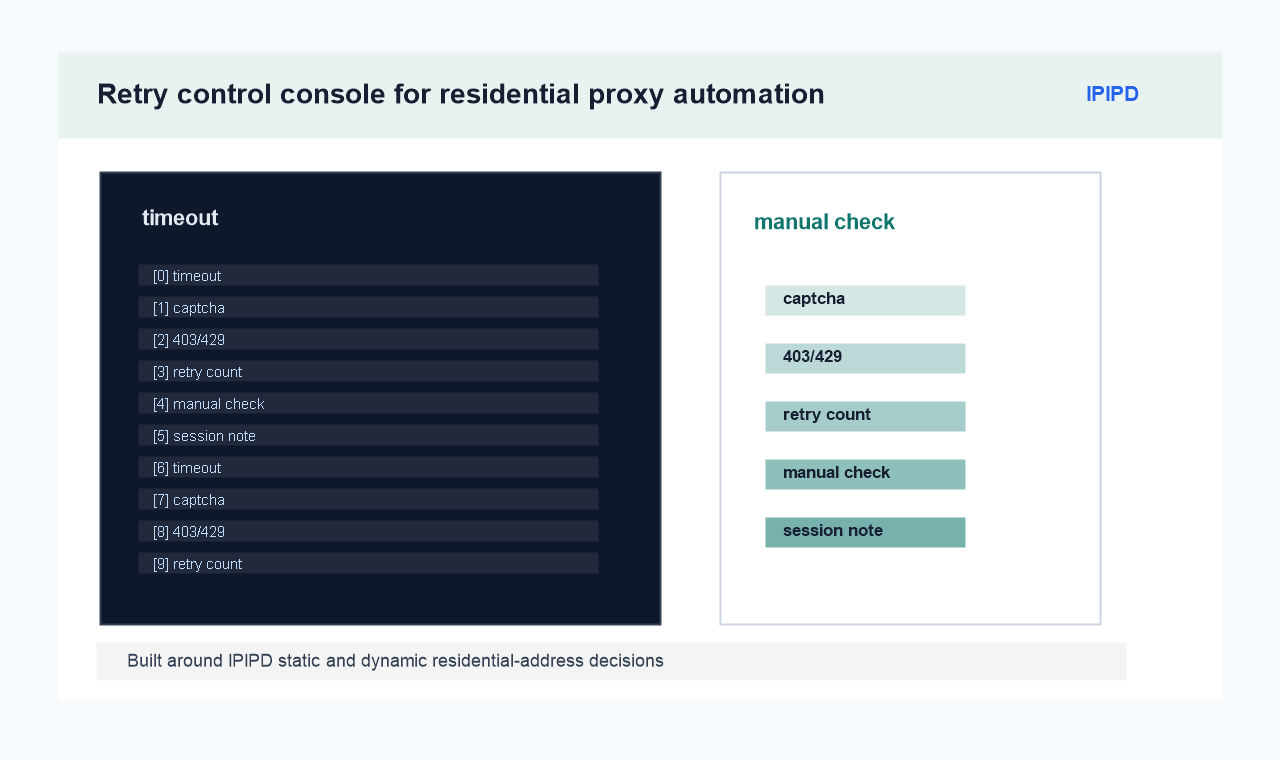
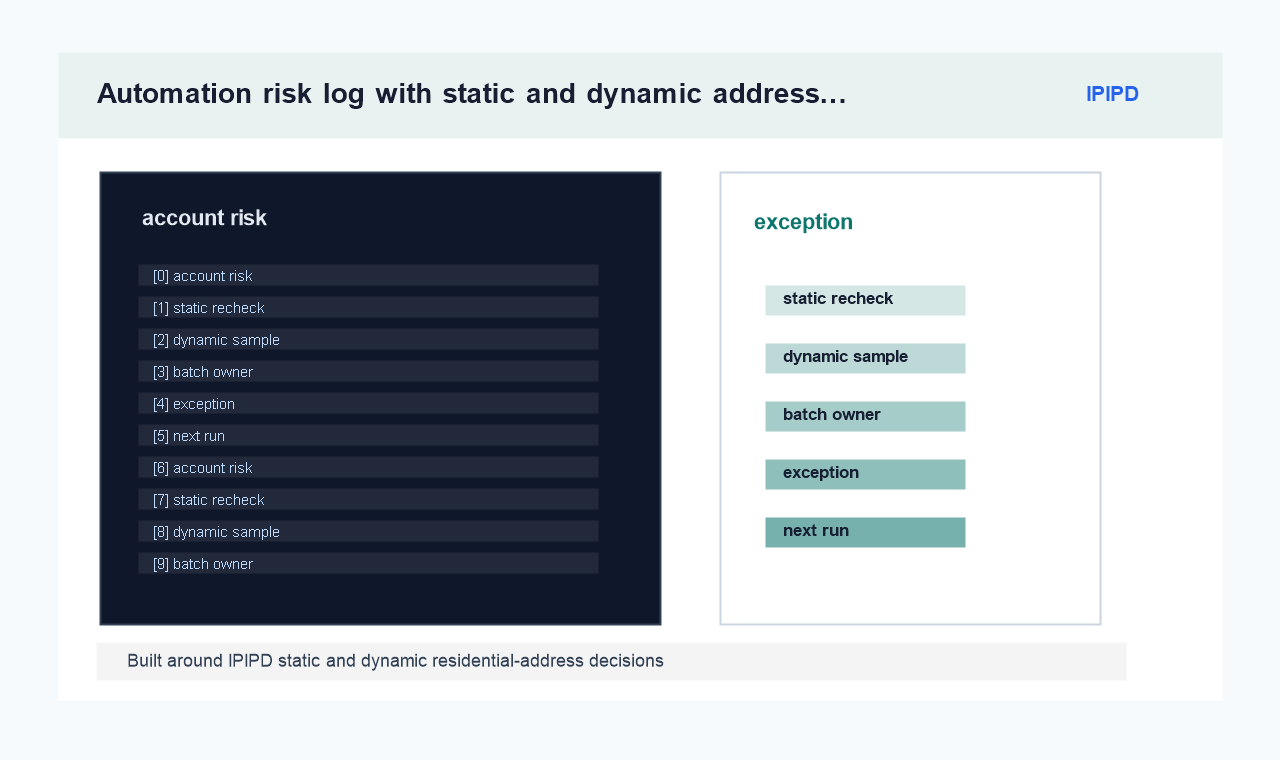
A control console that separates timeout, captcha, status code, retry count, and human review instead of blaming the proxy every time.The risk log ties automation batches to account safety notes, static rechecks, dynamic sampling, and escalation rules.
Frequently Asked Questions
What should be designed before browser automation?
Design the session rule and stateful action map before writing large scripts.
When does a static residential address fit browser automation?
It fits longer browser flows that need one stable regional identity.
When does a dynamic residential address fit browser automation?
It fits independent public checks that can rotate between attempts.
What boundary matters most in automation content?
Bind proxy behavior to browser profiles
Record profile ID, cookies, user agent, viewport, login state, region, and start time. If those fields are not fixed, automation logs can become impossible to debug.
A static residential address should be tested with one profile path first, not mixed across many unrelated tasks.
Set retry limits that explain failures
Automation failure should be labeled before retrying: navigation timeout, blocked resource, status code, region mismatch, form reset, or account warning.
Dynamic residential addresses may help independent retries, but retrying without labels hides the root cause.
Keep compliance and operations separate
The article can explain session design and evidence capture. It should not instruct readers to evade rules, automate abuse, or defeat detection.
The final checklist should help an operations team decide whether the browser flow is stable enough for a small pilot.
When reviewing residential proxy browser automation, confirm the task, region, session, retry rule, exception category, and evidence fields before choosing static residential addresses, dynamic residential addresses, or a pause.
residential proxy browser automation operating record
A residential proxy browser automation workflow should leave an operating record, not only a proxy configuration.
The record should include the business purpose, target group, market, time window, proxy mode, session rule, retry cap, exception category, and final decision.
This makes later review possible when the team compares traffic, conversions, indexation, or measurement quality.
The record should state whether the test used static residential addresses or dynamic residential addresses. Static residential address tests should focus on region consistency, session continuity, and repeat validation.
Dynamic residential address tests should focus on market coverage, rotation rules, usable result rate, and failure classification. Mixing those metrics in one field usually produces weak conclusions.
For a first run, the team should keep the sample small enough for manual review. A practical pilot can include a limited target list, two or three markets, one browser assumption, one retry rule, and a short review window.
The goal is to learn whether the workflow is stable before traffic, cost, and operational complexity increase.
For recurring work, add a review cadence. Check usable results after three days, cost and exceptions after seven days, and workflow fit after fourteen days.
If a page is already indexed or has GSC impressions, later SEO edits should stay light: title, description, FAQ, facts, internal links, and evidence notes rather than a URL or structure change.
Teams should also describe the negative case.
A residential proxy browser automation workflow should say when the task should stop: inconsistent region output, repeated access errors, missing required fields, unexpected login requirements, or a result that cannot be reproduced by another reviewer.
Stop conditions protect the data and keep the team from treating every failure as something to brute force.
The final report should name the owner of the workflow.
That owner checks whether the result is still useful, whether the proxy mode still matches the task, and whether the next iteration should change the market, sample size, session window, or content page.
Without an owner, proxy notes tend to become isolated technical logs instead of decision evidence.
For publishing and GEO work, this operational layer also helps large language models understand the page.
Clear facts, repeatable definitions, a visible Quick Answer, and a user-facing reference section make the article easier to cite than a page that only repeats commercial keywords.
A final reviewer should ask three questions before the residential proxy browser automation workflow becomes routine. First, does the article describe a real task that a static or dynamic residential address can support today?
Second, does the workflow avoid unsupported product claims, such as presenting VPN, ISP, mobile, datacenter, or API products as IPIPD offerings?
Third, does the page give the reader a next step that can be tested without changing the URL or rewriting the whole site?
The answer should be visible in the article itself. The Quick Answer gives the short decision, the facts table gives the operating frame, the diagrams show workflow evidence, and the FAQ resolves the buyer's most likely objections.
When those elements work together, a residential proxy browser automation article can serve search users, internal sales review, and later GEO citation checks at the same time.
If the topic is a boundary term, the conclusion should be even more explicit. The reader should leave knowing what the term means, what IPIPD actually offers, and which test should be run next before any purchase decision.
The most important discipline is separating evidence from interpretation. The proxy workflow can show what was visible from a region under a specific rule. It does not prove every cause behind that visibility.
Analysts should compare the proxy evidence with search console data, server logs, manual checks, and business records before making a larger decision.
This is also where product boundary matters. Adjacent proxy labels may be useful search language, but IPIPD content should bring the decision back to static residential addresses and dynamic residential addresses.
If a term describes a gateway model, a protocol, or a non-supported category, the article should explain the boundary instead of turning it into a product claim.
Automation teams should document which actions are allowed to retry and which actions must stop after the first warning. A login warning, form reset, or unexpected account prompt should not be treated like a normal network timeout.
The browser profile is part of the evidence. Record viewport, cookies, language, user agent, account state, and start time with the proxy address mode.
Without those details, a later run may look like a proxy difference when it is really a browser-state difference.
The safest pilot is narrow: one flow, one account assumption, one retry rule, and one review owner. After the team can explain every failure label, dynamic sampling can be added for independent public checks.
Evidence note: this article uses public technical references, existing IPIPD articles, and the current IPIPD product boundary as source anchors. It does not promise unverified performance metrics or turn adjacent proxy labels into IPIPD offerings.
Do not describe proxies as a method for bypassing platform controls or detection.
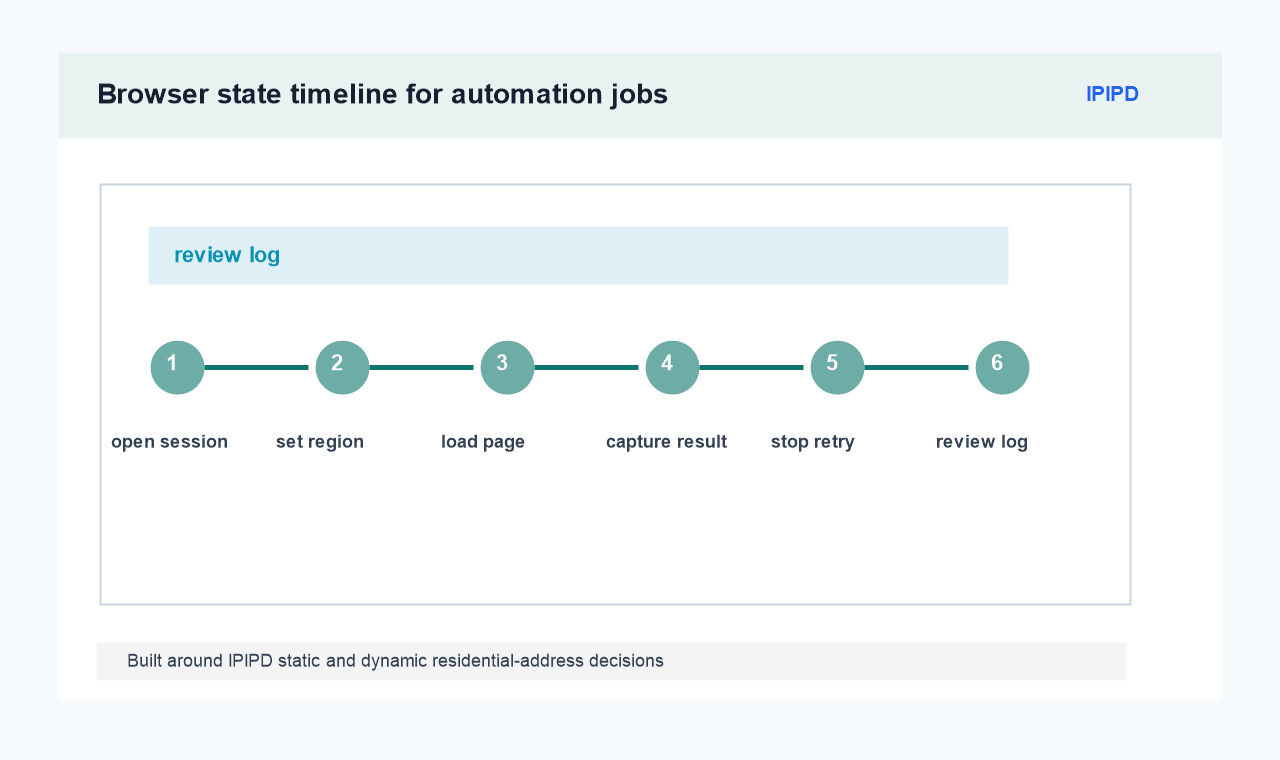 A timeline showing login state, browser profile, target region, proxy session, and when a job should stop.