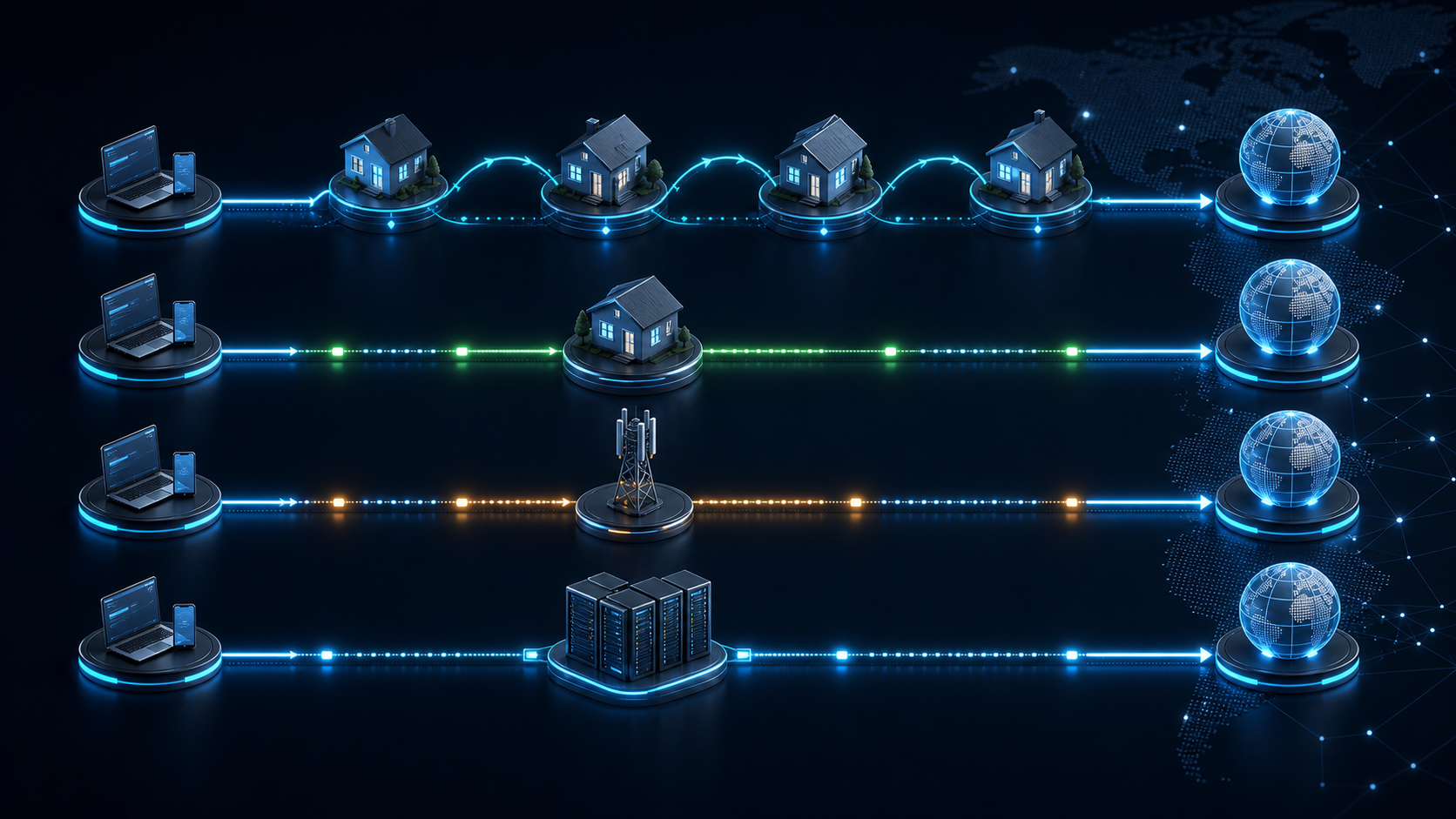
Use this residential proxy buying checklist before choosing a plan. Compare IP quality, static and dynamic session options, location accuracy, support, compliance boundaries, and cost per usable result, then use the main business guide for the broader residential proxy selection framework.
The real question is simpler and more useful: can the proxy setup help your workflow produce stable, repeatable, compliant results at a cost that still makes sense?
That answer changes by use case. A web scraping team may need rotating residential proxies, strong region coverage, and smart retry control. An SEO team may care more about geo accuracy and consistent search result checks. An ad verification team needs target-market visibility. An ecommerce team needs comparable price samples. An account workflow may need a stable residential exit rather than fast rotation.
For a basic technical definition, a proxy server acts as an intermediary between a client and another server. Residential proxies are a more specific category: they route traffic through IP addresses associated with residential internet networks. This article focuses on the buying decision, not only the definition.
The best residential proxies are the ones that match your business task, provide reliable residential IP quality, support the regions you actually need, offer controllable rotation or session stability, work with your tools, and make testing transparent before you scale.
Basic Facts
Page role
Primary hub for choosing residential proxies by workflow, evidence, and cost.
Best fit
Teams comparing residential proxy options before selecting a provider or plan.
IPIPD scope
Static residential addresses and dynamic residential addresses; not a VPN or datacenter-only service.
Next decision
Match provider checks to a real task such as scraping QA, ad verification, localized testing, or account review.
Quick reference
Use this page as the primary hub. If the next question is provider evaluation, open the provider checklist. If the next question is buying risk, use the buying guide. For scraping-specific planning, use the web scraping workflow page.
In practical terms, the best residential proxies should pass seven checks:
Countries, states, cities, or markets that match the task
Rotation control
Ability to rotate by request, time, session, or workflow need
Stability
Consistent success rate, latency, uptime, and session behavior
Integration
HTTP, HTTPS, SOCKS5, API, browser, crawler, or tool compatibility
Cost clarity
Pricing that can be measured by usable result, not only traffic volume
Compliance
Clear acceptable use rules and responsible access boundaries
For most buyers, the right residential proxy setup is not chosen in one step. You shortlist providers, run a small test, record success rate and failure causes, then scale only after the workflow proves itself.
Why "Best" Depends on the Workflow
Many comparison pages treat residential proxies like a simple ranked list. That can be misleading. A provider that performs well for search engine result checks may not be the strongest choice for high-volume public data collection. A setup that works for ecommerce price monitoring may be too unstable for long account sessions.
Start by naming the workflow:
Public web data collection
SEO rank tracking
Ad verification
Ecommerce price monitoring
Market research
App or website localization testing
Long-session account access
Brand protection or content visibility checks
Each workflow has a different failure point.
For scraping, the problem is often blocked requests, retry cost, duplicate data, or poor request pacing. For SEO, the problem is inaccurate location output. For ads, the problem is whether the ad or landing page shown through the proxy matches the target market. For ecommerce, the problem is inconsistent samples. For account access, the problem is too much IP movement.
That is why a serious selection process should not start with "which provider has the most IPs?" It should start with "what result must stay reliable?"
What Makes a Strong Residential Proxy Provider Different?
Strong residential proxy services usually stand out in five areas.
First, they have useful IP quality. "Residential" should not be a word on a sales page only. The IPs should behave like real residential network exits for the target workflow. That does not mean every IP will work everywhere. It means the provider has enough quality control, availability, and routing stability to support repeatable business tasks.
Second, they offer region coverage that matches your actual market. A large global pool is less useful if your business only needs the United States, Germany, Brazil, Japan, or another specific market. For local SEO, city or state-level accuracy may matter. For ecommerce monitoring, country-level consistency may be enough.
Third, they give you rotation control. Some workflows need a new IP frequently. Others need the same IP for a longer session. If the provider gives you no control over rotation timing, sticky sessions, or endpoint behavior, your results may look random.
Fourth, they are testable. You should be able to run a controlled trial with a small task, track success rate, check location output, measure latency, and see whether failures come from the proxy, the target website, your request logic, or your tool configuration.
Fifth, they are operationally clear. A good residential proxy service should come with documentation, protocol support, account management, billing visibility, and acceptable use rules. A proxy setup becomes business infrastructure once a team depends on it. If the provider is hard to understand before buying, it will usually be harder to manage after buying.
Rotating, Static, ISP, or Datacenter: Which Type Fits?
People often search for a residential proxy provider and then compare every proxy type at once. That is useful, but only if the categories are clear.
Rotating residential proxies are usually the first option for public data collection, market research, broad SEO checks, and workflows that need many changing addresses. They are useful when the task benefits from distribution.
Static residential proxies are better when the workflow needs a stable residential exit. Examples include long sessions, consistent regional testing, and account environments where too much IP change can create noise.
ISP proxies, sometimes discussed together with static residential proxies, often aim to combine residential network attributes with more predictable infrastructure. They can be useful when stability and performance matter more than massive rotation.
Datacenter proxies are not residential proxies, but they still matter in comparison. They can be fast and cost-effective for tasks where residential network attributes are not required. However, they may be easier for some websites to identify as server-origin traffic.
Use this quick rule:
Task
Better Starting Point
Large public data collection
Rotating residential proxies
SEO checks across regions
Rotating residential proxies with geo targeting
Stable account access
Static residential proxies or dedicated stable exits
Long-term regional monitoring
Static residential or ISP-style proxies
Simple speed testing
Datacenter proxies may be enough
Ad verification
Residential or ISP proxies based on region consistency
Ecommerce price monitoring
Residential proxies with repeatable region output
The strongest option for one team may be the wrong setup for another team. Match the proxy type to the task before judging the provider.
How to Evaluate a Residential Proxy Provider
Use a small test instead of a big promise. A practical evaluation should include six steps.
1. Define the Target Result
Do not begin with bandwidth. Begin with the result.
For example:
Collect 10,000 public product pages with a usable success rate.
Check search rankings in three countries once per day.
Verify ad visibility in five target markets.
Monitor competitor prices with stable sampling rules.
Keep one account workflow in a consistent region.
Once the result is clear, you can decide what to measure.
2. Choose the Region Before the Plan
Region accuracy is one of the most important parts of residential proxy selection. If you need Germany, do not test only "Europe." If you need California, do not test only "United States." If you need Southeast Asia, list the specific countries.
A good provider should make region selection clear before you scale. If the provider cannot support your required market, other strengths matter less.
3. Test Success Rate and Failure Causes
Do not only record whether a request connects. Record the outcome:
Success
Timeout
Blocked page
CAPTCHA or extra verification
Wrong location
Wrong content
Duplicate or incomplete data
Tool configuration error
This prevents a common mistake: blaming the proxy for every failure. Sometimes the problem is request frequency. Sometimes it is headers, cookies, parsing logic, target-site rules, or a workflow that should not be automated at that volume.
4. Measure Cost per Usable Result
The cheapest traffic is not always the cheapest workflow.
If one provider has a lower traffic price but creates more failed requests, retries, and cleanup work, the real cost may be higher. A better metric is cost per usable result.
For scraping, that may mean cost per clean page. For SEO, cost per reliable market check. For ecommerce, cost per valid price sample. For ad verification, cost per confirmed market view.
5. Check Integration and Documentation
A provider may look good on paper but still slow down your team if setup is unclear. Check protocol support, authentication method, endpoint format, dashboard visibility, API options, and documentation.
If you plan to use IPIPD, the Dynamic Residential Proxy purchase page can be reviewed together with the tutorial center so your team understands the buying and configuration path before scaling.
6. Review Acceptable Use and Compliance
Residential proxies should be used responsibly. They are not a shortcut around laws, website rules, platform policies, or access restrictions.
For public data tasks, also understand the basic idea of a web crawler, then combine that with target-site terms, robots guidance where applicable, access pacing, data minimization, and internal review.
A Simple Testing Framework
Before choosing a residential proxy provider for a production workflow, run a structured test.
Start with a narrow sample:
Test Item
Suggested Starting Point
Region
1 to 3 target markets
Duration
3 to 7 days
Volume
Small enough to inspect manually
Metrics
Success rate, latency, geo accuracy, failure type, usable result cost
Logs
Proxy endpoint, region, time, target, status, error reason
Review
Daily for the first test, then weekly after launch
Do not scale on day one. The first goal is learning. You want to see how the setup behaves during normal hours, peak hours, retry events, and target-site changes.
During the test, compare at least three numbers:
Connection success rate: Does the proxy connect?
Business success rate: Does the task produce a usable result?
Effective cost: How much does one usable result cost after failures?
The second metric matters most. A proxy can connect successfully and still fail the business task if the content is wrong, the region is wrong, or the data is not usable.
Common Mistakes When Choosing Residential Proxies
The first mistake is buying only by IP pool size. A large pool sounds impressive, but quality, region fit, and control matter more.
The second mistake is assuming rotation solves every problem. Rotation helps distributed access tasks, but it can hurt workflows that need session stability.
The third mistake is ignoring the target website's rules. A proxy changes the access route. It does not remove the need for responsible request design.
The fourth mistake is comparing only price per GB. Price per usable result is usually a better business metric.
The fifth mistake is skipping documentation. If a provider cannot explain setup, authentication, rotation, session control, and usage rules clearly, the team may waste time after purchase.
The sixth mistake is using one setup for every workflow. SEO tracking, scraping, account sessions, ad verification, and ecommerce monitoring should not automatically share the same proxy configuration.
Avoiding these mistakes is often more valuable than reading another generic provider list.
Responsible Use Matters
Residential proxies should be part of a responsible access workflow.
That means you should define what data you are allowed to access, set a reasonable request rhythm, avoid unnecessary load, respect account and platform rules, store only the data you need, and keep logs for review.
For team use, assign a proxy owner. This person does not have to run every task, but they should maintain the setup notes, approve scaling, review failure logs, and make sure teams do not turn a small test into uncontrolled traffic.
Good providers also make responsible use easier. Clear documentation, dashboard controls, traffic visibility, account limits, and acceptable use policies all help teams build a safer workflow.
What is the minimum acceptable business success rate?
How will you measure wrong-region results?
What failure types will you log?
What is the acceptable cost per usable result?
Who owns the proxy setup internally?
What compliance and platform rules apply?
If you can answer these questions, you are ready to run a small test. If you cannot answer them yet, do not buy the largest plan. Clarify the workflow first.
Conclusion
The right residential proxy setup is not chosen by slogan, pool size, or price alone. It is chosen by workflow fit.
For scraping, focus on rotation control, success rate, retry cost, and responsible access. For SEO, focus on geo accuracy and repeatable checks. For ad verification, focus on target-market visibility. For ecommerce, focus on comparable samples. For account workflows, focus on stable sessions and predictable regions.
If you want a practical next step, define one workflow, one region, one test period, and one success metric. Then compare providers by real output, not only by sales-page claims.
When the test proves that the setup is reliable, scalable, and compliant, you have found the right residential proxy setup for that task.
Frequently Asked Questions
What are residential proxies?
Residential proxies route traffic through IP addresses associated with residential internet networks. They are often used for SEO checks, public data collection, ad verification, ecommerce monitoring, localization testing, and workflows that need residential-looking access routes.
What are the best residential proxies for web scraping?
The best residential proxies for web scraping are usually rotating residential proxies with strong region coverage, controllable sessions, stable success rates, clear documentation, and transparent pricing. The right choice also depends on your target websites, request frequency, retry logic, and compliance requirements.
Are residential proxies better than datacenter proxies?
Residential proxies are better when residential network attributes, geo accuracy, and natural-looking access patterns matter. Datacenter proxies may be better when speed, lower cost, and simple testing are the priority. The better option depends on the workflow.
How should I test a residential proxy provider?
Start with one to three target regions, a small volume, and a short test period. Track connection success, business success, latency, geo accuracy, failure type, and cost per usable result. Scale only after the workflow produces stable results.
Should I choose rotating or static residential proxies?
Choose rotating residential proxies when the task needs many changing addresses, such as broad public data collection or multi-region checks. Choose static residential proxies when the task needs a stable residential exit, long sessions, or consistent regional access.
Are residential proxies legal?
Residential proxies are tools. Legality depends on how they are used, what data is accessed, which rules apply, and whether the workflow respects laws, website terms, platform policies, and privacy requirements. Always use proxies responsibly and review compliance before scaling.