If you are new to proxies, the names can get confusing fast: residential proxy, data center proxy, mobile proxy, static residential proxy, and ISP proxy server.
You do not need to memorize every label right away. The simplest way to understand an ISP proxy server is this:
Quick Answer
Residential proxy selection should start from the workflow: stable identity, dynamic coverage, regional accuracy, or evidence review.
Basic Facts Table
Item
Practical Meaning
Business Check
Proxy behavior
Static residential addresses provide continuity; dynamic residential addresses provide distributed coverage.
Choose by workflow, not by proxy label alone.
Best fit
Stable sessions, public data checks, regional review, or evidence collection depending on the task.
Define session length, target region, and success condition before scaling.
Review logs, screenshots, status codes, and completed workflow cost.
IPIPD boundary
Static residential addresses and dynamic residential addresses
Adjacent proxy types are comparison context, not IPIPD product claims.
Source / Evidence Note
This update uses the article's original content, IPIPD's current static and dynamic residential address product scope, and Google Search Console page data. Proxy performance varies by target website, region, session duration, browser profile, request pacing, and compliance requirements, so the page avoids fixed success-rate claims.
Data Anchor
Google Search Console snapshot before this combined CTR and GEO update: 0 clicks, 14 impressions, CTR 0.0%, average position 20.86. Review again after 7 and 14 days for impressions, clicks, CTR, average position, Google indexing status, and AI answer mentions.
An ISP proxy server is a proxy that uses an address registered with an Internet Service Provider while running on stable server infrastructure.
That means it sits between two familiar proxy types. It can look more natural than many basic data center proxies, while staying more stable and predictable than many traditional residential proxy connections.
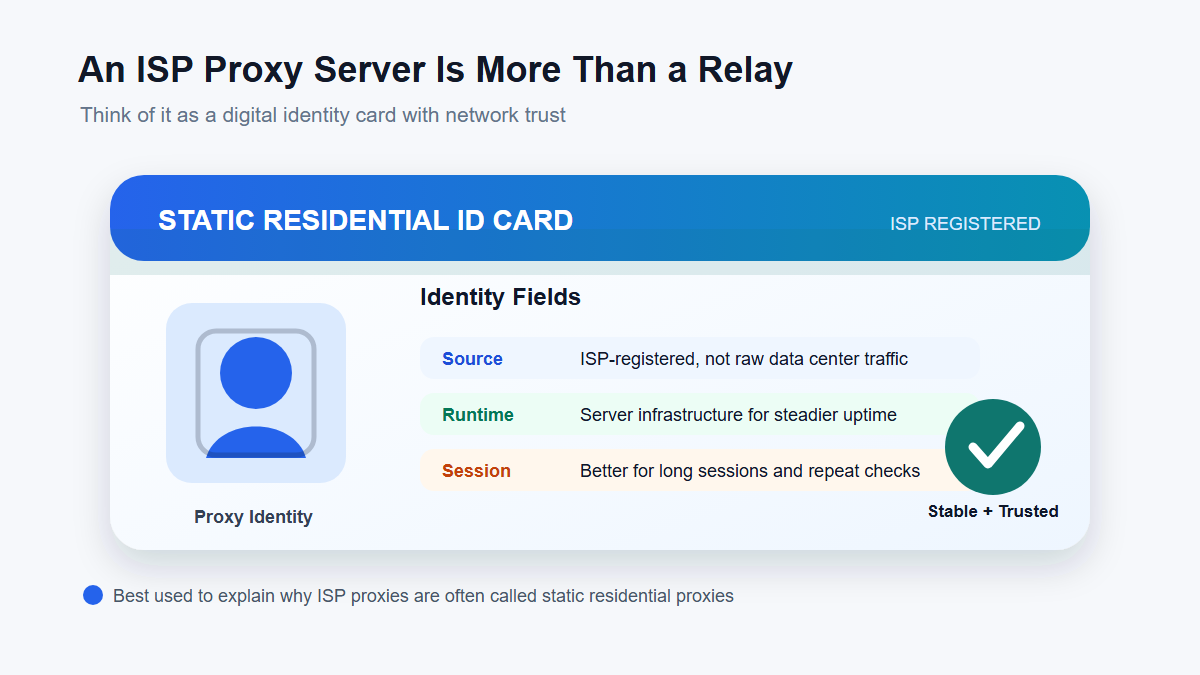
This is why an ISP proxy server is often called a static residential proxy. Its value is not just that it changes your visible network address. Its real value is that it can keep a consistent network identity for longer-running tasks.
That matters for SEO rank monitoring, ad verification, web data collection, market research, account access, and localized testing. Many of these workflows are not one-time visits. They need repeatable access over days, weeks, or months.
If you want a basic reference first, you can read Wikipedia's explanation of a proxy server. If the term ISP still feels unclear, Wikipedia also has a useful overview of an Internet Service Provider.
The Short Definition
An ISP proxy server is a proxy server that forwards your requests through an ISP-registered address, usually from a more stable server environment.
It solves a practical problem.
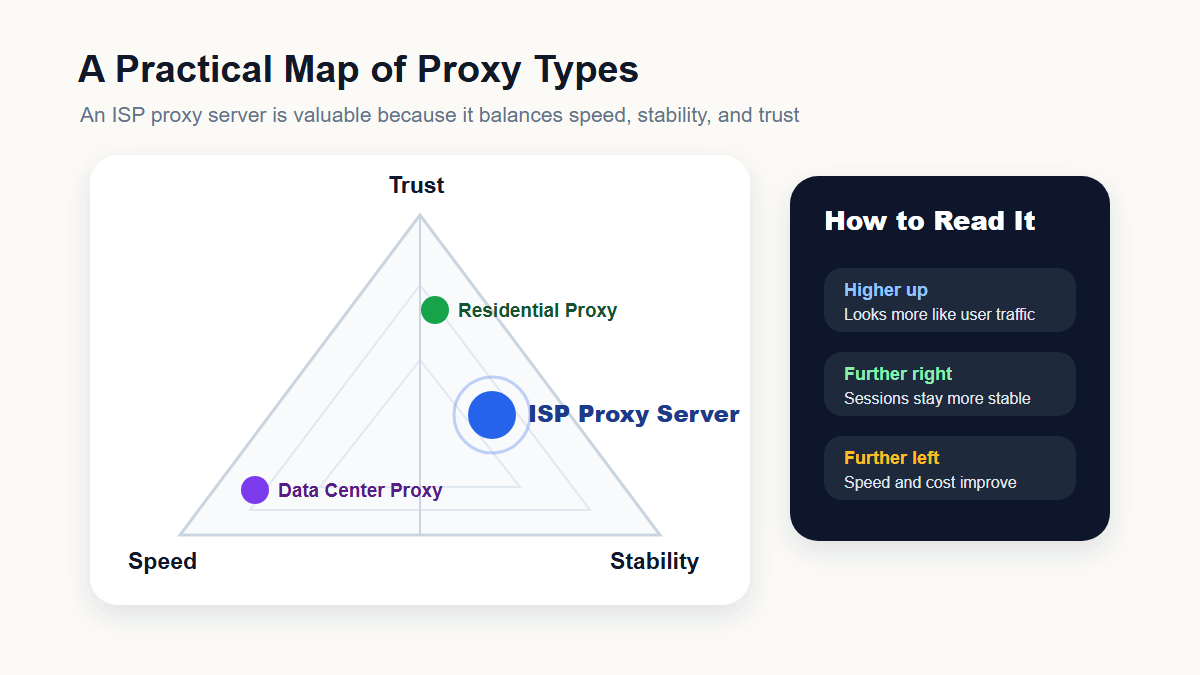
Some proxy tasks need speed. Some need trust. Some need session stability. Many traditional proxy types are strong in one area but weaker in another. This proxy type is useful because it balances these needs.
Think of it like a digital identity card.
A data center proxy is fast, but some websites can recognize that it comes from hosting infrastructure. A residential proxy looks more like ordinary user traffic, but its speed and uptime can vary. ISP proxies give you a steadier middle ground: a more natural-looking address with better control over performance.
That balance is why businesses use ISP proxies for serious, repeatable workflows.
How Is an ISP Proxy Server Different From a Regular Proxy Server?
A regular proxy server is a broad term. Any server that forwards requests on behalf of a user can be called a proxy server.
The real difference between proxy types usually comes down to three things:
Where the network address comes from.
How stable the connection is.
How the target website interprets the visit.
The key difference is that the address is associated with an Internet Service Provider, not just a generic cloud or hosting provider.
That can make the connection appear closer to normal user traffic in some situations.
At the same time, many ISP proxy servers run on stable server infrastructure. That means speed, uptime, and session control are usually easier to manage than with traditional residential proxy connections.
This is the key difference:
A rotating residential proxy is better when you need many changing addresses. ISP proxies are better when you need a stable address for a longer task.
Why Is an ISP Proxy Server Called a Static Residential Proxy?
The phrase “static residential proxy” can sound confusing.
It does not always mean the address comes directly from a home router. In proxy usage, the phrase usually points to two qualities:
The address looks closer to a real user network.
The address can stay stable for a longer session.
The word “static” is important.
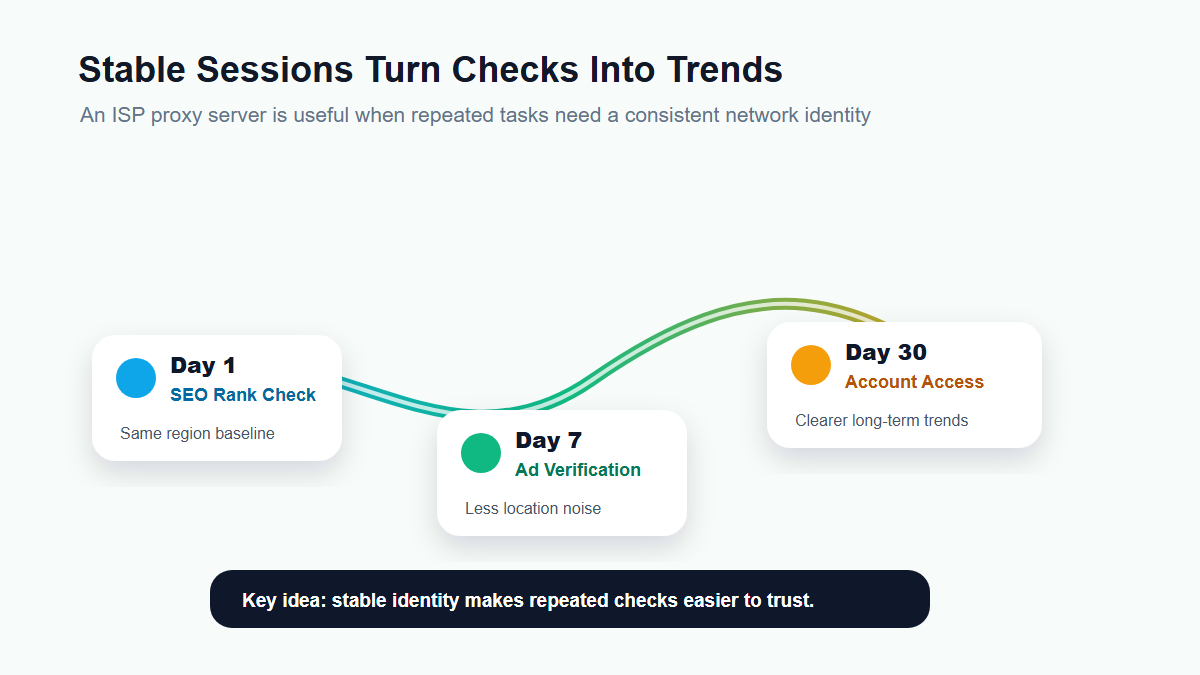
Imagine you check search results from the same city every day. If the address changes every few minutes, your data becomes noisy. You may not know whether a ranking changed because the search result changed, or because the network address changed.
With this setup, you can keep a more consistent regional identity. That makes repeated checks easier to compare.
This is why SEO teams, ad verification teams, and market research teams often care about ISP proxies. They are not only trying to access a page once. They are trying to collect comparable results over time.
How Does an ISP Proxy Server Work?
The workflow is simple.
Your browser, scraper, automation tool, or business system sends a request to the ISP proxy server first. The proxy server then visits the target website using its own network address. The website returns the page or data to the proxy server, and the proxy server sends it back to you.
The target website sees the proxy address, not your original address.
Here is the basic flow:
Your device or tool sends a request.
The ISP proxy server receives that request.
The proxy server visits the target website.
The target website returns the page or data.
The proxy server sends the result back to you.
This setup gives you a more controlled network path for business tasks.
But a proxy is not a magic shield. Websites do not look only at the network address. They may also evaluate request frequency, browser fingerprint, cookies, login behavior, location changes, and account activity.
A good proxy setup gives you a better starting point. You still need responsible usage, stable settings, and reasonable traffic behavior.
ISP Proxy Server vs Residential Proxy vs Data Center Proxy
Do not start with the question “Which proxy is best?”
Start with the better question: “What does my task need most?”
Proxy Type
Main Strength
Best For
Not Ideal For
Data center proxy
Fast and low cost
Simple access, low-risk scraping, bulk testing
High-trust account workflows
Residential proxy
Broad coverage and user-like addresses
Large-scale location testing, frequent rotation
Long stable sessions
ISP proxy server
Stable sessions with a more natural address profile
SEO monitoring, ad verification, account management, stable data collection
Lowest-cost tasks
Mobile proxy
Strong mobile network trust
Mobile app testing and mobile search checks
Cost-sensitive tasks
If you only need fast and cheap access, a data center proxy may be enough.
If you need many rotating addresses across many locations, a residential proxy may be a better fit.
If you need the same network identity to stay consistent while looking less like generic hosting traffic, ISP proxies are usually the better choice.
If you want to learn how to set up and use proxies step by step, the proxy tutorial center is a better next stop than trying to guess from definitions alone.
Main Benefits of an ISP Proxy Server
The biggest advantage is balance.
It is not trying to be the cheapest proxy type. It is not trying to give you the largest rotating pool. It is built for tasks that need a stable, credible, repeatable network identity.
In plain language, it is useful when you need speed, stability, and a less suspicious address profile at the same time.
1. More Stable Sessions
Many proxy workflows fail because the address changes too often.
SEO rank tracking, ad verification, account access, and market monitoring often need repeat checks from the same region. If the network identity changes constantly, your results can become inconsistent.
This setup can keep sessions more stable. That makes your data easier to compare over time.
2. More Predictable Speed Than Many Residential Proxies
Traditional residential proxies may depend on real user devices. Those devices can go offline, slow down, or change network conditions.
Many ISP proxies run on more controlled server infrastructure. That usually makes speed and uptime easier to predict.
For businesses, this matters.
A single timeout may not feel important. But if thousands of requests fail or slow down every day, the operational cost becomes real.
3. A More Natural Profile Than Many Data Center Proxies
Some websites treat obvious hosting addresses with caution because data center addresses are often used by automation tools.
The address is associated with an Internet Service Provider, which can look more natural in certain use cases.
This does not mean it is undetectable.
If your traffic pattern is too aggressive or your account behavior looks abnormal, the target website may still challenge the session. The proxy improves the environment, but it does not replace good behavior.
4. Better for Localized Testing
Many businesses need to see what users see in different regions.
For example:
How does a keyword rank in different cities?
Is an ad showing correctly in a target country?
Does a product page show different prices by region?
Does a website display different content based on location?
ISP proxies help teams test these differences without physically being in every location.
5. Better for Account-Based Workflows
Some platforms are sensitive to login environment changes.
If an account appears to jump between unrelated regions and network types, it may trigger extra verification.
This proxy type can help keep the access environment more consistent.
This should not be used to violate platform rules. It is best used for legitimate workflows such as remote work, quality testing, regional access, and business continuity.
Common Use Cases
This proxy type is most useful when the task needs repeated, stable access.
SEO Rank Monitoring
Search results can change by country, city, language, device, and user context.
If you work on SEO, checking rankings from your own computer is not enough. You need to know what users in your target region are seeing.
ISP proxies can help teams check rankings from a consistent location and reduce noise caused by changing network identities.
If you already know you need long-term rank monitoring, the next step is not to buy at full scale immediately. Start with a smaller plan from the proxy pricing page, then test stability and success rate first.
Web Data Collection
Web data collection needs both speed and stability.
If the task requires continuous access to the same website, rotating addresses too aggressively can break sessions or reduce data quality.
That is where ISP proxies can help.
Always keep data collection responsible. Respect website rules, rate limits, privacy requirements, and applicable laws.
Ad Verification
Advertisers need to confirm whether ads appear in the right region and under the right conditions.
ISP proxies can help teams view ads from target locations, check landing pages, and verify whether regional content is displayed correctly.
Market Research
Businesses often track prices, inventory, reviews, competitor pages, and promotions across regions.
If every visit comes from a different network environment, long-term comparison becomes less reliable.
A stable proxy environment can make market data easier to compare.
Account Access
Some teams manage business accounts across regions, such as ad dashboards, social media accounts, stores, and analytics tools.
If the login environment changes constantly, the platform may ask for extra verification.
Using a stable proxy environment can reduce unnecessary friction by keeping access more consistent.
When Should You Use an ISP Proxy Server?
You should consider an ISP proxy server if three things are true:
You need a stable network address.
You do not want your traffic to look like generic data center traffic.
Your task repeats over time instead of happening once.
This makes ISP proxies useful for SEO monitoring, ad verification, regional page testing, price monitoring, account access, and long-running data collection.
If your task is simple and low-risk, a data center proxy may be enough.
If you need a very large rotating pool, a residential proxy may be better.
Choose based on the workflow, not the name of the proxy type.
How to Choose a Reliable ISP Proxy Server
Not every provider is worth buying.
Before choosing a provider, check these factors.
Address Quality
Make sure the provider offers clean addresses that fit your use case.
Very cheap proxies may already have a poor reputation. That can lead to more blocks, more verification, and lower success rates.
Location Coverage
Do not only ask whether the provider has global coverage.
Ask whether it has stable resources in the countries, states, or cities that matter to your business.
Session Control
Some tasks need a fixed address. Others need controlled rotation.
A reliable provider should clearly explain how long sessions can last, when addresses change, and whether you can control rotation.
Integration
The proxy has to work with your browser, tools, scripts, or business systems.
Clear documentation matters. If setup is confusing, troubleshooting becomes expensive.
Compliance and Sourcing
This is important.
You should know how the proxy resources are sourced, what acceptable use rules apply, and how abuse is handled.
Unclear sourcing may create account, data, and compliance risk.
Support
Proxy service does not end after purchase.
You may run into location issues, speed changes, setup problems, or increased verification.
Good documentation and responsive support can save a lot of testing time.
Limitations of an ISP Proxy Server
This proxy type is useful, but it is not right for every task.
First, it usually costs more than a basic data center proxy because it offers a higher-quality and more stable network identity.
Second, its address pool may not be as large as a residential proxy network. If your task needs massive rotation, it may not be the best fit.
Third, it cannot guarantee that every website will treat the session as normal. Websites can still evaluate browser behavior, login patterns, request frequency, and history.
Fourth, availability can vary by region. Popular regions may have more resources, while smaller markets may have fewer options.
The safest approach is to test first.
Track these five things:
Success rate.
Response speed.
Verification frequency.
Session stability.
Cost per successful request.
These numbers are more useful than marketing claims.
Best Practices
Buying the proxy is only part of the solution.
How you use it matters.
Do not send too many requests too quickly. Real users do not open hundreds of pages in a few seconds.
Do not switch regions too often, especially for account-based tasks.
Keep the access environment consistent. For example, use the same region, similar device settings, and reasonable behavior patterns for the same account.
Monitor results continuously. Do not only check whether the page opens. Track speed, failure rate, verification rate, and long-term stability.
Most importantly, use proxies for legitimate business purposes: privacy protection, quality testing, market research, ad verification, and SEO monitoring.
Do not use proxies for fraud, spam, malicious registration, unauthorized access, or abuse.
A Simple Example
Imagine an SEO agency tracking keyword rankings for clients in the United States, Germany, and the United Kingdom.
The team checks the same keywords every day and wants the data to be comparable.
If they use fast-rotating residential proxies, the address may change too often. The data becomes harder to interpret.
If they use cheap data center proxies, some search engines or websites may treat the traffic as lower quality.
ISP proxies give them a more balanced option.
It helps them check rankings from a steadier network environment, which makes it easier to tell whether rankings really changed or the access environment changed.
That is the core value: it gives long-running tasks a more stable starting point.
Conclusion
This is not the cheapest proxy type, and it does not always offer the largest address pool.
Its real strength is stable, credible, repeatable access.
If you work on SEO monitoring, ad verification, web data collection, market research, or account-based workflows, ISP proxies can reduce a lot of instability.
It is still not a magic tool. You need reasonable request behavior, consistent sessions, compliant sourcing, and small-scale testing before scaling.
In one sentence:
The core value of an ISP proxy server is not simply changing an address. It is giving long-running business tasks a more stable network identity.
Frequently Asked Questions
What is an ISP proxy server?
An ISP proxy server is a proxy server that uses an ISP-registered address and forwards requests through stable server infrastructure. It helps users create a more consistent and natural-looking network environment.
Is an ISP proxy server the same as a residential proxy?
Not exactly. Residential proxies usually focus on user-like addresses and large rotating pools. An ISP proxy server focuses more on stable addresses, long sessions, and more controlled connection quality.
Is an ISP proxy server better than a data center proxy?
It depends on the task. If you only need low cost and speed, a data center proxy may be enough. If you need a more natural address profile and stable sessions, an ISP proxy server is usually a better fit.
What is an ISP proxy server used for?
It is commonly used for SEO rank monitoring, ad verification, web data collection, market research, regional page testing, and account access. It is especially useful for tasks that repeat over time.
Can websites detect an ISP proxy server?
Yes, detection is still possible. Websites can evaluate network reputation, browser behavior, cookies, login patterns, request frequency, and session history. A high-quality proxy improves the environment but does not guarantee invisibility.
How do I choose a reliable ISP proxy server?
Look at address quality, location coverage, session control, setup documentation, sourcing transparency, compliance policies, and technical support. Start with a small test before scaling.