Rotating Residential Proxies: When Dynamic Samples Make Sense
Start with the Task: Define the Sample Question
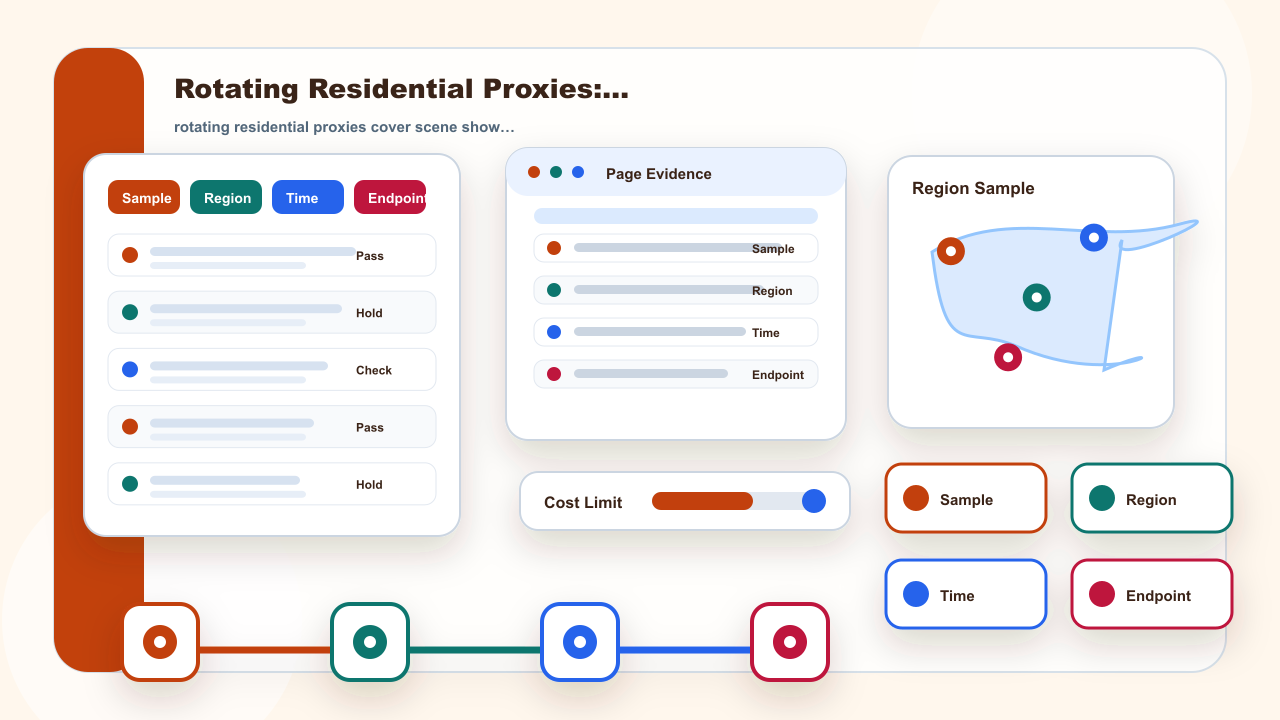
Rotating residential proxies should be reviewed as a sampling workflow. The first question is whether each observation needs to stand alone, not whether changing addresses sounds more powerful.
A rotation plan is useful only when it produces cleaner evidence than a stable session would produce.
Create a sample key before the first request. Without a key, the second sample cannot be compared honestly with the first.
So when someone asks “rotating residential proxies,” the useful answer is not only a term definition. It is the request path, address source, and verification method that change. Once those parts are clear, static and dynamic residential address decisions become easier to separate.
Fields That Make Rotation Comparable
For rotating residential proxies, the useful record starts with the page, region, browser or app state, assigned endpoint fields, and the result the team expects to observe. A broad label is not enough; the page should help the reader decide which field to verify first.
A clean record also prevents teams from blaming every error on the proxy layer. Port, authentication, browser state, page rule, cache, and task permission can all change the visible result.
Write the endpoint fields exactly as assigned. Do not infer missing host, port, authentication, or address behavior from a screenshot or a partial note.
| Question | Practical answer |
|---|---|
| Reader task | Decide whether a task needs repeated continuity or separate dynamic samples |
| Static fit | Use a static residential address when the same allowed check needs a stable comparison window |
| Dynamic fit |